Gold Cake

Cake is one of my very favorite desserts, and I would probably choose it over pie most of the time. The star of this episode is a gold cake, which is a relative of the classic pound cake. This recipe uses cake flour because of its low protein content, which results in a cake that is more tender. Alton also explained that he often prefers to use butter-flavored shortening when baking, as he thinks it gives more of a buttery flavor to baked goods than does actual butter. You can swap shortening for butter in any baking recipe, but you will need to make a couple of modifications because shortening is 100% fat, while butter is 20% water. This means that you will need to use 20% less shortening than the amount of butter called for, and you will need to increase the liquid in your recipe by 20%. Now, on to the cake.

Before starting this recipe, weigh the empty bowl of your stand mixer, noting the weight for later. In the stand mixer bowl, beat 140 g of butter-flavored shortening on low for about a minute.

To the beaten shortening, add 300 g sugar and a pinch of Kosher salt, and beat this mixture on medium for at least four or five minutes.

Next, with the mixer running, slowly add 130 g of egg yolks (about 8 yolks).

Once the yolks are incorporated, prepare your remaining wet and dry ingredients. In one vessel, combine 180 g of milk with 1 t vanilla extract.

IMG_6210

180 g of milk with 1 t vanilla.

In a separate bowl, sift together 350 g of cake flour and 14 g of baking powder.

Alternate adding the flour and milk mixtures to the batter by adding half of the flour, half of the milk, the remaining half of the flour, and the last of the milk.

IMG_6235

The final cake batter.

Once you have a smooth batter, again weigh your mixing bowl. Subtract the empty bowl weight you took earlier from the weight of the bowl+batter, and divide this number in half; you now have the weight of batter you should have in each cake pan for baking. Using this number, divide the batter evenly between two greased/floured 9-inch cake pans (my batter weighed 1070 g, so I allotted ~535 g per pan).

Bake the cakes in the top third of a 350-degree oven.

IMG_6239

Cakes in the top 1/3 of a 350-degree oven.

Check the cakes after 12 minutes of baking, rotating them if one cake is browning more than the other. The cakes are done when a toothpick inserted in the center of the cakes comes out clean, which took about 30 minutes for my cakes. Let the cakes cool in their pans (on racks) for 10-15 minutes.

IMG_6240

Cakes after baking until a toothpick came out clean – about 30 minutes.

Remove the cakes from their pans and let them cool completely.

IMG_6246

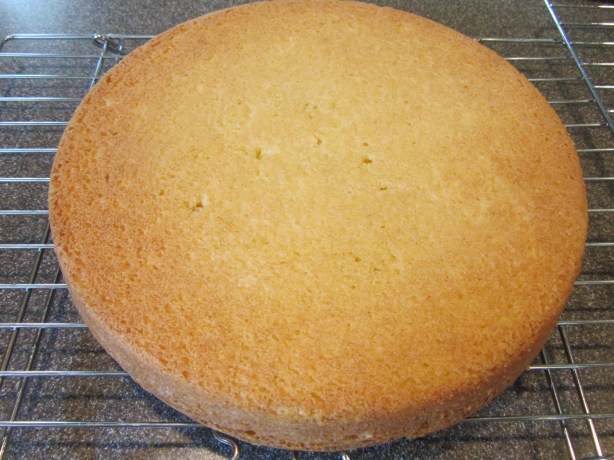
Cake removed from pan.

Now, you could eat these cakes plain, or with whipped cream and fruit, but I did what Alton did and frosted them with his cocoa whipped cream (recipe below).

Cocoa Whipped Cream

To go with his gold cake, Alton made this cocoa whipped cream. You will want to make the cream once your cakes are completely cool. While your cakes finish cooling, chill the mixing bowl and whisk attachment of your stand mixer by placing them in the refrigerator. When the cakes have sufficiently cooled, place 2 T of cold water in a small saucepan and sprinkle 1 t gelatin over the water’s surface; set aside for 5 minutes.

Place the saucepan over low heat, just until the gelatin has melted.

IMG_6257

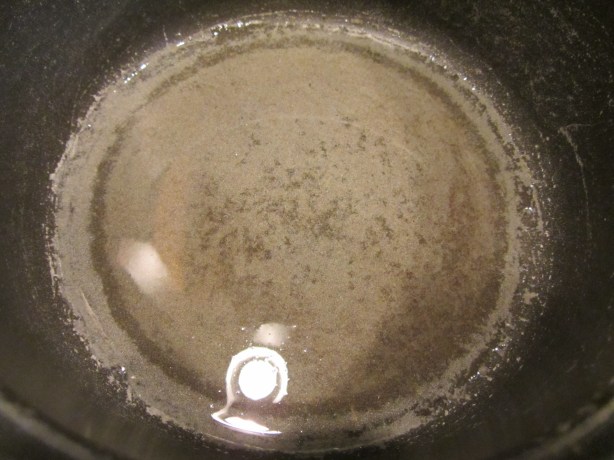
Gelatin, heated until just melted.

Meanwhile, in your cold mixing bowl, beat on low 2 C whipping cream, 1 t vanilla, and 1/2 C cocoa mix (you could probably use any cocoa mix, but Alton used his Good Eats mix, of which I still had some).

Slowly drizzle the melted gelatin into the cocoa/cream mixture and increase the speed.

IMG_6260

Cocoa mixture after all of the gelatin was added.

Beat the cream until it forms medium peaks.

IMG_6263

The final cocoa cream, beaten until it had medium peaks.

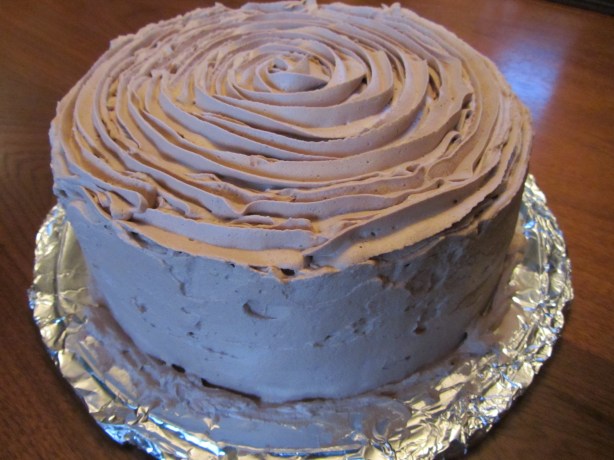
Use the whipped cream to frost Alton’s gold cake, or any other two-layer cake.

We thought Alton’s gold cake and cocoa whipped cream paired nicely together. The cake is a bit of a dry, crumbly cake, but has nice buttery flavor.IMG_6269 The cocoa whipped cream is a nice alternative to traditional frosting, having a light, airy texture and being less sweet than many frostings, but it also necessitates refrigerating your cake.

IMG_6272

A slice of Alton’s gold cake with cocoa whipped cream.

All in all, I would be more likely to make the cocoa whipped cream again over the cake. The cake had good flavor, but was just a bit too dry.

It is always fun in this project when I get to watch an episode of Good Eats that I have not previously seen; episode 80 was one I had definitely not seen before. The premise of this episode is that Alton goes on a local, schlocky morning show to discuss coleslaw. When the other scheduled guest fails to show, Alton becomes the main attraction, continuing on with recipes for other types of slaw. Now, I’ll be honest that I don’t get too overly excited about slaw, but Alton did make some slaws in this episode that looked pretty tasty. So, how did they turn out?

Coleslaw

A classic coleslaw was first in this episode. This recipe requires some forethought because the prep needs to begin a couple hours in advance. Start by combining 1/2 a head of green cabbage, 1/2 a head of red cabbage, and lots of Kosher salt in a colander. Leave the cabbage for a couple hours to drain any excess moisture.

For the dressing, combine 1/2 C buttermilk, 2 fluid oz mayo, 2 fluid oz plain yogurt, and 1 T pickle juice.

Whisk the dressing thoroughly, adding 1 t dry mustard and 1 T chopped chives.

When the cabbage has drained, rinse it very well with cold water and give it a few whirls in a salad spinner.

Add the cabbage to the prepared dressing, along with one sliced carrot, and toss to coat.

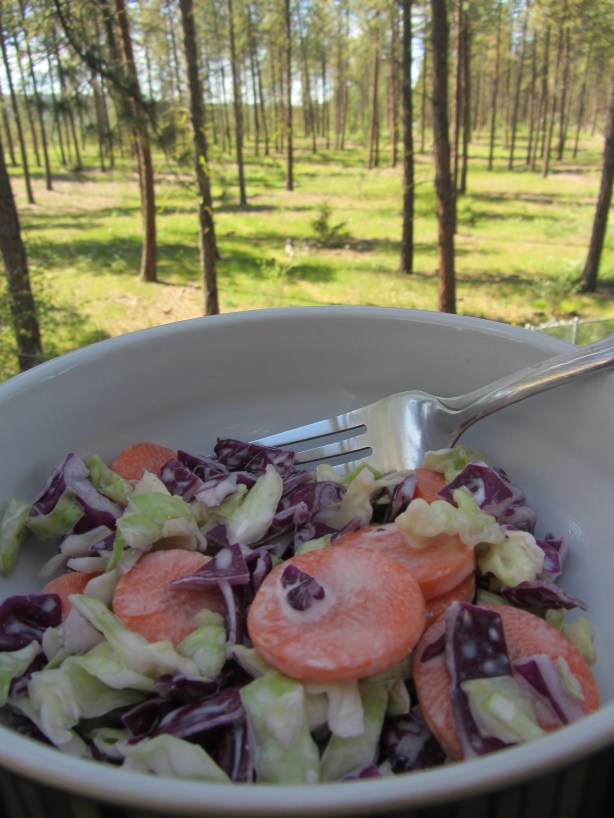
IMG_6306

A bowl of Alton’s coleslaw.

This coleslaw was good, but not exciting. I did like how the powdered mustard contributed a slight kick of heat, while the pickle juice added some tang. Otherwise, though, it was really just a classic coleslaw that you could buy in any deli. It would, however, make a nice condiment for a pulled pork sandwich.

Beet Slaw

After watching the episode, I was most excited about Alton’s beet slaw because I love anything with beets… and Asian pears… and goat cheese. Yep, this one appeared to be right up my alley. Before you do anything else in this recipe, you will want to steam a few beets until they are tender (it took about 15 minutes for my beets to be tender).

To make the dressing, combine in a large bowl 1/4 C red wine vinegar, 2 T lemon juice, 2 T honey, 1/4 t Kosher salt, and 1/2 t pepper.

Whisk in 1/4 C olive oil until emulsified.

To the dressing, add 2 C of jicama, peeled and cut into matchsticks.

Next, thinly slice 3 C of fennel; this is easiest on a mandolin. Add the fennel to the slaw, along with 1/4 C of grated onion.

Again with the mandolin, if you have one, thinly slice one Asian pear and add it to the mix.

Finally, peel and spiralize your beets until you have 4 C. Add the spiralized beets to the bowl.

Toss all of the vegetables with the dressing and crumble in 6 ounces of goat cheese to finish.

IMG_6334

Goat cheese added to slaw.

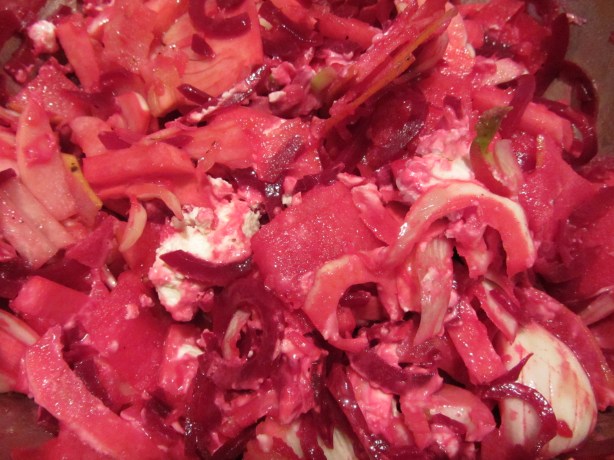
IMG_6335

Beet slaw.

I happened to make this slaw when my brother was visiting, and he declared that he really liked this slaw despite not typically liking beets. Ted and I thought this was great also. This recipe is a fantastic marriage of flavors and textures. The jicama, fennel, and Asian pear are light and crispy, while the beets and onion are tender, and the goat cheese adds a lovely creaminess. Flavorwise, the earthy sweetness of the beets was great with the sweet Asian pear, nutty jicama, and spicy onion. The fennel added subtle anise hints. The dressing was tangy with a hint of sweetness, and the goat cheese gave a creamy tartness. All-in-all I was really happy with this one and will make it again. I will say that it is most aesthetically pleasing the day it is made, as the beets turn everything purple as the slaw sits.

Marinated Slaw

I actually started this blog a couple days ago, but am only just now finishing it. As I type, I am sandwiched between our two Coonhounds. Brixie, our beloved little “dogter,” had a rough day today, having a lump removed from her paw that could potentially be malignant. We’re all crossing our fingers and paws that we get a good biopsy report in the next few days. Now, back to the food.

If you are looking for a make-ahead slaw, Alton’s marinated slaw may be the one for you. Essentially, this is a pickled slaw that develops flavor for three days before you eat it. I don’t know about you, but I love anything pickled. For this slaw, grate 1/2 a head of Napa cabbage, and julienne 2 red bell peppers and 2 green bell peppers (I used yellow peppers, instead of green). Alton tells you to drain the vegetables in a colander for two hours, though this is really quite pointless without adding salt to the vegetables, as nothing drains away.

Once your vegetables are prepped, bring to a boil 3/4 C cider vinegar, 1 C sugar, 2 T Kosher salt, 1 t celery seeds, and 1 T mustard seeds; I found that this recipe did not yield enough marinade, so I had to make a second batch of marinade.

Pack your vegetables tightly in a mason jar (as tightly as possible, or they will float to the top), and pour in the hot marinade. Refrigerate the slaw for three days before eating.

IMG_6346

Hot marinade poured over slaw.

I made this slaw before leaving town for a few days, and it was ready just when I returned home.

IMG_6380

Alton’s marinated slaw.

The flavor of this slaw reminds me of bread and butter pickles, as the marinade is both sweet and tangy. The mustard seeds add some great pops of crunch and zest, and the peppers retain a lot of their crispy texture. This is a bright slaw that would be a good addition for a barbecue or picnic, or just as a side dish to dinner.

Asian Slaw

After making a coleslaw, a beet slaw, and a marinated slaw, what other type of slaw could you possibly make? Asian slaw is the final recipe from this episode, and it piqued my interest the most (along with the beet slaw) when I watched the episode. Alton also happened to mention that this Asian slaw is a favorite of his.

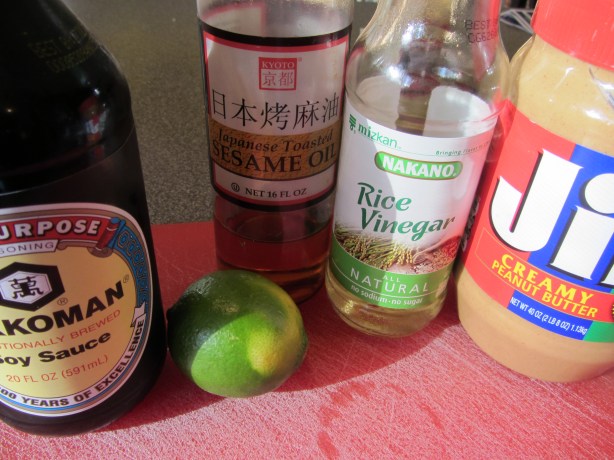
IMG_6347

Dressing ingredients: soy sauce, lime juice, sesame oil, rice wine vinegar, and peanut butter.

In a large bowl, whisk together 1 T soy sauce, the juice of a lime, 2 T sesame oil, 1/2 C rice wine vinegar, and 1/2 C peanut butter.

With tongs, add the following items to the dressing, tossing to coat:  2 T minced ginger, 2 minced serrano peppers, 1 shaved carrot (use a vegetable peeler), 1 julienned red bell pepper, 1 julienned yellow bell pepper, 2 T chopped mint, 2 T cilantro, 3 chopped green onions, 1 head of shredded Napa cabbage, and 1/2 t pepper.

Toss everything together until well-coated.

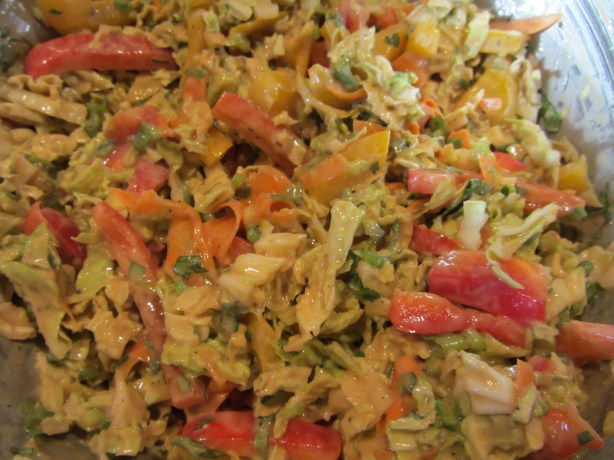
IMG_6377

Asian slaw, tossed to coat.

We both liked this slaw a lot, and it had fantastic Asian flavor from the ginger, sesame oil, lime, and peanut butter.

IMG_6379

Alton’s Asian slaw.

We ate this only as a side dish, but I would like to make it again, taking Alton’s suggestion of serving it as an entree; for a vegetarian entree, this slaw could be served with noodles or tofu, while you could serve it with flank steak for meat lovers. Personally, I can totally picture us eating this with steak as a summer entree on the deck.

Alton did a good job in this episode of demonstrating the diversity within the realm of slaw. Most of us probably see the word “slaw” and think of one thing:  coleslaw. For me, the standouts in this episode were the beet slaw and the Asian slaw.


I was super stoked to find that I would be making fresh pasta in the 79th episode of Good Eats. Fresh pasta is just plain delicious. Pass the gluten, please! Last year we took a pasta class, in which we made fresh noodles using a pasta machine, so I felt comfortable with the basics of making pasta dough. I had not, however, ever tried making filled pasta. First up?

Ravioli

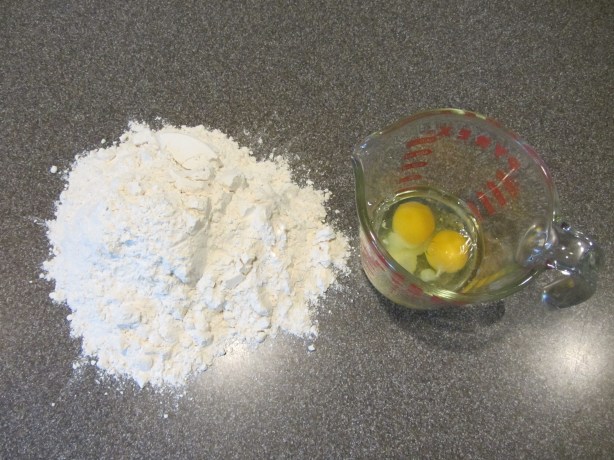
When making Alton’s fresh pasta, you need to plan ahead a little bit because your dough will need to rest for at least an hour, and you will want to freeze your pasta prior to cooking. For Alton’s ravioli, place a mound of flour (~3 C) on a clean work surface, making a well in the center. Combine in a measuring cup:  2 eggs, 3 T water, 1/2 t salt, and 1 t olive oil.
IMG_6150

Ready to make fresh pasta – a mound of flour and a mixture of eggs, water, salt, and olive oil.

Pour some of the liquid into the well in the flour, and begin stirring the liquid with two fingers, gradually incorporating some of the surrounding flour; use your other hand to support the “walls” of your flour mound. When you have a paste-like consistency, you can gradually add more of the liquid mixture.

Continue the process of adding liquid and stirring in flour until the liquid is all incorporated and you have a thick paste. Using your hands, knead your dough, adding more flour, until you have a smooth, non-tacky, semi-firm dough. You will likely have a fair amount of excess flour still remaining on your counter. Roll your dough into a ball, cover it in plastic, and refrigerate it for at least an hour.

IMG_6153

My finished pasta dough.

While your dough rests in the refrigerator, you can make your filling, which is Alton’s Good Eats meatloaf mix plus 3 T grated Parmesan, 1 T balsamic vinegar, and 1/2 t oregano.

Once your dough has sufficiently rested, cut it in half, setting one piece aside, covered in plastic.

IMG_6157

My dough, after resting in the refrigerator.

Shape the piece of dough you are working with into a candy bar-sized rectangle and sprinkle it with flour, passing it through a pasta machine on the widest setting.

Fold the dough in thirds, turn it 90 degrees, and pass it through again. Follow this procedure one more time, adding flour as needed, so you pass the dough through the widest setting a total of three times.

Continue passing the dough through the machine one time at each progressive setting until your dough has gone through setting #7 (If your pasta machine is like Alton’s, it will have 9 settings. My pasta machine has fewer settings, so I stopped at #4 of 6). Regardless of how many settings your pasta machine has, you want to have a final dough that is almost translucent.

Placing your long sheet of dough on a floured surface, use a teaspoon to place rounded balls of meat filling down the center of the dough sheet, spacing them two inches apart; be sure to place the balls slightly closer to one long edge of the dough, so you have enough dough to fold over the balls.

IMG_6182

Balls of meat filling placed on dough sheet.

In a small bowl, combine an egg and a little bit of water, whisking to combine. Brush this egg wash down the center of the dough right next to the meat balls. Next, brush the egg wash down the outside edge of the dough – only on the side closest to the meat. Finally, brush the egg wash between the meat balls.
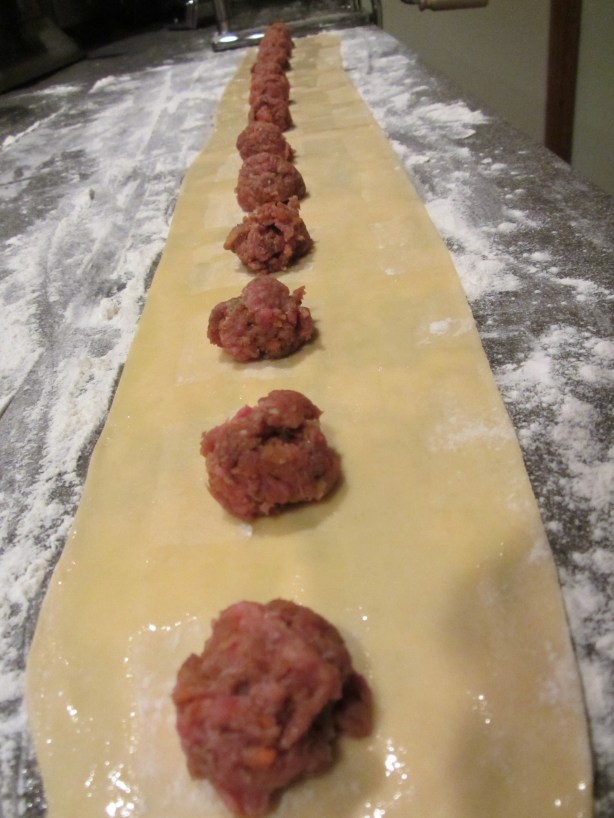
IMG_6183

Egg wash painted down the center of the dough, along the left edge, and between the meat balls.

Now you are ready to form your ravioli. Using your fingers, pull the longer side of the dough over the meat filling, using your fingertips to press excess air out around each ball of meat. Press all along the edges to ensure a good seal with the egg wash.
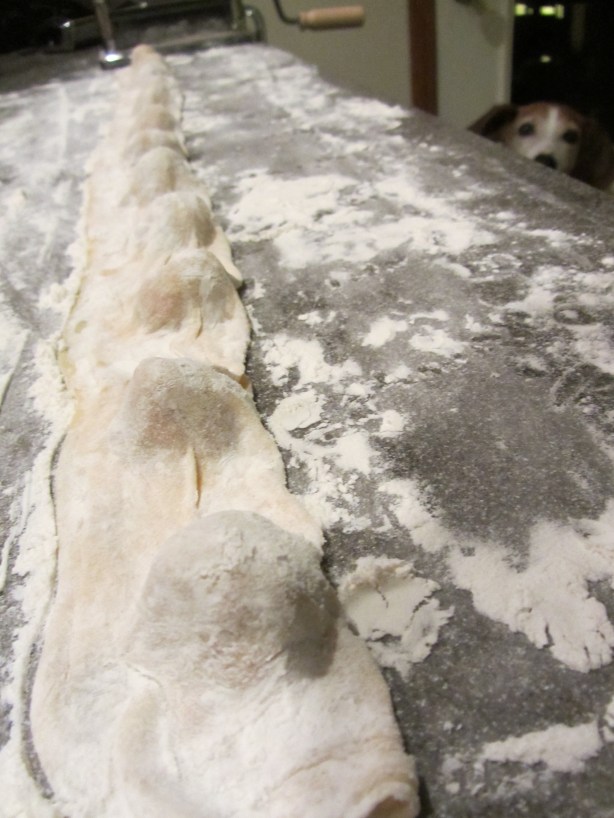
IMG_6184

Excess dough folded over filling, and pressed to remove air bubbles.

Using a pizza cutter, cut between the mounds of filling, forming individual ravioli. Carefully press around the edges of each raviolo, ensuring that there are no leaks.
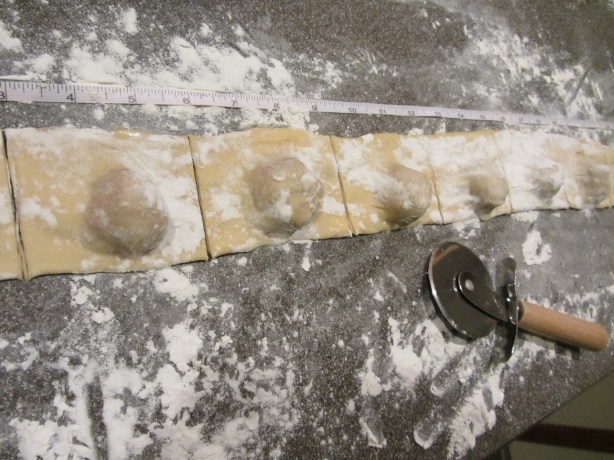
IMG_6175

Ravioli cut with a pizza wheel.

Place your ravioli on a sheet pan and freeze them for at least three hours.

IMG_6187

Ravioli in the freezer.

Once your ravioli are frozen, you can keep them frozen for later use, or you can cook them. To cook Alton’s ravioli, bring a pot of salted water to a boil, adding a dash of olive oil (to decrease surface area and prevent foaming).
IMG_6189

A pot of salted and oiled water.

Adding about 10 ravioli at a time, cook the pasta packets until they float; since the meat mixture is raw when you fill the ravioli, you may want to test one raviolo to make sure the filling is cooked.

Toss the cooked pasta in oil to prevent them from sticking together. For this pasta, Alton recommends a browned butter sauce with sage.

IMG_6193

Chopped sage for the sauce.

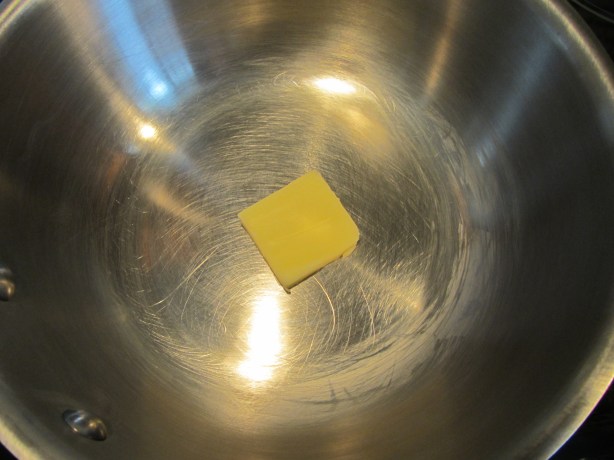
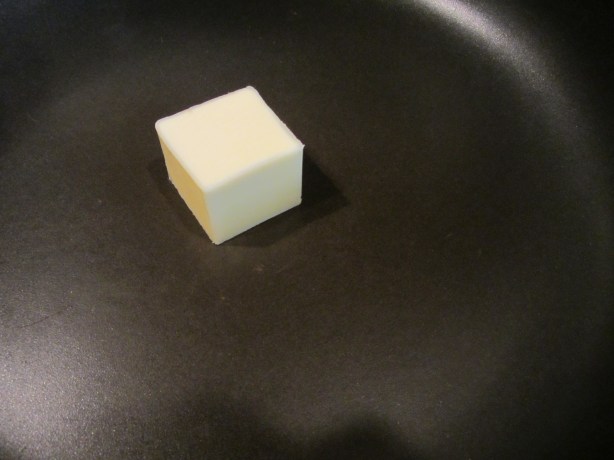
To make this sauce, heat a skillet over medium-high heat, adding a pat of butter.
IMG_6190

A large pat of butter for the sauce.

Let the butter cook until it starts to brown and foam. Add the ravioli, tossing them in the butter until their edges just start to brown.

IMG_6198

Cooked ravioli added to browned butter in skillet.

Finish the sauce by adding some chopped sage and black pepper.

IMG_6200

Sage and pepper added to skillet.

IMG_6201

A bowl of Alton’s meat ravioli with browned butter and sage.

So, how did Alton’s ravioli turn out? I was pretty happy with my first attempt at filled pasta, though my ravioli were certainly not picture perfect. We really enjoyed the tangy meatloaf filling in this pasta, and the texture of the pasta was great – perfectly al dente. When making fresh pasta, I think you really want the pasta to be the star of the show, and Alton’s simple brown butter sauce allowed the ravioli to shine. Making fresh pasta is a fun project and is certainly worth the effort.

Tortellini

Once I had made Alton’s ravioli, it was time to tackle his tortellini. For this recipe, Alton did not use a pasta maker, opting to make the tortellini only by hand, which makes it a bit more time-consuming. The basic dough for Alton’s tortellini is made in the same way as for the ravioli above, using a mound of ~3 C of flour and a mixture of 2 eggs, 3 T water, 1/2 t salt, and 1 t olive oil. The liquid ingredients are gradually added to the flour until a firm paste is achieved, and the resulting dough is kneaded by hand until a smooth, firm dough results.

The dough will need to rest in the refrigerator for at least an hour before the tortellini are formed.

IMG_6114

Final dough, to be refrigerated.

While the dough rests, you can make Alton’s cheese filling by combining 1/2 C ricotta cheese, 1/4 C grated Parmesan, 2 T thawed/drained frozen spinach, 1 egg, pepper, and a pinch of nutmeg.

When you are ready to form your pasta, cut your dough into four equal pieces, setting three of the pieces aside while you work with one.

Roll the piece of dough into a long, 1/2-inch thick snake. Using a pastry scraper, cut the snake into inch-long pieces, rolling each piece into a round ball.

Flatten each piece of dough into a disc, dust it with flour, and roll it out with a thin wooden dowel rod (we keep one in our kitchen window track to “lock” the window).

When you have finished rolling your dough, it should be thinner than a nickel. Next, Alton used a biscuit cutter to cut perfect dough circles, but my dough circles were round enough that I did not bother cutting them. The key with tortellini is not to overfill them, so you want to place only 1/4 t of filling in the center of each round.

IMG_6131

Filling placed in the center of the dough.

Brush one side only of each dough round with egg wash (1 egg plus a little bit of water), fold the dough over the filling, and press the edges to seal, forming a half-moon.

To form tortellini, pull the two pointed edges together below the filling, pinching them; if needed, add a little egg wash to keep the ends together.

Freeze the tortellini for three hours before cooking in salted/oiled water until they float.

IMG_6139

Formed tortellini in the freezer.

Alton did not recommend a particular sauce for his tortellini, so I served mine with a delicate tomato cream sauce with fresh basil.

IMG_6145

Alton’s tortellini with a tomato cream sauce.

We thought these were fantastic. The cheesy filling was light, the pasta had a great texture with just a little “bite,” and the light tomato sauce didn’t overwhelm the delicate filling of the pasta. Also, my tortellini were a little more aesthetically pleasing than my ravioli. Plus, hand forming each one of these babies made me appreciate them a little bit more! Both the recipes in this episode worked fantastically for my maiden voyage into fresh stuffed pasta, and I recommend them both highly.


Broccoli Casserole

The 78th episode of Good Eats is all about America’s potluck favorite:  the casserole. According to Alton, casseroles are either bound, layered, or scooped. The first casserole in this episode is a broccoli casserole, which is a bound casserole. This recipe begins with boiling a large pot of water and prepping 6 C of broccoli; you can use the florets, along with the stems, which you can peel and quarter.

Add a few pinches of Kosher salt to the boiling water and cook the broccoli for one minute, before placing it in ice water. This blanching process will help to preserve the broccoli’s green color.

Next, heat a large skillet with a pat of butter, adding 12 ounces of sliced mushrooms. Cook the mushrooms until they are browned and tender, remove the pan from the heat, and add the cooled broccoli.

To the broccoli/mushroom mixture, add 1/2 C mayo, 1/2 C yogurt, 1/3 C blue cheese dressing, 2 eggs, a rounded 1/2 C of shredded Cheddar cheese, a package of crumbled Ramen noodles, and the flavor packet from a package of Ramen.

This slideshow requires JavaScript.

Spray a lidded casserole dish with non-stick spray (you want the smallest dish possible that will hold your casserole) and add your broccoli mixture.

IMG_6046

Broccoli mixture placed in greased casserole dish.

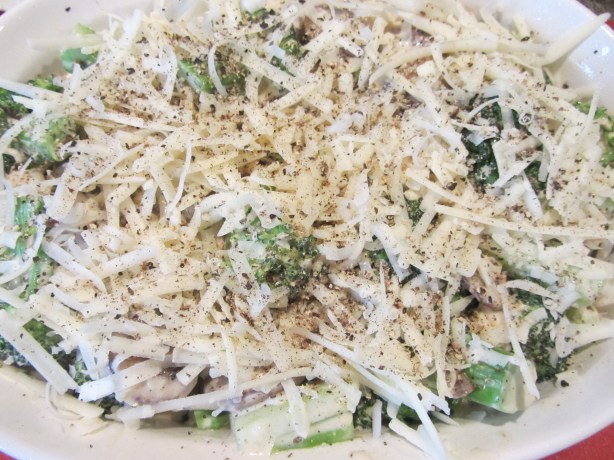
Sprinkle the top of the casserole with black pepper and another rounded 1/2 C of shredded Cheddar.

IMG_6047

Shredded Cheddar and black pepper on top of casserole.

Bake the casserole, covered, at 350 for 45 minutes. After 45 minutes, remove the casserole lid and let the casserole continue to cook until the cheese forms a nice crust on top.

Cool the casserole for at least 30 minutes before serving.

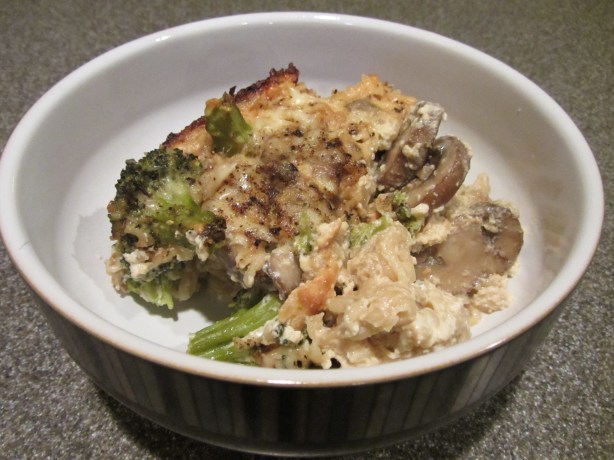
IMG_6053

Alton’s broccoli casserole.

Of the recipes in this episode, this was the one I was most enthusiastic about because I happen to really love broccoli. We both thought this was good, though not super exciting. Really, though, isn’t that just the way of the casserole? The blue cheese flavor was more apparent than I thought it would be, which paired well with the broccoli. The broccoli maintained its texture and color, and the Ramen noodles bound the casserole together nicely. This is a good weeknight recipe for an easy dinner, and it does leave you with leftovers.

Curry Chicken Pot Pie

Alton’s version of chicken pot pie, a scooped casserole, is next up in the casserole episode, and it starts with sweating 1 C each of sliced celery and chopped onion in canola oil with a pinch of Kosher salt.

IMG_6078

Celery and onion, sweating in canola oil with Kosher salt.

While your vegetables are sweating, roast 4 C of frozen vegetable mix in the oven until golden (I roasted my vegetables at 400 degrees).

IMG_6075

Frozen vegetable blend, to be roasted.

Once the vegetables are softened, move them to the edges of the pan and add 2 T butter, 3 T flour, and 1 t curry powder to the center of the pan.

Cook and stir until the mixture is smooth. Whisk into the pan 1 1/2 C chicken stock and 1/2 C milk that have been heated in the microwave until nearly boiling.

Bring this mixture to a boil and add the roasted vegetables.

IMG_6090

Roasted vegetables added to pan.

Stir in 2 C of cooked shredded chicken.

Place the chicken mixture into a foil-lined terra cotta dish; I used the base of my glazed tagine, so did not bother with lining it.

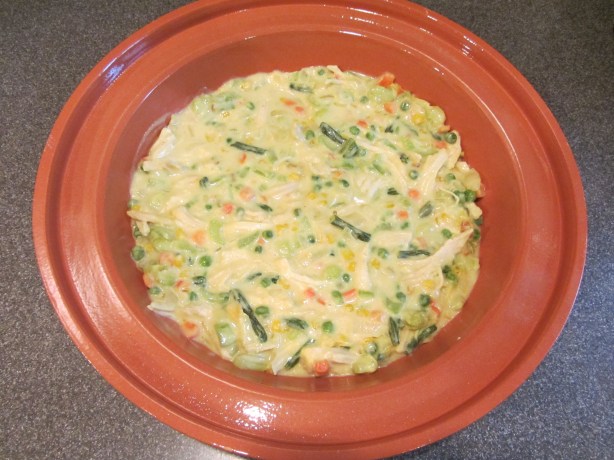
IMG_6096

Pot pie mixture placed in terra cotta dish.

Place a thawed piece of puff pastry on a floured surface (you can see details of how to thaw puff pastry here), patting its seams. Lightly roll the pastry with a rolling pin to smooth it out, and perforate it with a fork. Using a biscuit cutter, cut 10-12 circles, and place the rounds 1/2″ apart on top of the casserole.

Bake the casserole, uncovered, at 350 for 45 minutes. Cool before serving.

IMG_6103

Alton’s chicken pot pie.

Quite frankly, this pot pie was disappointing. My pastry didn’t puff, which was likely my fault for using older puff pastry. But, more than that, the base of the pot pie was just “meh.” I think this recipe would have been substantially better had Alton used fresh, rather than frozen vegetables, as the vegetables were somewhat rubbery. I would not make this recipe again, as there are surely countless better pot pie recipes available.

Garlic Shrimp Casserole

Last up in this episode is Garlic Shrimp Casserole, which really should be called “Leftover Chinese Food Casserole.” In a saucier, heat 2 C of chicken broth.

IMG_6058

Chicken broth in saucier.

Add a slurry of 2 T cold water with 2 T cornstarch, which will serve to thicken the dish.

Whisk in 1/2 t red pepper flakes and 1/2 C heavy cream.

IMG_6061

Cream and red pepper flakes added to broth.

Pour this mixture over 2 pints of leftover garlic shrimp (or other Chinese leftovers) and a pint of cooked white rice that have been placed in a foil-lined terra cotta dish.

Jiggle the pan and sprinkle the casserole with 3/4 C of toasted Panko breadcrumbs.

Bake, covered, at 350 for 45 minutes. Cool before serving.

I threw this together on a busy weeknight, opting to use leftover Chinese beef, rather than shrimp. Honestly, we really didn’t care for this and I would not recommend this recipe. This was just completely underwhelming, which, frankly, I expected after watching the episode. Boring is the best word to describe this recipe. All in all, this episode of Good Eats has to be one of my least favorites thus far. I would possibly make the broccoli casserole again in a pinch, but I would not make the pot pie or the garlic shrimp casseroles again. Here is to hoping that the next episode is more exciting!

Sweet or Savory Pâte à Choux

When I was in elementary school, a different kid in my class was tasked with bringing snacks for the class each week. No-bake cookies with chocolate and oats were in regular rotation because they were easy to make and most of the kids liked them. My mom usually sent me with cupcakes or other (baked) cookies. One girl’s mother scored massive points with all of the kids (and probably made all the other parents feel like slouches), as she always made homemade cream puffs.

Personally, I have never made cream puffs or eclairs… until now. Baking and pastry are definitely two of my favorite things, so I eagerly whipped up a batch of Alton’s Pâte à Choux yesterday. Pâte à Choux is a pastry dough that is designed to make pastries that can be filled; therefore, when you bake the dough, it is supposed to only form one or two large bubbles, as opposed to the numerous bubbles desired in certain breads and such. In order to create these large bubbles in the pastry, steam needs to be created. Bread flour, and especially bread flour for bread machines, is ideal for Pâte à Choux because it has the highest protein content of all flours, which allows it to absorb more liquid; more liquid equals more steam production. To make Alton’s Pâte à Choux, combine a cup of water and 6 T butter in a pan. If you are making savory dough, also add 1 t Kosher salt. Or, if you are making a sweet dough, as Alton did in the episode, add just a pinch of Kosher salt and 1 T sugar.

Bring this water/butter mixture to a boil over high heat. Meanwhile, weigh out  5 3/4 ounces of bread flour. I did not have bread flour for bread machines, so just used bread flour.

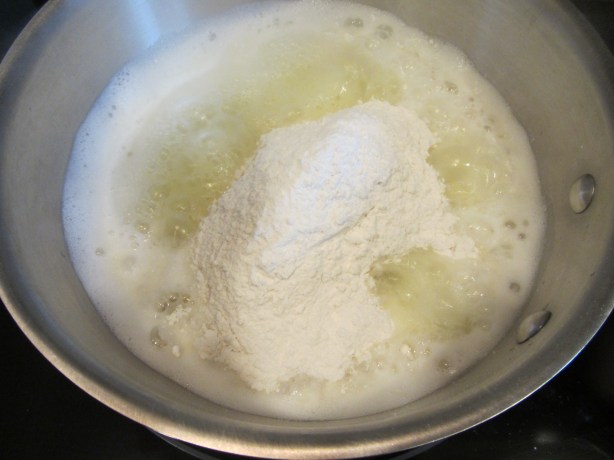
When the butter has completely melted and your liquid is boiling, add all of the flour, at once, to the pan.

IMG_5968

Flour added to boiling butter/water.

Stir the flour into the liquid with a spatula until a paste forms. Decrease the heat to low and continue to stir the dough until all of the flour is incorporated and the dough is no longer sticky. Turn off the heat and transfer the dough to the bowl of a standing mixer, setting it aside until it is cool enough to touch.

While the dough cools, place four eggs and two egg whites in a measuring cup; the egg yolks will act as an emulsifier in the dough, while the whites will give the dough structure.

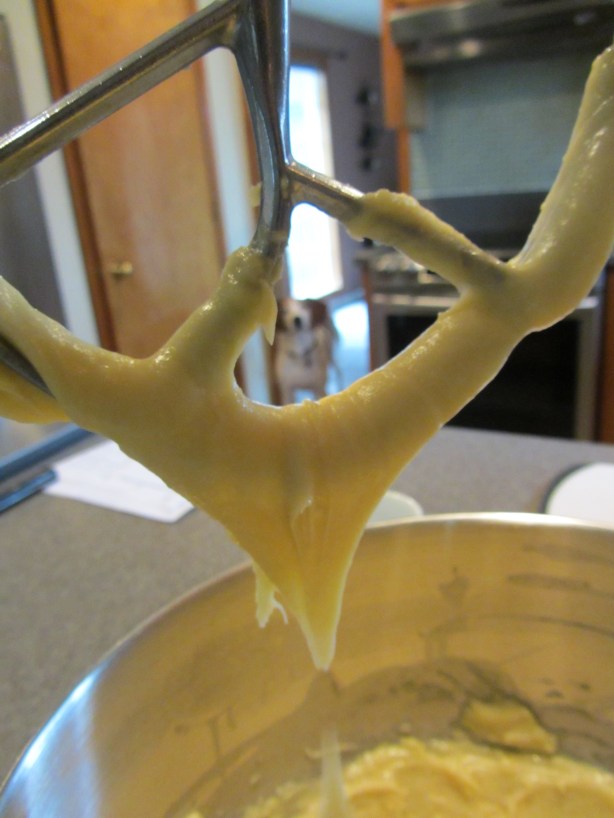
When the dough has sufficiently cooled, slowly add the eggs to the dough, keeping the mixer running. You want to continue adding egg until the dough hangs from the paddle attachment in a ‘V’ shape; for me, this required all of my eggs.

IMG_5978

Dough after adding all of the eggs. A perfect ‘V’ shape off of the paddle.

At this point, you can use your dough immediately, or you can let it rest at room temperature for a couple hours before using. When you are ready to use your dough, prepare a piping bag with a piping tip; Alton did not specify which tip to use, but I used one that was about 3/8″ in diameter and it worked fine. Large Ziploc bags work well for piping too – just snip off one corner, insert the inside part of the coupler, place your desired tip on top, and screw on the coupler ring.

IMG_5966

Ziploc bag turned into piping bag.

Preheat your oven to 375 degrees and line a sheet pan with parchment paper. If your parchment is sliding around, you can pipe a dollop of dough on each corner of your sheet pan, pressing the parchment down in the dough to keep it from sliding.

To make eclairs, pipe the dough into ‘S’ shapes, with the tail of each ‘S’ facing up toward you. With a wet finger, pat down the tails.

Alternatively, you can make cream puffs by piping the dough in concentric circle patterns, finishing in the center. Again, pat down any points with a wet finger.

IMG_5985

Dough, piped into concentric circles for cream puffs.

Place the eclairs (or cream puffs) in the center of the oven, increasing the temperature to 425 degrees, and setting the timer for 15 minutes. After 15 minutes, decrease the oven temperature to 350 degrees, and bake the eclairs for an additional 10 minutes. As soon as your eclairs/cream puffs are cool enough to handle, pierce them with a sharp paring knife to release excess steam.

IMG_5988

Piercing a hot eclair to release steam.

Cool the pastries completely.

At this point, you can bag and freeze the pastry shells for up to a month, bag and store them at room temperature for a week, or you can fill them with a filling of your choice. To do as Alton did in this episode of Good Eats, make vanilla pudding, using only 3/4 of the recommended liquid.

Then, using a small star tip and a piping bag, poke a hole in each eclair/cream puff, filling them with the pudding until the pudding starts to come out the end. Chill the filled pastries.

To bedazzle your eclairs/cream puffs with chocolate, melt 1 C chocolate chips with 1 t vegetable oil in a double boiler. Dip each pastry into the chocolate mixture. Or, you can pour your chocolate into a squeeze bottle and decorate them that way. I opted for the dipping method.

If you do not plan to eat your eclairs right away, keep them refrigerated. I made a mixture of eclairs and cream puffs, ending up with 17 eclairs and 6 cream puffs. I stuck most of my pastries in the freezer for later use, but filled several yesterday.

IMG_6003

Chocolate dipped eclairs.

I have to say that this is a great recipe. Not only are these delicious, but they are really super easy. My pastries turned out light, airy, and slightly crispy on the outside. The pastry itself was barely sweetened and each pastry had a perfect cavity inside for filling. The vanilla pudding was a super easy filling option, and the chocolate set up into a slightly crispy shell. This one is a keeper. For a different option, you could make ice cream sandwiches with cream puffs, splitting them in half. Or, you could make Alton’s savory Pâte à Choux, filling split puffs with a savory salad.

IMG_6007

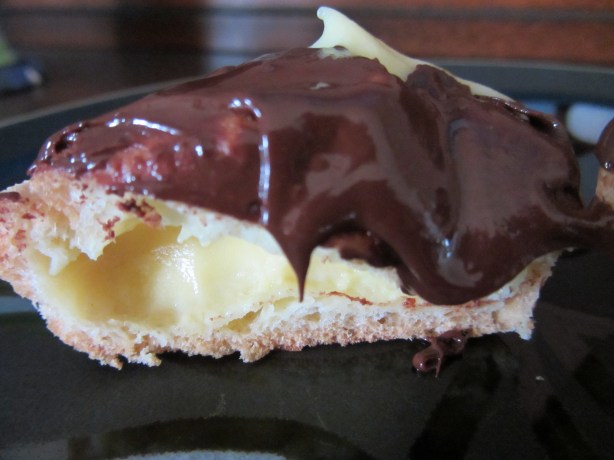
A cream puff, cut in half.

Funnel Cake

So, what else can you do with Pâte à Choux? Well, you always opt for funnel cake! To make this classic carnival/fair favorite, heat ~1 inch of vegetable oil to 375 degrees.

IMG_6011

Oil, heating to 375 degrees.

Using a #12 piping tip, pipe Pâte à Choux into the hot oil in a circular pattern. Cook the pastry until it is golden brown, flip it over, and cook until the second side is golden.

Remove the pastries to a rack over a sheet pan and dust them liberally with powdered sugar.

My funnel “cakes” turned out more like funnel “straws,” but they were still quite delicious.IMG_6018 I found that the pastry was too thick for the #12 tip, though I had set my dough aside for a while. Still, my pastries were like eating little fried pillows with powdered sugar. These were definitely tasty, though not as pretty as they should be.

I have never been the biggest fan of pork chops. I remember sitting at the kitchen table when I was little, staring down a seemingly gray hunk of pork my mom had cooked for dinner, and dreaming of dessert; looking across the round oak table, my brother’s face mirrored my own. To this day, my mom says she has never understood why neither of her kids liked pork chops. My mom has always been a great cook, so I doubt she cooked pork chops poorly. Still, my impression of pork chops was summed up perfectly by Lorelai Gilmore when she said that eating pork chops is like sucking on a Pottery Barn catalog. I mean, really… tell me that you have never had that exact experience. So, last night for dinner, I set out to see if I could finally find a pork chop I liked.

Stuffed Grilled Pork Chops

After watching this episode of Good Eats, I determined that I needed to head to the local butcher shop to get my pork chops. See, according to Alton Brown, all pork chops are not created equal. While all pork chops come from the back of the pig, shoulder and sirloin chops are particularly tough and require wet cooking methods. Center-cut pork chops are the best, and Alton’s favorite center-cut chops are rib cut chops because they are composed of one muscle, making them the best choice for stuffed pork chops. My butcher shop cut two chops for me, making them about two inches thick, which is perfect for Alton’s recipe. For these chops, Alton insists that you make a brine, as pork is inherently dry, and a brine will serve to impart both flavor and moisture. To make the brine, combine in a lidded container 1 C Kosher salt, 1 C dark brown sugar, 1 T black peppercorns, and 1 T dry mustard. Add 2 C of hot cider vinegar and shake the container to dissolve everything.

Set the brine aside for 5-10 minutes to let the flavors fully develop. Next, add a pound of ice to the brine, and shake the container again until the ice is almost melted.

Now you are ready to place your chops into the brine, ensuring that they are completely covered. Though I only had two pork chops, I needed the full amount of brine to cover my chops, so if you are cooking four large chops, you may need to double the brine. Refrigerate the chops for two hours in the brine.

Toward the end of your brining period, you can make your pork chop stuffing. For four pork chops, combine 1 1/2 C crumbled cornbread, 1/4 C halved dried cherries, 2 T golden raisins, 1/4 C chopped walnuts, 2 t sliced fresh sage, 1/2 t pepper, 1/2 t Kosher salt, and 1/4 C buttermilk.

Set the stuffing aside while you prep your brined chops. The online recipe tells you to rinse your brined chops, but Alton did not do this in the episode. I did pat my chops with paper towels to remove excess moisture.

Next it is time to cut stuffing pockets in your pork chops. To do this, Alton placed his pork chops in a bagel slicer, but I just held mine with one hand and cut with the other. Either way, place your chops fat-side up and insert a long, thin knife (preferably a boning knife) straight down until you hit bone. Angle the blade up toward the surface, creating a cavity in one direction. Turn the knife around and cut in the other direction. You can check to see that your cavity is large enough by feeling with your finger. There is a video of Alton cutting his pockets, which you can access from the recipe link above.

In the episode, Alton used a large plastic syringe, with the tip cut off, to fill his pork chop pockets with stuffing. I used a plastic bag that I cut the corner out of, creating a makeshift piping bag. Still, I found that I had to use my fingers to push the filling down into the pocket. I filled my pork chops with as much filling as I could, and I used all of it.

To grill your pork chops, you will want to preheat your grill to high heat for at least 10 minutes. Brush your chops with oil and place them on the middle burner for 2 minutes.

Rotate the chops 90 degrees and leave them for 2 more minutes; this will create nice criss-cross grill marks.

IMG_5949

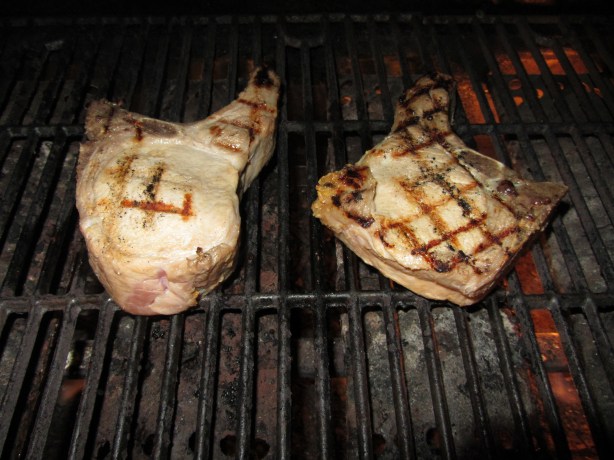
Pork chops, turned 90 degrees and left for 2 more minutes.

Flip your chops, leaving them for 2 minutes.

IMG_5950

Pork chops, flipped after 4 minutes of cooking. Left to cook 2 more minutes.

Finally, rotate the chops 90 degrees for a final 2 minutes.

IMG_5951

Pork chops, rotated 90 degrees to cook for 2 final minutes.

You want to cook your chops to an internal temperature of 140 degrees. If your chops are not done, place them over indirect heat and cook them until they reach 140. My chops took quite a lot (20-30 minutes) of additional grilling to reach 140.

IMG_5952

Pork chop after cooking to internal temperature of 140.

So, how did Alton’s stuffed pork chops taste? These were the best pork chops I had ever had. The pork was tender and moist, and just slightly pink in the middle, and you could taste the seasoning from the brine. The filling was a delicious accompaniment, with tartness from the cherries, sweetness from the raisins, occasional bursts of sage, and crunch from the walnuts.

IMG_5954

Pocket of filling inside pork chop.

This is a must-do recipe, especially if you are a pork fan. I guess I need to call my mom to tell her I finally met a pork chop I liked.

P.S. A bonus tip from Alton:  If you ever need to know how much propane you have in your tank, you can check the level by pouring ~a cup of boiling water down the side of your propane tank. You can tell where the propane level is by feeling where the metal switches from hot to cold.

While my beer was fermenting from last episode, I got busy prepping the four recipes from the 75th episode of Good Eats. The main player in this episode is that famous star of the cocktail party:  dip. Alton raises the question in this episode of what, exactly, constitutes a dip. Is salsa a dip? Alton concludes that salsa is not, in fact, a dip. Why? It does not meet Alton’s dip criterion, which is that a dip must be able to travel from its vessel to your mouth without going “splat” on the floor. Sour cream and onions do, however, make a suitable dip, which is the first one up in in this episode.

Onion Dip from Scratch

Sour cream and onion dip, also known as “California Dip,” was apparently very popular in the 60s, and Alton’s take on it begins with a bowl containing 1 1/2 C sour cream and 3/4 C mayonnaise (I used homemade mayo).

img_5823

Sour cream and mayo (homemade) make the dip base.

The next step is to heat a medium skillet over medium-low heat, adding 2 T olive oil, 1 1/2 C diced onions, and a pinch of Kosher salt. The onions should be cooked until they are caramelized and golden, which will take about 20 minutes.

Once the onions are golden brown, set them aside to cool a bit. Finally, add the onions, 1/2 t Kosher salt, 1/4 t white pepper, and 1/4 t garlic powder to the sour cream/mayo bowl, stirring to combine.

img_5826

Caramelized onions added to dip base, along with Kosher salt, white pepper, and garlic powder.

This dip came together super easily and was quite addictive, and I served it with good bread, baby carrots, and bell pepper.

img_5829

Alton’s onion dip with veggies and bread.

The sweet caramelized onion flavor is just right with the tangy sour cream and creamy mayo, and it is easy to see how this would be a crowd favorite.

Hot Spinach and Artichoke Dip

Back when I did Alton’s episode on artichokes, I seriously questioned his judgement in not including a recipe for spinach/artichoke dip. Alas, I guess this dip episode explains why he did not. Spinach and artichoke dip is definitely one of my favorites, so I was excited to make Alton’s version. Alton has a newer version of this recipe on his web site, which I actually made for our neighborhood New Year’s Eve party this year. The big difference between the Good Eats recipe and the new recipe is that there is a higher ratio of cream cheese to spinach.

img_5843

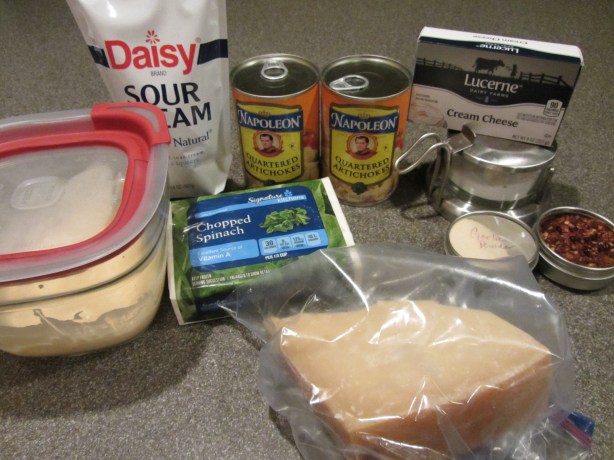
Ingredients for artichoke/spinach dip: mayo, sour cream, frozen spinach, artichoke hearts, cream cheese, Kosher salt, garlic powder, red pepper flakes, and Parmesan.

For the original recipe, begin by combining 1/4 C mayo (I again used homemade), 1/4 C sour cream, and 6 ounces of cream cheese, warmed in the microwave.

Heat 1 C of chopped frozen spinach and 1 1/2 C frozen artichoke hearts  in a cup of boiling water until warmed through; I had to use canned artichoke hearts, so I did not heat them. Be sure to thoroughly drain the spinach, squeezing out any excess water.

To the mayo/cream cheese mixture, add the spinach and artichoke hearts, along with 1/3 C grated Parmesan, 1/2 t red pepper flakes, 1/4 t garlic powder, and 1/4 t Kosher salt.

img_5850

Spinach, artichoke hearts, Parmesan, red pepper flakes, garlic powder, and Kosher salt added to dip base.

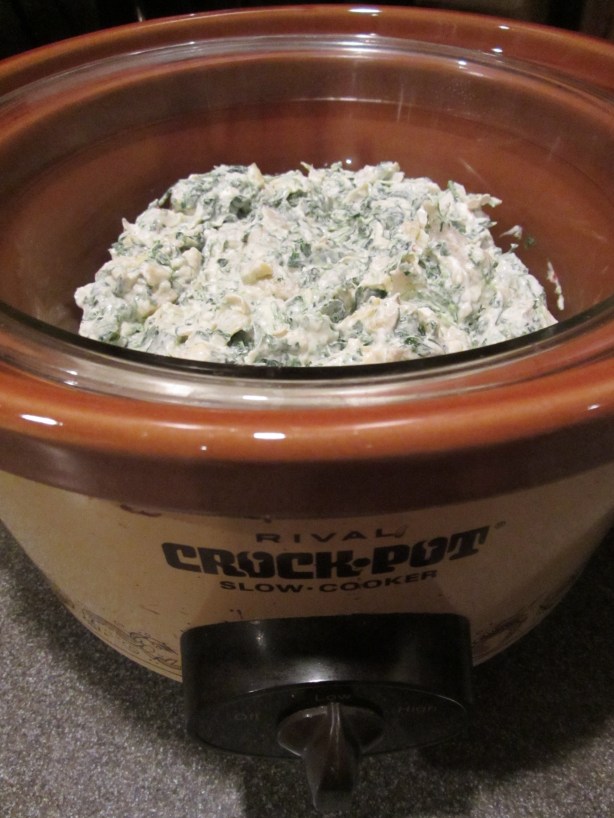
This dip is, of course, best served warm. You can keep the dip warm by putting about an inch of water into a Crockpot, setting the bowl of dip into the water. Set the Crockpot to low and it will keep the dip warm for serving.

img_5854

Spinach and artichoke dip, kept warm in a Crockpot.

We ate Alton’s artichoke dip with bread, crackers, and veggies.This dip creamy, tangy, has a touch of heat, and has a variety of textures.

img_5853

Spinach and artichoke dip.

I do have to say that I prefer Alton’s updated version of this dip over the original, as I like a greater ratio of dip base to artichokes/spinach. We also really appreciated the heat from the red pepper flakes in this recipe. This is one I will make again, albeit the updated recipe.

Guacamole

A dip episode would not be complete without a recipe for guacamole. We make guacamole pretty frequently, usually just tossing together some avocados, lime juice, Kosher salt, garlic, and sometimes some salsa. If I want to put more time into it, I go to a recipe my mom created that uses roasted tomatillos. To make Alton’s version, squeeze the juice of a lime into a bowl and add the flesh of three avocados, tossing the avocados to coat them thoroughly and prevent browning.

Drain the lime juice from the avocados, reserving it for later.

img_5863

Lime juice drained off of avocados and set aside for later.

To the avocados add 1/2 t Kosher salt, 1/2 t cumin, and 1/4 t cayenne pepper. Mash the avocados with the seasonings, using a potato masher.

Once you have your desired consistency, add 1/2 an onion, chopped. Next, add 1 T cilantro, 1/2 of a seeded jalapeno, 1 clove of garlic, 1 T of the reserved lime juice, and 2 Roma tomatoes, seeded and chopped.

Mix everything together, press plastic wrap onto the surface, and let the dip sit in a cool place for two hours before serving.

img_5886

Alton’s guacamole.

Of course, we ate our guac with some tortilla chips. This guacamole was good, but it was nothing outstanding, and I wouldn’t go out of my way to make it again. I did like the additions of the tomatoes, onion, and jalapeno, as they added texture and flavor, but I thought it could use a touch more heat.Mom’s recipe remains my favorite, as those roasted tomatillos take guac to a new level.

Chicken Liver Mousse

Last up in this episode was Alton’s chicken liver mousse, which was to be my foray into cooking with liver. I only made half a batch of this recipe, as it was just for the two of us and the shelf-life of this dip is only a couple days. For a full batch of the dip, heat a large saucier over medium heat and melt 2 T of butter.img_5891 To the melted butter add 2 C chopped onions, 1 chopped Granny Smith apple, 1 t fresh thyme, and a heavy pinch of Kosher salt. Cover the pan and let it cook until the contents are golden.

Next, add a pound of cleaned/drained chicken livers to the pan. I found chicken livers near the chicken in my grocery store. Honestly, I find chicken livers hard to stomach when they are raw; they just are not at all appetizing to me, and I may have gagged a little… just a little.

Anyway, stir the livers gently, cooking them until they are gray on the outside, but still pink on the inside; Alton says this will take about three minutes, but it took several minutes longer for my livers to be cooked. Once the livers are cooked, add 1/4 C brandy to the pan and simmer for a minute.

Remove the pan from the heat, letting it cool for five minutes. Once the liver mixture cools, puree it in a food processor until it is smooth.

In a separate bowl, beat a cup of heavy cream until it has soft peaks.

Finally, fold the whipped cream into the liver mixture in two installments.

img_5914

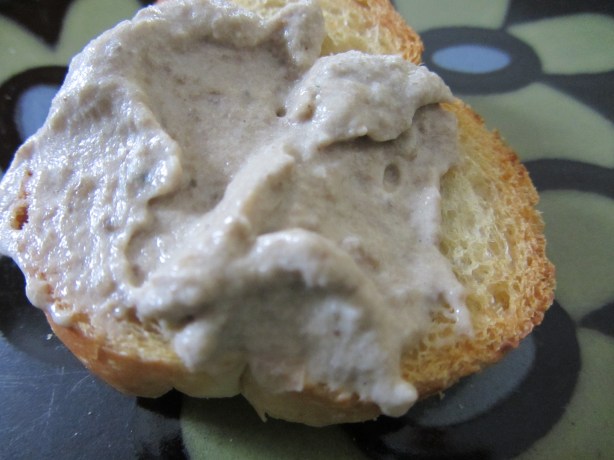
Alton’s chicken liver mousse on crispy baguette.

Serve immediately or cover and refrigerate for up to two days. We thought this was just okay. We have had other chicken liver pâtés that we have really enjoyed (in fact, we had a great one last week at a restaurant), but this one was not our favorite. The color of this mousse was sort of gray and unappealing, and Ted commented that he found the mousse overly sweet. Of the recipes in this episode, this one was our least favorite.

I didn’t really become a beer drinker until I was in my 20s. Growing up, the only beer I was really exposed to was what my dad drank, and he got on the microbrew bandwagon at the very beginning. I was pretty shocked when I had my first Budweiser at a wedding, as it was so thin and flavorless compared to the beer I had always known. I guess you could say I was destined to be a beer “snob” from the beginning. Since then, I have developed my beer palate substantially, and I enjoy quite a few styles of beer today.

Ted got into homebrewing before we were ever a couple. Over the years we have made several batches of beer together, some of which have been pretty good. Our worst homebrew was a blueberry beer that was my idea, and it involved infusing the beer with pounds of fresh blueberries. The beer was pretty terrible, and a complete waste of fantastic blueberries. Our kitchen was also a sticky, purple mess after bottling that beer, but the dog seemed to enjoy that part.

We also brewed a beer years ago for a local homebrew competition. This particular beer was infused with apricot kernels (again, my idea). We came home late one evening to find that the airlock on our glass carboy had become clogged with apricot kernels, leading to a beer explosion all over our bedroom. Yes, we kept the beer in our bedroom; our bedroom was the right temperature and we could keep the animals away from it. We spent hours that night cleaning beer and apricot kernels off of every surface. Our poor hardwood floors were just never the same.

Good Brew

Alton’s homebrew recipe from this episode of Good Eats was to be my first time brewing beer on my own (though Ted did help with some heavy lifting). This particular beer is made using malt extract, as opposed to all-grain brewing. All-grain brewing is more complicated because you convert the starches to sugars, while that step is done for you if you use malt extract. For this recipe, you will need to have the following hardware:  a 3+ gallon pot (actually, more like 5 gallon), a probe thermometer, a pair of nesting colanders/strainers, two lidded 7-gallon buckets with airlock holes (preferably with spigots), an airlock, plastic tubing, a bottle filler, bleach, bottles, and caps and a capper, if you are using them. For ingredients, you will need liquid pitchable yeast (I used a California ale yeast), 7 pounds of malt extract, 1/2 pound milled barley, 1 3/4 ounces of Kent Goldings hops, 1 ounce of Cascade hops, 7 pounds of ice, 4 gallons of spring water, and an additional pint of spring water. Note:  one gallon of the water, along with the pint, should be kept cold, while the rest of the water can be room temperature.

img_5786

Malt extract, milled barley, Cascade hops, Kent Goldings hops, and pitchable yeast.

To begin the brewing process, you will want to sterilize all of your equipment by pouring two ounces of bleach into your bucket, filling it with cold water. Dump all of your equipment (for today you will need your strainers, bucket lid, and airlock) into the bleach solution, letting it sit. The bathtub is a great place for this.

img_5785

Bucket and equipment being sterilized with bleach water.

Meanwhile, you can begin brewing by pouring two gallons of bottled water into your pot.

Add 1/2 pound of milled barley and turn the heat to high. Using your probe thermometer, monitor the temperature of your barley solution; you will want to bring the heat to ~150 degrees, then decrease the heat, allowing the temperature to continue to rise to 155 degrees. Maintain 155 degrees for 30 minutes. This part of the brewing process is called “mashing.”

When your timer has gone off, add another gallon of bottled water to the pot, along with your seven pounds of malt extract. Note:  Malt extract has the consistency of honey, so it is helpful to warm the malt extract in warm water to make it easier to remove from its container.

Increase the heat to high, bringing the mixture to a boil. If the mixture foams badly, decrease the heat until the foam settles, and raise it again.

Once you have reached a boil, decrease the heat to a simmer. Now it is time to add your flavoring hops, so add 1 ounce of Cascade hops and 3/4 ounce of Kent Goldings hops, cooking for 10 minutes.

After the flavoring hops, it is time to add the aroma hops (this is called dry hopping), so add the remaining ounce of Kent Golding hops. Turn off the heat, cover the pot, and let the mixture sit for five minutes.

While your brew is sitting, thoroughly rinse your bucket and all of your equipment to get rid of any bleach. Dump your seven pounds of ice, along with your cold water (1 gallon plus 1 pint) into your bucket.

Nesting your strainers over the top of your bucket, strain your mash into the ice/water in your bucket. This strained mash is called “wort,” which is young beer.

Take the temperature of your wort with a clean thermometer. Your yeast packet will tell you the temperature at which it can be added to your wort. In the episode, Alton’s wort was cool enough that he could add his yeast right away, but this was not the case for me. Since I was brewing late in the evening, I had to wait until the following morning to add my yeast. In any case, when your wort is cool enough for your yeast, mix the yeast and pour it into the wort – there is no need to stir or shake.

img_5818

Adding my yeast the following morning once my wort was cool enough.

Place the lid on the bucket, fill the airlock with water, and place your bucket in a cool, dark place. The airlock allows the fermenting beer to release pressure, so your fermenter will not explode.

img_5820

Airlock filled with water.

After seven days, time the bubbles in your airlock; if they are more than a minute apart, you are ready for the next step. I proceeded to the next step after eight days. On this day, you will need to sterilize your second bucket and its lid, your plastic tubing (if using), and your bottle filler, which you can do again with bleach/water. You will also need to sterilize your bottles, which I did by running them through the dishwasher with some bleach. If you are using bottle caps, you can sterilize them by boiling them in water in a saucepan.

img_5832

Bottle caps being sterilized by boiling them in water.

When all of your equipment is ready to go, bring a pint of water and 3/4 C sugar to a boil, allowing it to cook for five minutes.

img_5834

Sugar and water to be boiled for five minutes.

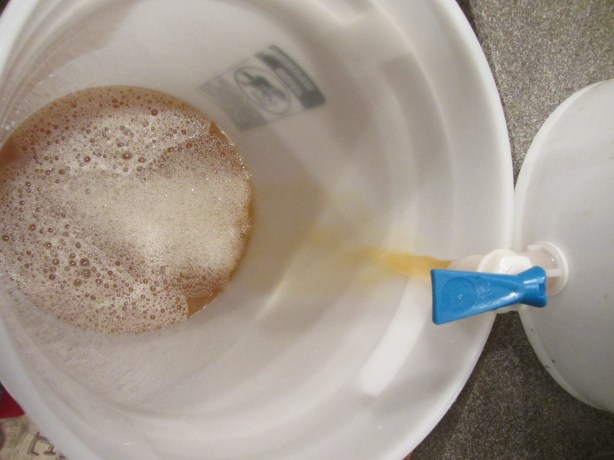
Pour the sugar solution into the bottom of your clean bucket. Using your plastic tubing, or a spigot if your bucket has one, transfer your beer from its original fermenter to your clean bucket that is holding the sugar solution.

img_5837

Beer being transferred to second bucket containing sugar solution.

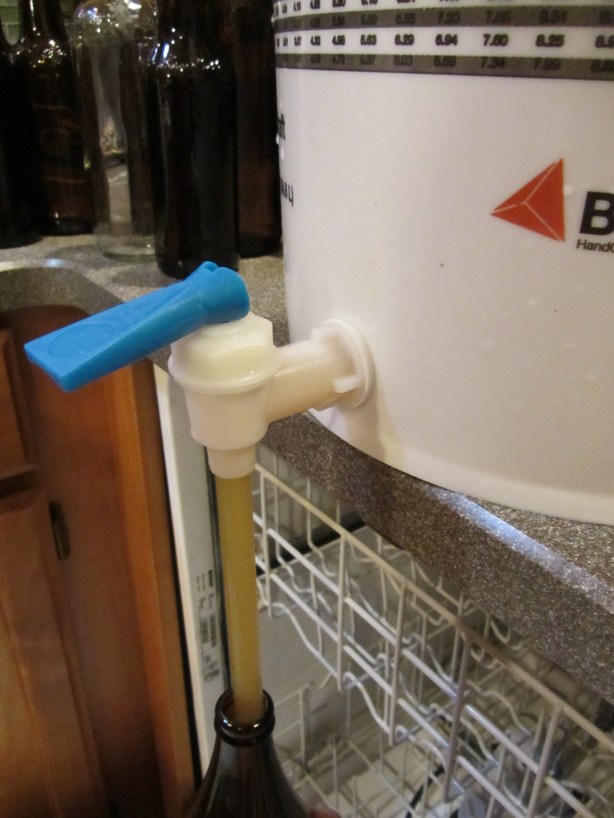
Finally, transfer the beer to your clean bottles, using your bottle filler.

img_5839

Beer being transferred from bucket to bottles, using bottle filler.

Cap the bottles and place them in a cool place for 7-14 days before trying.

I first tried my beer seven days after bottling, splitting a 22-ounce bottle with my brother. As I poured it, I was concerned that it would not have enough carbonation, but it was actually fine.

img_5890

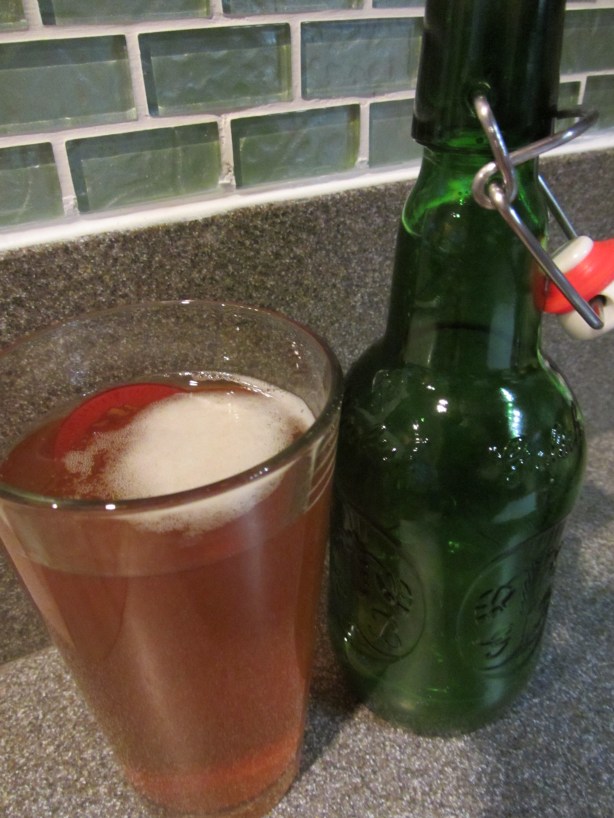
A bottle of Alton’s homebrew.

This beer is a sure-fire easy-drinking beer that could be enjoyed by beer drinkers of all types. This beer is golden in color, light, and has citrus notes that would make it refreshing on a hot day. And, the carbonation seems to be just about right. Overall, I am pretty pleased with this homebrew, and I would recommend Alton’s method for anyone looking to try homebrewing for the first time.

The 73rd episode of Good Eats is all about tomatoes and different uses for them. Seeing that Ted is not a huge tomato fan, I was not sure what he would think of some of these applications, but worst case scenario would see me stocking up heavily on lycopene. Alton went over some tomato facts in the episode, stating that there are six types of tomatoes we can get commercially – globe, plum, cherry, pear, grape, and currant (in order of size from largest to smallest). A beefsteak tomato is a red globe tomato that is extra large in size. Oh, and never store tomatoes in the refrigerator, as temperatures colder than 50 degrees permanently stop a component of tomatoes that gives them flavor.
Stuffed Tomatoes

For six servings of Alton’s stuffed tomatoes, cut the tops off of six large globe tomatoes, using a serrated knife. Scrape the seeds and pulp out of the tomato, using your fingers or a grapefruit spoon.

Sprinkle the tomatoes liberally with Kosher salt and invert them on a rack for 15 minutes; this will remove excess moisture from the tomato shells.

While the tomatoes drain, combine 2 C sauvignon blanc and 1 C hot water; add 3 C dried mushrooms to the liquid mixture to rehydrate.

While Alton used a blend of chanterelles, morels, and shiitakes, I only used shiitakes. Next, heat a large skillet, adding 2 T olive oil, 1 T minced garlic, 2 T minced shallots, and 1 C finely diced onion. Cook the onion until translucent.

img_5763

Garlic, shallots, and onion, cooking in olive oil.

Using your hands, squeeze excess moisture from the hydrated mushrooms, reserving the liquid. Chop the mushrooms and add them to the pan, cooking for five minutes over medium heat.

Add a cup of your reserved mushroom liquid to the pan and bring it to a simmer for five minutes. Follow this up with 1/4 t pepper and 1 chopped tomato. Finally, add 1 1/4 C panko breadcrumbs.

By this time, your tomato shells should have shed any excess moisture and you can use a measuring cup to fill the shells with the mushroom mixture.

For a final topping, combine 3 1/2 ounces of goat cheese with 1 T parsley, dividing this mixture evenly among the tomatoes. Place the stuffed tomatoes under a preheated broiler for 5-7 minutes, and enjoy!

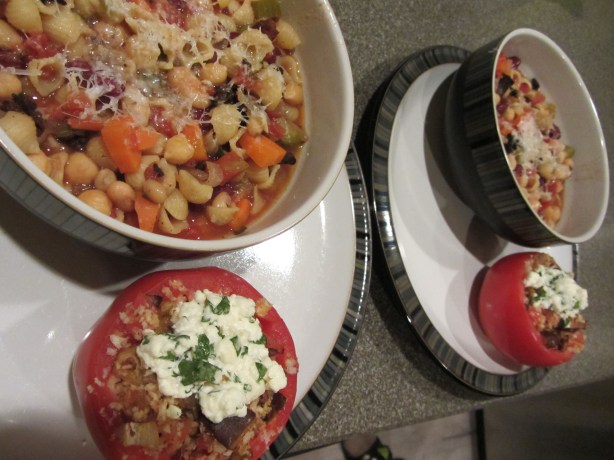
We ate Alton’s stuffed tomatoes as a side dish to my mom’s hearty minestrone soup.

img_5783

Stuffed tomatoes alongside hearty minestrone soup.

Ted thought this recipe was just OK, as he didn’t care for the tomato shells. As a tomato fan, however, I thought Alton’s stuffed tomatoes were delicious. The tomato shells maintained their texture and were far from soggy, contributing a bright tomato flavor. The mushroom filling had a fantastic umami flavor and slightly crunchy texture, and, well, who doesn’t like goat cheese? This recipe is a great blend of textures and flavors, and could be served as a vegetable side dish or as a vegetarian entree.

Tomato Sauce

I was curious to see how this episode’s tomato sauce would compare to Alton’s canned tomato sauce that I made over two years ago when I was writing up the second season of Good Eats. This episode is all about using fresh tomatoes, and this recipe calls for 20 fresh Roma tomatoes. In addition, you’ll need olive oil, fresh thyme, fresh oregano, Kosher salt, pepper, garlic, and onion.

img_5708

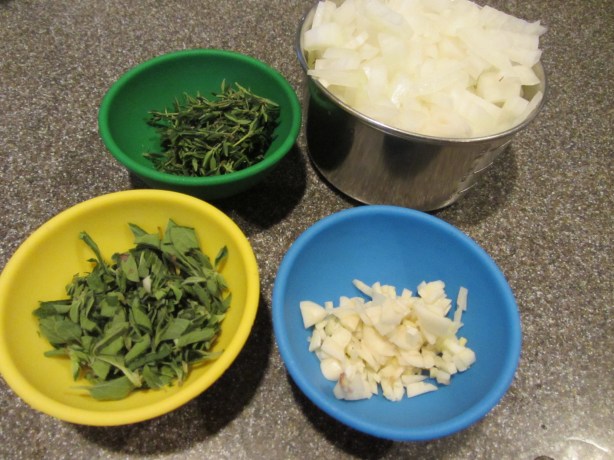
Garlic, onion, oregano, and thyme.

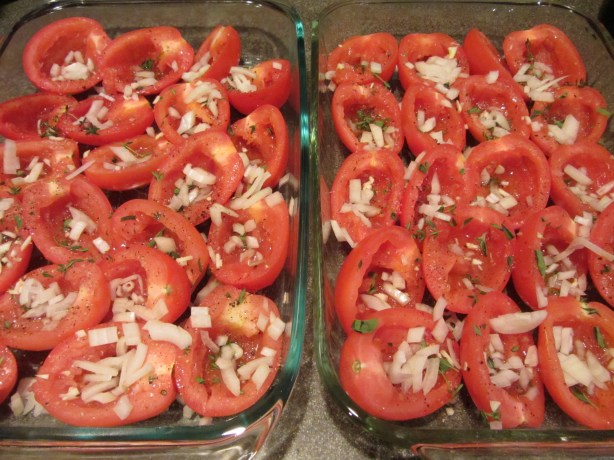
Begin by halving/seeding the Roma tomatoes, placing them cut side up in two 13×9-inch glass baking dishes.

Spritz (or, in my case, drizzle) the tomatoes with olive oil, and sprinkle them evenly with 1 T each of chopped fresh thyme and oregano. Alternatively, you can use 2 t of each herb, dried.

img_5710

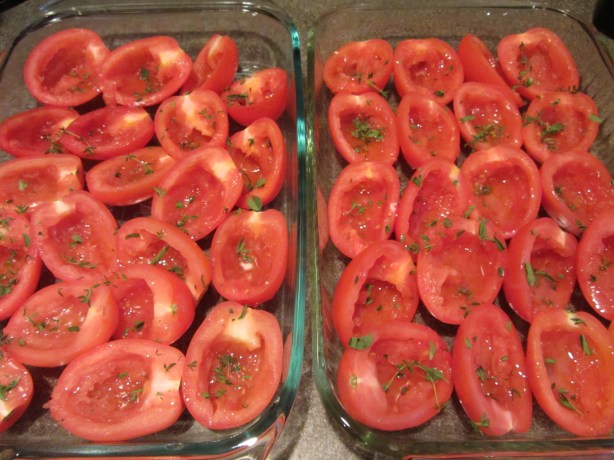
Tomatoes, drizzled with olive oil and sprinkled with oregano and thyme.

Sprinkle Kosher salt and 1/2 t black pepper over the tomatoes, along with 2 t minced garlic and 1 C finely diced onion (any type will work).

img_5711

Kosher salt, pepper, garlic, and onion added to tomatoes.

Stick the tomatoes into a 325-degree oven for two hours.

img_5714

Tomatoes after roasting for two hours.

After two hours, increase the oven’s temperature to 400 degrees for an additional half hour.

Remove the tomatoes from the oven and run them through a food mill (I have my mom’s ancient one that she used to use for applesauce) to get rid of their skins/seeds; you can do this directly over a medium saucepan. It will take a while to push them all through the food mill and you will get very little yield.

Add a cup of white wine (Alton used “cheap Chardonnay”) and bring the sauce to a boil over medium heat. Once boiling, decrease the heat and simmer the sauce for five minutes.

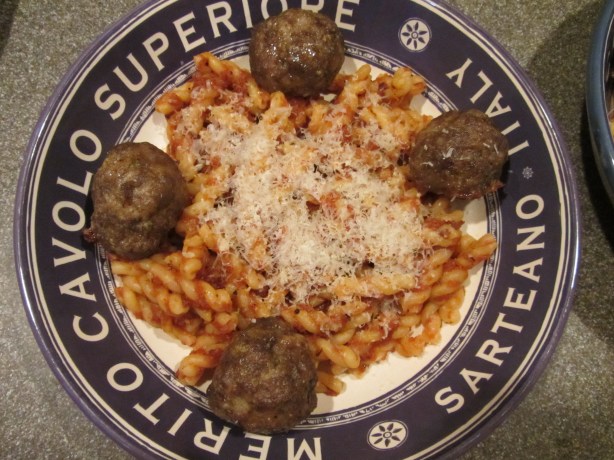
I served this tomato sauce over pasta, along with homemade lamb/beef meatballs (made by Ted) and Parmesan.

img_5732

Alton’s completed tomato sauce. with pasta and meatballs.

Honestly, I was disappointed in this sauce. This recipe made just enough sauce for a pound of pasta, and it was nothing special. The wine flavor seemed too prominent for my taste, so I would simmer it longer, if I were to make this again… which I probably will not do. I expected to prefer this sauce over the one from season two, especially since this one uses fresh tomatoes, but I would choose Alton’s canned sauce any day.

TBL Panzanella

The final recipe from this episode is for a TBL (tomato/bacon/lettuce) panzanella salad. In the episode, Alton demonstrates that this panzanella is a great alternative to a BLT sandwich, and that it showcases tomatoes very well. I love a good panzanella, or a good BLT for that matter, so I was enthusiastic about this recipe. Beginning the night before you want to eat this panzanella, cut a quart of 1-inch high-quality bread cubes, placing them on a pan to dry overnight.

The following day, cook six slices of bacon, saving the drippings. I used my bacon that I made from episode 59.

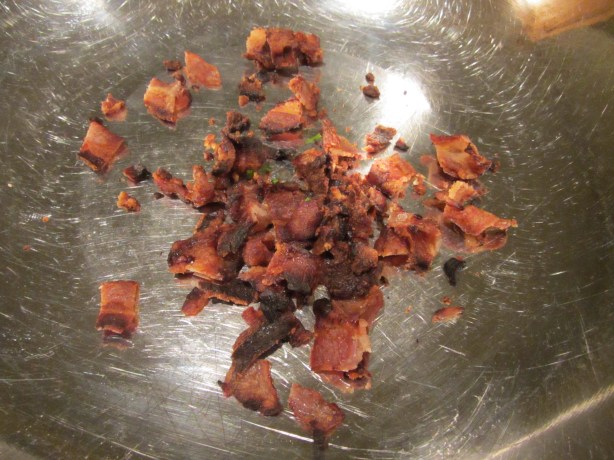
Cut the bacon into 1-inch pieces and place them into a large bowl.

img_5742

Chopped bacon.

In a separate bowl, toss the dried bread cubes with the warm bacon drippings.

img_5748

Dried bread cubes tossed with bacon drippings.

Next, sear 2 C of halved grape tomatoes in a hot pan, face down, for about five minutes. Add the seared tomatoes to the bacon bowl.

Halve 2 C of raw yellow pear tomatoes (I had to use yellow grape tomatoes), adding them to the bacon/tomato bowl. Next, add 2 C of chopped Romaine lettuce.

In a small lidded container, shake together 3 T olive oil, 1/4 C red wine vinegar, 1/4 t salt, and 1/4 t pepper.

img_5736

Olive oil, red wine vinegar, salt, and pepper for the dressing.

Combine the bread cubes with the rest of the salad and drizzle on the dressing. Finish the salad off by adding a chiffonade of fresh basil and mint.

I thought this was a really good panzanella salad. The bread cubes stayed crunchy, the bacon added meatiness, and the tomatoes gave a super fresh flavor. I thought the vinegar-based dressing paired well also.This is also a very colorful, pretty salad. To me, this is more of a warm weather meal, but we enjoyed it nonetheless. I think this still had a few too many tomatoes for Ted’s taste, but I may make this again for myself and enjoy it on a sunny day on the deck.

Do you ever have memories from childhood that seem incredibly prominent, such that you feel like they occurred with regular frequency? For some reason, I have a very strong memory of my mom making cheese souffle when I was little; the odd thing is that my memory makes me feel that this happened regularly, when, in fact, it may have only happened once or twice. I think I will have to call my mom later and have her set the record straight about her cheese souffle routine. Whether it happened once or many times, I remember sitting at the dining room table with my dad and brother, eagerly anticipating my mom’s arrival from the kitchen with her hot souffle dish. Would her souffle successfully rise and puff above the top of the dish? I recall a beautiful orange souffle, golden on top, with a perfect puffy “top hat.”

Cheese Souffle

Though I had consumed cheese souffle when I was young, I had never made one before I set out to prepare Alton’s souffle for our Saturday breakfast. Per Alton’s instructions, I preheated my oven to 375, which is his temperature rule for any souffle. For a souffle vessel, he recommends a 1.5-quart round souffle dish, preferably with an unglazed bottom (for heat penetration) and fluted sides to increase surface area; it just so happens that we have a dish just like this. First, I greased my souffle dish with cold butter.

img_5663

Souffle dish, greased with cold butter.

Next, I added 1 T of grated Parmesan to the dish, covering it with plastic wrap and shaking to coat the inside of the dish. I found that I actually needed a little more Parmesan to coat my dish, so I added some extra and shook again. Lining the dish with Parmesan gives the souffle something to “hold onto” as it climbs the walls. The souffle dish goes into the freezer while you prep everything else.

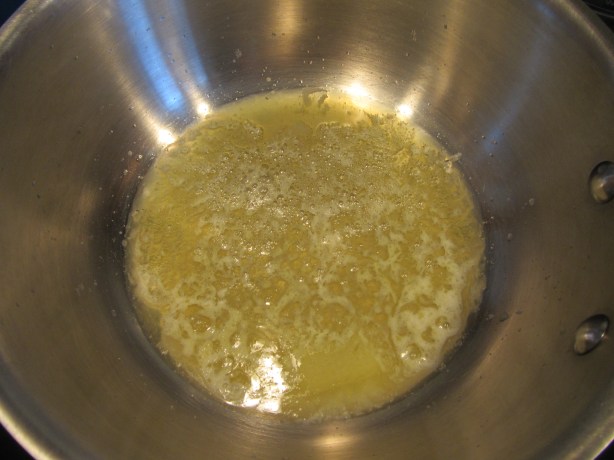
Alton’s recipe then calls for making a roux by melting 1 1/2 ounces of butter over medium heat, allowing the butter to cook until it stops bubbling, which means most of the water has been cooked out.

img_5680

Butter, cooking until it stops bubbling.

While the butter cooks, in a lidded container combine 3/4 ounce flour, 1 t dry mustard, 1/2 t garlic powder, and a heavy pinch of Kosher salt, shaking to combine.

You will also want to separate 4 egg yolks (you will need 5 egg whites later, so save the whites here), grate 6 ounces of sharp Cheddar cheese, and heat 1 1/3 C milk in the microwave.

When the butter has ceased bubbling, add the dry ingredients to the pan, whisking over low heat until you have a nutty aroma. To the roux, add the hot milk, whisking and increasing the heat.

Beat your egg yolks until light in color and turn the heat off under the roux. Temper the egg yolks by gradually adding small amounts of the hot roux, whisking. Once you have added about half of your roux, you can whisk the egg yolks into the roux pan.

Keeping the pan off of the heat, whisk in the grated Cheddar until you have a smooth mixture, which will take a few minutes. Set the base aside to cool.

Note:  To cut down on preparation time the day you are making your souffle, you can make the souffle base to this point and refrigerate it for up to a week; just be sure to press a layer of plastic wrap onto the surface to avoid having a “skin” form. If you do this, you will need to bring the base to room temperature before using. While your base cools to room temperature (or warms to room temperature if you prepared it in advance), beat 5 egg whites in a metal bowl, along with 1 T water and 1/8 t cream of tartar until you have stiff peaks.

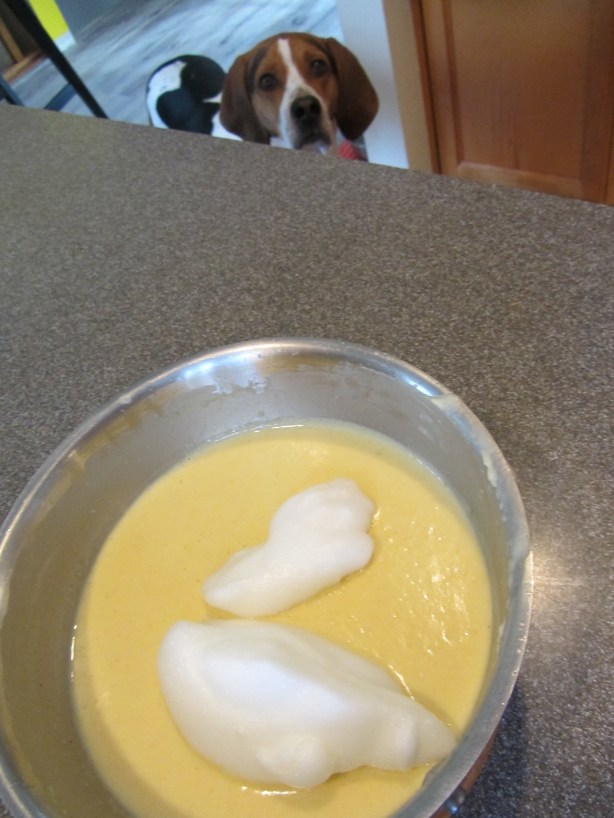
Stir 1/4 of your egg whites into your room temperature base, as this will lighten the base.

img_5691

Stirring 1/4 of the egg whites into the souffle base.

Gently fold the remaining whites into the base in three installments, avoiding deflating the foam by over-mixing.

Pour the souffle into the prepared dish and use your thumb to make an indentation all around the edge of the souffle, as this will help to form a nice “top hat.” Place your souffle dish in a pie pan (for ease of removal from the oven), and bake it for 35 minutes.

img_5697

Souffle in prepared dish.

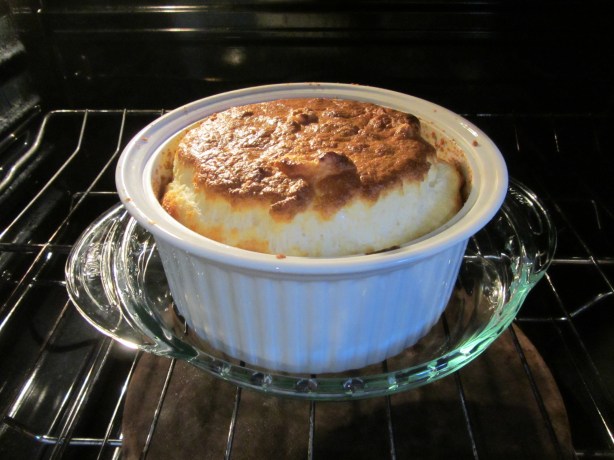
After 35 minutes, use a sharp paring knife to peek into the middle of the souffle – if there is a lot of liquid, place it back in the oven for 5 more minutes. My souffle seemed to be done after 35 minutes.

img_5698

Souffle after baking for 35 minutes.

Serve your souffle promptly. The nice thing about a cheese souffle is that you could eat it for any meal, but we had ours for breakfast before an 11-mile run.

Honestly, I was worried that my souffle was going to flop, as I felt that I had over-beaten my egg whites, but it actually turned out quite nicely. I do wish my souffle would have had a better rise above the top of the dish, but it still was nice and airy, and had a light crust on the outside. The cheese flavor was really prominent in this souffle and it had the texture of super light scrambled eggs. Souffles can be intimidating, but they are really not difficult, and Alton’s recipe seems to be one that works.