Posts Tagged ‘dessert’

The 96th episode of Good Eats originally aired in December, hence the Christmas cookie theme. I say, however, that Christmas cookies deserve to be eaten at any time of the year, and March seemed like a perfect time to crank some cookies out of my kitchen. First up?

Sugar Cookies

This is a recipe that I actually made years ago (maybe in 2005?) for Christmas at my parents’ house. It was the first Christmas Ted spent with my family and I remember decorating the cookies on Christmas Eve prior to Ted’s arrival. My brother and I were going to head to Christmas Eve mass with our parents, and we somehow ended up with two martinis in our systems prior to church. Let me just say that mass was a little more entertaining than usual, and I ended up with very brightly (and abstractly) decorated cookies. The cookies were a hit then, so I knew they would be good when I made them this time around. This recipe begins by sifting together 3 C flour, 1/4 t salt, and 3/4 t baking powder.

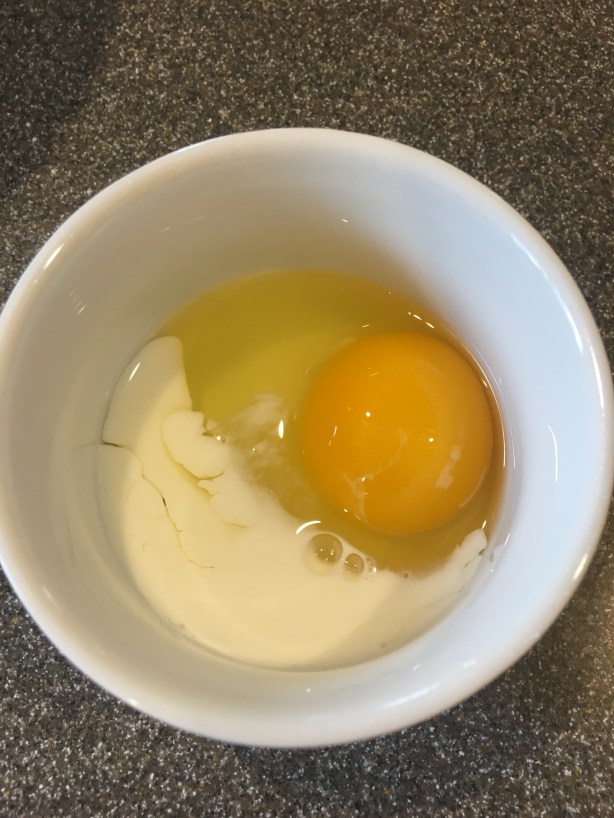
Also, in a small bowl, combine 1 egg and 1 T milk.

IMG_6626

Wet ingredients – egg and milk.

Oh, and place a sheet pan in the freezer. Next, in a stand mixer with the paddle attachment, cream together 1 C butter and 1 C sugar until light and fluffy.

Slowly add the wet ingredients to the mixer until mixed in.

IMG_6629

Wet ingredients added to mixing bowl.

Then, slowly add the sifted dry ingredients on low, mixing until the dry ingredients are incorporated and the dough forms a ball.

Divide the dough in half, patting each half into a flat slab. Wrap the dough in plastic or wax paper and place it in the refrigerator for two hours.

IMG_6633

Dough, divided into two equal slabs, and ready to head into refrigerator.

When you are ready to cut out your cookies, sprinkle your work surface with powdered sugar (Alton prefers sugar to flour because flour causes the dough to develop more gluten). Roll the dough to 1/4″ thick, lifting the dough every so often to be sure it isn’t sticking; I found that I needed quite a lot of powdered sugar to keep the dough from sticking to my counter.

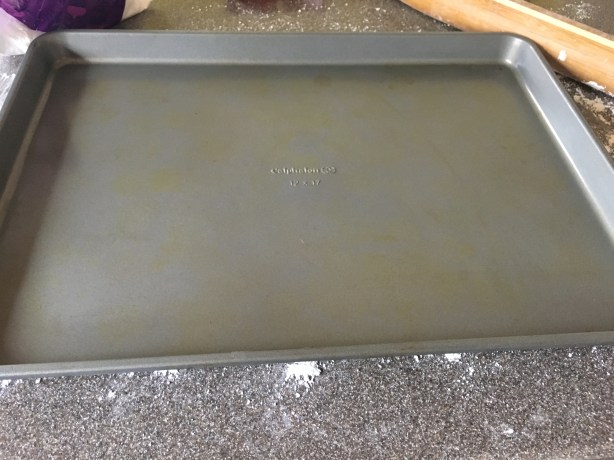
Remember that frozen sheet pan from earlier? Place it on your rolled dough for 10 minutes to re-chill the dough before cutting.

IMG_6638

Cold sheet pan placed on top of rolled dough.

Use cookie cutters (FYI Alton likes plastic ones) to cut cookies from your dough, transferring them to parchment-lined baking sheets.

Bake the cookies for four minutes at 375, rotate the pans, and bake them for four to five more minutes. I found that my cookies needed a little more time than this. Let them cool completely on racks before frosting.

IMG_6643

Cookies, after baking.

This sugar cookie recipe is fantastic. The dough comes together super quickly and is very easy to work with. The resulting cookies are crispy on the outside and slightly tender on the inside, and they have a rich, buttery flavor. I highly recommend this one! Oh, and how should you decorate said cookies? With Alton’s recipe for royal icing, of course! See below.

Royal Icing

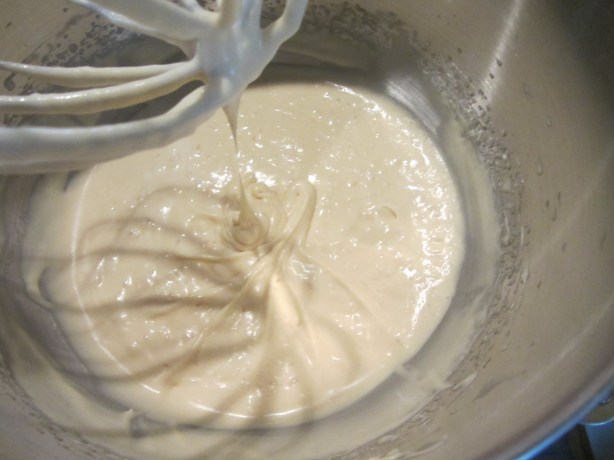
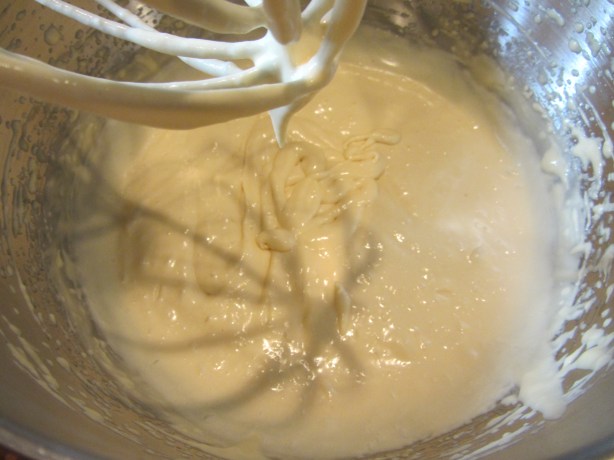
If you are looking for a way to decorate your sugar cookies, look no further than Alton’s royal icing recipe. To make his icing, beat four egg whites or three ounces of pasteurized egg whites (I used pasteurized egg whites) with 1 t vanilla, using the whisk attachment of a stand mixer.

Gradually add 4 C of sifted powdered sugar until you have a smooth, lump-free icing.

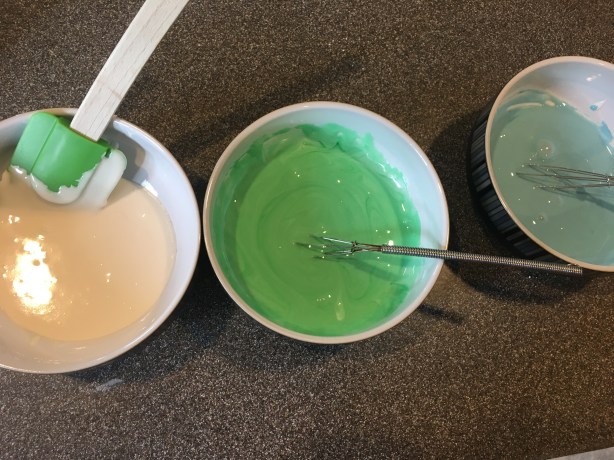
Divide the icing among small bowls, adding coloring as you desire. As far as coloring goes, Alton prefers powdered food coloring because it lasts the longest and has no additives. I only had liquid food coloring, so that is what I went with.

IMG_6650

Royal icing, divided and colored.

Frost your cookies and let them sit until the frosting has set up. Oh, and if you end up with a bad color, Alton recommends adding cocoa powder until you have covered it up.

IMG_6651

My decorated sugar cookies.

This icing could not be easier to make and it sets up beautifully. Since royal icing is thin, it can be a bit messy to deal with, but it looks and tastes great. This is a fool-proof royal icing recipe that pairs perfectly with Alton’s sugar cookies. I threw a bunch of my frosted cookies in the freezer for later enjoyment, so you can always make these ahead.

Chocolate Peppermint Pinwheel Cookies

Last in this episode was Alton’s recipe for chocolate peppermint pinwheel cookies. I actually made this recipe years ago also, but for a cookie exchange when I was in graduate school. I remembered liking these cookies then. These cookies start with a batch of Alton’s sugar cookies.

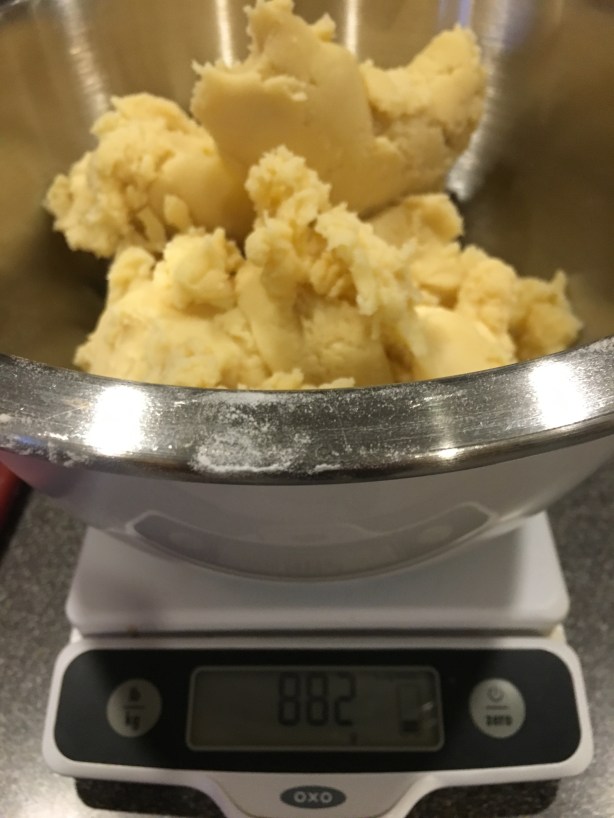
Divide the sugar cookie dough in half (it is best to do this by weight), and place the dough in two bowls.

IMG_6576

Dividing sugar cookie dough in half by weight.

One half of the dough will become peppermint dough, while the other half will become chocolate dough. Add 1 t vanilla to one of the bowls of dough, and add 1 t peppermint extract to the other.

To the peppermint dough, add 1/2 C crushed candy cane (or peppermint candy).

To the dough with vanilla extract, add 3 ounces of melted unsweetened chocolate (you can melt it in the microwave, stirring until melted).

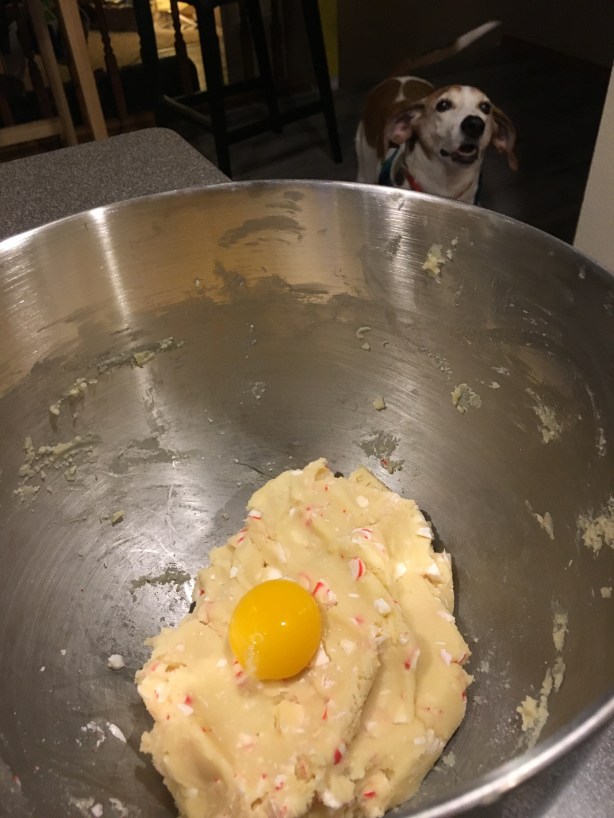
Use gloved hands to mix the peppermint and chocolate into the two doughs. Additionally, add 1 egg yolk to the peppermint dough, mixing it in by hand.

IMG_6584

Crushed peppermint and egg yolk added to dough with peppermint extract.

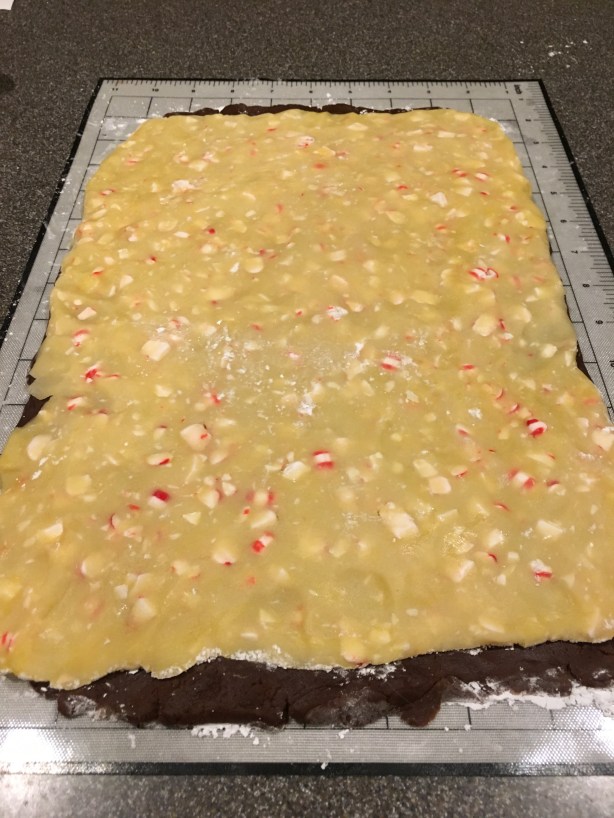
Chill the two doughs for five minutes. Roll out the two doughs to 1/3-1/4″ thick rectangles, using powdered sugar to keep the dough from sticking. You want your chocolate rectangle to be slightly longer and thinner than your peppermint rectangle. Place the chocolate dough on a non-stick mat or a pliable cutting board (I rolled my dough out on a non-stick mat, so I wouldn’t have to transfer it).

Place the peppermint dough on top of the chocolate dough, pressing the doughs together.

IMG_6594

Peppermint dough placed on top of chocolate dough and the two are pressed together.

Use the edge of the non-stick mat or cutting board to roll the doughs into a log. Wrap the log in wax paper and refrigerate it for at least two hours.

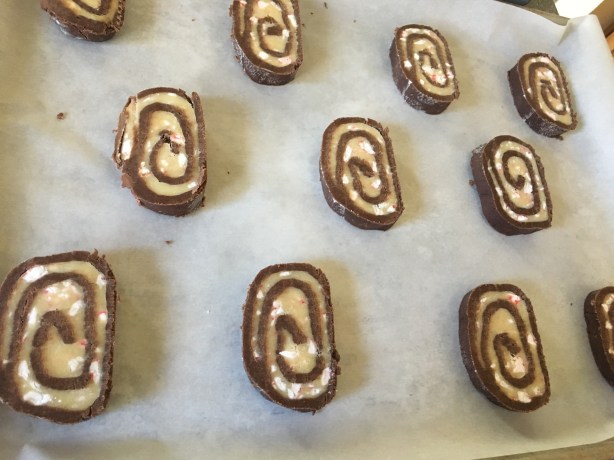
When ready to bake, slice the log into 1/2″ slices, placing them on parchment-lined sheets.

IMG_6602

Dough sliced into rounds.

Bake the cookies for 12-13 minutes at 375-degrees, rotating the pans once during baking. Cool the cookies for two minutes on the baking sheets before transferring them to racks.

These cookies are chewy and dense, and have little pockets of crunchy peppermint. They are pretty and fun to make, and they definitely have a seasonal feeling to them. That being said, though, why is peppermint only popular at the holidays? Peppermint ice cream is one of my very favorite flavors, but you can only find it for a couple months each year. Anyway, these cookies are worth a bake, and, yes, you can freeze these too!


I have begun dabbling in cheesemaking, which has taken some of my time away from this project recently, but I aspire to get back into more of a regular rhythm with this blog. I have a long list of different things I want to cook/bake, in addition to this project, and I have to find time to do them all. Honestly, I should probably try to make one thing on my list each day, and maybe I could eventually catch up! With only two of us, I can only make so much food at a time, though. I did find occasions to make Alton’s sweet potato recipes from Good Eats, so here are my write-ups of those recipes.

Chipotle Smashed Sweet Potatoes

I kind of had a negative perception of sweet potatoes until a few years ago. When picturing sweet potatoes, I would picture the classic sweet potato casserole with marshmallow topping, which is a dish I just do not care for. Now, though, I love to use sweet potatoes in a variety of ways, including in a breakfast hash, as “noodles”, and as oven fries. Alton’s first use for sweet potatoes was a smashed form. For this recipe, place a steamer basket in a pot over a quart of water. I used my small steaming pot. Once you see steam, place 1 1/4 pounds of peeled/cubed sweet potatoes in the top of the steamer and cover the pot. Let the potatoes steam for 20 minutes.

Drain the water from the pot and dump in the steamed potatoes, adding 2 T butter and 1/2 t Kosher salt. Mash the potatoes with a potato masher to your desired consistency.

Finally, finish the potatoes by mixing in 1 chopped canned chipotle pepper in adobo sauce, along with 1 t of the adobo sauce.

IMG_6310

Chipotle smashed sweet potatoes.

First off, this recipe could not get easier or quicker, making it great to make anytime. Second, this is a really tasty dish! I added a bit more adobo sauce and salt after tasting the finished potatoes, but that is just personal preference. The sweetness of the potatoes is a great match for the smoky heat of chipotles. I will make this one again. Actually, I think I will pick up some sweet potatoes when I head to the store today, and we will have these as a side dish in the next week.

Sweet Potato Waffles

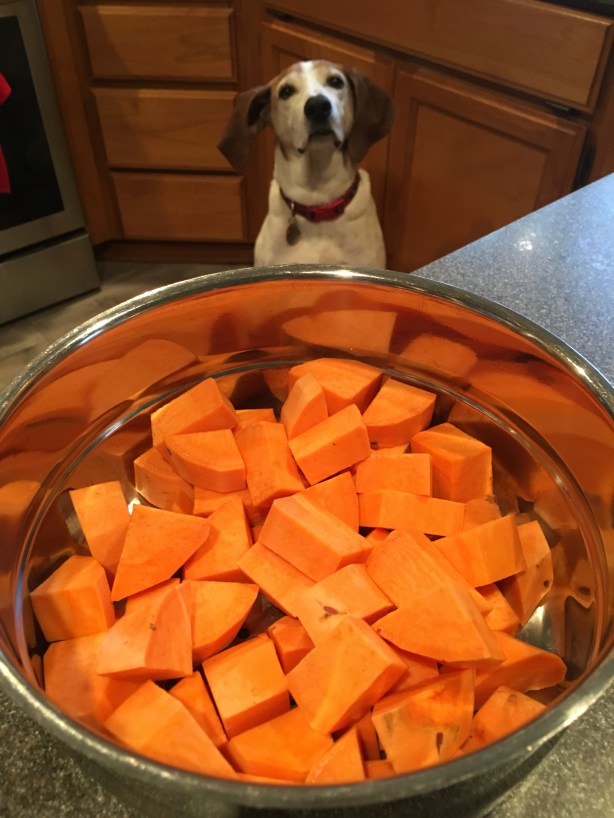
It seems that post people strongly prefer either pancakes or waffles. Although I do like both pancakes and waffles, I’d have to say that I am a waffle person. On a recent lazy weekend morning, I made Alton’s sweet potato waffles. To make these, first sift together into a bowl 2 C flour, 1 T baking powder, and 1/2 t Kosher salt. You will also need to peel, cube, and steam (for 20 minutes) enough sweet potatoes to make 1 1/2 C of mashed sweet potatoes.

IMG_6272

Peeled and cubed sweet potatoes, to be steamed.

In a second bowl, stir together 1 C milk, 1/4 C light brown sugar, 1 T orange zest, 1 1/2 C peeled/cubed/steamed/mashed sweet potatoes, and 1/4 C butter, melted.

Add the dry ingredients to the wet ingredients, stirring just until combined.

In a third bowl, beat 6 egg whites until you have medium peaks. Fold the beaten egg whites into the sweet potato mixture in three installments; the first installment can just be stirred into the batter to lighten it, but gently fold the second and third installments into the batter.

Dish the waffle batter (Alton recommends two scoops with a #20 disher) onto a preheated waffle iron, cooking for 5-6 minutes or until crispy.

IMG_6292

Batter placed on heated waffle iron.

Top the waffles with butter, syrup, and toasted pecans, or whatever strikes your fancy.

IMG_6294

A sweet potato waffle with butter, syrup, and toasted pecans.

These waffles were really good, but they do take more time and effort than typical waffles. Is the extra effort warranted? For a special occasion, I would argue they are worth the effort. The waffles themselves are lightly sweetened from the sweet potato and brown sugar, though I would not be able to identify the sweet potato in them from flavor alone. Their yellow hue, however, does give some evidence of their star ingredient. These waffles definitely have more flavor than your typical waffles, and I actually preferred them simply with some melted butter on top.

Sweet Potato Pie

Pumpkin pie seems to be a polarizing dessert, with people either loving or hating it. I really like pumpkin pie, but Ted happens not to care for it. Alton claims that his sweet potato pie is superior to pumpkin pie, stating on his web site that, “This pie is everything I ever wanted out of pumpkin pie, only without the pumpkin.” Begin Alton’s pie by steaming 1 1/4 pounds of peeled and cubed sweet potatoes for 20 minutes.

Place the steamed potatoes in a stand mixer, beating them on low speed with a paddle attachment until they start to fall apart. Increase the speed and beat them until fully mashed. Next, add 1 1/4 C plain yogurt, beating to combine.

IMG_6252

Yogurt added to sweet potatoes, after mashing potatoes in mixer.

Mix in 3/4 C dark brown sugar, 5 egg yolks, 1/2 t cinnamon, and 1/4 t nutmeg, beating until incorporated.

The batter will still have some lumps.

IMG_6254

Pie filling.

Pour the pie filling into a 9-inch pie shell placed on a sheet pan, and smooth the top of the pie with a spatula. Sprinkle the top of the pie with 1 C of chopped/toasted pecans and drizzle the pie with 1 T maple syrup.

Place the pie (on the sheet pan) in a 350 degree oven for 50-55 minutes, or until its internal temperature is about 170 degrees. Cool the pie for an hour before slicing.

For easy slicing, Alton inverts his pie onto a cutting board, removing it from the pan. He then slices the upside-down pie with an electric knife before returning the pie to the pan. Store any leftover pie in the refrigerator.

IMG_6264

A slice of sweet potato pie.

So, how did Alton’s sweet potato pie fare in our house? I liked the pie, but not as much as pumpkin pie. Ted, on the other hand, preferred the sweet potato pie to pumpkin pie, though this still wasn’t one of his favorites. Alton’s pie is less sweet than pumpkin pie, and you really taste the tang of the yogurt. It does have a lighter, fluffier texture than a typical pumpkin pie, which I liked. I did also like the addition of toasted nuts and maple syrup on the top of the pie, and I could see that working well on pumpkin pie also. This pie was definitely good, but it wasn’t an all-time favorite in our house. If you have a household of people who do not care for pumpkin pie, this could be worth a try on your holiday table.


The 93rd episode of Good Eats is all about ways to utilize a variety of grains in the kitchen; wheat berries, bulgur, and couscous are the stars of the show. Wheat berries are whole wheat kernels that have not been processed. Bulgur, on the other hand, is whole wheat that has been cracked and partially cooked. Finally, couscous is actually not a grain at all, but a pasta that is often mistaken for being a grain because of its nutty flavor and usage in grain-like recipes. First up:  wheat berries.

Basic Cooked Wheat Berries

Alton first demonstrates his go-to method for cooking wheat berries, which can then be used in a variety of recipes. To begin, place 2 C of wheat berries in a large skillet, toasting them over medium-high heat until they begin to smell nutty. This toasting step is omitted in the online recipe, but certainly imparts more flavor in the finished wheat berries.

Place the toasted wheat berries in a pressure cooker, adding two heavy pinches of Kosher salt and 4 C of water, or enough to cover the wheat berries by about an inch.

Close the lid of the pressure cooker and bring it up to pressure over high heat. Decrease the heat and maintain the pressure for 45 minutes. If you have an electric range like I do, you may find that you have to adjust the burner temperature regularly to maintain pressure.

IMG_6057

Pressure cooker, being brought to pressure.

After 45 minutes of cooking, release the pressure from your cooker. I had never cooked wheat berries before, so I was not sure exactly what a perfectly cooked wheat berry would look like.

I found the wheat berries to have a nutty flavor and a slightly chewy al dente texture. I took Alton’s recommendations and used my wheat berries to make the next two recipes in the episode:  wheat berry tapenade and mushroom wheat berry pilaf.

Wheat Berry Tapenade

The first way Alton suggests to use cooked wheat berries is in his wheat berry tapenade. For the tapenade, combine three minced garlic cloves, 1 C chopped Kalamata olives, 1/2 t Dijon mustard, and 1 t Kosher salt.

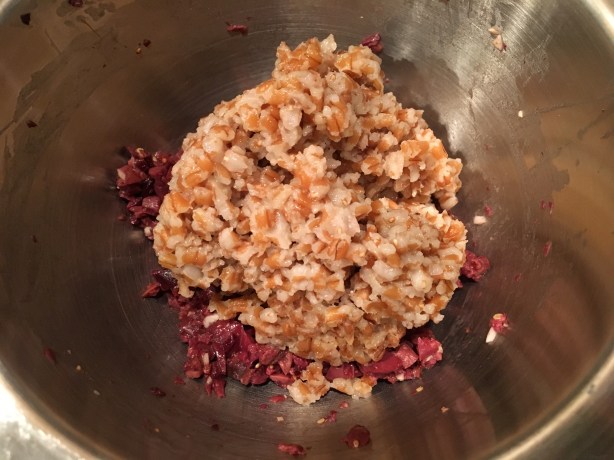
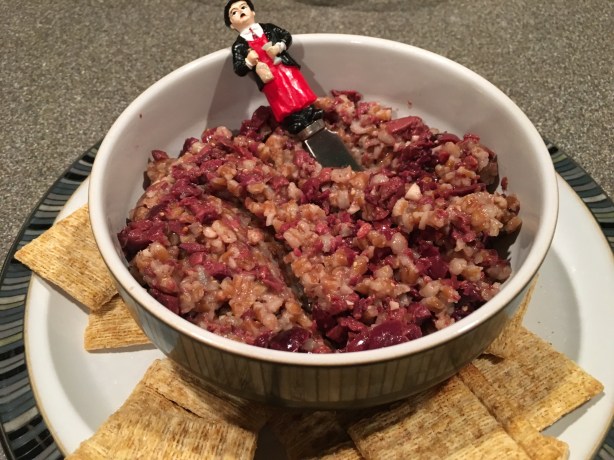
Stir in 1 C of cooked wheat berries, and serve the tapenade with crackers or toast.

IMG_6071

Cooked wheat berries added to olive mixture.

IMG_6073

Wheat berry tapenade.

We ate this as an appetizer one evening and both thought it was super tasty. In fact, we ate a whole bowl. This tasted like any great Kalamata tapenade, but with much more to offer in the texture department. The salty, briny flavor of the olives supplemented with the tang of the mustard paired well with the nuttiness of the wheat berries. I did end up adding a squeeze of fresh lemon juice to my tapenade, as I felt it could use a small kick of acid. This is a healthy and fast appetizer to make (once the wheat berries are already cooked), and I will be making it again very soon.

Mushroom Wheat Berry Pilaf

I can only assume that Alton is a huge fan of his mushroom wheat berry pilaf, as an updated version of this recipe appears in his newest cookbook. The biggest difference between this version and the updated recipe is that the updated recipe uses no rice. For the pilaf, heat 1 T olive oil in a large skillet, adding 1 1/2 C chopped onion, a pinch of Kosher salt, 5 minced garlic cloves, and 1 T butter. Stir after each addition.

Increase the heat to high and add 1 pound of sliced mushrooms (I used cremini), and 1 T soy sauce.

IMG_6081

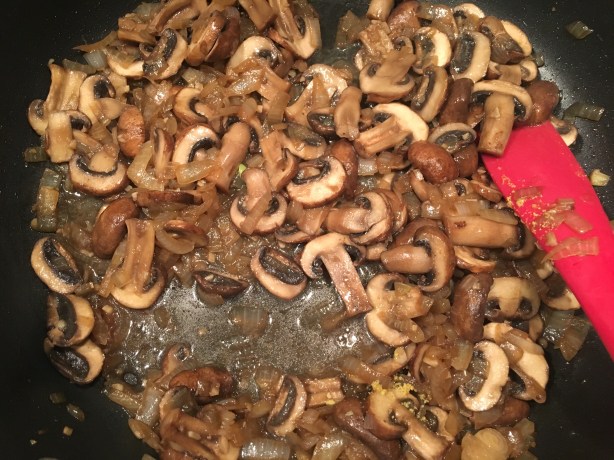
Mushrooms and soy sauce added to skillet.

Continue to cook the mushrooms until they have reduced by half, which will take a little while.

IMG_6082

Mushrooms, cooked until reduced by half.

Once the mushrooms have reduced, add 1/4 C chicken broth, 1/4 C red wine, 1 C cooked wheat berries, 1 1/2 C cooked rice, 1/2 t chopped fresh thyme, 1 t chopped fresh rosemary, and 1 t chopped lemon zest.

IMG_6089

Mushroom wheat berry pilaf.

We ate this as an entrée and both really liked it. For a vegetarian entree it had a lot of flavor and a variety of textures. The mushrooms and soy sauce give this dish a lot of umami flavor, while the herbs give it a nice freshness. The lemon zest comes through in this recipe in a big way, giving a refreshing, bright tang that really lightens everything up. Plus, this is another healthy, delicious way to incorporate whole grains. This is a fantastic recipe that could be used as either an entree or a side.

Bulgur Gazpacho

You had me at “gazpacho.” I absolutely love a spicy, tangy gazpacho, so this recipe piqued my interest right away.

IMG_5973

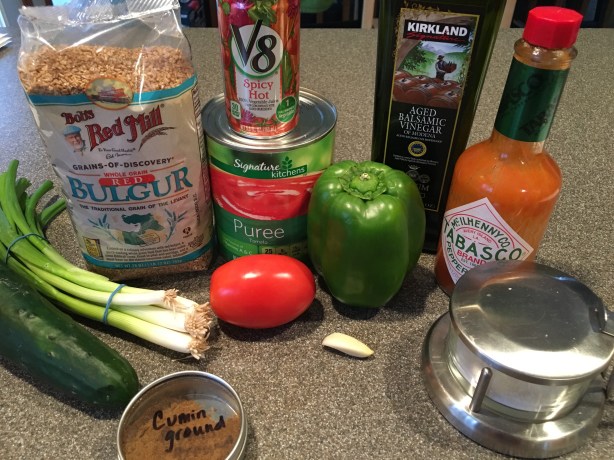
Ingredients for bulgur gazpacho: cucumber, scallions, bulgur, cumin, tomato puree, tomato/veg juice, tomato, garlic, green bell pepper, balsamic vinegar, hot sauce, and Kosher salt.

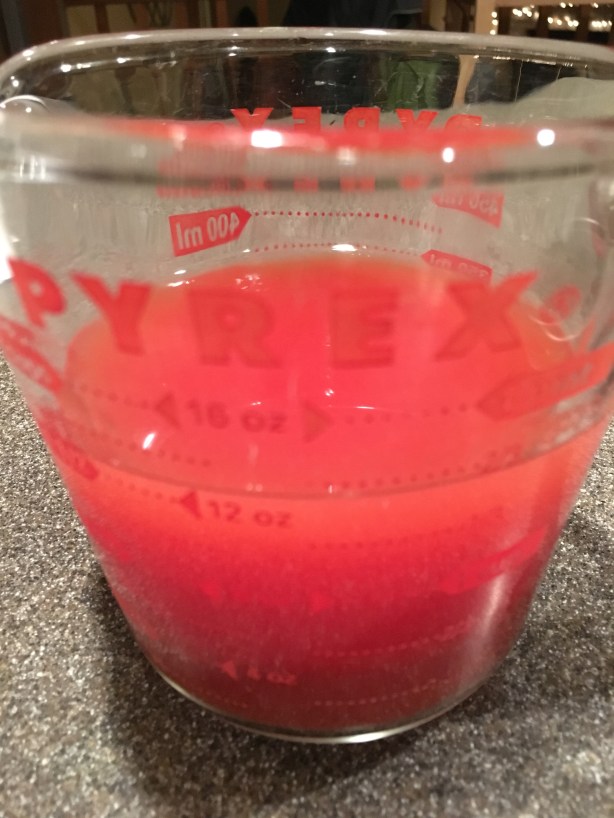
Start by bringing 1 C of water to a boil with 1/2 C tomato puree; I did this in the microwave.

IMG_5976

Water and tomato puree being heated to a boil.

Pour the tomato mixture over 3/4 C bulgur in a bowl, sloshing to combine. Cover the bowl with a plate and set it aside for 20 minutes.

After 20 minutes, add 1 minced garlic clove, 4 sliced scallions, 1 C seeded/diced cucumber, 1 C chopped tomato, and 3/4 C diced green bell pepper.

Next, stir in 1/2-1 C tomato juice (I used spicy V8), 2 T balsamic vinegar, 1-2 t hot sauce, 1/2 t cumin, and 1 1/2 t Kosher salt. Stir the gazpacho until combined and place in the refrigerator for at least an hour before eating.

IMG_5988

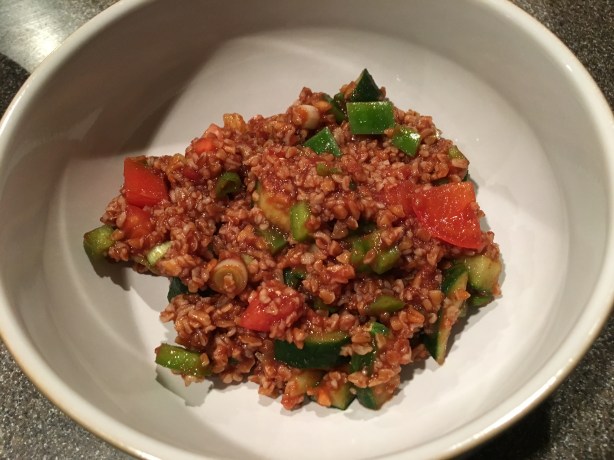
Bulgur gazpacho.

Sure enough, we really enjoyed this recipe. Though this isn’t soupy, it does have the vibrant, zesty flavors of a gazpacho. Also, with the addition of bulgur, this gazpacho has enough substance to stand alone as an entrée. There is also a lot of texture to this dish, coming from the variety of vegetables and the bulgur. This would be a really nice summer entree or side dish.

Steamed Couscous

Couscous is something we used to eat a lot, and this episode made me realize it is something we should eat more often. Alton begins his couscous segment with his recipe for steamed couscous, which can then be used in any couscous recipe. To make Alton’s couscous, prepare a steamer basket by adding water to the bottom pan, keeping the water level a couple inches below the bottom of the top basket. Heat the pan, allowing steam to begin to form. I used my pasta pot.

IMG_6011

Preheating steamer.

Meanwhile, rinse 2 C of couscous with water and turn it out onto a sheet pan. Sprinkle the couscous all over with Kosher salt.

Once steam has formed in your steamer, line the top part of the steamer with a damp kitchen towel and dump the couscous into the towel. Fold the towel over the couscous, forming a bundle. Place the lid on the steamer and set a timer for 15 minutes.

After 15 minutes, use tongs to lift the couscous-filled towel, dumping the couscous onto the sheet pan again. Drizzle 1/2 C cold water over the couscous, tossing.

Next, spritz the couscous with oil or non-stick spray, also lubing your hands. Rub the oil into the couscous for about three minutes, breaking up any clumps.

Once again, transfer the couscous back into the towel-lined steamer, folding the towel over the couscous. Place the lid on the steamer and steam the couscous for a final 10 minutes.

IMG_6028

Couscous after final 10 minute steaming.

I have to say that this couscous method is the most labor-intensive one I have ever used. The resulting couscous was fluffy and lump-free, but I don’t think I would go to the trouble of making couscous this way again. I did what Alton did and used my steamed couscous to make his cherry couscous pudding, which follows below.

Cherry Couscous Pudding

Although I have eaten my share of couscous, I had never had it in a sweet application… until this recipe. For this one, heat 1/2 C whole milk, 3 T sugar, and 1/4 C dried cherries. Once warm, set aside for 10 minutes to steep.

After 10 minutes, add the pulp of one vanilla bean to the milk.

Pour the milk mixture over your steamed couscous (see above), stirring to combine.

IMG_6045

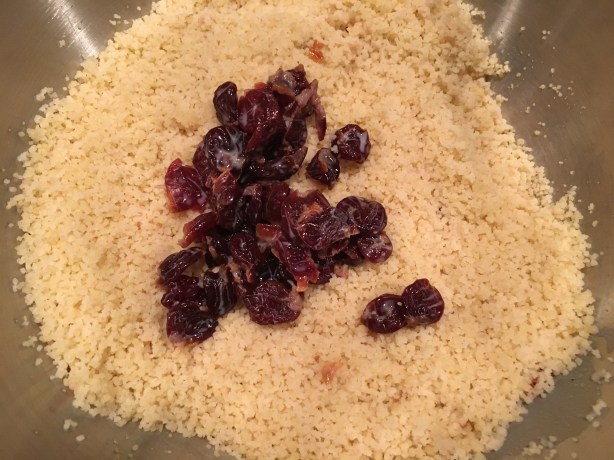
Milk mixture poured over steamed couscous.

Add 8 ounces vanilla yogurt and refrigerate the pudding for at least an hour before serving.

Sprinkle individual servings of the pudding with cinnamon.

IMG_6095

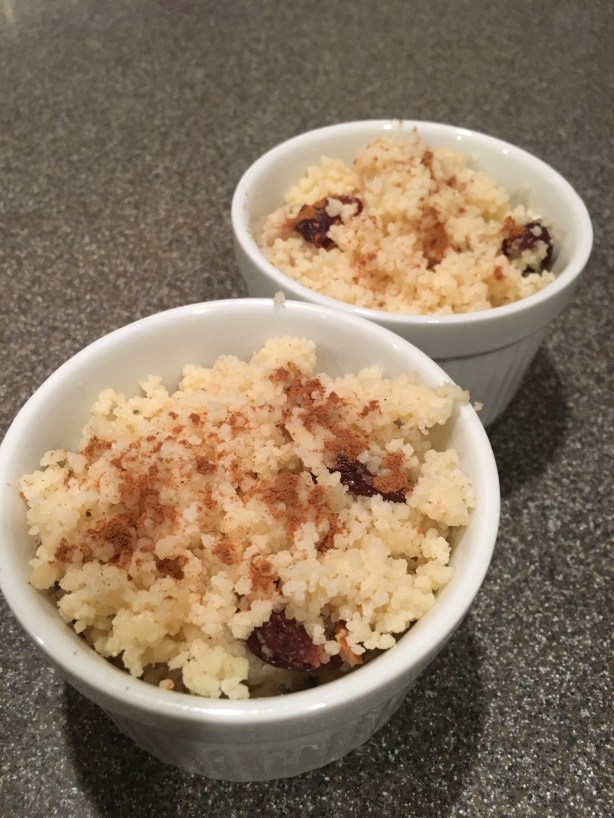
Couscous pudding, sprinkled with cinnamon.

This recipe was a real dud. It was dry and flavorless, but I think I know what the issue was. In the episode, Alton cooked his steamed couscous as written above, using the full batch of couscous to make this pudding. In looking at the online recipe, I see that it calls for only 1 1/2 C of the steamed couscous. This may be a first, but I think the online recipe may be correct, while Alton’s preparation in the episode resulted in a super dry couscous that was anything but pudding-like. I am somewhat tempted to make this again with only 1 1/2 C of couscous, as surely it would have better flavor and texture. Honestly, this is the first couscous recipe I have not liked, and I cannot recommend it as it was prepared in the episode.

Red Snapper en Papillote

When watching all of these Good Eats episodes, certain recipes really jump out at me. In this episode, the recipe for snapper en papillote was the one that made me super enthusiastic. I really loved the red snapper in a salt dome that I made way back in episode 10, so another snapper recipe made me excited. Unfortunately, the seafood store where I previously found whole red snapper has closed, so I had to turn to the grocery store; the fish monger was unable to get a whole red snapper, so I wound up with some other type of snapper (honestly, I don’t know exactly what it was). My fish was also not cleaned, so I had to do that myself, with a little help from my husband. If you do happen to be shopping for a whole red snapper, be sure to check the eyes of the fish, as true red snappers will have red eyes. If, like me, you cannot find red snapper in your area, Alton says you can substitute whole trout, tilapia, arctic char, or tilefish in this recipe. Regardless of the type of fish you use, for this recipe, a 1-2 pound fish will work best. Start by rinsing 1 C of couscous in cold water; sprinkle it with Kosher salt and set it aside while you prep the fish.

Prep the fish by rinsing your whole fish under cold water, scraping it with a knife to remove any remaining scales. Trim off all fins, but leave the tail intact. Pat the fish dry, including inside the fish, and line a large sheet pan with parchment paper, leaving a long overhang (the parchment needs to be large enough to fold over the whole fish). Place the fish diagonally across the parchment, sprinkling it all over (including inside the cavity) with Kosher salt and black pepper.

IMG_5759

My whole fish, sprinkled with salt and pepper.

Place a handful of fresh oregano and parsley inside the fish, along with a few slices of lemon and red onion. You can stick anything extra under the fish.

IMG_5760

My fish, stuffed with fresh oregano, parsley, red onion, and lemon.

Sprinkle the rinsed couscous all around the fish, along with 1 C of drained/quartered artichoke hearts, 1 C halved cherry tomatoes, and 2 t garlic. Place lemon slices and sliced red onion along the top of the fish, and drizzle everything with 1/2 C white wine. Finally, dab 1 T of butter along the top of the fish.

IMG_5762

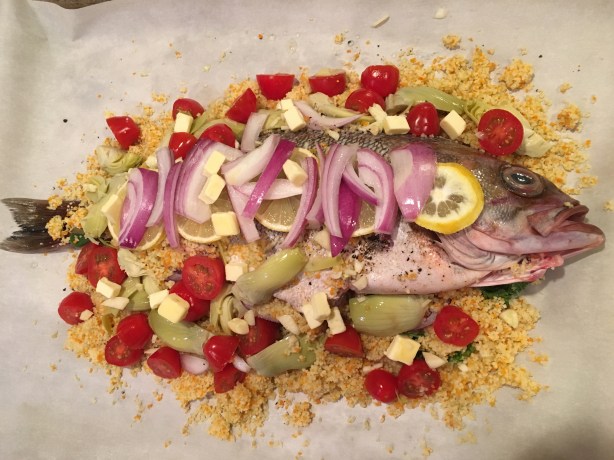
Couscous, artichoke hearts, tomatoes, garlic, lemon, red onion, wine, and butter added to fish.

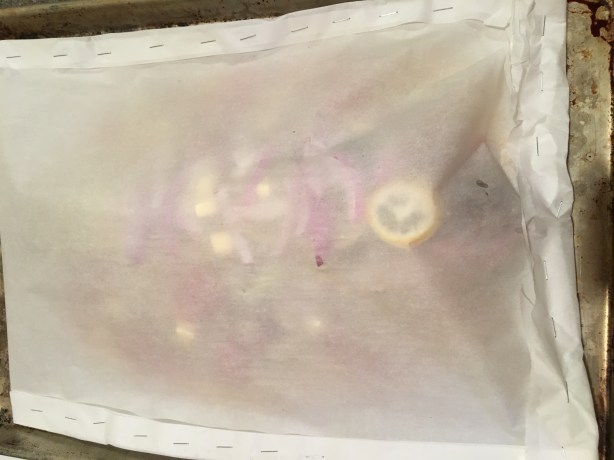
Fold the parchment paper over the fish, creasing the three open sides of the packet. Staple the whole package shut, placing staples about every inch.

IMG_5765

Parchment folded and stapled over fish.

Place the fish in an oven preheated to 425 degrees for 30 minutes.

IMG_5766

Fish packet in 425-degree oven.

Once out of the oven, cut the parchment packet open and serve the fish.

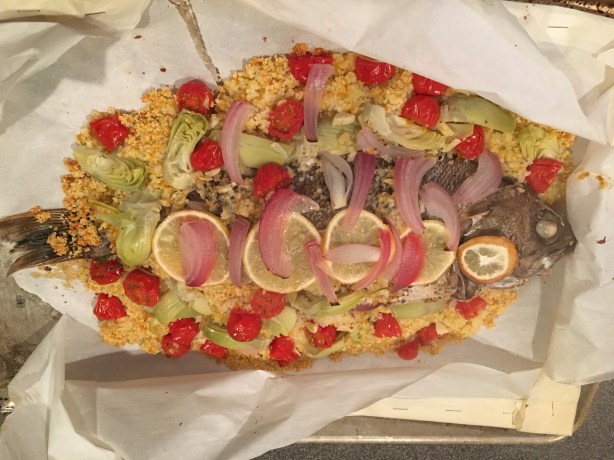
IMG_5767

Fish after cooking for 30 minutes.

Unfortunately, this recipe didn’t wow me as much as I hoped it would, but some of that may have been due to my fish, which was kind of “blah.” I am open to trying this again with a different whole fish. I did like that this recipe is a one-pan dinner with built-in sides of couscous and vegetables, and the fish was nicely cooked. My couscous did end up being slightly gummy, but the combination of flavors in the dish was great, and I did like the presentation. If you can get whole red snapper where you live, I think this might be a great recipe to try.

Salmon Fillet en Papillote with Julienned Vegetables

The second recipe in this episode is super easy and is made in individual servings, making it easily adaptable for any number of guests. As with the snapper recipe above, parchment paper is used here to create a pouch, but this time there is one pouch per person. Start with a fairly large rectangle of parchment, folding it in half. Use scissors or a knife to cut a large half-heart shape from the creased side of the parchment. Unfold the parchment to reveal your full parchment heart. Ahhh… takes me right back to 3rd grade.

On the right side of the parchment heart place 1/3 C carrot strips, 1/3 C fennel strips, 1/3 C snow pea strips, and 1/3 C leek strips.

Place an 8-ounce salmon fillet (skin side down) on top of the vegetables and season everything with Kosher salt, pepper, and 1/8 t ground coriander.

IMG_5696

Salmon fillet placed on top of vegetables. Seasoned with salt, pepper, and coriander.

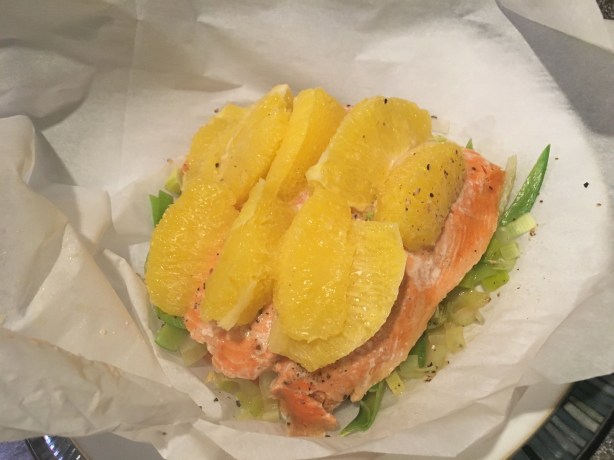
Place the wedges of a small peeled orange on top of the fish and sprinkle the whole mound with a “wee shot” of vermouth.

Fold the parchment over the fish, creasing the edge at the top of the heart, and folding the edge up. Go halfway down the length of the fold, make a crease, and fold again, sort of like sealing a calzone. Continue creasing and folding all the way around the heart, twisting the parchment tip and folding it under.

IMG_5700

Parchment folded over fish and sealed by creasing/folding all the way around.

Place the whole packet in the microwave and cook on high for 4 minutes, or cook for 12 minutes in a 425-degree oven. Since there were two of eating Alton’s salmon packets, I opted, for comparison’s sake, to cook one packet in the microwave and the other in the oven. My microwaved fish was moist and flaking easily after 4 minutes, but my oven fish needed several more minutes to be cooked.

IMG_5703

Fish after cooking in the microwave.

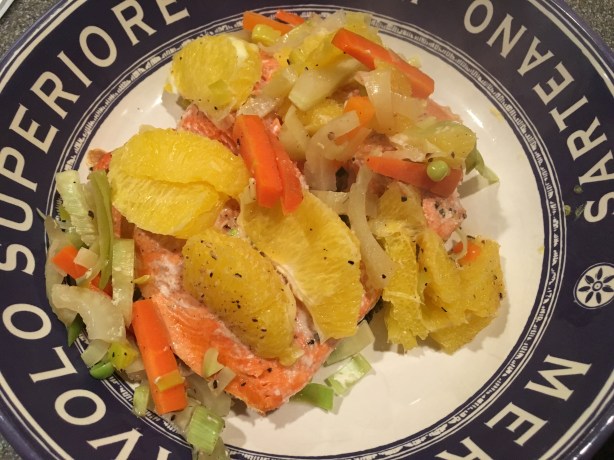
I found this to be a successful recipe, resulting (in the microwave case) in nicely cooked fish. The orange wedges paired nicely with the fish and contributed a lot of moisture, and the whole dish had just a hint of vermouth.

IMG_5711

Salmon en papillote with oranges and vegetables.

Once again, this was a nice one-packet meal, as each packet included the fish and accompanying veggies. Plus, you can have this on the table in less than 30 minutes and it is healthy.

Ramen Shrimp Pouch

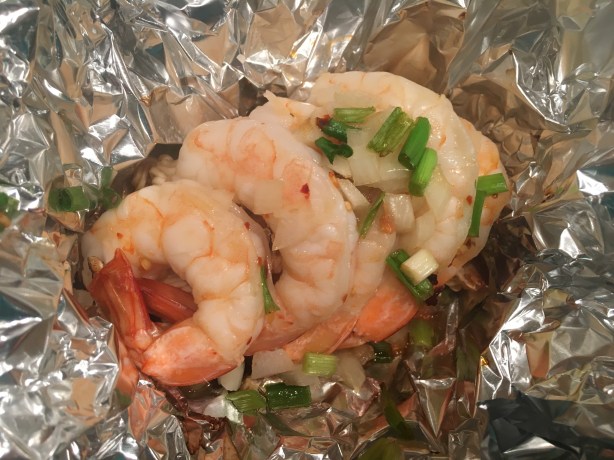
The third recipe in Alton’s series of pouch recipes is for shrimp lovers and is definitely a quickie that could be prepped any day of the week. As with the salmon pouches above, you can make as few or as many of these packets as you need to suit your number of diners. To make this one, preheat the oven to 400 degrees and lay out a large square of foil for each diner. On the center of each foil square, layer in this order:  1/2 of a block of noodles from a ramen package, 2 T chopped dried mushrooms, 5 large shrimp that have been peeled and deveined, 2 T chopped onions, 2 T chopped scallions, a pinch of red pepper flakes, and a pinch of Kosher salt.

Ball the foil up around the top of the shrimp, leaving a small opening at the top. Use the opening in each foil packet to pour in 1 T vegetable broth, 1 T mirin, 2 t soy sauce, and 1 t sesame oil.

Crimp the foil closed tightly, leaving a tiny steam porthole in the top of each packet. Place the packets in the preheated oven for 15 minutes; you may want to place them on a baking sheet, just in case they leak.

IMG_5647

Shrimp packets in the oven.

IMG_5649

Shrimp packet after 15 minutes in the oven.

Though I am not a shrimp lover, I thought this was a very clever and tasty dish. The shrimp were perfectly cooked after 15 minutes and you could taste all of the flavors in the pouch. I will say that some of my noodles were a bit chewy, so I would suggest breaking the noodles up slightly before putting them on the foil, and maybe adding a bit more liquid directly over the noodles. With a little tweaking, I think this could be an outstanding weeknight shrimp recipe.

Stone Fruit Pouches

Alton finished up his pouch cookery with a dessert. For each person eating, lay out a large double layer square of foil. In the center of each square, place 1/2 C crumbled gingersnaps, 1 quartered plum, 1 sliced apricot (8 pieces), 2 t sugar, 1 t lime zest, a pinch of Kosher salt, and 1 T cubed butter. I had no choice but to adapt this recipe a little bit, as it was certainly not stone fruit season when I made them. I opted to use mango and quince in my pouches.

Fold up the foil, leaving an opening at the top, and pour in the juice of half a lime and a shot of brandy.

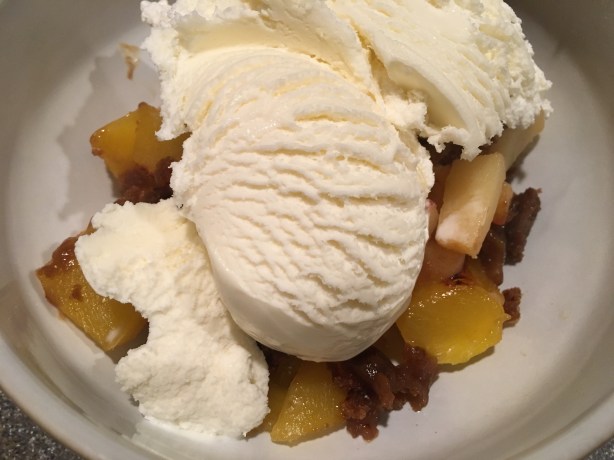
Seal up the packets, leaving a tiny porthole. These packets can be cooked in a 500-degree oven or on a grill. If using a grill, they should be done in 10 minutes, or after 15-20 minutes in the oven. Serve the warm fruit with vanilla ice cream.

IMG_5733

Warm fruit served with vanilla ice cream.

The gingersnaps almost caramelize, the fruit softens, and you taste hints of lime and brandy. I bet these pouches would be good with peaches or pineapple too, and they would make for a super easy prep-ahead dessert during grilling season. Yes, this is one to keep in your back pocket.

If last episode of Good Eats was all about cake, I suppose it is only fitting that this episode dealt with icing. Alton made the point that store-bought cake mixes are generally quite good, and, in fact, they are sometimes better than the cakes we can make at home. For this reason, a cake mix was used in this episode, and Alton used it to make two round layers. Once his cakes were baked, it was onto the icing.

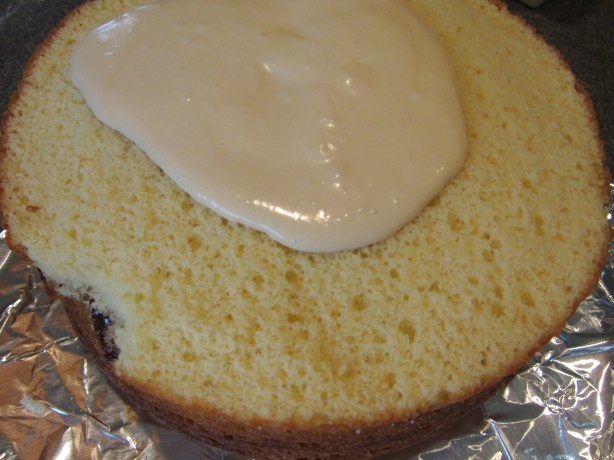
IMG_6383

One of my two cake mix layers.

Buttercream

First up, Alton made his version of buttercream. To make this recipe, you will need to have 10 ounces of softened butter, so you will need to set your butter out in advance. In a small saucepan, combine 1/2 C sugar and 1/2 C dark corn syrup, bringing this mixture to a boil over high heat. When your sugar syrup has large bubbles, turn off the heat and set the syrup aside for a few minutes.

While the syrup cools, beat 4 eggs with a whisk attachment until they are thick and have lightened in color.

It is ideal to use a metal turkey baster to add the hot syrup to the eggs, as you can drizzle the syrup into the edge of the mixing bowl, avoiding the whisk (the syrup will solidify upon hitting the whisk). You will, however, want to oil your baster first by drawing vegetable oil into the baster, and then pushing it out again. Using your lubed baster, and with the mixer running on low speed, drizzle the hot syrup into the eggs, trying to get it in the space between the bowl and the whisk.

Continue this process until all of the syrup has been added. When all of the syrup is in, increase the speed to high and beat until the side of the bowl is warm, but not hot, to the touch; this should take about two minutes.

IMG_6424

Buttercream after adding all of the syrup.

Next, piece by piece, slowly add your softened butter, only adding a new piece of butter when the previous piece has been completely mixed in. Your resulting buttercream should be smooth, creamy, and thick enough to frost a cake. The key word here is “should.” Mine was not. My buttercream had turned into sort of a broken soup at this point.

I attempted to save my buttercream by first heating it on the stove to get the tiny lumps of butter incorporated.

I then tried beating it again, and it was smoother, but it still was not thickening properly.

IMG_6453

Beating the buttercream again.

I decided to try chilling it and beating it again, which resulted in a slightly thicker consistency, but it still was inadequate. My last hope was to try chilling it even longer, but this still did not solve the problem.

IMG_6455

Beating the buttercream after chilling.

After working on this buttercream for a couple hours, I finally pulled the plug. My buttercream tasted fantastic – rich, buttery, and sweet, but it just was too runny. I did use it for a pseudo crumb coat on my cake, but it just did not work well. Oh, and did I mention that while I was having my buttercream fiasco, my dog decided to sample my cake? Yep, he took a bite right out of the side.

IMG_6456

Using the buttercream for a crumb coat.

I have successfully made buttercream in the past, using a sugar syrup. The recipes I have had success with in the past have all used a candy thermometer and specific temperatures for the syrup. I wonder if my syrup was not hot enough, or if I did not add it quickly enough. I also wonder if my butter was too soft. After reading the online reviews of this recipe, I see that I was not the only person to struggle with this particular recipe. Honestly, I wouldn’t bother with this recipe again, as I know that there are other buttercream recipes out there that work, while this one did not for me. When all was said and done, I wound up frosting my cake with store-bought buttercream, which is just not the same.

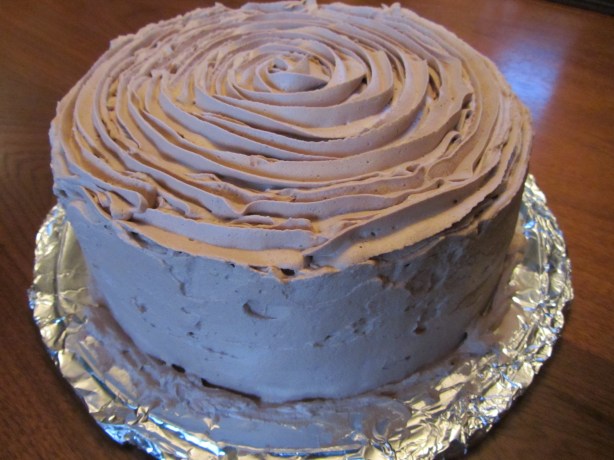
IMG_6460

Giving in and frosting my cake with store-bought buttercream.

Oh, but if you choose to make this buttercream and it works for you, you do also have the option of adding flavor. For chocolate buttercream, melt 4 ounces of chopped dark chocolate, letting it cool for a few minutes. Add the melted chocolate to the finished buttercream. For coffee buttercream, dissolve 1 t of instant espresso in 2 t coffee liqueur. Or, you can add any extract or food coloring of your choosing. Store buttercream in an airtight container with an additional layer of plastic wrap. If you make the buttercream in advance, bring it to room temperature and re-whip it before frosting your cake.

Ganache

For his cake, Alton opted to make a ganache to use as a filling between cake layers. To make the ganache, heat 6 ounces of heavy cream with 3 T corn syrup in a small saucepan.

Add 12 ounces of chopped dark chocolate and stir until the chocolate is melted and smooth.

IMG_6391

Chopped dark chocolate.

Remove the pan from the heat and add 1/2 t vanilla extract.

IMG_6395

Ganache after chocolate was melted and smooth. Adding vanilla off the heat.

Let the ganache cool before using. Spread the ganache between cake layers, using a spatula to spread it almost to the cake edge.

Unlike the buttercream, this ganache recipe was super fast and easy, and it tasted great. I typically use a regular frosting between cake layers, rather than a filling, but I really liked the contrast of dark chocolate between layers. And, if you refrigerate your cake, the ganache becomes fudge-like and dense, adding a level of richness. Oh, and my suggestion if you happen to have leftover ganache is to refrigerate it until set. You can form balls with the firm ganache, rolling them in cocoa powder or powdered sugar to form truffles. Or, you can just eat it with a spoon like I did.

Writing Chocolate

A recipe for writing chocolate was last in this episode. For this one, combine 1 C chocolate chips and 2 t canola oil in a microwave-safe container, stirring to coat the chips with the oil.

Microwave the chocolate for one minute on high. Stir the chocolate until it is completely smooth. For decorating, transfer the chocolate to a piping bag or a plastic bottle.

This recipe also worked very well and was super easy. It is certainly an easy way to add some writing to a cake. It tastes much better than the artificial writing icing you can buy in the store too.

Cake Assembly

Though not a recipe per se, Alton did go over some of his cake assembly/decorating basics.

  1. He opts for a lazy susan for cake decorating, placing it on top of an upturned cake pan.
  2. To level his cakes, Alton uses two wooden yard pickets, placed on their sides in a V-shape. He places his cake inside the V and slices along the top of the pickets with a bow saw blade.
  3. He also uses the pickets for splitting cake layers, turning them onto their shorter sides. Again, using a bow saw blade, he slices across the top of the pickets, slicing the cake into two layers.
  4. When frosting a cake, place the layers in the following order from base to top:  bottom of cake 1, top of cake 1, top of cake 2, and bottom of cake 2.
  5. When you have the filling between your layers, first frost the cake with a thin crumb coat of icing (about 1/4 of your icing) and refrigerate. This crumb coat will make it easier to apply a smooth layer of icing.
  6. When frosting a cake, apply more icing than you think you need to the top of the cake. Spread the icing, working out to the edges and down the sides. It is always better to remove excess icing than to add more.

Gold Cake

Cake is one of my very favorite desserts, and I would probably choose it over pie most of the time. The star of this episode is a gold cake, which is a relative of the classic pound cake. This recipe uses cake flour because of its low protein content, which results in a cake that is more tender. Alton also explained that he often prefers to use butter-flavored shortening when baking, as he thinks it gives more of a buttery flavor to baked goods than does actual butter. You can swap shortening for butter in any baking recipe, but you will need to make a couple of modifications because shortening is 100% fat, while butter is 20% water. This means that you will need to use 20% less shortening than the amount of butter called for, and you will need to increase the liquid in your recipe by 20%. Now, on to the cake.

Before starting this recipe, weigh the empty bowl of your stand mixer, noting the weight for later. In the stand mixer bowl, beat 140 g of butter-flavored shortening on low for about a minute.

To the beaten shortening, add 300 g sugar and a pinch of Kosher salt, and beat this mixture on medium for at least four or five minutes.

Next, with the mixer running, slowly add 130 g of egg yolks (about 8 yolks).

Once the yolks are incorporated, prepare your remaining wet and dry ingredients. In one vessel, combine 180 g of milk with 1 t vanilla extract.

IMG_6210

180 g of milk with 1 t vanilla.

In a separate bowl, sift together 350 g of cake flour and 14 g of baking powder.

Alternate adding the flour and milk mixtures to the batter by adding half of the flour, half of the milk, the remaining half of the flour, and the last of the milk.

IMG_6235

The final cake batter.

Once you have a smooth batter, again weigh your mixing bowl. Subtract the empty bowl weight you took earlier from the weight of the bowl+batter, and divide this number in half; you now have the weight of batter you should have in each cake pan for baking. Using this number, divide the batter evenly between two greased/floured 9-inch cake pans (my batter weighed 1070 g, so I allotted ~535 g per pan).

Bake the cakes in the top third of a 350-degree oven.

IMG_6239

Cakes in the top 1/3 of a 350-degree oven.

Check the cakes after 12 minutes of baking, rotating them if one cake is browning more than the other. The cakes are done when a toothpick inserted in the center of the cakes comes out clean, which took about 30 minutes for my cakes. Let the cakes cool in their pans (on racks) for 10-15 minutes.

IMG_6240

Cakes after baking until a toothpick came out clean – about 30 minutes.

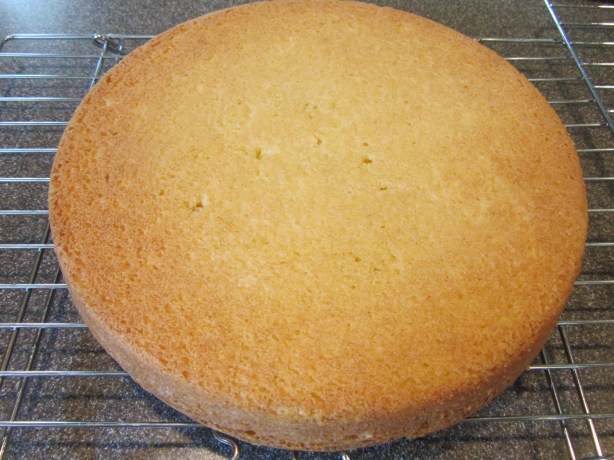
Remove the cakes from their pans and let them cool completely.

IMG_6246

Cake removed from pan.

Now, you could eat these cakes plain, or with whipped cream and fruit, but I did what Alton did and frosted them with his cocoa whipped cream (recipe below).

Cocoa Whipped Cream

To go with his gold cake, Alton made this cocoa whipped cream. You will want to make the cream once your cakes are completely cool. While your cakes finish cooling, chill the mixing bowl and whisk attachment of your stand mixer by placing them in the refrigerator. When the cakes have sufficiently cooled, place 2 T of cold water in a small saucepan and sprinkle 1 t gelatin over the water’s surface; set aside for 5 minutes.

Place the saucepan over low heat, just until the gelatin has melted.

IMG_6257

Gelatin, heated until just melted.

Meanwhile, in your cold mixing bowl, beat on low 2 C whipping cream, 1 t vanilla, and 1/2 C cocoa mix (you could probably use any cocoa mix, but Alton used his Good Eats mix, of which I still had some).

Slowly drizzle the melted gelatin into the cocoa/cream mixture and increase the speed.

IMG_6260

Cocoa mixture after all of the gelatin was added.

Beat the cream until it forms medium peaks.

IMG_6263

The final cocoa cream, beaten until it had medium peaks.

Use the whipped cream to frost Alton’s gold cake, or any other two-layer cake.

We thought Alton’s gold cake and cocoa whipped cream paired nicely together. The cake is a bit of a dry, crumbly cake, but has nice buttery flavor.IMG_6269 The cocoa whipped cream is a nice alternative to traditional frosting, having a light, airy texture and being less sweet than many frostings, but it also necessitates refrigerating your cake.

IMG_6272

A slice of Alton’s gold cake with cocoa whipped cream.

All in all, I would be more likely to make the cocoa whipped cream again over the cake. The cake had good flavor, but was just a bit too dry.

Sweet or Savory Pâte à Choux

When I was in elementary school, a different kid in my class was tasked with bringing snacks for the class each week. No-bake cookies with chocolate and oats were in regular rotation because they were easy to make and most of the kids liked them. My mom usually sent me with cupcakes or other (baked) cookies. One girl’s mother scored massive points with all of the kids (and probably made all the other parents feel like slouches), as she always made homemade cream puffs.

Personally, I have never made cream puffs or eclairs… until now. Baking and pastry are definitely two of my favorite things, so I eagerly whipped up a batch of Alton’s Pâte à Choux yesterday. Pâte à Choux is a pastry dough that is designed to make pastries that can be filled; therefore, when you bake the dough, it is supposed to only form one or two large bubbles, as opposed to the numerous bubbles desired in certain breads and such. In order to create these large bubbles in the pastry, steam needs to be created. Bread flour, and especially bread flour for bread machines, is ideal for Pâte à Choux because it has the highest protein content of all flours, which allows it to absorb more liquid; more liquid equals more steam production. To make Alton’s Pâte à Choux, combine a cup of water and 6 T butter in a pan. If you are making savory dough, also add 1 t Kosher salt. Or, if you are making a sweet dough, as Alton did in the episode, add just a pinch of Kosher salt and 1 T sugar.

Bring this water/butter mixture to a boil over high heat. Meanwhile, weigh out  5 3/4 ounces of bread flour. I did not have bread flour for bread machines, so just used bread flour.

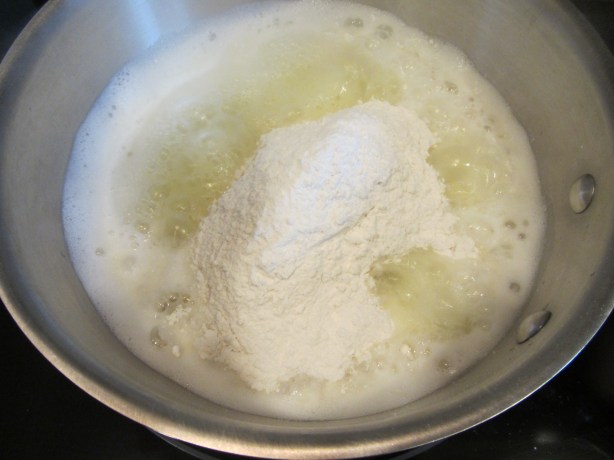
When the butter has completely melted and your liquid is boiling, add all of the flour, at once, to the pan.

IMG_5968

Flour added to boiling butter/water.

Stir the flour into the liquid with a spatula until a paste forms. Decrease the heat to low and continue to stir the dough until all of the flour is incorporated and the dough is no longer sticky. Turn off the heat and transfer the dough to the bowl of a standing mixer, setting it aside until it is cool enough to touch.

While the dough cools, place four eggs and two egg whites in a measuring cup; the egg yolks will act as an emulsifier in the dough, while the whites will give the dough structure.

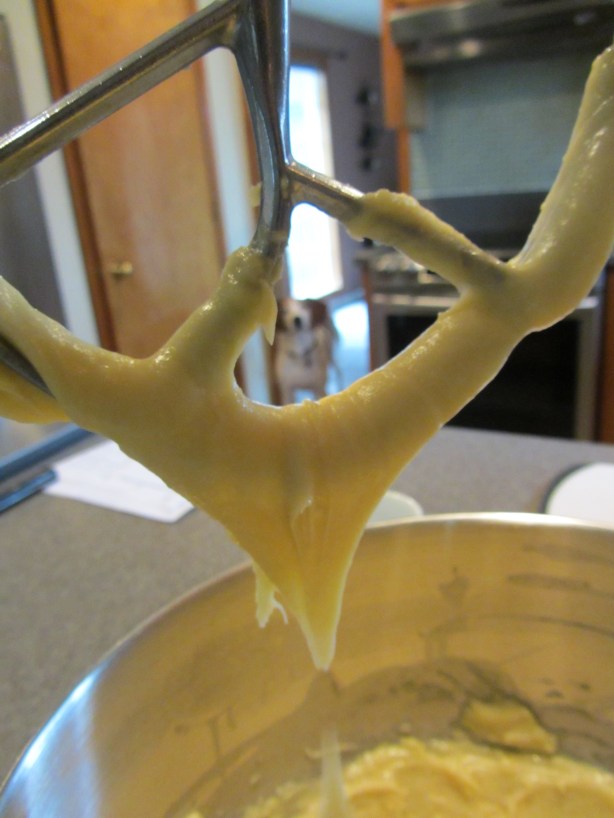
When the dough has sufficiently cooled, slowly add the eggs to the dough, keeping the mixer running. You want to continue adding egg until the dough hangs from the paddle attachment in a ‘V’ shape; for me, this required all of my eggs.

IMG_5978

Dough after adding all of the eggs. A perfect ‘V’ shape off of the paddle.

At this point, you can use your dough immediately, or you can let it rest at room temperature for a couple hours before using. When you are ready to use your dough, prepare a piping bag with a piping tip; Alton did not specify which tip to use, but I used one that was about 3/8″ in diameter and it worked fine. Large Ziploc bags work well for piping too – just snip off one corner, insert the inside part of the coupler, place your desired tip on top, and screw on the coupler ring.

IMG_5966

Ziploc bag turned into piping bag.

Preheat your oven to 375 degrees and line a sheet pan with parchment paper. If your parchment is sliding around, you can pipe a dollop of dough on each corner of your sheet pan, pressing the parchment down in the dough to keep it from sliding.

To make eclairs, pipe the dough into ‘S’ shapes, with the tail of each ‘S’ facing up toward you. With a wet finger, pat down the tails.

Alternatively, you can make cream puffs by piping the dough in concentric circle patterns, finishing in the center. Again, pat down any points with a wet finger.

IMG_5985

Dough, piped into concentric circles for cream puffs.

Place the eclairs (or cream puffs) in the center of the oven, increasing the temperature to 425 degrees, and setting the timer for 15 minutes. After 15 minutes, decrease the oven temperature to 350 degrees, and bake the eclairs for an additional 10 minutes. As soon as your eclairs/cream puffs are cool enough to handle, pierce them with a sharp paring knife to release excess steam.

IMG_5988

Piercing a hot eclair to release steam.

Cool the pastries completely.

At this point, you can bag and freeze the pastry shells for up to a month, bag and store them at room temperature for a week, or you can fill them with a filling of your choice. To do as Alton did in this episode of Good Eats, make vanilla pudding, using only 3/4 of the recommended liquid.

Then, using a small star tip and a piping bag, poke a hole in each eclair/cream puff, filling them with the pudding until the pudding starts to come out the end. Chill the filled pastries.

To bedazzle your eclairs/cream puffs with chocolate, melt 1 C chocolate chips with 1 t vegetable oil in a double boiler. Dip each pastry into the chocolate mixture. Or, you can pour your chocolate into a squeeze bottle and decorate them that way. I opted for the dipping method.

If you do not plan to eat your eclairs right away, keep them refrigerated. I made a mixture of eclairs and cream puffs, ending up with 17 eclairs and 6 cream puffs. I stuck most of my pastries in the freezer for later use, but filled several yesterday.

IMG_6003

Chocolate dipped eclairs.

I have to say that this is a great recipe. Not only are these delicious, but they are really super easy. My pastries turned out light, airy, and slightly crispy on the outside. The pastry itself was barely sweetened and each pastry had a perfect cavity inside for filling. The vanilla pudding was a super easy filling option, and the chocolate set up into a slightly crispy shell. This one is a keeper. For a different option, you could make ice cream sandwiches with cream puffs, splitting them in half. Or, you could make Alton’s savory Pâte à Choux, filling split puffs with a savory salad.

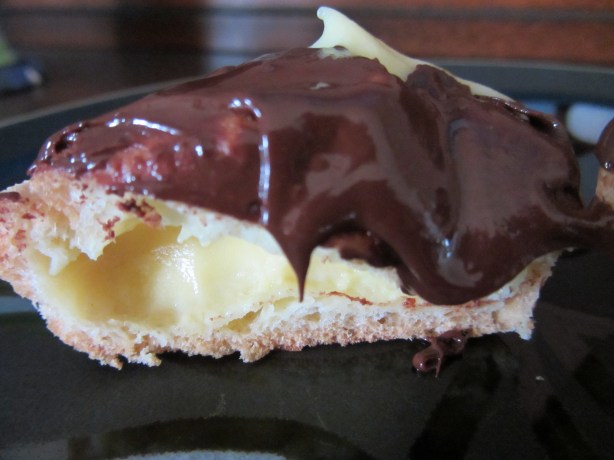
IMG_6007

A cream puff, cut in half.

Funnel Cake

So, what else can you do with Pâte à Choux? Well, you always opt for funnel cake! To make this classic carnival/fair favorite, heat ~1 inch of vegetable oil to 375 degrees.

IMG_6011

Oil, heating to 375 degrees.

Using a #12 piping tip, pipe Pâte à Choux into the hot oil in a circular pattern. Cook the pastry until it is golden brown, flip it over, and cook until the second side is golden.

Remove the pastries to a rack over a sheet pan and dust them liberally with powdered sugar.

My funnel “cakes” turned out more like funnel “straws,” but they were still quite delicious.IMG_6018 I found that the pastry was too thick for the #12 tip, though I had set my dough aside for a while. Still, my pastries were like eating little fried pillows with powdered sugar. These were definitely tasty, though not as pretty as they should be.

I am taking some liberties here and doing this special out of order, as this special episode was really the 7th one to air, but I’m writing it up as my third special. We wound up hosting Thanksgiving at our house this year, and the recipes from this episode composed a large portion of our Thanksgiving menu. Yes, I know Thanksgiving was quite a while ago, but it seems we’ve had non-stop things going on for the last several weeks. The premise of this special is that Alton intends to give you a solid, stress-free Thanksgiving menu, much of which can be prepared in advance. In the episode, he breaks down exactly when you need to complete each step of each recipe, so everything winds up on the table at the same time. I was slightly skeptical as to how well his schedule would actually work when put to the test. Without further ado, here are the recipes from Alton’s second Thanksgiving-specific special, along with his Thanksgiving schedule.

Butterflied, Dry Brined Roasted Turkey 

In the online recipe, the turkey and panzanella are written as one, but really you will begin prepping the turkey and two other menu items before you begin the panzanella, which I will write up separately below. Note that, for this recipe, you will need to have your bird thawed four days in advance. The ideal bird for this recipe is a 14-pound frozen turkey, which you can thaw, wrapped, in the refrigerator; allow one day for every four pounds.
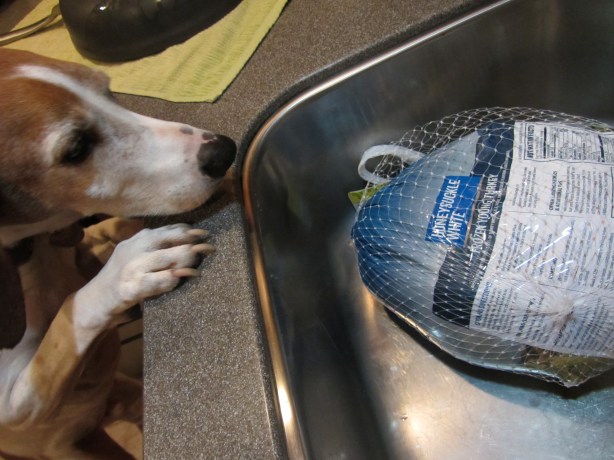
img_5514

My 14-ish pound bird.

If you really want to get fast/fancy, you can purchase a pump and thaw your turkey in a cooler next to your sink, placing the pump in the sink and covering it with cold water. Run the pump tube up into the cooler with the bird. Meanwhile, open the drain spout on the cooler, allowing it to drain into the sink. Make sure you reach equilibrium if you try this method, or you could end up with water all over the floor. If the cooler is draining too quickly, you can partially plug the hole with some foil. I opted for a third method and thawed my bird in a bucket of cold water, changing the water every couple hours, which took about eight hours. Four days prior to serving, make a dry brine by grinding 3 1/2 T Kosher salt, 1 1/2 t dry thyme, 1 1/2 t rubbed sage, 1 1/4 t black peppercorns, and 1 1/2 t allspice berries in a spice grinder.

Remove the neck and giblets from the bird, reserving them if you plan to make Alton’s gravy. Placing your turkey breast side down, use kitchen shears to cut up one side of the turkey’s backbone. Flip the bird 180-degrees and cut up the other side of the backbone, holding onto the neck. Save the bones for Alton’s gravy.

Flip your bird over, so it is breast side up and press the keel bone with the heels of your hands until it cracks and the bird flattens.

Sprinkle half of the dry brine on each side of the bird, patting it into the turkey. I know this sounds odd, but place your flattened bird, breast side up, on a parchment-lined sheet pan and let it age in your refrigerator for four days, uncovered.

The day you plan to serve your turkey, remove it from the refrigerator 3:40:00 ahead of meal time. Place the turkey in a 425-degree oven 2:05:00 ahead of serving; if you are also making Alton’s panzanella, you will place the bird directly on an upper oven rack without a pan, allowing the turkey’s juices to drip into the panzanella below. Otherwise, yeah, you will probably want to use a pan! When you have 1:35:00 to dinner, decrease the oven temperature to 350. You will want to continue cooking your turkey until it reaches 155-degrees in the deepest part of the breast. I will confess that I cooked my turkey until it was ~160 degrees.

img_5590

My completed turkey, after cooking to ~160 degrees.

Remove the turkey from the oven and let it rest under foil. My bird was done pretty much on schedule, so it had plenty of time to rest while we finished up other things.

img_5591

My completed turkey, after cooking to ~160 degrees… and a desperate dog.

Honestly, this is the easiest turkey you will ever make and it takes so little time. Also, we could not believe how much the spices from the dry brine (isn’t that really a cure?) had permeated the meat – so much flavor! This will be the turkey I make the next time I prep one. Yes, your oven does get slightly messy, but that is worth it. This is my new favorite turkey recipe.

Bourbon Pecan Pie

Okay, so this pecan pie recipe is awesome because you can make it up to two weeks ahead of time. I actually made this for us to eat the week after Thanksgiving, as we already had enough dessert contributions for our Thanksgiving meal (including a pecan pie!). The first step for Alton’s pie is to make his spiced pecans. Oddly, he did not actually demonstrate this recipe in the episode, though he did mention that you need the spiced pecans in your pie. So, I simply followed the online recipe for the spiced pecans, making a half pound of them.
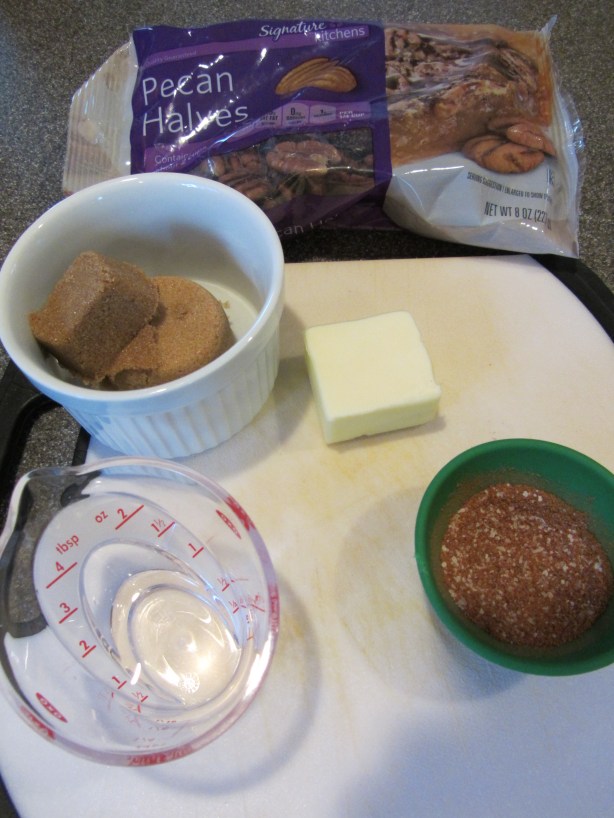
img_5614

Ingredients for spiced pecans: pecan halves, light and dark brown sugar, butter, water, and spice blend.

To make a half pound of spiced pecans, combine in a bowl 1/2 t Kosher salt, 1/4 t cumin, 1/4 t cayenne, 1/4 t cinnamon, and 1/4 t dried orange peel (I didn’t have this, so left it out).

Toast the pecan halves in a pan over medium heat until they smell toasted, and stir in 2 T butter.

Once the butter has melted, stir in the spice mixture.

img_5619

Spice mix added to buttered pecans.

Finally, add 1 T water, 1 T dark brown sugar, and 1/8 C light brown sugar. Stir until the nuts are coated evenly and spread them on a parchment-lined sheet pan to cool, breaking up any clusters.

Once your spiced pecans are complete, you are ready to make the rest of your pie, beginning, of course, with the crust. In a food processor, pulse 3 1/2 ounces plain pecan halves until fine. To your pecans add 6 oz flour, 4 T cold butter, 1/2 t Kosher salt, 2 T ice water, and 2 T bourbon, pulsing after each ingredient is added, and avoiding over-processing.

Flatten the dough into a disc and place it in a ziplock bag, refrigerating for 30 minutes.

img_5639

Dough flattened in a disc, and placed in a ziplock bag to cool.

Meanwhile, heat the oven to 350 degrees. Make the filling by melting 4 T butter. In a bowl, whisk together 3 eggs, 1/2 C sugar, 1/4 t Kosher salt, 1 t vanilla, 1 T bourbon, the 4 T of butter you melted before, and 6 ounces (by weight) of golden syrup; golden syrup can be tricky to find, so I ordered it online.

When your dough has chilled, cut the two opposing side seams of your ziplock with scissors. Open the bag and sprinkle both sides of the dough disk with flour. Cover the dough with the bag again and roll it into an 11-inch circle.

Alton recommends using a 9.5-inch fluted tart pan with a removable bottom, as you can simply place your dough circle onto the bottom of the pan, folding up the excess dough. When you place the bottom of the pan into the edges, you can simply unfold the excess dough, pressing it into the flutes. I, however, do not have a tart pan of that size, so I opted for a regular pie plate, transferring my dough circle by rolling it around a rolling pin. This dough is slightly sticky, so you do need to use flour.
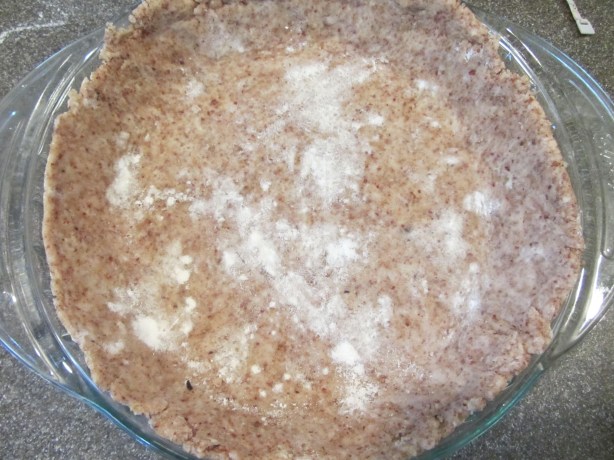
img_5652

Crust, transferred to pie plate.

Regardless of which pan you use, press the dough into the pan before adding 6 ounces of your spiced pecans, chopped. Pour the filling mixture over the pecans and jiggle the pan to evenly distribute the nuts.

Bake the pie for 20 minutes. At this time, remove your pie from the oven, placing it on a rack. Decorate the top of your pie by placing spiced pecan halves around the edge of your pie – you will need about two ounces of spiced pecans for this.

Stick your pie back in the oven and bake it until the internal temperature is 200 degrees, which Alton says should take about 10 more minutes. If your oven is like mine, however, it will take 15-20 minutes of additional baking. Remove your pie from the oven and let it cool.

img_5657

Pie after baking to internal temp of 200.

If you are making it in advance, cover your cooled pie with plastic wrap and place it in the freezer for eight hours to two weeks. When you are approaching your serving time, remove your frozen pie from its pan and slice it; you can place it back in the pan. Refrigerate your pie until ready to serve. Alton guarantees that this pie will not seep or weep, and I can vouch for that. I never froze my pie, as we simply ate it once it had cooled down. Still, unlike many pecan pies, this one had a filling that maintained its shape and form.

img_5660

A slice of Alton’s pecan pie.

To boot, we really liked the bourbon flavor in this pie, which paired well with the spices from the pecans. The golden syrup also seemed to give more of a caramelized flavor versus using corn syrup. The crust in this recipe is crispy, light, and pretty savory, which we thought contrasted greatly with the super sweet filling. I will make this pecan pie again for sure, as it is probably the best pecan pie I have had.

Whipped Potatoes

Thanksgiving just wouldn’t be complete without some form of potato, right? This special episode featured Alton’s recipe for whipped potatoes. Like the other recipes in this episode, this is one for which much of the prep can be completed in advance. A full 24 hours ahead of serving time, you will want to peel four pounds of Yukon Gold potatoes, and slice them as thinly as possible; a mandolin makes this much faster, if you have one.

Place the potato slices in an 8-quart container, covering them with a gallon of cold water. Let the potato slices sit overnight, allowing the water to remove any excess starch.

You will not need to touch your potatoes again until 1:30:00 before serving time, which is when you will place your potatoes into a strainer (resist the urge to dump the potatoes into the strainer, as you want to avoid transferring all of that starchy water). Rinse your potato slices with clean water and spin them in a salad spinner to dry.

Transfer the potatoes to a large pot, covering them with a gallon of whole milk, and placing them on a burner over medium-high heat.
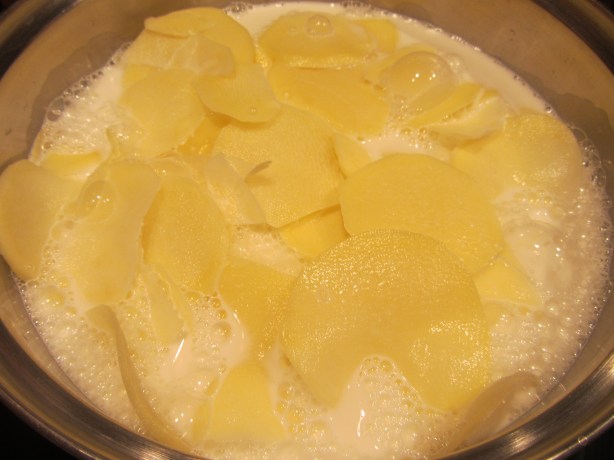
img_5580

Potatoes and a gallon of whole milk, placed on the stove.

Twenty-five minutes before your meal, drain your potatoes, reserving the milk. Press the potatoes through a ricer into your serving bowl, adding 4 ounces butter, 1 C of the reserved milk (you can use the rest of the milk for something like potato soup), and 1 T Kosher salt. Whip the potatoes with a hand mixer for 15 seconds. Yes, seriously, 15 seconds will do it. Resist the urge to blend the potatoes further, as they will become gummy. Sadly, because I was scrambling around on Thanksgiving, I forgot to take photos of my potatoes as I riced/whipped them, so I have no photos of my finished product. These potatoes seemed to be very popular around our Thanksgiving table, and I have to say that this is now my favorite mashed potato recipe. The potatoes were super light and fluffy, and had just the right amounts of butter and salt. Cooking the potatoes in milk gave them a very creamy mouthfeel and flavor. I highly recommend this recipe, and it will be the one I use when I next make mashed potatoes.

Roasted Root Vegetable Panzanella

As I mentioned above, this panzanella is designed to go along with (and cook with) Alton’s dry brined roasted turkey. While you begin prepping the turkey four days in advance, this panzanella only needs to be prepped 24 hours ahead of your dinner, so Alton covered this as the fourth recipe in the episode. So, 24 hours ahead, cut eight ounces of hearty multigrain or sourdough bread into 1/2″ cubes, leaving them on a sheet pan in a cold oven to dry out overnight.

At this time you will also want to mince two cloves of garlic, chop a red onion, and shred eight ounces of Brussels sprouts (this is super fast with the shredding blade in a food processor).

Place these prepped items into separate containers and refrigerate. Finally, peel 1 1/2 pounds each of parsnips and rutabagas, cutting them into chunks. Combine the parsnips and rutabagas in a container and place them in the refrigerator.

The following day, you will begin your panzanella when you pull your turkey out of the refrigerator, which will be 3:40:00 ahead of dinner. At this time, dump your rutabaga/parsnip combo into a large roasting pan, along with 2 t vegetable oil.

img_5570

Rutabagas and parsnips placed in roasting pan with vegetable oil.

When you place your turkey in the 425-degree oven (2:05:00 ahead), also place your roasting pan into the oven, directly beneath your turkey; this will allow the turkey’s juices to drip into the vegetables. Once you have 1:35:00 to your planned dinner time, add the diced red onion to your roasting pan, tossing, and decrease the oven to 350 degrees.

img_5575

Red onion added to roasting pan.

Forty-five minutes ahead, add your bread cubes, shredded Brussels sprouts, and garlic to your panzanella, tossing.
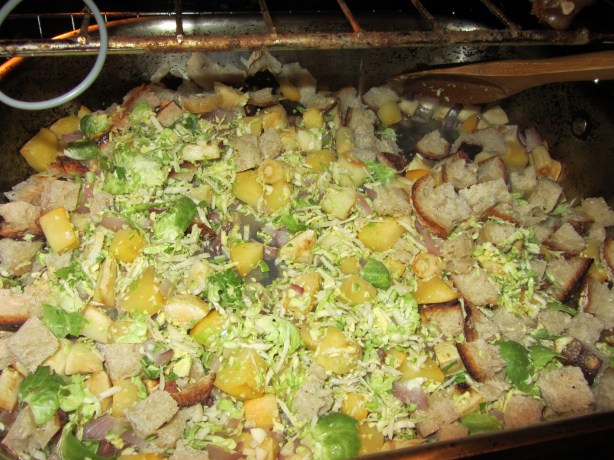
img_5588

Bread, sprouts, and garlic added to panzanella.

Thirty minutes before dinner, remove the roasting pan from the oven and add 1/4 C cider vinegar, 2 t fresh thyme, a pinch of Kosher salt, and some black pepper to the roasting pan.
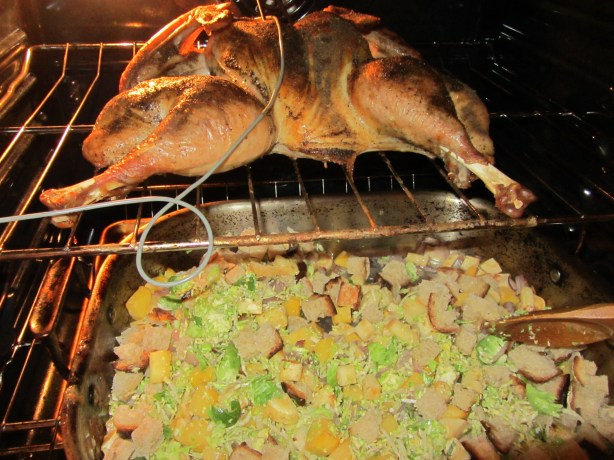
img_5589

Cider vinegar, fresh thyme, salt, and pepper added to finish panzanella.

Toss everything around and transfer the panzanella to a serving bowl. The flavors in this panzanella were fantastic, but I was highly disappointed in the texture of the bread cubes. To me, a panzanella should have super crunchy bread cubes, but this bread was kind of soggy. I do intend to make this again, but I plan to toast my bread cubes in advance, and I will add them to the salad right before serving. Aside from the bread, the sweetness of the root vegetables was great with the slight tang of vinegar and bite of garlic/onion. I’m sure the turkey juices didn’t hurt the flavor at all either! Again, this is a delicious recipe, but it does need some help in the texture department. Cooking this with the turkey makes everything super easy, which is a huge bonus.

Turkey Giblet Gravy

Last, but not least, Alton had to include a recipe for gravy in his second Thanksgiving special, no? Remember the turkey neck and backbone that we saved from prepping Alton’s turkey four days before Thanksgiving? Well, we’re going to use them here, along with the giblets. Four hours before dinner heat 1 T canola oil in a pot over medium heat, adding the turkey neck and backbone.

img_5560

Turkey neck and backbone, cooking in vegetable oil.

Brown the bones, turning them often for about 5-6 minutes.

img_5561

Turkey neck and backbone, cooking in vegetable oil, turning often.

Once the bones are browned, add the giblets, a small onion, a carrot, a stalk of celery, and a heavy pinch of Kosher salt to the pan.

img_5563

Onion, carrot, giblets, celery, and Kosher salt added to bones.

Cook all of the vegetables until they are tender, which should take about five minutes. Next, add 1 t black peppercorns, 1 bay leaf, 1 sprig of fresh rosemary, 2 sprigs of fresh thyme, and 6 C of water.

img_5565

Peppercorns, bay leaf, fresh rosemary, fresh thyme, and water added to make stock.

Cover the pot, bringing it to a boil. Once boiling, remove the lid and decrease the heat, leaving the pot to simmer for 1 1/2 hours.
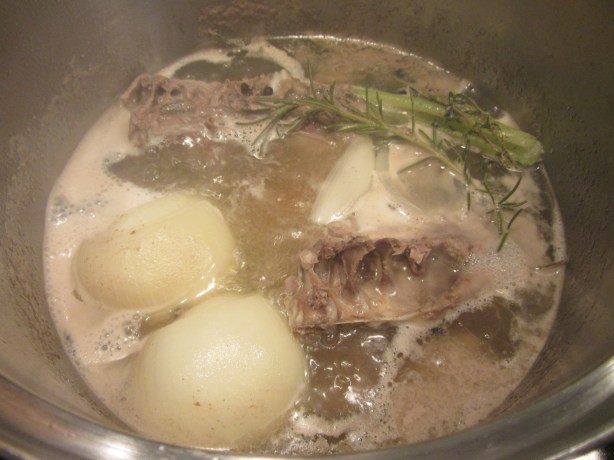
img_5566

Stock, after being brought to a boil.

Two hours prior to dinner, strain the stock, saving the giblets. You can discard the rest of the solids.

Once the giblets are cool, chop them finely. When you have 1:30:00 to dinner, pour 2 C of your stock into a saucier over medium heat. At this same time, pour 1/2 C of additional stock into a lidded container, along with 1 T flour, shaking to make a slurry.

Slowly whisk this slurry into the warm stock in the saucier.

Again, in your shaking container, combine another 1/2 C of cooled stock with 1 T potato starch, shaking.

Turn the burner off under your pan and allow your gravy to cool to below 190 degrees. Once below 190 degrees (which should be about 1:20:00 before your meal), turn the heat to low and whisk in the potato slurry. I had some trouble with this, as my slurry appeared to be quite lumpy, so I had to add some additional hot stock and re-shake my slurry. Once your slurry is incorporated, also add 1 t chopped fresh sage, 1 t fresh thyme, 1 t fresh rosemary, 1 t Kosher salt, and 1/4 t pepper.
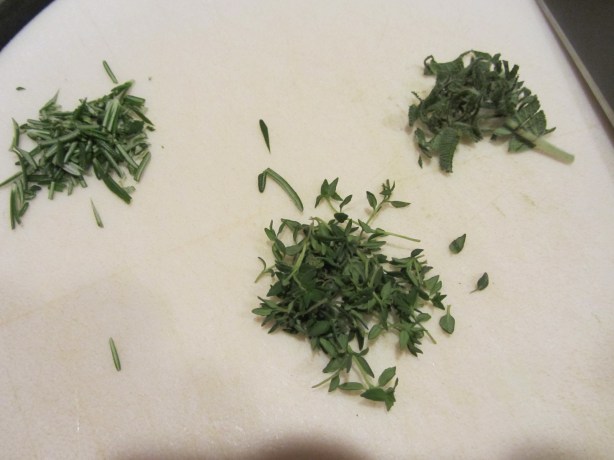
img_5587

Fresh rosemary, thyme, and sage to finish gravy, along with chopped giblets.

When your gravy has reached a simmer, stir in the chopped giblets and turn off the heat. When heated through, you can transfer your gravy to a thermos to keep it warm until you are ready to serve. I failed to get a final photo of my gravy, unfortunately. I am not a huge gravy person, but this one got some rave reviews at our house. The gravy seemed like it was going to be way too thin, but it did thicken up some. Flavor-wise, the gravy fans here really seemed to enjoy it.

So, to sum up Alton’s second Thanksgiving special, I have to say that I was quite pleased with all of the recipes, how they worked together, and his timeline was pretty spot on. If you follow his directions, you can have a pretty stress-free, well-timed Thanksgiving dinner with his five recipes here. While all of the recipes were honestly very good, I would absolutely not skip the turkey, potatoes, or pie. Below is a breakdown of my Thanksgiving Day Alton-based schedule, aiming for a 5:00 pm dinner. Honestly, it worked pretty darn well, and we were seated right around 5 o’clock.

1:00 PM – Start gravy stock.

1:20 PM – 1) Bird out of refrigerator. 2) Rutabagas and parsnips in roasting pan.

2:55 PM – Bird and vegetables in oven at 425 degrees.

3:00 PM – Strain gravy stock and cool giblets.

3:25 PM – 1) Add red onion to vegetables. 2) Decrease oven temp to 350.

3:30 PM – 1) Strain/spin potatoes. 2) Put potatoes in pot with milk. 3) Make gravy and transfer to thermos.

4:15 PM – 1) Add bread, sprouts, and garlic to vegetables. 2) Remove bird when it hits 160.

4:30 PM – 1) Add cider vinegar and seasonings to vegetables. 2) Rice potatoes and whip.

Fresh Yogurt

Yogurt is one of those things that I always feel I should eat more of than I do. I tend to go in spurts with yogurt, eating it frequently for a while, and then not at all. Alton’s yogurt episode began with homemade yogurt. I made homemade yogurt once years ago when I was in grad school, as part of my food microbiology lab course. All I really remember from that experience was that I had a lab partner from Mongolia who called himself “Woody,” I could barely understand a word he said, and our yogurt was very pink. Needless to say, I was hopeful that my Woody-less yogurt would be more successful. When making Alton’s yogurt, you can use any type of milk that you choose, but Alton opted for organic 2% milk in the episode of Good Eats. Alton did say that whole milk will result in looser yogurt, while skim milk will yield yogurt with a grainy texture. In addition to a quart of milk, you will need 1/2 C of powdered milk, 2 T honey, and 1/2 C of plain yogurt, containing live cultures.

img_5475

Ingredients for homemade yogurt: plain yogurt with live cultures, dry milk, honey, and milk.

Begin by pouring your milk into a saucepan, adding the powdered milk and honey.

Meanwhile, allow your yogurt to come to room temperature.

img_5482

Plain yogurt, being brought to room temperature.

Using a probe thermometer, heat the milk mixture to 120 degrees over medium heat. Remove the milk from the heat, and pour it into a clean cylindrical container, allowing it to cool to 115 degrees.

Once the milk has cooled, whisk about a cup of the warm milk into the yogurt.

img_5488

About 1 C of warm milk whisked into yogurt.

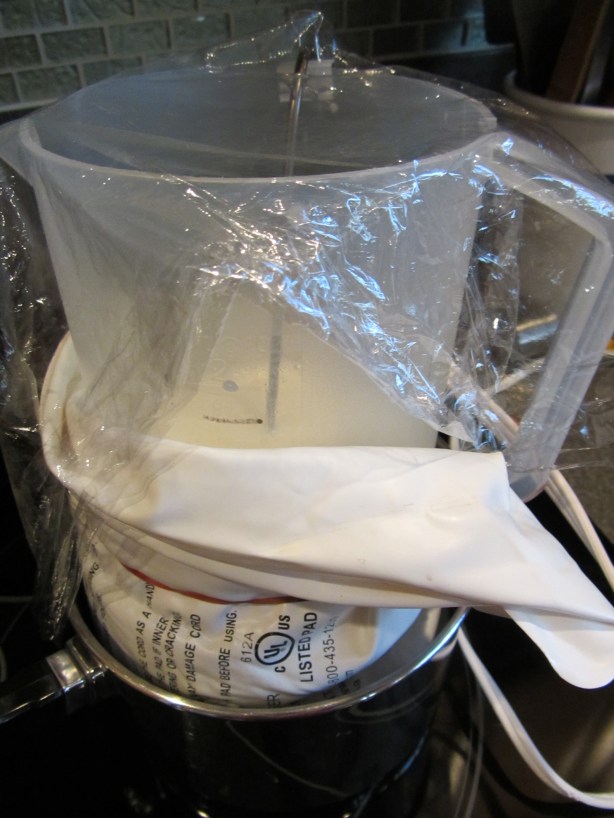
Then, whisk the yogurt/milk mixture back into the cylinder of milk. Wrap the cylinder in a heating pad that will maintain the yogurt’s temperature between 100 and 120 degrees; you can test your heating pad first by filling your cylinder with water.

img_5489

Yogurt added to milk and wrapped with heating pad to ferment for 6 hours.

Allow your yogurt to ferment for three to 12 hours, depending on how you like the texture of your yogurt; a shorter fermentation will yield looser yogurt, while a longer fermentation will give thicker yogurt. Alton did an even six hours in the episode.

img_5491

Yogurt, after fermenting for 6 hours.

Refrigerate your yogurt overnight before using.

img_5493

Alton’s homemade yogurt.

I thought this yogurt was fine, but really nothing special. If anything, I would have liked this yogurt to have had a thicker texture, so I would possibly ferment it a little longer if I were to make it again. Honestly, I wouldn’t go to the trouble of making this again when I can easily buy yogurt that I like just as much.

Thousand Island Dressing

So, really, Alton calls this dressing “Million Island Dressing” in the episode, and it is a good use for some of his homemade yogurt. To make his dressing, whisk together 1 C plain yogurt, 2 T vegetable oil, and 2 T tomato sauce.

img_5523

Yogurt, tomato sauce, and vegetable oil.

Once combined, add 2 t lemon juice, 2 t dry mustard, and 2 t sugar.

img_5525

Lemon juice, dry mustard, and sugar added to dressing.

Next, whisk in 1 t Kosher salt and 1/2 t pepper.

img_5526

Kosher salt and pepper added to dressing.

Finally, fold in 1/2 C diced onion, 1 T relish, 1 T chopped green olives, and 1 minced jalapeno.

I enjoyed this dressing more than I thought I would. It has a really good kick from the jalapeno, tang from the yogurt and lemon, and bite from the onion. It also adds a lot of texture to a salad. We actually liked this enough that I made it a couple times in one week for us to eat on our lunch salads. This is a really good salad dressing.

Tarragon Yogurt Sauce

If you are looking for another savory application for plain yogurt, this tarragon sauce is one to try. This sauce is very versatile and could be served over many things, including fish, eggs, and vegetables; in the episode, Alton says that his favorite use of this sauce is over braised carrots, so that is how I opted to use mine. For this sauce, begin by heating a saucier over medium heat, adding 2 T olive oil, 1/2 t Kosher salt, 1/2 C finely chopped onion, and 1 1/2 t minced garlic.

img_5530

Olive oil, Kosher salt, onion, and garlic in saucier.

I did not have a saucier until recently, but I inherited my parents’ copper-bottomed Calphalon saucier when my brother and I finished sorting through our parents’ belongings; thankfully, my parents are still living, but they really do not cook anymore. Yes, I have learned that a saucier is a very nice tool to have for a job such as this tarragon sauce. While your onion and garlic saute, combine 2 T cornstarch and 1 C chicken stock in a lidded container, and shake to combine. This slurry will help to thicken the sauce, and will also prevent over-coagulation of proteins, AKA curdling. Cream-based sauces have enough fat to prevent curdling, but yogurt-based sauces do not. Anyway, add the slurry to the pan, increase the heat, and add 1 1/2 T dried tarragon, whisking.

Remove the pan from the heat and temper 1 C of plain yogurt by gradually whisking in some of the sauce mixture. Finally, add the tempered yogurt to the pan, whisking.

Heat the sauce over low heat, just until warmed through. As I said before, we ate this sauce over carrots as a side dish.

The tarragon flavor in this sauce is quite strong, giving a real anise-like flavor, and you also really taste the yogurt. This is a sauce you could make with other herbs too; I think a dill version would pair terrifically with salmon. Either way, this is an easy sauce to dress up veggies or protein.

Yogurt Cheese

What is yogurt cheese? Yogurt cheese is yogurt that has been allowed to drain, removing whey. While cheese has had its whey removed, regular yogurt has not. Allowing yogurt to drain results in a thick yogurt that has a consistency similar to cream cheese. To make yogurt cheese, line a strainer with two layers of cheesecloth, setting the strainer over a bowl. Add a quart of plain yogurt to the strainer, folding the cheesecloth over the top.

img_5593

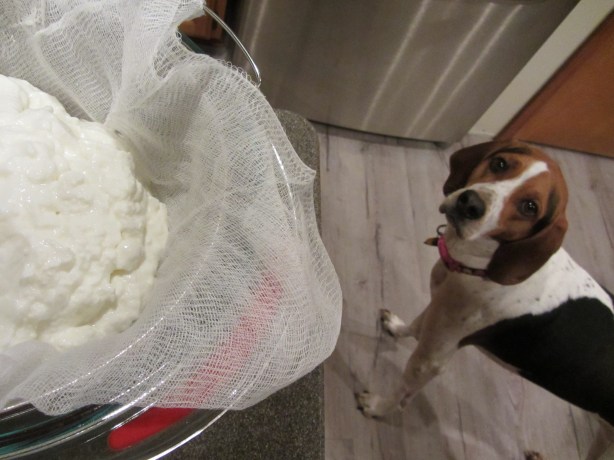
A quart of plain yogurt in a cheesecloth-lined strainer.

Weigh the yogurt down with the lid of a pot and a can, refrigerating it for four hours.

Yogurt cheese can be used plain as a spread, or in Alton’s recipe for frozen yogurt, which I will write about below. I tasted the plain yogurt cheese, but opted to use it for Alton’s other recipe; it tasted like plain yogurt… just much, much thicker.

Herb Spread

This herb spread is basically the same recipe as the one for yogurt cheese above, but with added seasonings. To a quart of plain yogurt (I used homemade) add 1 1/2 t cumin, 2 T chopped parsley, 1 t Kosher salt, and 1/2 t pepper.

img_5497

Cumin, parsley, Kosher salt, and pepper added to a quart of plain yogurt.

As with the yogurt cheese above, place a cheesecloth-lined strainer over a bowl and add the yogurt mixture.

img_5499

Seasoned yogurt poured in cheesecloth-lined strainer to drain.

Weigh the yogurt down with a pan lid and can, allowing it to drain for four hours in the refrigerator.

The resulting spread is tangy and has a punch of cumin, and it is great with crackers or on sandwiches.

img_5504

Herb spread with crackers.

Talk about an easy hors d’oeuvre, and it is even easier if you use store-purchased yogurt!

Lemon-Ginger Frozen Yogurt

This recipe is the perfect use for Alton’s yogurt cheese. Combine in a bowl 4 C plain yogurt cheese, 3/4 C sugar, 1/2 C light corn syrup, 2 t lemon zest, 1 T minced fresh ginger, and 3 T lemon juice.

Whisk the yogurt mixture until smooth and freeze in an ice cream mixture per the manufacturer’s instructions.

In the last few minutes of churning, add 1/4 C chopped crystallized ginger.

Freeze the frozen yogurt in the freezer until firm.

img_5606

Alton’s lemon-ginger frozen yogurt.

This frozen yogurt is super refreshing and reminds me of warmer weather (as I type this, it is snowy outside and the Christmas tree is illuminated). The first time we ate this frozen yogurt, the crystallized ginger seemed too chewy, but after freezing the yogurt for a longer period, the chewiness went away. I definitely foresee making this again, as it is packed with ginger and lemon flavor, and is a relatively healthy treat. This is worth making.


In Season 1 of Good Eats, chocolate was chosen as the subject of the final episode, which I wrote about here. That episode featured a couple of chocolate desserts that used chocolate chips. Again, chocolate is the star of the 63rd episode, but this time the recipes utilized cocoa powder as the source of chocolate.

Baking with cocoa powder always makes me nervous since we have two dogs. Years ago, I made a chocolate cake from scratch and placed it INSIDE a kitchen cabinet. Imagine my surprise when Ted called to tell me that he had arrived home to find that Hitcher, our male hound, had jumped onto the kitchen counter, pried open the cabinet, and eaten the chocolate cake. Thankfully, Hitcher turned out to be just fine!

Cocoa Brownies

Naturally, the first recipe Alton tackled with cocoa powder was for a classic brownie. I have always found that brownies made from scratch with cocoa powder are much richer and have more intense chocolate flavor. For baked goods, Alton recommends that you use natural process cocoa, which is redder and more bitter than Dutch process cocoa. To make his brownies, preheat your oven to 300 degrees and spray an 8″ square pan with nonstick spray. Additionally, line the pan with parchment paper, allowing the paper to hang over two opposite edges of the pan; this will allow you to easily lift the brownies from the pan. The online recipe does not mention the parchment paper, but it really is a good trick.

IMG_4769

Pan sprayed with nonstick spray and lined with parchment paper to overhang on two sides.

When your pan is set, sift together 1 1/4 C natural process cocoa, 1 C brown sugar, 1 C sugar, 1/2 C flour, & 1/2 t Kosher salt.

Next, in a stand mixer with the paddle attachment, beat 4 eggs until light.

Add the sifted dry ingredients to the eggs, gradually incorporating them until smooth.

IMG_4780

Batter after incorporating dry ingredients.

Once the batter is smooth, add 2 t vanilla extract and 8 ounces (2 sticks) of melted butter; you will want to add the butter gradually and on low speed.

Finally, scrape the bowl and pour the batter into your prepared pan.

IMG_4802

Batter in pan, and ready to go in the oven.

Bake the brownies for 45 minutes before checking with a toothpick. You will want to remove your brownies from the pan when a little bit of crumb still sticks to the toothpick, which took about 49 minutes in my oven.

IMG_4803

My brownies, after baking for about 49 minutes.

In the Good Eats episode, Alton strictly tells you to remove the brownies from the pan as soon as they come out of the oven. He also tells you to immediately cut the brownies, using a pizza cutter.

Once cut, allow the brownies to cool completely on a rack. My brownies were a little tricky to cut, so I would probably let them cool for a few minutes out of the pan before attempting to cut them. These brownies are really good if you like your brownies to be super dark and rich. Seriously, you cannot eat a lot of these. These paired very well with vanilla ice cream, which helped to cut the chocolate slightly. Personally, I like brownies to be kept in the refrigerator… but that’s just me.

IMG_4812

These brownies pair greatly with vanilla ice cream.

Cocoa Syrup

Next up in Alton’s cocoa arsenal was his take on chocolate syrup. Growing up, I was always more of a hot fudge sauce girl, while my brother was a chocolate syrup fanatic. I was curious to see if homemade chocolate syrup would convert me to more of a syrup person. For this particular recipe, you will want to try to use Dutch process cocoa, as it works better in applications with low fat content. Honestly, I looked at three stores for Dutch process cocoa and could not find it, so I made my syrup with a cocoa powder that was a blend of natural and Dutch process cocoas. To make Alton’s chocolate syrup, begin by combining 3 C sugar, and 1 1/2 C water in a pan. Bring the sugar and water to a boil and add 2 T light corn syrup; this will prevent crystallization.

IMG_4833

Sugar, water, and corn syrup being brought to a boil.

To this, slowly add 1 1/2 C cocoa powder, along with 1/4 t Kosher salt. You will want to gradually whisk the cocoa powder into the liquid, which will take a little bit of time.

IMG_4835

Salt and cocoa powder, gradually being whisked into liquid mixture.

Finally, once all of the cocoa powder is incorporated, stir in 1 T vanilla extract.

Pour the syrup into a squeeze bottle and allow it to cool to room temperature.

IMG_4838

My chocolate syrup.

If you want to reheat your syrup, place the squeeze bottle in hot water for ~10 minutes. I served this chocolate syrup in the traditional way – over vanilla ice cream, and with cake on the side.

IMG_4840

Chocolate syrup over ice cream.

I have to admit that this syrup is pretty darn good, and much better than the stuff you can buy. The chocolate flavor is much more intense, and this tastes like a much darker chocolate than store-bought syrups. I also think this syrup is a bit thicker than other chocolate syrups I have had, which I like. If you’re a chocolate syrup fan, I’d certainly give this one a try. Note that this recipe makes a lot of chocolate syrup, but you could always cut the recipe in half.

Hot Cocoa

Last but not least, no cocoa episode would be complete without a recipe for hot cocoa. To make Alton’s hot cocoa mix, into a large, lidded container place 2 C powdered sugar, 1 C Dutch process cocoa, 2 1/2 C powdered milk, 1 t salt, 2 t cornstarch, and a pinch of cayenne pepper.

Place the lid on the container and shake the mixture to thoroughly combine.

IMG_4821

The shaken/combined cocoa mix.

To serve Alton’s cocoa, fill a mug 1/3 full with Alton’s cocoa mix and add boiling water just to cover the powder.

Stir the cocoa/water mixture to create a thick slurry. Finally, top off the mug with more boiling water and stir again to combine.

We do not typically drink a lot of hot chocolate, but this was pretty good. Of course, this isn’t really the season for hot chocolate either. We both really liked the addition of the cayenne (I added a pretty hefty pinch), which made this a little different from your typical hot cocoa. We had our hot cocoa with whipped cream because really, why not?

IMG_4830

Alton’s hot cocoa, served with whipped cream, of course.

I will probably make this mix again, though I will likely wait for colder weather to make it again. I have to say, though, that I have a serious hankering for some chocolate after typing up this episode. Though the brownies are long gone, we still have homemade chocolate syrup and hot cocoa mix, one of which I will probably be tapping into shortly!