Posts Tagged ‘alton brown’

I have not been able to bring myself to write up a Good Eats episode. My dad died on March 18th, after spending three weeks in the ICU; those three weeks were a roller coaster ride, as his condition fluctuated often and rapidly. At times, we thought he would soon be leaving the hospital to head to a rehab facility, but then he would head downhill again. Finally, on March 18th, he succumbed. We received a great gift that day, as Dad was suddenly the most lucid he had been in weeks. He was able to tell us that he was ready to go and he said his goodbyes to all of us.

Needless to say, my dad’s funeral was two days ago and I am still completely devastated, as I lost one of my very best friends, and also my key life adviser. Dad and I shared many common interests, but food and Good Eats were among them. Dad always loved to chat about the recipes I was cooking for my next blog post, and he often recalled watching particular episodes with me in earlier years. Although it is emotionally tough to write a post without him here, I also know he would want me to continue my project, as he thought it was really “neat.”

Carrot Slaw

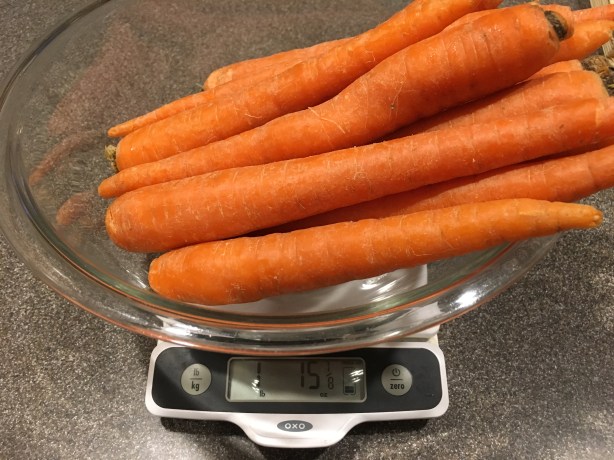
For a make-ahead side dish, try Alton’s carrot slaw. Begin by washing two pounds of carrots. If they are thicker than an inch at their bases, peel them also.
IMG_1596

Two pounds of carrots.

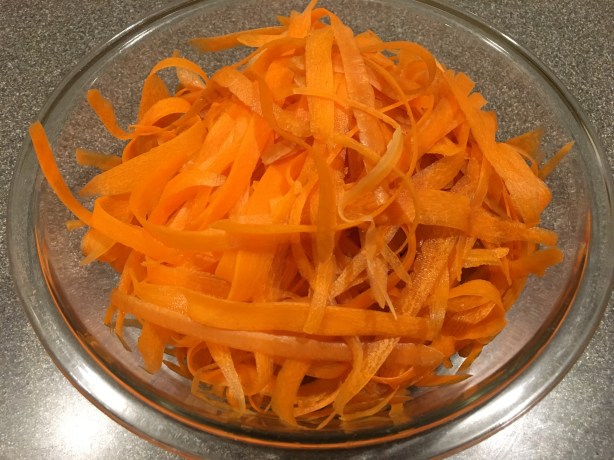
Next, use a vegetable peeler to peel the carrots into thin strips. This was quite a noisy task in my house, as our coonhounds are obsessed with carrots, and they howled for the duration of my peeling!
IMG_1597

Two pounds of carrots, peeled into ribbons.

Place the following ingredients in a lidded container that is twice the volume of your carrot strips:  1/2 C mayo, pinch of Kosher salt, 1/3 C sugar, 1/2 C drained crushed pineapple (canned), 1/2 C raisins, 2 t curry powder, a pinch of caraway and/or celery seed, and 1 t minced garlic.

Whisk these ingredients together to form a dressing.

IMG_1609

The combined dressing.

Finally, add the carrot strips, place the lid on the container, and shake the carrots until they are thoroughly coated with the dressing.

IMG_1617

Carrot slaw.

You can eat the slaw immediately or refrigerate it for up to a week. We ate this slaw as a side dish with dinner and both found it to be a flavorful vegetable option, though I felt it was a little sauce-heavy. I don’t know about you, but we tend to get in a rut with our vegetable side dishes, so this was definitely a different choice. My carrot strips were pretty long, which ended up being a bit tricky to eat (like super long noodles), so I would recommend trying to make slightly shorter carrot strips. This recipe is a mix of sweet and savory flavors, and the raw carrots maintain a slight crunch. This could be a good make-ahead option for a summer potluck.

Glazed Carrots

In this episode, Alton refers to this recipe as his all-time favorite carrot recipe. When purchasing carrots, Alton recommends buying carrots with fresh-looking green ends; be sure to trim the stems to a length of one inch once you are home, as they tend to pull moisture from the carrots. And, if you want to store carrots as Alton does, keep them wrapped in bubble wrap. I tend to just opt for plastic wrap, myself. To make glazed carrots, cut, on the bias, a pound of carrots into coins that are 1/3″ to 1/4″ thick.

Place the carrot discs in a 12-inch skillet, along with an ounce of butter, a large pinch of Kosher salt, and a cup of ginger ale.

Heat the burner to medium heat, cover the pot, and bring the liquid to a simmer. Once simmering, decrease the heat to medium-low and cook the carrots for five minutes with the lid on.

After five minutes, remove the lid, add 1/2 t chili powder, and increase the heat to high. Resist the urge to stir the carrots, though you can gently shake the pan. Continue to cook the carrots until the liquid is almost gone, which should take about five minutes.

Check the carrots with the tip of a sharp knife – they should be just knife-tender. Sprinkle the carrots with a tablespoon of chopped parsley and serve immediately.

IMG_1709

Glazed carrots.

I have to agree with Alton that these glazed carrots are delicious. This recipe comes together super quickly and is perfect for any weeknight. I highly recommend this one for a side dish.

Carrot Cake

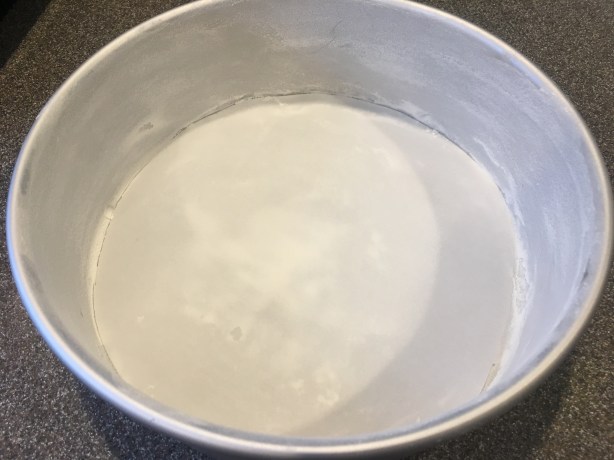
Carrot cake seems to be the most polarizing type of cake. For me, carrot cake is way up at the top of the list, so this recipe gave me a good excuse to have a few slices. To make Alton’s version of carrot cake, preheat your oven to 350 and lube the bottom and sides of a cake pan with butter. Coat the pan with flour, removing any excess, and line the bottom of the pan with a disc of parchment paper. When I watched Alton prep his pan, I recognized the pan immediately as the same one he used to make his cheesecake in episode 61.
IMG_1717

Buttered and floured pan, lined on the bottom with parchment.

Next, shred 12 ounces of carrots on the large side of a box grater and place them in a bowl. Yes, this part is a pain, but at least your arm burns some calories, so you can eat a larger slice of cake later.

Dump the following ingredients into the bowl of a food processor:  12 ounces of flour, 1 t baking powder, 1 t baking soda, 1/4 t allspice, 1/4 t  cinnamon, 1/4 t nutmeg, and 1/2 t salt. Pulse the dry ingredients until combined and add them to the carrots, tossing them until coated.

Next, combine 10 ounces of sugar, 2 ounces of dark brown sugar, 3 eggs, and 6 ounces of plain yogurt in the food processor. With the machine running, drizzle in 6 ounces of vegetable oil. Add the wet mixture to the carrots, mixing ten times with your hands.

Pour the carrot mixture into your prepared pan and bake the cake for 45 minutes.

IMG_1741

Batter poured into prepared pan.

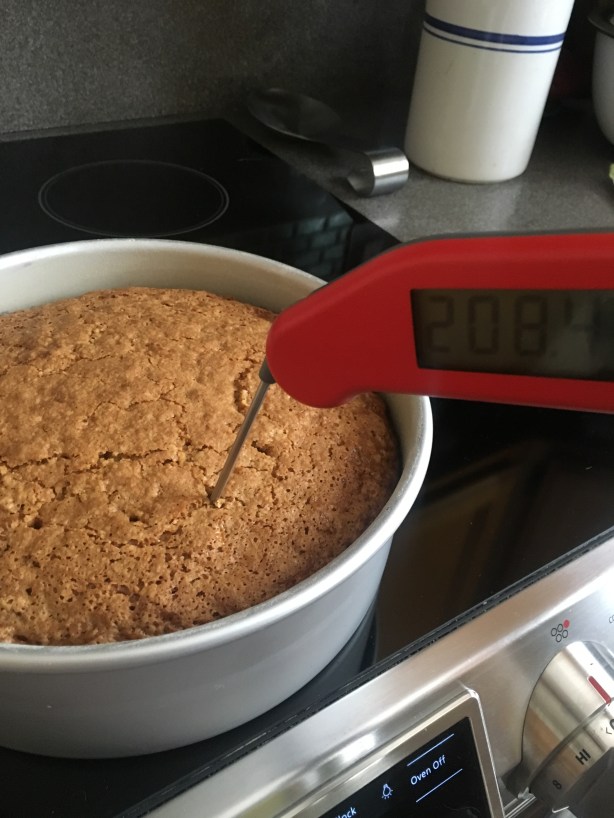
After 45 minutes, decrease the heat to 325 and bake for 20 more minutes, or until the cake has an internal temperature between 205 and 210 degrees (mine was at 208 after the initial 20 minutes). Oh, and when taking the temperature of a cake, place the thermometer half-way between the center of the cake and the rim of the pan.
IMG_1742

Cake after baking for 65 minutes.

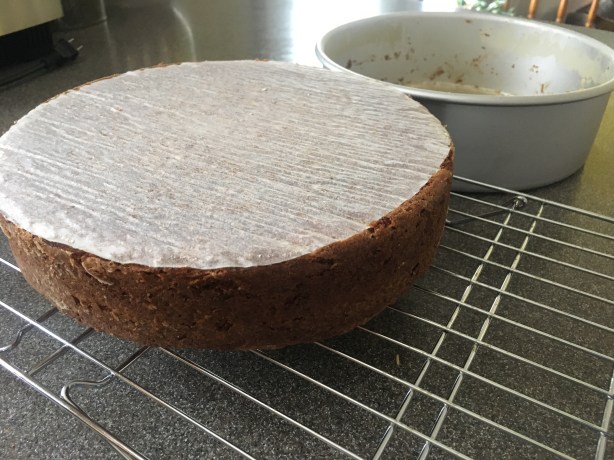
Let the cake cool completely before frosting. I let my cake cool in the pan for the first half hour, and then removed it from the pan for the remainder of the cooling process.
IMG_1745

Cake, removed from pan after 30 minutes of cooling. Allowed to cool completely on rack.

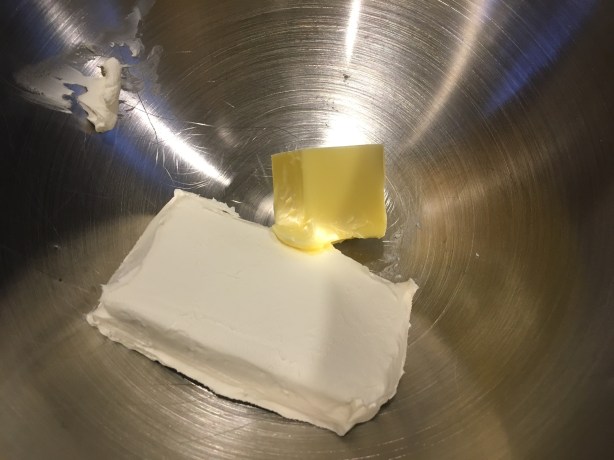
For Alton’s cream cheese frosting, combine 8 ounces of room temperature cream cheese with 2 ounces of room temperature butter.
IMG_1747

Softened cream cheese and butter in mixer.

Add 1 t vanilla and 9 ounces of sifted powdered sugar, mixing until smooth.

Chill the frosting for 5-10 minutes before using it to frost your cooled cake.
IMG_1757

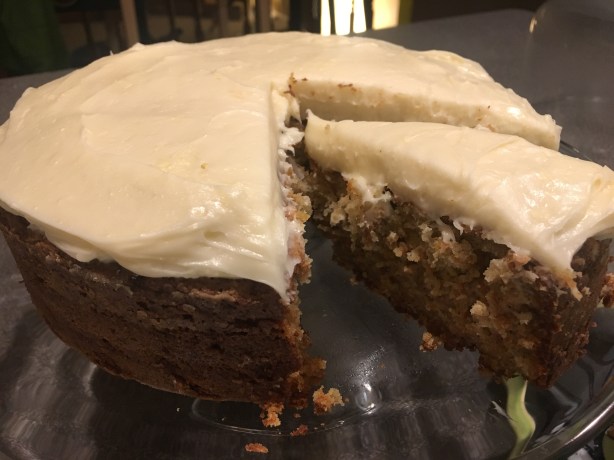
Frosted carrot cake.

IMG_1760

A slice of Alton’s carrot cake.

As I said before, I love carrot cake, and this is a simple one. I like the fact that the carrots are really the star of this cake, as there are no pineapple chunks, or walnuts, or raisins in this one. Also, since this is a one-layer cake, it is a cake that can easily be made on a busy day. Alton’s carrot cake is moist, dense, and has just the right amount of sweetness to balance with the sweeter cream cheese frosting. The frosting is smooth and creamy, and the recipe makes the perfect amount to frost the top of this carrot cake. I am actually making this cake again this weekend, as it is my dog’s 13th birthday on Sunday and he adores carrots. He will only get a tiny nibble, but we humans will eat the rest in celebration of him.
I have had a busy last few weeks and really not by any sort of choice. First, I found myself with a full week of jury duty, which saw me spending full days at the courthouse. While the experience was educational and informative, I am glad to once again have control over my schedule.

Unfortunately, right at the end of my jury service, my dad had an accident and broke eight ribs; two of the ribs were displaced and he also had a Hemothorax. Needless to say, I flew to be with him as soon as I could, and I spent six days visiting him. He is, unfortunately, still in the ICU, so I will likely be traveling to see him again shortly. I am hoping and praying for good news soon. It would be great to see him finally turn the corner. Yes, 2019 has not been kind to me thus far.
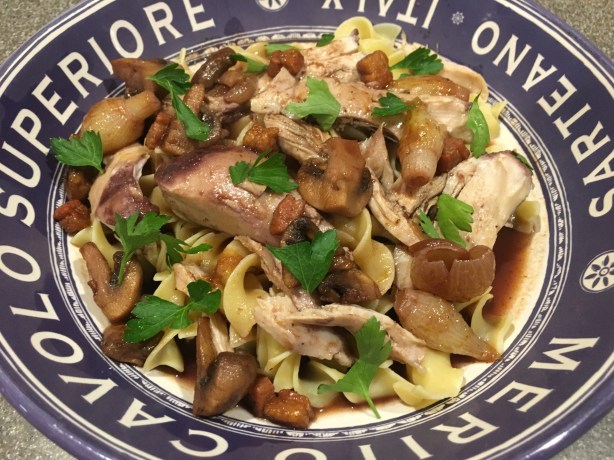
Coq au Vin

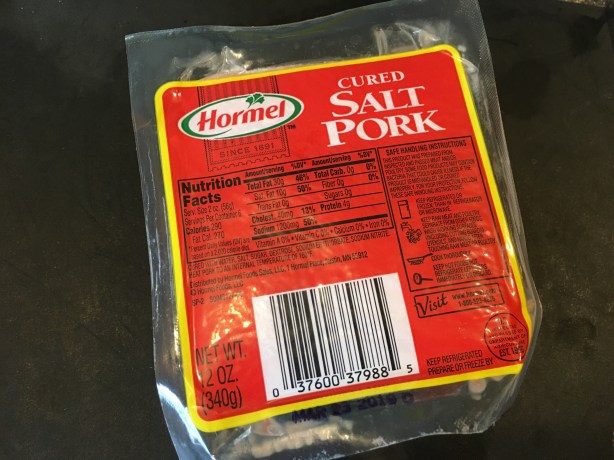
In an effort to distract myself and do something productive, I’m sitting down to write up a dish I actually prepared weeks ago:  Alton’s Coq au Vin. Coq au Vin is an old French dish that was originally composed as a means of cooking old, tough roosters (I was informed of this fact by both Alton and my dad). This dish certainly takes some time to prepare and you need to start a day ahead of eating. Salt pork is the first ingredient in this recipe, but you can substitute slab bacon if you are unable to find the salt pork. I lucked out and found salt pork at my local grocery store.

IMG_1639

Salt pork.

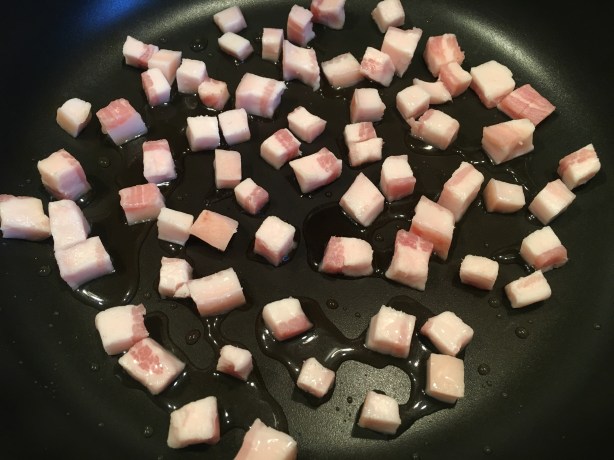
Cube six ounces of the salt pork and place it in a large skillet over medium heat, along with 2 T water. Cover the skillet and let the pork cook for 5-10 minutes.

IMG_1647

Cubed salt pork in skillet with water.

While the pork cooks, place four chicken thighs and four chicken legs on a metal rack over a sheet pan and season them liberally with Kosher salt and pepper.

IMG_1641

Chicken thighs and legs seasoned with Kosher salt and pepper.

Put 1/4 to 1/2 C flour in a large plastic bag and add a few pieces of the seasoned chicken at a time. Shake the bag to coat the chicken pieces with the flour until all of the chicken has been coated. Set the coated chicken pieces back on the wire rack and set them aside.

When the pork has darkened in color and has rendered some of its fat, remove the lid from the skillet and continue to cook the pork until it is crispy and brown.

Remove the pork from the pan and add 24-30 pearl onions to the pork fat. You will need to peel your pearl onions prior to using them; you can do this easily by cutting off the root end of each onion and cutting a deep V where the root was. Place the onions in boiling water for a minute and let them cool. Once cool, the skins should slide right off.

Cook the peeled onions in the pork fat until they are golden brown, and then remove them from the pan.

Next, add three or four chicken pieces to the skillet and cook the chicken until it is golden brown on all sides.

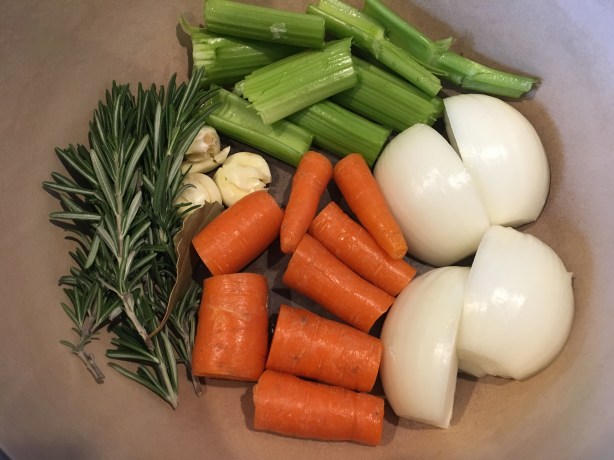
While the chicken browns, prepare a “bed” for the browned chicken by placing the following ingredients in the bottom of a Dutch oven:  two quartered ribs of celery, two quartered carrots, a quartered onion, 6-8 fresh Rosemary sprigs, three crushed garlic cloves, and one Bay leaf.

IMG_1637

Vegetable bed in Dutch oven: celery, carrot, onion, Rosemary, garlic, and a Bay leaf.

As the chicken pieces finish browning, place them on top of the vegetables in the Dutch oven.

IMG_1660

Browned chicken placed on vegetables in Dutch oven.

When all of the chicken has been browned, add 1 T butter to the skillet, along with eight ounces of quartered mushrooms. Scraping the pan, cook the mushrooms for about five minutes, or until they are golden brown.

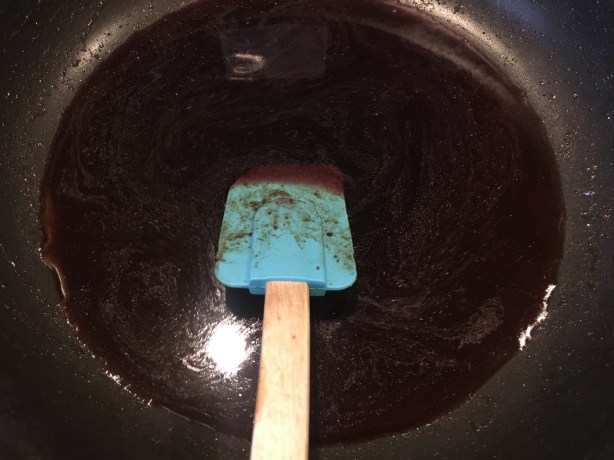
Remove the mushrooms from the pan, let them cool, and combine them in a container with the cooled pork and onions. Set the mushroom mixture in the refrigerator until the next day. Pour any excess fat out of the pan and discard it (I had very little extra fat in my pan). Remove the pan from the burner and add 1 C Pinot Noir to deglaze the pan, scraping the bottom with a spatula.

IMG_1663

Pinot Noir added to deglaze pan.

Add 2 T tomato paste to the skillet, stirring to combine, and pour the liquid over the chicken in the Dutch oven.

Finally, add 2 C chicken broth to the chicken, along with the rest of the open bottle of wine and another full bottle of Pinot Noir.

Put a lid on the Dutch oven and place it in the refrigerator overnight. The following day, place the Dutch oven in a cold oven and set the oven to heat to 325 degrees. Set a kitchen timer for two hours and check the chicken a few times to be sure it is submerged in the cooking liquid. After the two hour cooking period, remove the Dutch oven from the oven and use tongs to transfer the chicken from the Dutch oven to a packet of foil. Place the foil packet of chicken in the cooling oven to keep warm.

Strain the cooking liquid into a saucier, discarding the vegetables (or you can feed them to your dog, as Alton did in the episode).

Place the saucier over high heat and reduce the liquid by one third, which should take about 30 minutes. You can check the fluid level by placing a rubber band around a long spoon handle at the initial fluid level. When that level has dropped by 1/3, you are good to go.

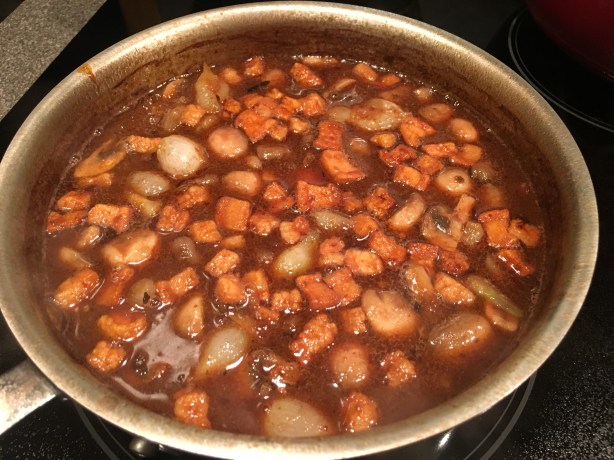
Once the sauce has reduced, add the onions, mushrooms, and salt pork to the saucier and cook for 15 more minutes.

IMG_1685

Salt pork, onions, and mushrooms added to sauce.

Serve the chicken and sauce over cooked egg noodles.

IMG_1688

Coq au Vin served over egg noodles.

This is a really delicious recipe, but it does take some effort and time. For me, it took two and a half hours of prep the first day, followed by the cooking time the second day. I would certainly consider this to be a special occasion dish simply because of the amount of prep. We did, however, get several meals out of this one recipe, so perhaps the time per meal is not much. The chicken in this dish comes out super moist and tender, and has a slight purple hue. The sauce has many layers of flavor, but is light in body. If you want a chicken dish that can serve a group and results in perfectly cooked chicken with lots of flavor, this is the one.

This episode of Good Eats is unique because Alton does not actually cook anything. Instead, this episode serves to prove or debunk five culinary myths. Through a series of kitchen experiments, Alton evaluates each myth and concludes whether each is true or false.

Myth #1 – The juices of meat are sealed in by searing.

For this myth, Alton weighed two steaks prior to cooking. The steaks were both oiled, but no salt was added, as salt pulls out liquid. One steak was seared on both sides in a hot skillet, while the other steak was not seared. The seared and unseared steaks were placed in a 400-degree oven at the same time, and a probe thermometer was placed in the center of each steak; the thermometers were set to beep when the steaks reached a temperature of 140 degrees. The seared steak reached 140 degrees faster than the unseared steak, so the seared steak was removed from the oven and allowed to rest for five minutes. After four additional minutes in the oven, the unseared steak reached 140 degrees, and was removed from the oven/allowed to rest.

After both steaks had rested, they were weighed a second time. The unseared steak lost 13% of its raw weight, while the seared steak lost 19% of its original weight. Based on these results, Alton concluded that searing does not seal in meat juices, and declared this myth to be “SMASHED.”

Myth #2 – Birds can be killed from the toxic fumes of nonstick pans.

In all honesty, Alton did not conduct any actual experiment for this myth. Instead, he simply talked about the conclusions that have been made by studies conducted on this topic. It has been found that nonstick pans release toxic fumes when they hit a temperature above 500 degrees, and especially when they are empty. These fumes can kill birds and can also cause humans to have flu-like symptoms. Alton opts to avoid all high-heat cooking in nonstick pans, including searing, frying, broiling, and even sautéing. This myth is “TRUE.”

Myth #3 – Mushrooms should not be washed because they absorb water.

The method for this experiment was to place four ounces of mushrooms in a hand sieve, which was then placed inside a glass bowl; four of these mushroom/sieve/bowl combos were set up. A liter of water was poured over the mushrooms in three of the four bowls, while the final bowl of mushrooms were left dry. The first bowl of mushrooms was allowed to sit in the water for 10 minutes before removing and draining the mushrooms. The second bowl of mushrooms was allowed to sit in the water for 20 minutes before removing and draining the mushrooms. The third bowl of mushrooms sat in the water for 30 minutes before removing and draining the mushrooms. The final bowl of mushrooms was rinsed thoroughly under running water and allowed to drain.

After all of the mushrooms were drained, the mushrooms from each sieve were weighed to analyze how much water they had absorbed. The mushrooms soaked for 10 minutes had gained 0.2 ounces of water, or about one teaspoon. The 20 minute mushrooms had gained 0.25 ounces of water, or about a teaspoon. Thirty minutes of soaking resulted in the mushrooms gaining 0.15 ounces of water, or about a teaspoon. The mushrooms rinsed under running water had gained 0.2 ounces of water, or about a teaspoon.

This experiment demonstrated that mushrooms absorb a small amount of water regardless of length of exposure to water. Since mushrooms tend to have a fair amount of grit and dirt on them, Alton concluded that he will thoroughly wash his mushrooms. This myth was “SMASHED.”

Myth #4 – Adding oil to pasta water keeps noodles from sticking together.

To test this myth, Alton added a gallon of water, 1 T of olive oil, and a pinch of Kosher salt to a pasta pot. The pot was covered and placed over high heat until the water reached a boil. Once the water was boiling, Alton added a half pound of pasta to the water, decreased the heat to medium-high, and cooked the pasta until it was al dente.

After cooking, Alton drained the pasta, allowing the liquid to drain into a long, clear tube beneath the strainer. After several minutes, the drained liquid had separated into its oil and liquid phases, with the oil rising to the top of the tube. Alton calculated the drained amount of oil to be 0.43 ounces, which was about 85% of the original tablespoon of oil added to the pasta water.

Since only 15% of the olive oil remained on the surface of the drained pasta, Alton concluded that not enough oil coated the pasta to prevent the noodles from adhering to each other. This myth was hereby “SMASHED.” Alton did, however, state that adding oil to pasta water can prevent the water from foaming by oiling the bonds of the starch released from the noodles. Or, you can just use a larger vessel with more water.

Myth #5 – Water can explode when microwaved.

The experiment for this myth involved placing a tall, narrow, glass bottle (picture a Snapple bottle) full of water in a microwave. The water was microwaved for three minutes on high power, which resulted in water spraying all over the inside of the microwave. This “explosion” of water is called spontaneous boiling, which occurs when the temperature rises above the boiling point without the formation of any bubbles. Since the inside of the glass bottle was perfectly smooth, there were no nucleation sites, which are spots where bubbles can form. In addition, the small opening of the bottle kept the water still, so when the heat energy built up within the bottle, one large bubble was formed and the water sprayed everywhere. To avoid this, when microwaving, use a container with a large opening and stir the contents regularly. This final myth was deemed to be “TRUE.”
Seeing as it is currently 12 degrees outside here, it really isn’t peak melon season. I take the episodes in the order they come, though, so we enjoyed a couple melon recipes in February. Although the melon was not of the greatest quality, these recipes still managed to give us a little taste of summer.

Hot Melon Salad

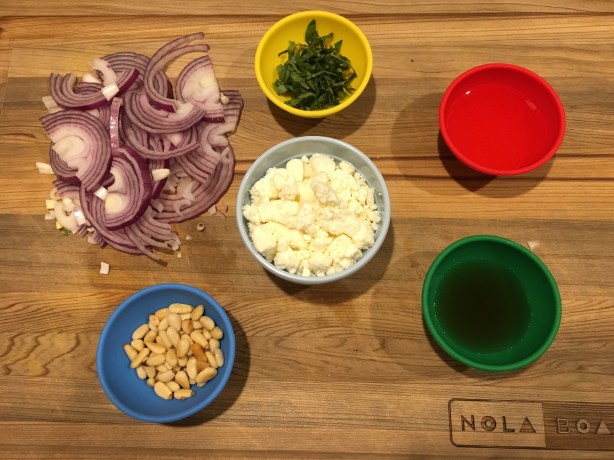
I have wanted to make this melon salad since I watched this episode with my dad when it originally aired in 2005. I remember that it just sounded so good to me when I first watched this episode. Alton prefers to use a high-powered outdoor gas burner for his wok, which is a setup my dad adopted after watching Good Eats. I do have my dad’s outdoor burner, but it needs a new hose, so I used our flat-bottomed wok on our regular old stove. Whether you are cooking indoors or out, heat your wok on a hot burner until water droplets instantly turn to steam upon hitting the pan. As with any stir fry, be sure to have all of your ingredients ready ahead of time, as the cooking goes very quickly. The ingredients for this dish are 1 1/2 T olive oil, a thinly sliced red onion, 8 ounces of cubed honeydew melon, 8 ounces of cubed cantaloupe, 1 T basil chiffonade, Kosher salt, black pepper, 2 t red wine vinegar, 2 ounces feta cheese, and 1 T toasted pine nuts.

IMG_1524

Ingredients for salad: red onion, basil, olive oil, red wine vinegar, toasted pine nuts, and feta cheese. Not pictured: melon.

Speaking of cantaloupe, did you know that all of the cantaloupes in this country are really muskmelons? Anyway, once the wok is hot, add the oil to the pan and swirl to coat.

IMG_1525

Oil in hot wok.

Add the sliced red onion and toss until heated through.

IMG_1526

Onion added to hot wok.

Next, add the cubed melon and toss again, cooking until the corners of the melon just start to brown slightly. Add the tablespoon of basil, along with a pinch of Kosher salt and some black pepper.

Drizzle the vinegar into the pan and transfer the salad to a serving dish. Finish the salad by sprinkling on the feta and pine nuts.

IMG_1532

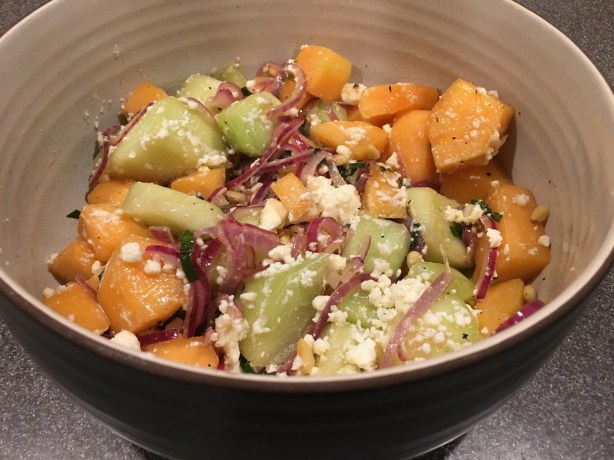
Alton’s hot melon salad.

We had this as a side dish one night and we ate the entire salad. I really like the flavors in this salad and how they compliment each other. The melon becomes sweeter from the heat, yet the red wine vinegar gives just a light touch of acidity. The feta adds some much-needed salt, while the red onion gives some pungency. The crunch of the pine nuts is a nice addition to a salad that is otherwise composed of ingredients with fairly similar textures. To me, this dish would be a perfect summer grilling side dish, and I intend to make it again, just as soon as deck season arrives.

Melon Sorbet

A fresh melon sorbet is the second recipe in this episode, and it is super easy to throw together.

IMG_1549

Sorbet ingredients: watermelon, lemon juice, vodka, and sugar.

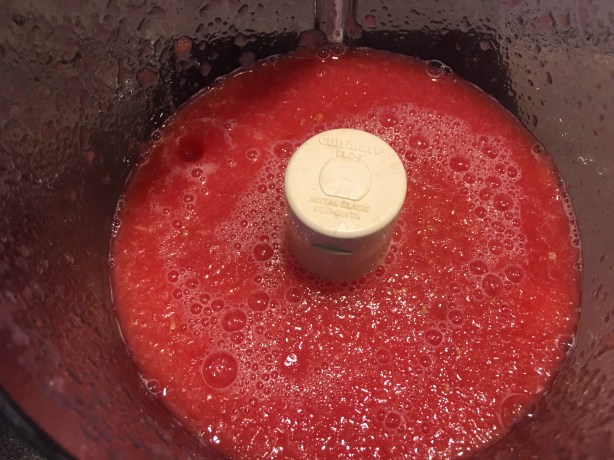
Puree a pound plus five ounces of watermelon in a food processor.

IMG_1550

Pureed watermelon.

To the pureed melon, add 3 T fresh lemon juice, 2 T vodka, and 9 ounces of sugar. The vodka serves to lower the freezing point of the sorbet, making the texture softer and less icy.

IMG_1552

Lemon juice, vodka, and sugar added to watermelon puree.

Refrigerate the melon mixture for at least two hours before churning in an ice cream maker.

IMG_1570

Churning sorbet after chilling.

Once churned, transfer the sorbet to an airtight container and freeze for 3-4 hours before eating.

IMG_1620

Watermelon sorbet.

The amounts of watermelon flavor and aroma in this sorbet are amazing, especially considering that I could not get great fruit. The color of the sorbet also seemed more vibrant than the color of the melon itself. As for texture, this sorbet stayed pretty soft and scoopable, and had very few large ice crystals. This sorbet truly is a taste of summer. It is quite sweet, so I have to wonder if a slight decrease in sugar could make this even better, though I suppose that could also alter the final texture of the sorbet. Perhaps I will just have to make two batches of sorbet once melon is in season – one with the original sugar concentration and one with a slightly lower concentration. I also intend to try this with some other types of melon, though I would imagine the sugar would have to be adjusted accordingly for the sugar contents of different melons. This sorbet is super refreshing, easy, and can brighten up even the coldest of winter days.

I was not overly stoked for an entire episode of pudding recipes. I mean, pudding is fine, but it’s not exactly exciting. I did, however, get very happy when I was a kid and my mom would leave pudding in the refrigerator for an after-school snack; chocolate pudding was my brother’s favorite, while I always preferred butterscotch. Speaking of butterscotch pudding, if you have not tried the butterscotch pudding in Alton’s latest book, it is a must-make. Here is my rundown of Alton’s pudding recipes, and I must say that two out of three wowed me.

Indian Rice Pudding

Indian rice pudding is the first recipe in this episode. The ingredients in this recipe are 1 C cooked rice, 1 C milk, 1/2 C heavy cream, 3/4 C coconut milk, 2 ounces sugar, 1/4 t ground cardamom, 1 1/2 ounces golden raisins, and 1 1/2 ounces chopped unsalted pistachios.

IMG_1429

Rice pudding ingredients: cooked rice, milk, heavy cream, coconut milk, sugar, cardamom, golden raisins, and pistachios.

For the pudding, put the milk and rice in a large skillet and bring to a boil over medium heat, stirring.

Once boiling, decrease the heat to low and simmer the milk/rice until it has thickened slightly, which should take about five minutes; if you run a spatula along the bottom of the pan, the liquid should be thick enough to part and stay parted.

IMG_1432

Rice and milk after coming to a boil and simmering.

When you have achieved this desired consistency, increase the heat to medium and add the cream and coconut milk, followed by the sugar and cardamom (use a whisk to incorporate the cardamom).

When the mixture has reached a boil again, decrease the heat to low and cook for five more minutes.

IMG_1439

Pudding cooked for 5 more minutes.

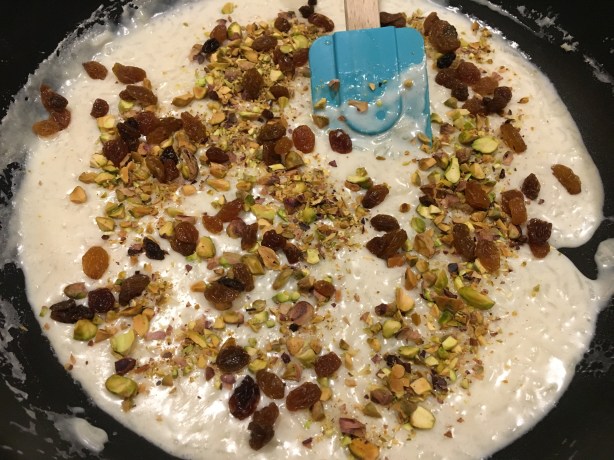
Remove the pan from the heat and stir in the raisins and nuts.

IMG_1440

Raisins and pistachios added to pudding off the heat.

Transfer the pudding to your desired serving vessel(s) and enjoy immediately, or you can chill the pudding overnight, which is how Alton prefers it. If you do opt to chill the pudding, press plastic wrap on the surface of the pudding to prevent formation of a skin.

IMG_1442

Alton’s rice pudding.

I tasted the rice pudding when it was warm, but chose to refrigerate it overnight before eating a full serving. This rice pudding is delicious. The pudding is thick, rich, creamy, and indulgent. The subtle flavor of coconut milk is in the background, while pistachio flavor is predominant. The raisins add little punches of fruit flavor, while the nuts add a little crunch. This is great for dessert or for breakfast, or for both! I fully intend to make this again soon. In fact, I am really wishing I had some right now! Excellent recipe.

Tapioca Pudding

I do not recall ever having tapioca pudding prior to making this recipe. I asked my parents about tapioca pudding the other day and my mom said she remembers her mother making it, while my dad did not think he had ever had tapioca pudding. Tapioca, by the way, is a starch from the cassava plant. Tapioca is sold in several forms, but this recipe calls for large pearl tapioca. The recipe begins by soaking 3 1/2 ounces of tapioca in a pint of cold water overnight; you can do this at room temperature.

After the soak, drain the pearls and put them in a crock pot, along with 2 1/2 C milk, 1/2 C heavy cream, and a pinch of Kosher salt. Stir the pudding, put the lid on the cooker, and let the pudding cook on high for two hours.

After the two hour cook time, beat one egg yolk with 1/3 sugar in a bowl – this will form a paste.

IMG_1513

Tapioca after cooking for two hours.

Temper the egg yolk mixture by slowly whisking 1 – 1 1/2 C of the warm tapioca into the eggs.

Once tempered, add the egg mixture back to the crock pot of tapioca and whisk to combine. Add the zest of a lemon to the cooker, place the lid back on, and let the pudding cook for 15 more minutes.

Transfer the tapioca to an airtight container, pressing plastic wrap directly onto its surface. Let the pudding cool to room temperature before refrigerating until it is thoroughly chilled.

IMG_1521

Pudding after cooking for 15 more minutes.

IMG_1558

Chilled tapioca pudding.

This pudding was good, but not amazing like the rice pudding. Since I am not a tapioca pudding expert I cannot say for sure, but I felt like the texture of this pudding was maybe a little thinner than it should be. I liked the added texture from the slightly chewy tapioca pearls, but the base was a little on the soupy side. As for flavor, it was just sort of creamy with subtle lemon overtones. I may make this again, simply because I have half a bag of tapioca pearls remaining, but I won’t add this one to the permanent recipe vault.

Chocolate Pudding

What pudding episode would be complete without a recipe for chocolate pudding? This is a two-step recipe, in which you first make a dry pudding mix, and then use the mix to make the pudding. To make the dry mix, in a lidded container combine 1 1/2 ounces non-fat dry milk, 2 ounces cornstarch, 1 t salt, 3 ounces Dutch cocoa powder, and 6 ounces powdered sugar. Shake the container to combine the ingredients.

To make the pudding, put 1 3/4 C of the dry pudding mix in a saucier. Whisk 2 C milk and 2 C heavy cream into the dry pudding mix.

Bring the mixture to a boil over medium heat, whisking occasionally. Once boiling, decrease the heat to low and simmer for four minutes, whisking.

Remove the pan from the heat and stir in 1 t vanilla.

IMG_1458

Adding vanilla off the heat.

Pour the pudding through a sieve and into a serving bowl. Press plastic wrap directly on the surface of the pudding to prevent the formation of a skin, and refrigerate the pudding for at least four hours before eating.

IMG_1481

Alton’s chocolate pudding.

This is the best chocolate pudding I have ever eaten. The pudding is super rich and creamy in both texture and flavor. It is smooth and chock full of chocolate flavor, and a little goes a long way. I am going to whip up another batch of this pudding shortly. It is super good.

This January has given 2019 a little bit of a rough start for me. I had a short, nasty stomach bug for the first two days of the year, which was followed up with back pain for several days. After that, I traveled to be with my dad while he had cancer surgery. Two days after I returned home from my trip, I came down with a nasty flu-like bug that knocked me out for 10 days. Whew! Good riddance, January!

Turkey with Stuffing

Although the holidays are long gone, this recipe certainly has a holiday feel to it. While Alton’s other turkey recipes have really featured the turkey itself, this one is all about the stuffing. In the episode, Alton actually goes into very little detail about prepping/cooking the turkey, so I opted to brine my turkey, using the brine recipe from the original Good Eats Thanksgiving special. The premise of this recipe is that Alton can make a well-balanced stuffing that will cook inside the turkey, and that the turkey and stuffing will reach their desired temperatures at nearly the same time. To make the stuffing, chop 1 C each of onion, celery, and green bell pepper.

img_0953

A cup each of celery, onion, and green bell pepper.

Toss the chopped vegetables with 1 T vegetable oil and 1 T Kosher salt. Spread the vegetables on a sheet pan and roast them for 25 minutes at 400.

After 25 minutes, add 3 C cubed Challah bread (I made my own) to the vegetables, give everything a toss, and continue roasting for 10 more minutes.

img_0957

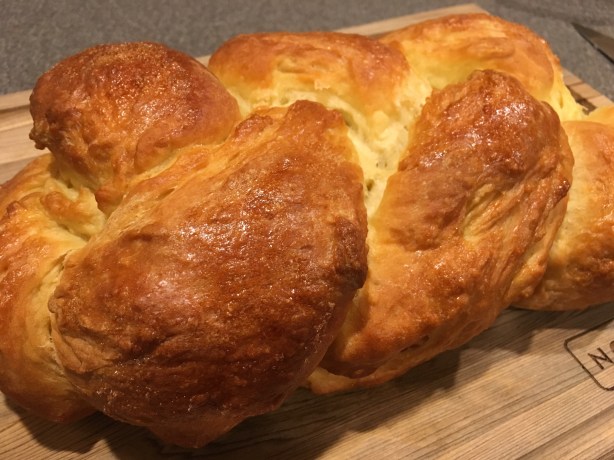
My Challah bread, ready to be cubed.

Next, place two ounces of dried mushrooms (porcini, morels, or shiitakes) in a bowl and pour a quart of boiling chicken stock over them. Let the mushrooms rehydrate for about 30 minutes.

img_0958

Shiitake mushrooms, soaking in boiling chicken broth.

When the mushrooms have finished their soak, drain them (reserving their liquid), chop them, and place them in a large bowl, along with 4 ounces dried cherries, 2 ounces chopped pecans, 2 beaten eggs, 2 t dry rubbed sage, 2 t dry parsley, the roasted vegetables and bread, and 1/2 t pepper.

img_0961

Dried cherries and chopped pecans.

img_0968

Chopped mushrooms added to cherries and pecans.

img_0970

Chopped mushrooms added to cherries and pecans, along with eggs, rubbed sage, and dry parsley.

Add enough of the reserved mushroom liquid to moisten, but not saturate, the mixture; I used about a cup, though Alton was vague about this in the episode and it actually appeared as if he added all of the reserved liquid.

img_0972

Challah, vegetables, pepper, and mushroom liquid added to mixture.

Place the stuffing in a cotton produce bag, or use cheesecloth to make one – you can seal it with butcher’s twine. Place the bag of stuffing in a microwave-safe bowl and microwave it on high for six minutes. Also, preheat the oven to 400 degrees.

To put the stuffing in the turkey, prop the open end of the turkey up on the side of a bowl and use tongs to plunge the bag of stuffing into the bird. If you have a plastic cutting board, you can form it into a tube shape, insert the tube-shaped cutting board into the cavity, and push the bag through the tube.

img_0975

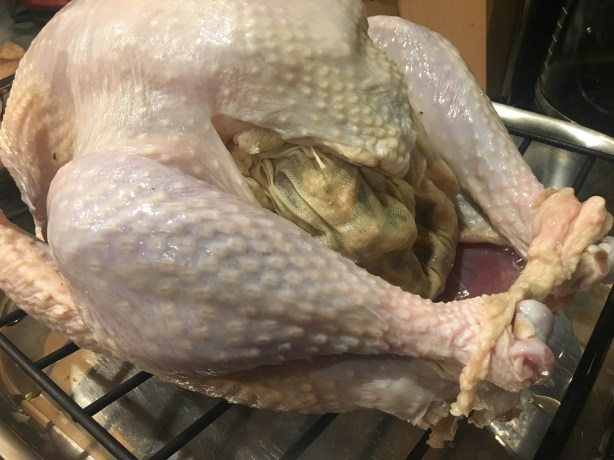
Microwaved stuffing placed inside turkey.

For this recipe, you will ideally want two thermometers – one inserted in the thigh and one inserted into the center of the stuffing; I only have one oven-safe thermometer, so I placed that in the thigh and checked the stuffing periodically with an instant read thermometer. Place the bird in a roasting pan and roast it for 45 minutes at 400 degrees. After 45 minutes, decrease the oven temperature to 350 and cook until both the stuffing and the thigh meat are about 170 degrees. When done cooking, remove the stuffing bag with tongs and place the stuffing in a serving bowl.

img_0977

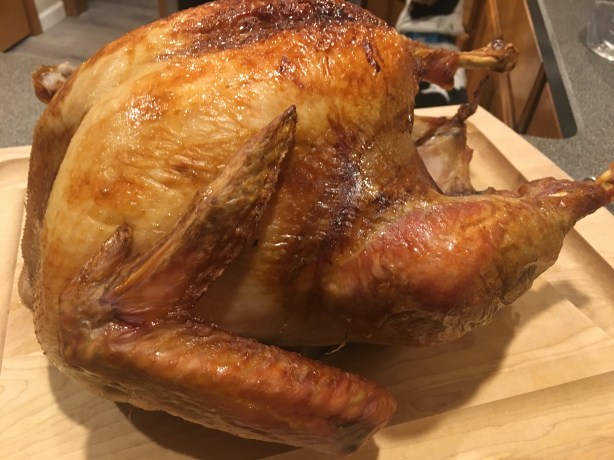
Turkey after cooking to thigh temperature of 170.

img_0983

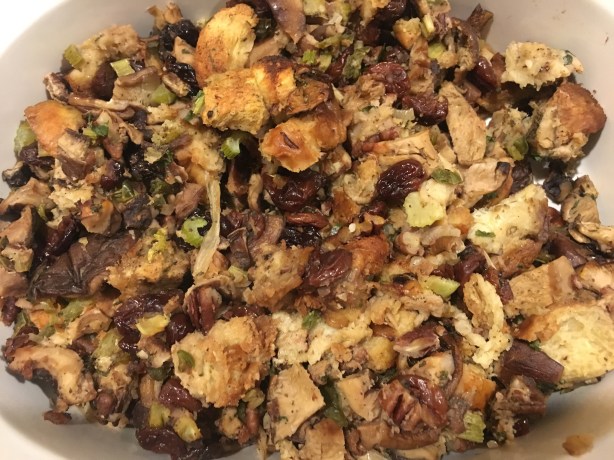
Alton’s stuffing.

Tent the turkey with foil and let it rest for 15-20 minutes before carving. Okay, so there were some good things about this recipe and some bad things. This stuffing has a wide variety of both flavors and textures, with flavors ranging from sweet/tart to umami, and textures that range from slightly crunchy to moist and soft. I will say that the stuffing would have been too wet, and probably overpowered with mushroom flavor, if I had added all of the mushroom liquid as Alton appeared to do in the show. My biggest problem with this recipe was that it didn’t achieve the goal of having the stuffing and turkey finish cooking at the same time. For me, the stuffing was done cooking long before the turkey was, so I ended up pulling the stuffing out early while I had to continue cooking the bird for a good 20 minutes. In my mind, that makes this recipe a failure. Also, I think the bird could have done with a little less cooking. While I would consider making the stuffing again, I would not attempt to cook it in the bird again. Instead, I would opt for either the original Good Eats roast turkey or the butterflied, dry brined turkey.

Stuffed Squash

Since the tendency with stuffing is to stuff vegetables into meat, Alton decided to formulate a recipe where a meat filling is stuffed into squash. Acorn squash are the squash of choice for this recipe, as they are perfect for individual servings. To make four servings (I only made two), cut the lids off of four acorn squash and scoop out their seeds; be very careful when doing this, as I discovered it is very easy to poke a hole in the bottom of the squash! Be sure to save the lids for later. If your squash will not sit flat, you can also cut off part of the bottoms to make them level.

img_0914

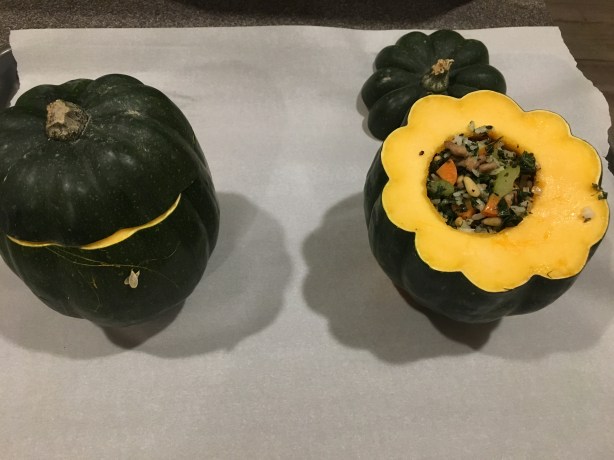
My two acorn squash, ready to be prepped.

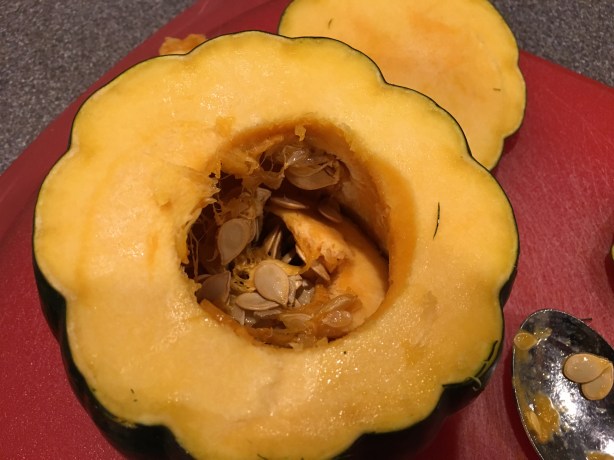
img_0915

Lids off and scooping out seeds.

Set the prepared squash on a parchment-lined sheet pan. To make the filling, cook 1/2 pound ground pork in a large skillet over medium heat until the pork is no longer pink. Transfer the pork to a small bowl and set it aside.

Return the pan to the burner, but decrease the heat slightly. Add 1 T olive oil to the pan, along with 1/4 C chopped carrots, 1/4 C chopped celery, 1/4 C chopped onion, and a pinch of Kosher salt. Cook the vegetables until they have softened a bit.

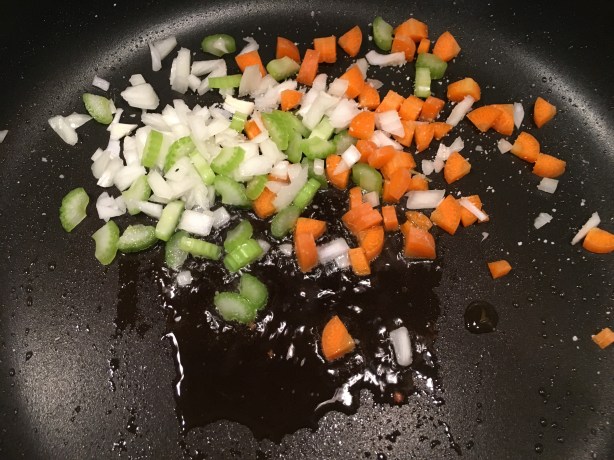
img_0924

Celery, onion, and carrot added to hot oil, along with a pinch of Kosher salt.

Deglaze the pan by adding 1/2 C white wine and scraping up any browned bits.

img_0927

Wine added to deglaze the pan.

Follow the wine with 10 ounces of thawed/drained/chopped frozen spinach, 1 1/2 C cooked rice, 1 1/2 t dried oregano, the cooked pork, and 1/2 C toasted pine nuts.

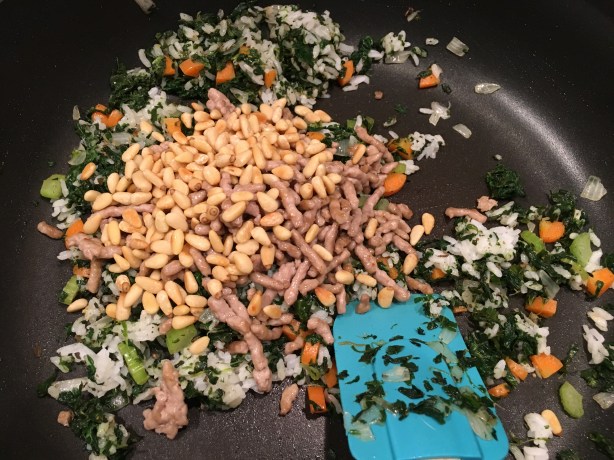
img_0932

Spinach, rice, oregano, pork, and pine nuts added to the skillet.

Stir the filling until it is heated through and add a few grinds of black pepper. Remove the filling from the heat and place 1/2 T butter in the bottom of each prepared squash.

Spoon the stuffing into the squash, avoiding tightly packing the stuffing.

img_0936

Filling spooned into prepped squash and lids placed on top.

Place the lids on the squash and cook them for one hour at 400 degrees, or until the squash are just fork tender.

img_0941

Alton’s stuffed squash.

We ate these squash as our dinner entrée and were pretty happy with them. Ted really does not care for squash, in general, but he agreed that the sweetness of the squash paired well with the very savory pork filling. This is a an easy meal that really gives you both your protein and veggies in one, and the individual squash “serving dishes” are sort of fun. The squash also did not become mushy, as some squash are wont to do. I could see making the filling ahead of time for these, and on a busy weeknight you would only have to fill the squash and put them in the oven. Super easy!


Just like that, the hectic holiday season is behind us and we are into 2019. We spent our Christmas at my brother’s house, so we did not host either Thanksgiving or Christmas in 2018. It always feels odd to me when I do not end up cooking much at the holidays, and my only real contribution to Christmas dinner was a batch of roasted Brussels sprouts. We had great food, though, including a salty Wayco ham.

I always have a long list of things I want to cook/bake that are unrelated to this blog project. I plan to actually sit down and make a list of the top things I want to make this year, so I can physically cross them off as I complete them. I had planned to make my list yesterday since it was the first day of the year, but I spent the day with a fever on the couch instead. Boo.

Savory Polenta

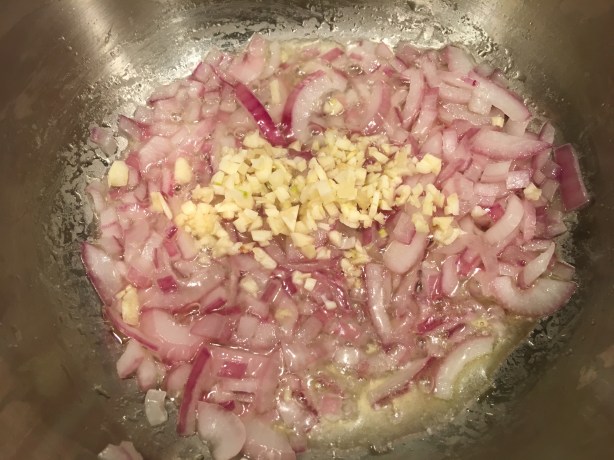
The 115th episode of Good Eats is one that Alton chose to remake in his new show Good Eats:  Reloaded. Savory polenta is the first recipe in this one. So, what is the difference between grits and polenta? According to Alton, grits and polenta are different preparations of the same main ingredient:  cornmeal. Grits are often made from ground hominy, which is white, while polenta is made from ground yellow corn. Either way, when purchasing cornmeal to use in either grits or polenta, always look for stone ground cornmeal; the terms “polenta” and “grits” are often featured together on the label of stone ground cornmeal. To make polenta, place 2 T olive oil in a saucier over medium heat. Add 3/4 C chopped red onion and 1 1/2 t Kosher salt, and cook the onion until it has softened.

Add 2 cloves of minced garlic and cook for two minutes.

IMG_0815

Garlic added to onion.

Next, add a quart of chicken broth and bring the broth to a boil over high heat.

When the broth is boiling, gradually add 1 C coarse cornmeal, whisking it in. Once all of the cornmeal has been added, place a lid on the pan and place it in a 350 degree oven for 40 minutes, stirring the polenta every 10 minutes.

Remove the pan from the oven and stir in 3 T butter, 2 ounces grated Parmesan, and 1/4 t pepper.

You can now eat the polenta as it is or you can pour the warm polenta into a parchment-lined 9×13″ pan. Let the polenta cool to room temperature in the pan, and then place it in the refrigerator for 1-2 hours.

IMG_0829

Polenta poured into 9×13 pan.

After chilling, flip the polenta out onto a cutting board and use a biscuit cutter to cut rounds.

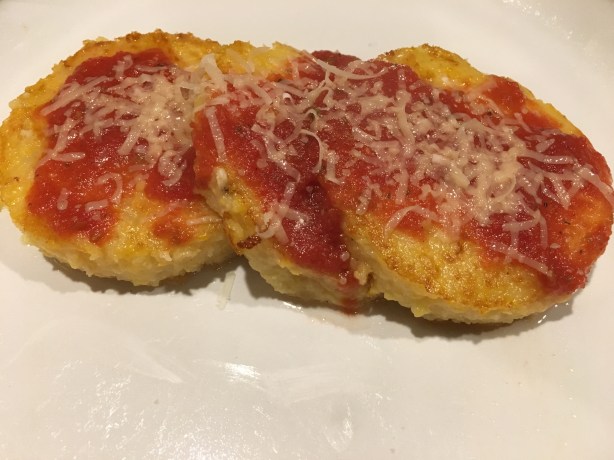
Toss the polenta circles in olive oil and you can fry, saute, or grill them; I opted for sautéing. I served my polenta with a homemade tomato sauce and some grated Parmesan.

IMG_0839

Polenta rounds with tomato sauce and Parmesan.

This polenta is easy and delicious. We tasted the polenta after adding the butter, cheese, and pepper, and I would have been content to eat a bowl just like that. I also liked the sautéed version, as there was a slight golden crust on the outside, while the polenta remained tender and buttery on the inside. The garlic and onion flavors were obvious and made the polenta savory with a little kick. This would also be a great vegetarian dinner option if you substituted vegetable broth for the chicken broth, and this seems like a very kid-friendly dinner option too. Don’t bother with that tube of polenta at the grocery store when you can make this version at home!

Cheese Grits

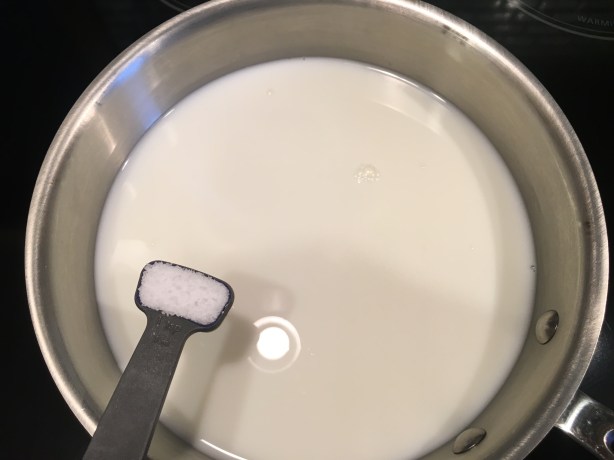
I first remember having grits when I was in the Florida Keys for my cousin’s wedding. We stopped for breakfast at an oceanfront restaurant and grits were one of the side dish options. I instantly became a grits fan. For Alton’s grits, combine 2 C milk, 2 C water, and 1 1/2 t Kosher salt in a saucier and bring the mixture to a boil.

IMG_0707

Milk, water, and Kosher salt in a saucier.

Once boiling, slowly whisk 1 C coarse cornmeal into the liquid.

Place a lid on the pan and cook the grits for 20-25 minutes, stirring every two or three minutes, and keeping the heat as low as possible. I found that my grits were still too thin after 25 minutes, so I cooked them for about 35 minutes.

IMG_0714

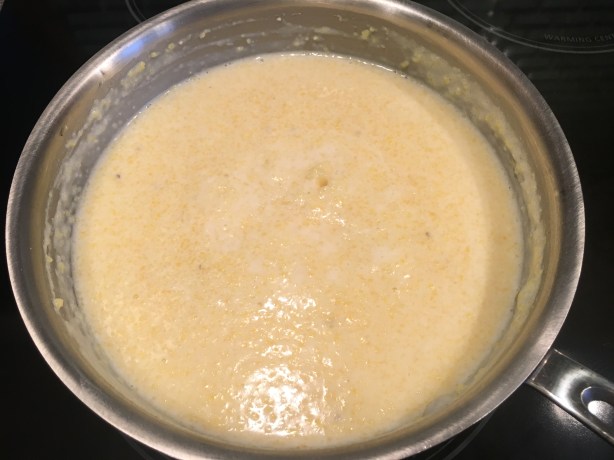
Grits after stirring/cooking for ~35 minutes.

Stir in 4 T butter and season with Kosher salt, if needed.

IMG_0713

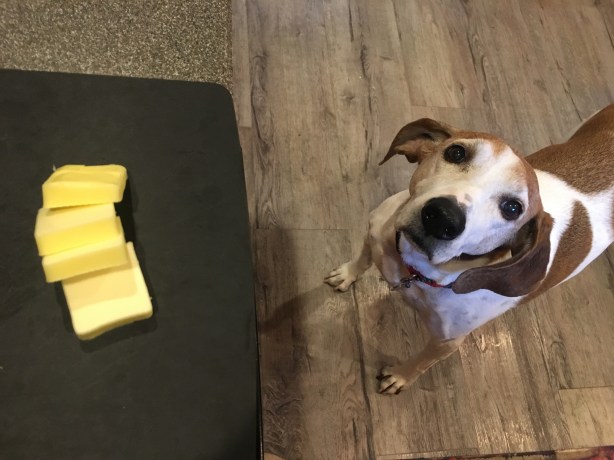
4 T butter.

IMG_0715

Butter added to grits.

Lastly, slowly stir in 4 ounces of shredded cheddar cheese.

IMG_0717

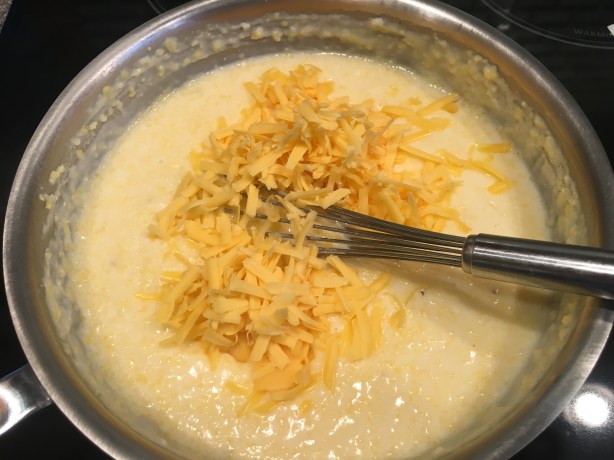
Cheddar, slowly added to grits.

We ate these grits for a pre-run breakfast, alongside purple barley bread and they kept me fueled for 8.5 miles.

IMG_0722

A bowl of cheese grits.

These grits are cheese, rich, and creamy. Due to their richness, I could only eat a small bowl before I felt pretty full. Alton’s grits are definitely heavier than his version of polenta, but equally tasty.

Pineapple Upside-Down Cornmeal Cake

Lastly, Alton finishes this episode with a sweet pineapple upside-down cake. Although this cake has been around forever, this was my first time making a pineapple upside-down cake. To begin the cake, place 3/4 C whole milk in a microwave-safe bowl and microwave the milk until it is boiling. Sprinkle 1 C coarse cornmeal over the milk and let it sit.

IMG_0748

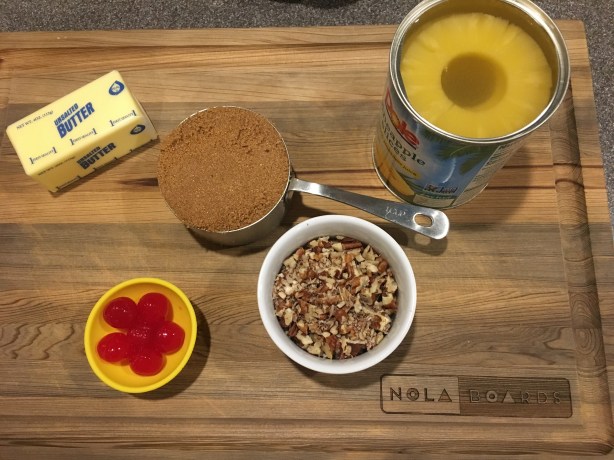
Topping ingredients: butter, dark brown sugar, canned pineapple rings, toasted pecans, and maraschino cherries.

Next, place a 10-inch cast iron skillet over medium heat and melt 4 ounces of unsalted butter in the pan. When the butter has melted, use a pastry brush to brush some of the butter up the sides of the pan. The butter will brown slightly.

Add 1 C dark brown sugar to the pan and stir until melted, which will take about five minutes; watch the sugar carefully, as it can easily burn.

Once the sugar has melted, remove the pan from the heat and place canned pineapple slices around the perimeter of the pan, and one additional ring in the center.

IMG_0755

Pineapple rings added to caramel.

Put a maraschino cherry in the center of each pineapple slice and sprinkle 1/3 C of toasted/chopped pecans over the pineapple.

Drizzle on 3 T of the juice from the canned pineapple and set the skillet aside to cool slightly.

IMG_0759

Pineapple juice drizzled over topping.

While the skillet cools, combine 4 3/4 ounces flour, 2 t baking powder, and 1/2 t salt in a large bowl.

IMG_0762

Flour, baking powder, and salt.

In a medium bowl, whisk together 3 eggs, 3/4 C sugar, 1/2 C canola oil, and the milk-soaked cornmeal from earlier.

When the wet ingredients are combined, add the wet mixture to the dry ingredients and whisk for a count of six. The final batter will be a little lumpy, but that is okay. Do not over mix.

IMG_0768

Wet mixture added to dry ingredients.

Pour the cornmeal batter over the pineapple in the skillet and place in a 350 degree oven for 40 minutes.

Let the cake cool for 30 minutes before flipping the cake out of the skillet. Cut the cake into wedges and serve.

IMG_0779

Cooled cake flipped onto cake stand.

IMG_0788

Alton’s pineapple upside-down cake.

This cake is fun to make because it looks pretty when you invert it out of the pan. The topping is a delicious mix of dark caramel, crunchy pecans, and juicy pineapple; the best part, in my opinion, is the part by the edges of the pan, as the caramel is thick and slightly chewy there. The batter of this cake has the slight grittiness of cornmeal, and is only slightly sweet. I like the fact that the cake itself is not overly sweet, as the topping is sweet enough. This cake is great for breakfast, dessert, or both!

This chocolate episode came at a good time, allowing me to share some of Alton’s chocolate goodness with friends and relatives at the holidays. There is really no way we could have eaten all of this chocolate without help! It’s really too bad that my mom doesn’t live closer to me because, though she is tiny, she can pretty much eat her weight in chocolate. Somehow, we persevered and the recipes from this episode have been devoured. All of the recipes in this episode are ganache-based, meaning they are composed of a mixture of chocolate and cream. First up is Alton’s:

Ganache Frosting

This ganache is composed of only two ingredients:  chocolate and cream.

IMG_0594

Only two ingredients for this frosting: bittersweet chocolate and heavy cream.

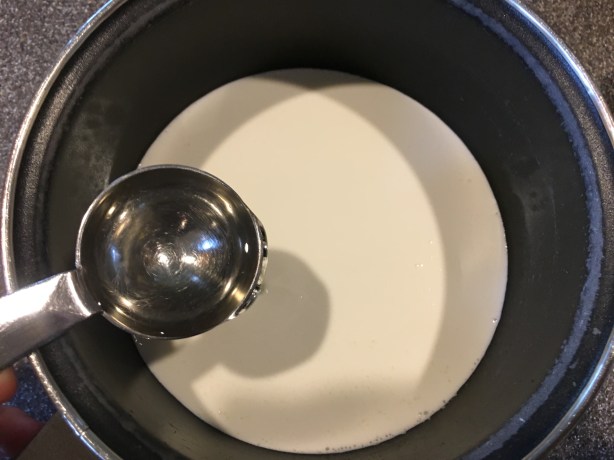
The recipe starts with heating a pint of heavy cream (which is also a pound) in a microwave for 3-4 minutes, or until simmering. Note:  when heating milk products in the microwave, use a vessel twice the original volume of dairy to prevent overflow. While the cream heats, chop a pound of bittersweet chocolate with a serrated knife.

IMG_0595

A chopped pound of chocolate.

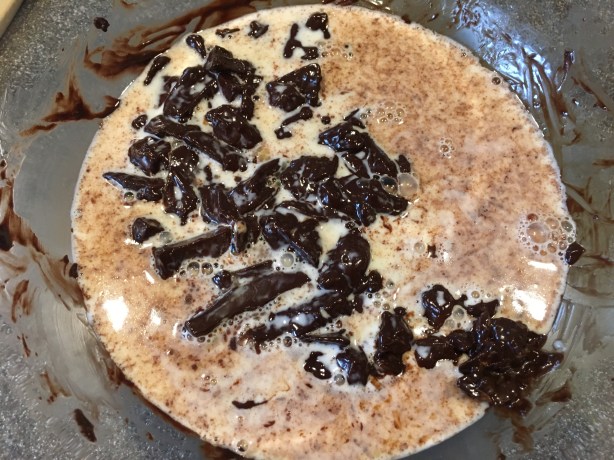
Place the chopped chocolate in the bowl of a food processor and pour the warm cream over the chocolate. Let the cream/chocolate sit for two minutes.

When the two minutes are up, pulse the chocolate and cream three times, or until smooth.

IMG_0601

Chocolate and cream after pulsing 3x.

Transfer the ganache to a bowl. You can use the ganache immediately as a pourable cake glaze.

IMG_0604

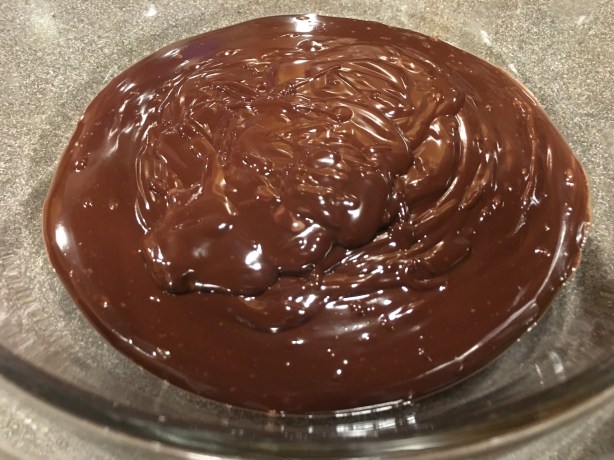
Ganache transferred to a bowl.

Or, you can let the ganache cool for an hour and whip it in a stand mixer to make a cake frosting.

This ganache will keep for two weeks if kept tightly covered and refrigerated. For later use, bring the ganache to room temperature before whipping with a stand mixer. I first used this ganache frosting to frost a simple sheet cake, which we ate for multiple days.

IMG_0617

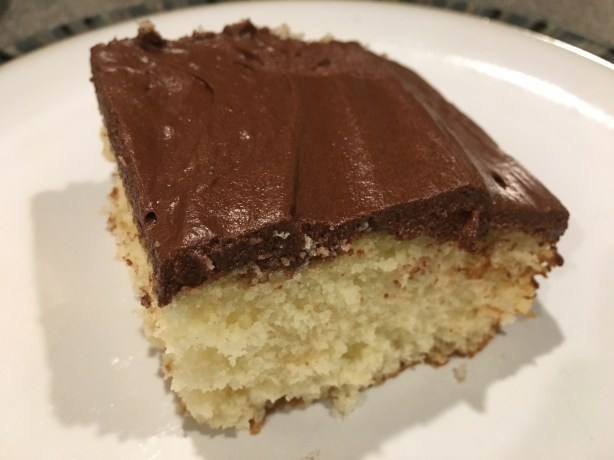
A slice of sheet cake with Alton’s ganache frosting.

I actually prefer this frosting cold because I like the dense mouthfeel of the cold chocolate in contrast with soft, light cake. After frosting a 9×13″ sheet cake, I still had enough frosting for two dozen cupcakes, which I frosted for my in-laws’ Christmas party. I will say that the frosting is best aesthetically when used after the first whipping. This frosting is quite rich, so you only need a thin layer of frosting for a good punch of chocolate. This is about the easiest chocolate frosting you could ever make, and it is so much better than anything you could buy in the store.

Chocolate Truffles

When we headed to my sister-in-law’s house for Thanksgiving, I decided to bring Alton’s truffles to share. I made the truffles two days before turkey day. To make Alton’s truffles, place 10 ounces of chopped bittersweet chocolate in a microwaveable bowl and add 3 T of unsalted butter.

Set the chocolate aside while you bring 1/2 C cream and 1 T light corn syrup to a simmer in a saucepan over medium heat.

IMG_0541

Heavy cream and light corn syrup.

While the cream heats, place the chocolate/butter in the microwave for 30 seconds; stir the mixture and put it in the microwave for another 30 seconds or until the chocolate starts to melt.

Pour the simmering cream over the chocolate and let it sit for two minutes.

IMG_0552

Cream poured over chocolate/butter.

After two minutes, stir 1/4 C brandy into the chocolate, stirring until smooth.

IMG_0554

Brandy being stirred into chocolate mixture.

Pour the chocolate mixture into an 8×8″ baking dish and place it, uncovered, in the refrigerator for one hour.

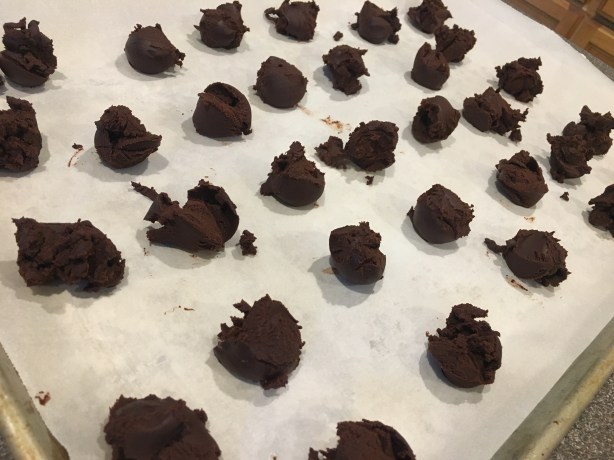
After an hour of chill time, use a melon baller to portion the ganache into rough balls, transferring them to a parchment-lined sheet pan; do not worry about shaping the truffles at this time. When all of the truffles have been portioned, place them back in the refrigerator for 30 minutes.

IMG_0560

Portioned ganache.

This is the point of the recipe where things get a little more technical, as Alton used a heating pad to melt eight ounces of bittersweet chocolate, keeping the chocolate between 90 and 94 degrees; it is critical not to go above 94 degrees, as this will change the crystalline structure of the chocolate. I found that I had very uneven heating with my heating pad, so I gradually melted my chocolate in the microwave, stirring and checking the temperature after every 15-20 seconds.

Once your chocolate is melted and between 90 and 94 degrees, roll your truffles into smooth balls with gloved hands. Dip an ice cream scoop into the melted chocolate and place a truffle ball into the scoop, using your gloved fingers to coat the center with melted chocolate.

IMG_0564

Coating a truffle center in melted bittersweet chocolate.

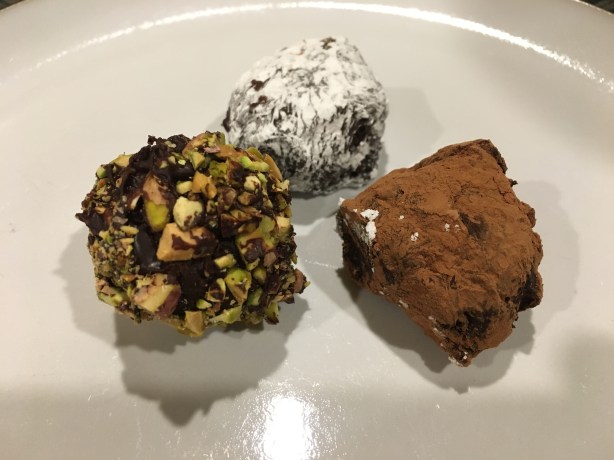
Once coated in chocolate, place the coated truffle into a topping of your choice:  chopped pistachios, cocoa powder, powdered sugar, or toasted coconut. It is ideal to let each truffle sit in the topping until the next truffle is done being coated with chocolate.

Transfer the finished truffles to a wax paper-lined airtight container. Store the truffles in the refrigerator, but serve them at room temperature.

I ended up with 32 truffles, and I used toppings of powdered sugar, cocoa powder, and chopped pistachios.

IMG_0569

Truffles.

Oh my, these truffles are super rich. If you are able to keep your coating chocolate in the ideal temperature range, your truffles will have a crispy chocolate shell surrounding their dense, rich filling. The filling is creamy, rich, slightly bitter, and intensely full of chocolate. These are absolutely worth the time and effort of making, as well as the calories. They pair fantastically with bourbon or with coffee, depending on the time of day. This is a wonderful recipe.

Good Eats Fudgepops

This episode finishes up with Alton’s version of a fudgecicle.

IMG_0657

Ingredients for fudgepops: bittersweet chocolate, vanilla extract, cocoa powder, heavy cream, and whole milk.

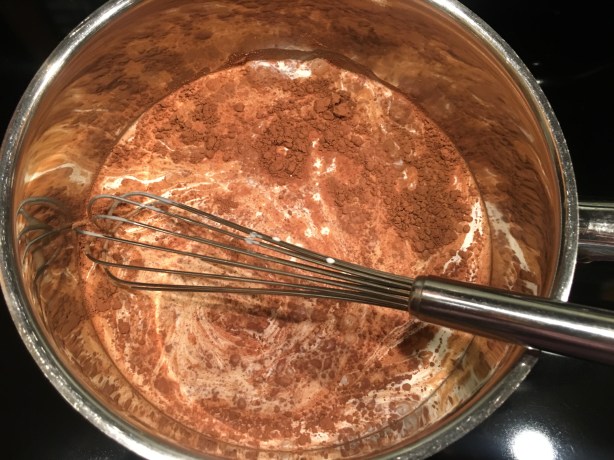
Start by putting 2 T cocoa powder into a medium saucepan, and add 12 ounces of heavy cream and eight ounces of whole milk.

IMG_0662

Cocoa powder combined with milk and cream.

Bring the milk and cocoa to a simmer over medium heat, whisking to combine.

IMG_0663

Cocoa powder combined with milk and cream, and brought to a simmer.

When the dairy is simmering, pour it over eight ounces of chopped bittersweet chocolate, letting it sit for two-three minutes.

Whisk the chocolate mixture until smooth and add 2 t vanilla extract.

Using a turkey baster, equally distribute the chocolate mixture among popsicle molds.

IMG_0671

Chocolate distributed among popsicle molds.

Place the fudgepops in the freezer for four hours, or until set.

IMG_0729

Alton’s fudgepop.

Conversely, if you are craving hot chocolate, Alton says you can melt one of his fudgepops in the microwave. I chose to halve this recipe since I was just making the fudgepops for two of us, and I ended up with four fudgepops. These fudgepops are full of rich chocolate flavor and they are pretty creamy. They did have a very slight icy texture, but I thought these were pretty good. They were very hard to get out of the molds, but that may have been more of a function of my popsicle molds than due to the recipe itself. I don’t know that I would go out of my way to make these again, but I’ve also never been the biggest fudgepop fan.

The ground is frosted here and the holidays are just around the corner. Thankfully, we don’t have any snow yet. We are not hosting Thanksgiving this year, but I still highly recommend Alton’s Thanksgiving recipes. His “Countdown to T-Day” special is broken down into a specific schedule that works beautifully and cuts down on hosting stress. The original Good Eats roast turkey is also delicious.

For Thanksgiving this year, Ted is making a cranberry gin and tonic and a cherry pie. I will be making my dad’s blue cornbread and sausage stuffing, along with Alton’s pecan pie from the countdown special. It sounds as if there will be plenty of food!

Parmesan Crisps

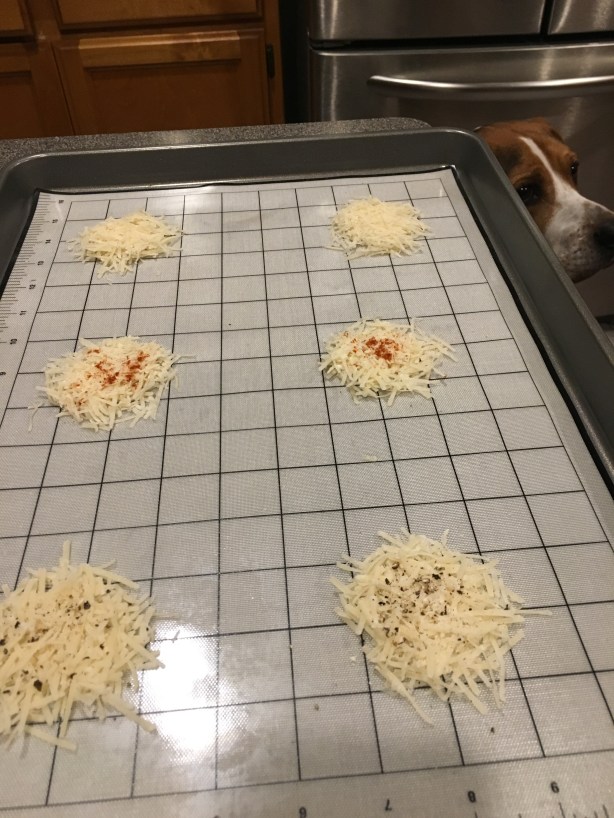
We always have a lot of cheese in our house, but the 113th episode of Good Eats gave me a great excuse to consume some more, beginning with Alton’s Parmesan crisps. I’ve mentioned before that I introduced my dad to Good Eats years ago and it became one of his favorite shows. He served us this recipe as an appetizer when we went to his house several years ago, as he had recently watched this episode. To make the crisps, you first need to line a baking sheet with either parchment paper or a silicone mat. Next, place tablespoonfuls of grated Parmesan cheese on the lined baking sheet, flattening them into discs. Be sure to space the discs adequately, as they will spread.

You can leave the Parmesan plain, or you can sprinkle on some seasoning, such as black pepper or paprika. I made a total of six crisps:  two plain, two with pepper, and two with paprika.

IMG_0494

Two plain crisps, two with paprika, and two with black pepper.

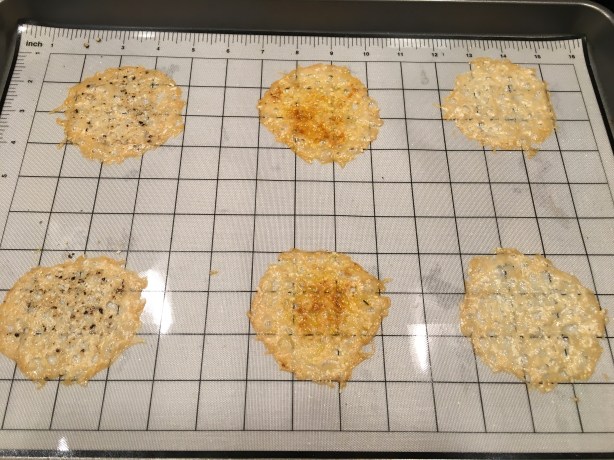
Stick the baking sheet in a 375 degree oven for 10 minutes. *These were the baking instructions from the episode, whereas the online recipe tells you to bake the crisps in a 300 degree oven for 5-6 minutes. If you bake the crisps at 375, they will be done in 4-5 minutes.

IMG_0496

Cheese crisps after baking.

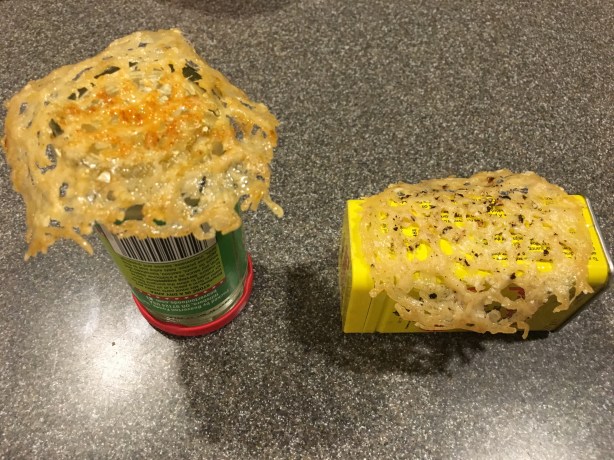
When you pull the baking sheet from the oven, you can let the discs cool into flat chips, or you can shape them into little cups by draping them over cups or spice jars until they cool and harden.

IMG_0498

Molding crisps on spice jars.

You could fill the cups with a small salad or a meatball and serve as a party hors d’oeuvre, or you can stick the flat Parmesan discs into mashed potatoes as a garnish.

IMG_0501

Parmesan cheese crisps.

These cheese crisps are about the easiest snack you could ever make. They bake up crispy with the salty nuttiness of Parmesan, and they are kind of fun to eat – like eating a lacy cheese doily.

Cheese Soup

A couple weeks before I started this episode, we had kind of a chilly weekend, and I made the comment that I was in the mood for hearty soup. Ted found a recipe for beer cheese soup online and I made a batch for lunch that afternoon. Little did I know that I would be making Alton’s cheese soup a couple weeks later! Alton’s cheese soup starts with heating a quart of chicken broth to a simmer on the stove.

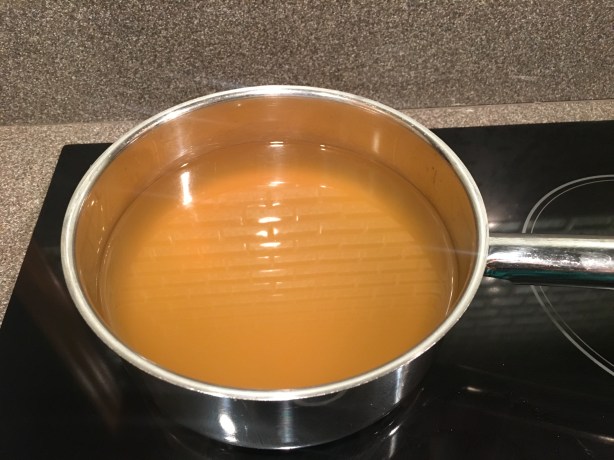
IMG_0372

A quart of chicken broth, heating to a simmer.

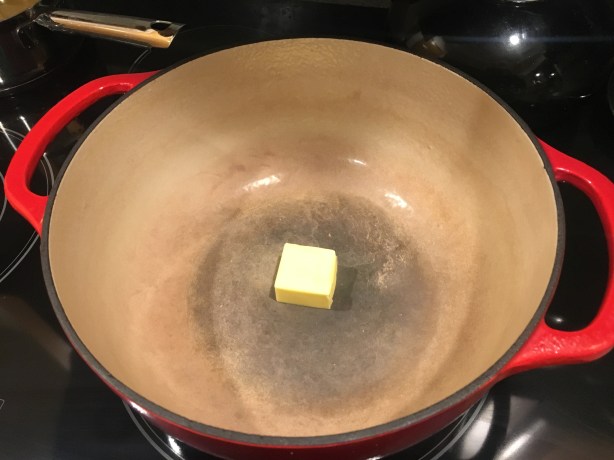
While the broth warms, melt 2 T butter in a large pot or Dutch oven over medium heat.

IMG_0373

2 T butter in a Dutch oven.

To the melted butter, add 5 ounces diced onion, 5 ounces diced carrot, 5 ounces diced celery, and a big pinch of Kosher salt.

Let the vegetables cook for 5-10 minutes, or until softened. Using a hand sieve, sprinkle 3 T flour evenly over the vegetables. Stir and cook the flour until it is no longer visible.

Increase the heat to high and slowly pour in the warm broth, stirring as you pour.

IMG_0387

Warm broth added to vegetables.

Next, add 1 bay leaf and 1 T garlic, stirring to incorporate. Cover the pot, decrease the heat to low, and simmer the soup for 30 minutes.

After the simmer, remove and discard the bay leaf, and pour in 1 C heavy cream. Use an immersion blender to blend the soup until it is smooth.

Now it is time for the cheese, and Alton uses 10 ounces of shredded Fontina for his soup, stirring it in a handful at a time.

Once all of the cheese has melted and the soup is smooth, finish the soup by adding 1 t Marsala, 1 t Worcestershire sauce, 1/2 t hot sauce, and 1/2 t white pepper.

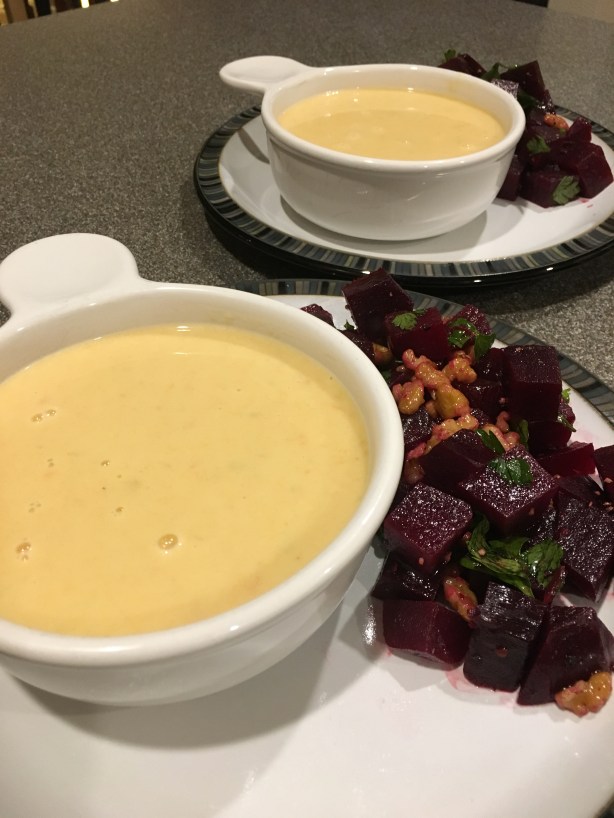
IMG_0413

Alton’s cheese soup.

Alton recommends serving his cheese soup with a good beer. You can keep the soup warm in a thermos if you are not going to serve it right away. To re-heat leftover soup, a double boiler is recommended to prevent curdling. This soup is really delicious, having a velvety, creamy mouthfeel without being overly heavy. The flavor of the soup is rich, cheesy, and perfectly seasoned. I would say this is one of the best cheese soups I have had, and it is excellent for a chilly day.

Fromage Fort

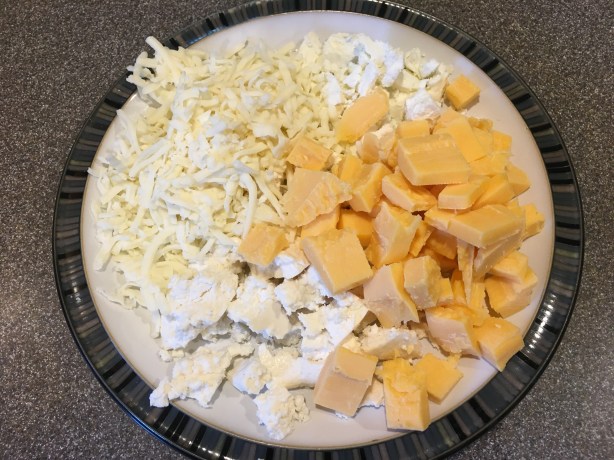
The last recipe in this episode is a great use for any leftover cheese you may have sitting around. You will need a pound of cheese for this recipe, and you can use any blend of cheeses you would like. I used a blend of sharp cheddar, mozzarella, goat cheese, and queso fresco.

IMG_0357

A pound of cheese: cheddar, goat, mozzarella, and queso fresco.

Let the cheeses come to room temperature for an hour before you begin. Remove any hard rinds from the cheese, cutting cheeses into rough 3/4″ cubes. If you are using any super hard cheeses, you will want to grate them. Place your pound of cheese in a food processor, adding 1/4 C dry white wine, 3 T room temperature unsalted butter, 1 clove of garlic, and a small handful of parsley.

Process the cheese mixture for a full two minutes. Serve the cheese spread with crackers.

IMG_0367

Fromage fort.

This was a great way to use up some excess cheese, and it was definitely better than any prepared cheese spreads you can buy in the grocery store. The fun thing about this is that it will be different every time, depending on which cheeses you use. I don’t think I could have identified the cheeses in my spread, other than the cheddar. The garlic was quite prominent, while the wine was pretty subtle. I foresee myself making this again, as we really like to have appetizers and we often (ahem, always) have a variety of cheeses in our refrigerator.

To finish this one off, I’ll share some cheese tips from Alton. To store soft cheese, place it in a lidded container with a slice of apple or a damp paper towel. Store hard cheeses by wrapping them (not tightly) in wax paper, securing them with rubber bands. Always bring cheese to room temperature before eating.

For a cheese tasting, Alton suggests serving three cheeses with a theme, such as three cheeses from the same country, three of the same type of cheese with different lengths of aging, or three cheeses made with the same type of milk. Allow 1/4 pound of cheese per person for a cheese tasting.

And, for those of you who are lactose-intolerant, you can feel pretty safe when eating aged cheeses. Why? Aged cheeses have little to no lactose because the bacteria in the cheese has consumed the lactose. I don’t know about you, but I’m craving some cheese now.

Garden Vegetable Soup

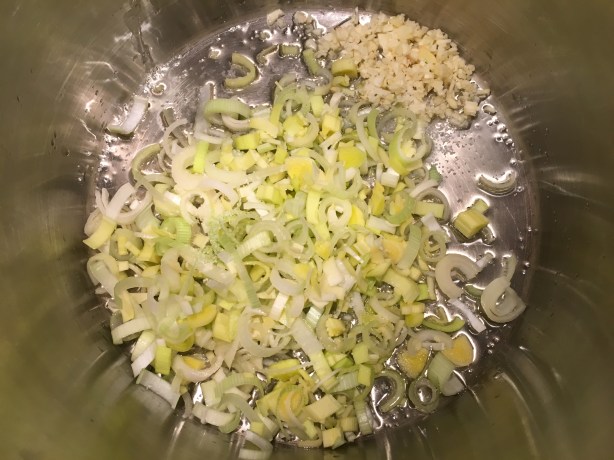
As with the last episode of Good Eats, Alton’s goal in this episode was to develop kid-friendly recipes; this time, though, he tackled soup. The first soup he made was a vegetable soup. This soup starts by heating 4 T olive oil in a soup pot over medium-low heat. Add to the oil 2 C chopped leeks (be sure to wash them well), 2 T minced garlic, and a pinch of Kosher salt.

IMG_0139

Leeks, garlic, and salt added to hot oil.

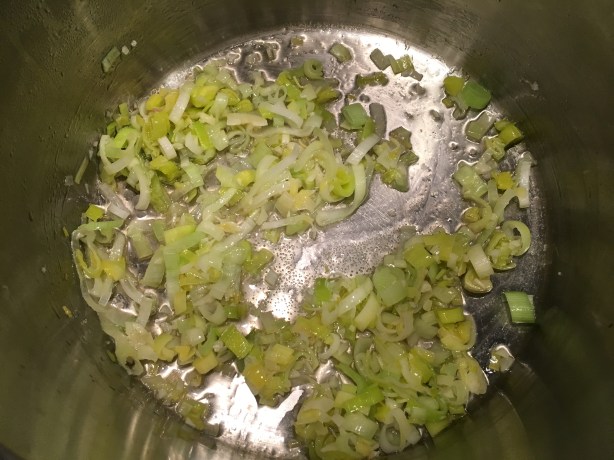
Cook the leeks and garlic until they have softened.

IMG_0141

Leeks and garlic after sweating.

Next, add 2 C peeled/chopped carrots, 2 C peeled/diced potatoes, and 2 C green beans, broken into bite-sized pieces.

Increase the heat under the vegetables, cooking them for 4-5 minutes. Pour in 2 quarts of chicken or vegetable broth; Alton says he is fine with using purchased broth here. Of course, homemade would always be better, though!

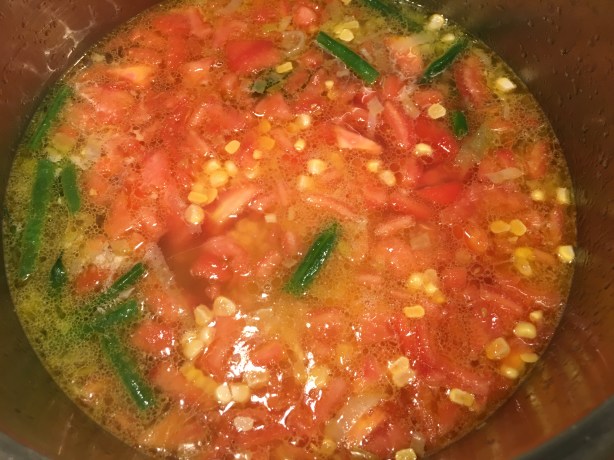
Once the broth is in the pot, increase the heat to high, bringing the broth to a simmer. When simmering, add 4 C peeled/seeded/chopped tomatoes, 2 ears of corn kernels, and a few grinds of black pepper.

IMG_0147

Corn, tomatoes, and pepper added to the soup.

Turn the heat to low, place a lid on the pot, and simmer the soup for 25-30 minutes, or until the vegetables are fork tender.

To finish the soup, stir in 1/4 C parsley and 1-2 t fresh lemon juice.

IMG_0163

Lemon juice and parsley stirred in.

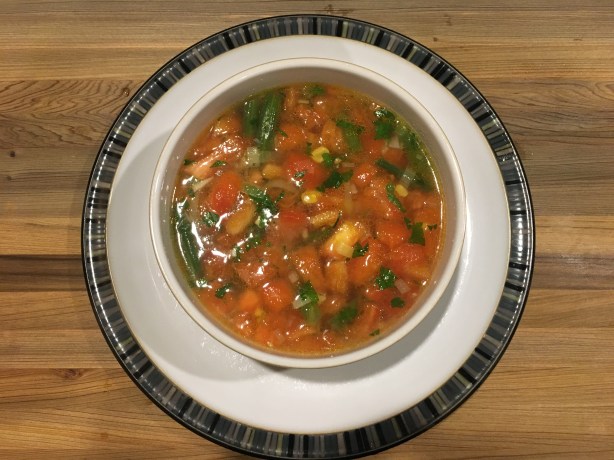
IMG_0169

A bowl of Alton’s vegetable soup.

This is a pretty basic vegetable soup recipe, and I have to admit that I assumed it would be quite bland. I also was unsure of whether Ted would like it, as he is not a huge tomato fan. Ted and I, however, were both pleasantly surprised at the amount of flavor in this soup! The individual vegetables maintained their textures and vibrant colors, and the soup had a bright, fresh vegetable flavor. The lemon gave the soup a perfect pop of much-needed acidity. The only thing you may need to adjust is the amount of salt, depending on how much you sprinkle in when sweating the leeks and garlic. This is a super easy, healthy recipe that you easily could make with kids in the kitchen, and it is a great way to eat a bunch of fresh vegetables.

Grape Gazpacho

Now that the weather is cooling off, we really aren’t in gazpacho season anymore. The ingredients needed for Alton’s grape gazpacho, though, are available year-round. Gazpacho is always better if allowed to sit for a few hours before eating, so plan to make this a few hours ahead.

IMG_0196

Tomatillos, cucumber, and Granny Smith apple.

The soup begins with seeding and chopping one cucumber.

IMG_0198

Seeded cucumber.

Place half of the cucumber in a food processor and the other half in a large bowl. Next, peel, seed, and chop a Granny Smith apple, placing half of it in the food processor and the other half in the large bowl.

IMG_0199

Peeled apple.

Chop 1 C husked tomatillos, and do the same as with the cucumber and apple, placing half of the tomatillos in the food processor and half in the large bowl.

Add the following ingredients to the food processor:  1 pound green grapes, 1 C toasted walnuts, 1 C plain yogurt, 1 C white grape juice, 1 t rice wine vinegar, and 6 mint leaves.

Pulse the ingredients in the food processor nine or ten times, until blended but still maintaining some texture.

IMG_0209

Mixture after pulsing 9-10 times.

Pour the mixture from the food processor into the large bowl with the cucumber, apple, and tomatillos, stirring to combine.

IMG_0212

Blended mixture added to bowl of fruit/vegetables.

Cover the soup with plastic wrap and refrigerate it for two-three hours before eating.

IMG_0242

Green grape gazpacho.

As with most cold soups, this one comes together super quickly, and it is super convenient since you can make it ahead of time. This soup was just okay for me, though it did have some interesting flavors. I found that it really called for the addition of some Kosher salt. The soup was certainly light and refreshing, and the walnuts gave it some body. I would definitely prefer this soup in warmer weather, as it has a slightly sweet and tart flavor from the grapes and tomatillos. This is another healthy and easy recipe that kids could certainly aid in making, but this wasn’t a favorite for me.