Posts Tagged ‘good eats’

Fresh Yogurt

Yogurt is one of those things that I always feel I should eat more of than I do. I tend to go in spurts with yogurt, eating it frequently for a while, and then not at all. Alton’s yogurt episode began with homemade yogurt. I made homemade yogurt once years ago when I was in grad school, as part of my food microbiology lab course. All I really remember from that experience was that I had a lab partner from Mongolia who called himself “Woody,” I could barely understand a word he said, and our yogurt was very pink. Needless to say, I was hopeful that my Woody-less yogurt would be more successful. When making Alton’s yogurt, you can use any type of milk that you choose, but Alton opted for organic 2% milk in the episode of Good Eats. Alton did say that whole milk will result in looser yogurt, while skim milk will yield yogurt with a grainy texture. In addition to a quart of milk, you will need 1/2 C of powdered milk, 2 T honey, and 1/2 C of plain yogurt, containing live cultures.

img_5475

Ingredients for homemade yogurt: plain yogurt with live cultures, dry milk, honey, and milk.

Begin by pouring your milk into a saucepan, adding the powdered milk and honey.

Meanwhile, allow your yogurt to come to room temperature.

img_5482

Plain yogurt, being brought to room temperature.

Using a probe thermometer, heat the milk mixture to 120 degrees over medium heat. Remove the milk from the heat, and pour it into a clean cylindrical container, allowing it to cool to 115 degrees.

Once the milk has cooled, whisk about a cup of the warm milk into the yogurt.

img_5488

About 1 C of warm milk whisked into yogurt.

Then, whisk the yogurt/milk mixture back into the cylinder of milk. Wrap the cylinder in a heating pad that will maintain the yogurt’s temperature between 100 and 120 degrees; you can test your heating pad first by filling your cylinder with water.

img_5489

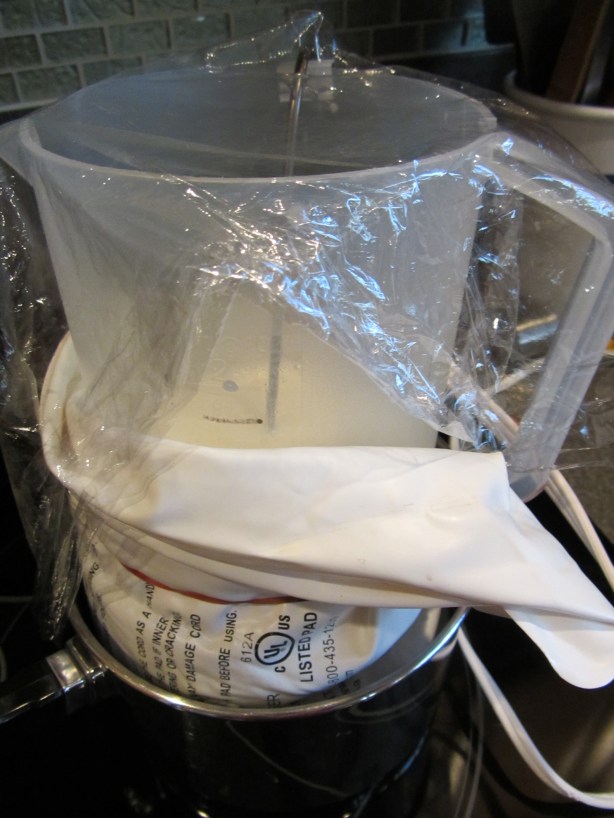
Yogurt added to milk and wrapped with heating pad to ferment for 6 hours.

Allow your yogurt to ferment for three to 12 hours, depending on how you like the texture of your yogurt; a shorter fermentation will yield looser yogurt, while a longer fermentation will give thicker yogurt. Alton did an even six hours in the episode.

img_5491

Yogurt, after fermenting for 6 hours.

Refrigerate your yogurt overnight before using.

img_5493

Alton’s homemade yogurt.

I thought this yogurt was fine, but really nothing special. If anything, I would have liked this yogurt to have had a thicker texture, so I would possibly ferment it a little longer if I were to make it again. Honestly, I wouldn’t go to the trouble of making this again when I can easily buy yogurt that I like just as much.

Thousand Island Dressing

So, really, Alton calls this dressing “Million Island Dressing” in the episode, and it is a good use for some of his homemade yogurt. To make his dressing, whisk together 1 C plain yogurt, 2 T vegetable oil, and 2 T tomato sauce.

img_5523

Yogurt, tomato sauce, and vegetable oil.

Once combined, add 2 t lemon juice, 2 t dry mustard, and 2 t sugar.

img_5525

Lemon juice, dry mustard, and sugar added to dressing.

Next, whisk in 1 t Kosher salt and 1/2 t pepper.

img_5526

Kosher salt and pepper added to dressing.

Finally, fold in 1/2 C diced onion, 1 T relish, 1 T chopped green olives, and 1 minced jalapeno.

I enjoyed this dressing more than I thought I would. It has a really good kick from the jalapeno, tang from the yogurt and lemon, and bite from the onion. It also adds a lot of texture to a salad. We actually liked this enough that I made it a couple times in one week for us to eat on our lunch salads. This is a really good salad dressing.

Tarragon Yogurt Sauce

If you are looking for another savory application for plain yogurt, this tarragon sauce is one to try. This sauce is very versatile and could be served over many things, including fish, eggs, and vegetables; in the episode, Alton says that his favorite use of this sauce is over braised carrots, so that is how I opted to use mine. For this sauce, begin by heating a saucier over medium heat, adding 2 T olive oil, 1/2 t Kosher salt, 1/2 C finely chopped onion, and 1 1/2 t minced garlic.

img_5530

Olive oil, Kosher salt, onion, and garlic in saucier.

I did not have a saucier until recently, but I inherited my parents’ copper-bottomed Calphalon saucier when my brother and I finished sorting through our parents’ belongings; thankfully, my parents are still living, but they really do not cook anymore. Yes, I have learned that a saucier is a very nice tool to have for a job such as this tarragon sauce. While your onion and garlic saute, combine 2 T cornstarch and 1 C chicken stock in a lidded container, and shake to combine. This slurry will help to thicken the sauce, and will also prevent over-coagulation of proteins, AKA curdling. Cream-based sauces have enough fat to prevent curdling, but yogurt-based sauces do not. Anyway, add the slurry to the pan, increase the heat, and add 1 1/2 T dried tarragon, whisking.

Remove the pan from the heat and temper 1 C of plain yogurt by gradually whisking in some of the sauce mixture. Finally, add the tempered yogurt to the pan, whisking.

Heat the sauce over low heat, just until warmed through. As I said before, we ate this sauce over carrots as a side dish.

The tarragon flavor in this sauce is quite strong, giving a real anise-like flavor, and you also really taste the yogurt. This is a sauce you could make with other herbs too; I think a dill version would pair terrifically with salmon. Either way, this is an easy sauce to dress up veggies or protein.

Yogurt Cheese

What is yogurt cheese? Yogurt cheese is yogurt that has been allowed to drain, removing whey. While cheese has had its whey removed, regular yogurt has not. Allowing yogurt to drain results in a thick yogurt that has a consistency similar to cream cheese. To make yogurt cheese, line a strainer with two layers of cheesecloth, setting the strainer over a bowl. Add a quart of plain yogurt to the strainer, folding the cheesecloth over the top.

img_5593

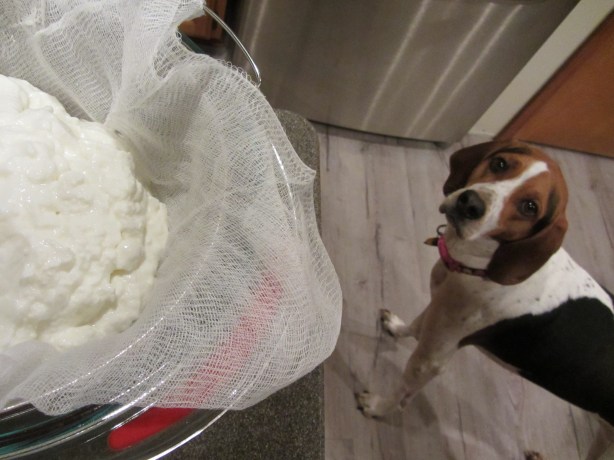
A quart of plain yogurt in a cheesecloth-lined strainer.

Weigh the yogurt down with the lid of a pot and a can, refrigerating it for four hours.

Yogurt cheese can be used plain as a spread, or in Alton’s recipe for frozen yogurt, which I will write about below. I tasted the plain yogurt cheese, but opted to use it for Alton’s other recipe; it tasted like plain yogurt… just much, much thicker.

Herb Spread

This herb spread is basically the same recipe as the one for yogurt cheese above, but with added seasonings. To a quart of plain yogurt (I used homemade) add 1 1/2 t cumin, 2 T chopped parsley, 1 t Kosher salt, and 1/2 t pepper.

img_5497

Cumin, parsley, Kosher salt, and pepper added to a quart of plain yogurt.

As with the yogurt cheese above, place a cheesecloth-lined strainer over a bowl and add the yogurt mixture.

img_5499

Seasoned yogurt poured in cheesecloth-lined strainer to drain.

Weigh the yogurt down with a pan lid and can, allowing it to drain for four hours in the refrigerator.

The resulting spread is tangy and has a punch of cumin, and it is great with crackers or on sandwiches.

img_5504

Herb spread with crackers.

Talk about an easy hors d’oeuvre, and it is even easier if you use store-purchased yogurt!

Lemon-Ginger Frozen Yogurt

This recipe is the perfect use for Alton’s yogurt cheese. Combine in a bowl 4 C plain yogurt cheese, 3/4 C sugar, 1/2 C light corn syrup, 2 t lemon zest, 1 T minced fresh ginger, and 3 T lemon juice.

Whisk the yogurt mixture until smooth and freeze in an ice cream mixture per the manufacturer’s instructions.

In the last few minutes of churning, add 1/4 C chopped crystallized ginger.

Freeze the frozen yogurt in the freezer until firm.

img_5606

Alton’s lemon-ginger frozen yogurt.

This frozen yogurt is super refreshing and reminds me of warmer weather (as I type this, it is snowy outside and the Christmas tree is illuminated). The first time we ate this frozen yogurt, the crystallized ginger seemed too chewy, but after freezing the yogurt for a longer period, the chewiness went away. I definitely foresee making this again, as it is packed with ginger and lemon flavor, and is a relatively healthy treat. This is worth making.


Artichokes were the star of the 70th episode of Good Eats. Alton first prepped artichokes in a traditional way, serving them cooked whole. There is no online link to this particular recipe, but I will spell it out as well as I can. This was my first time eating a whole artichoke in quite a long time, as my parents went through quite a phase with artichokes when I was a teenager. Seriously, we ate steamed artichokes a couple times a week for quite a while, and my brother and I were eventually completely burnt out. Having Alton’s version of the whole artichoke has rekindled my adoration for the thistle (FYI artichokes are thistles), and I will be serving them periodically as a side dish.

When selecting artichokes to eat whole, pick ones that are about the size of a large orange, are heavy for their size, and that have tight, crisp leaves.

img_5431

Whole artichokes.

Alton recommends storing them in the refrigerator in a 2-liter soda bottle that has been cut in half and placed back together to form a capsule. Prior to cooking your artichokes, dip them upside down in cold water, swirling them to release any debris in their leaves. Using an electric knife, cut off the tops and bottoms of the artichokes, saving the stems. Peel the stems prior to cooking and cook them with the artichokes; cooking the stems was new to me, but definitely worth it.

img_5432

Artichokes, tops and bottoms cut off, and stems peeled.

To cook the chokes, put 2 t Kosher salt in a wide stainless steel of anodized aluminum pot (artichokes can react with other metals, producing off-flavors and colors). Add the artichokes, stem side up and cover them with cold water by at least an inch.

The artichokes will float, but you can weigh them down with a steamer basket insert and a weight.

img_5436

Artichokes, weighed down with a steamer basket insert and weight.

Bring the water, uncovered, to a boil over high heat. Don’t forget to throw in the stems! Artichokes contain both chlorophyll and acids, which are normally separate. However, when you cook an artichoke, the acids and chlorophyll combine, producing compounds that will turn artichokes brown; these compounds are volatile, so you can let them evaporate by keeping your pot uncovered. If you do not want to watch the pot, you can insert your probe thermometer, setting the alarm for 210 degrees. Once your water is boiling, decrease the heat and let the artichokes simmer for 10 minutes. Test the artichokes by inserting a sharp paring knife into the stem end – if the knife goes in with little resistance and comes out clean, the artichokes are done.

img_5437

Artichokes, after being brought to a boil and simmering for 10 minutes.

Drain your cooked artichokes in a foil-covered colander for at least five minutes before serving. To eat the artichokes, serve them next to lemon butter, dipping each leaf and scraping the “meat” with your teeth.

img_5441

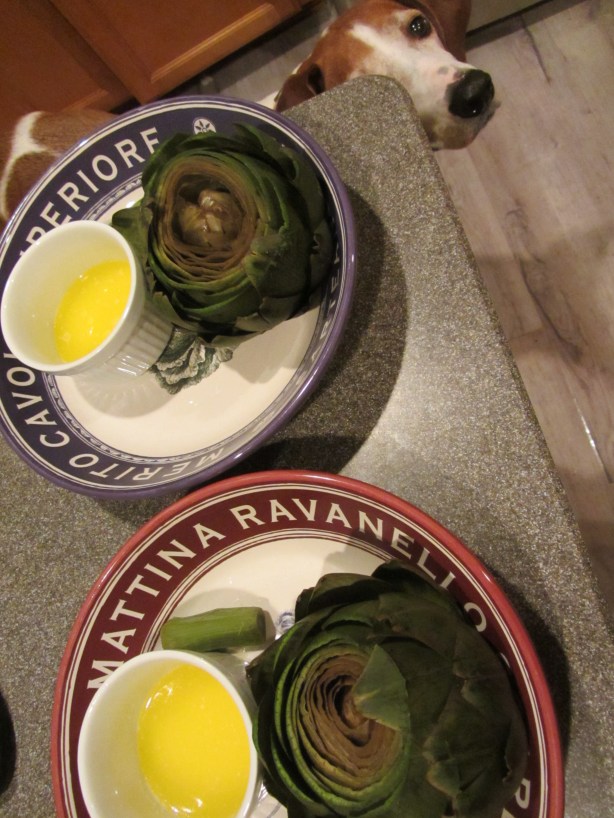
Cooked artichokes, served with lemon butter.

Once you only have tiny leaves remaining, pull the leaves apart, exposing the hairy choke inside.

Pressing down on the choke with one hand, use a sharp paring knife to cut around the base, just under the dark green line.

img_5447

Using a sharp knife to cut around beneath dark green line.

Pull the top off and discard, and remove any remaining hairy tufts. Eat the remaining base of the artichoke, dipping it in lemon butter.

We really enjoyed Alton’s preparation of whole artichokes, especially since neither of us had eaten on in years. In fact, we liked them so much that we cooked them a second time last week. And, the bases and stems are totally worth eating – good eats for sure!

Broiled Chokes

Alton’s second artichoke preparation is for broiled chokes. For this recipe you will need a grapefruit spoon, a serrated knife (preferably electric), a vegetable peeler, two containers of acidulated water (water with lemon juice added), and a cutting board. Holding a whole artichoke, first pull off and discard all of its leaves until you have just a purple interior remaining.

Run a vegetable peeler down the sides of the choke and the stem. Also run the peeler around the outside until you have a smooth surface. To help prevent browning, dip your utensils in one container of acidulated water between uses.

img_5453

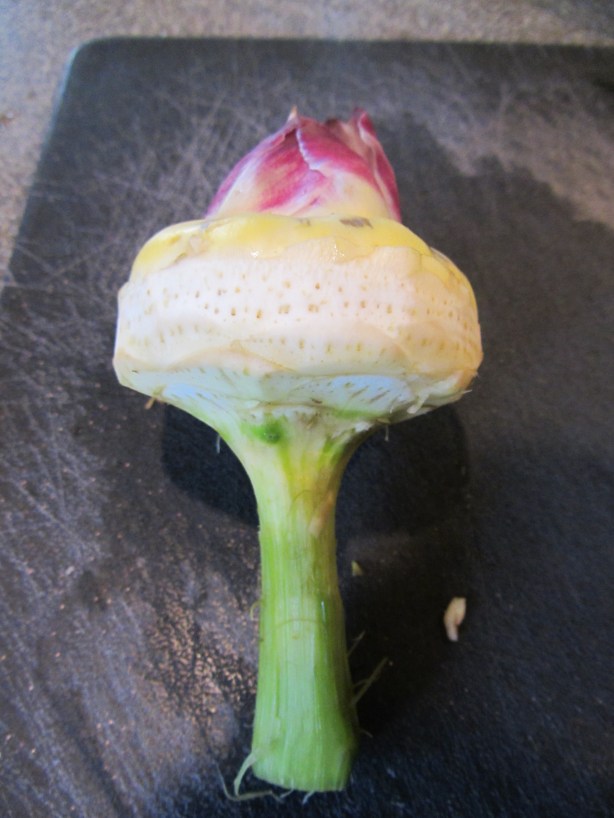
Artichoke, after being cleaned up with a vegetable peeler.

Once your choke is clean, use an electric knife to cut it in half. Use a grapefruit spoon to pry out the hairy choke, which will probably take a few tries. Place the cleaned choke in the second container of lemon water while you clean the others.

When ready to use, drain the chokes and wrap them tightly in paper towels. Toss them with olive oil, Kosher salt, and pepper, and broil them, face-up, on a rack 5-6 inches below the heat for five minutes. Flip the chokes and broil for three minutes on the second side.

Eat the chokes as they are, or do as Alton did in the episode and marinate them in his herb oil, which I will write up below.

Herb Oil

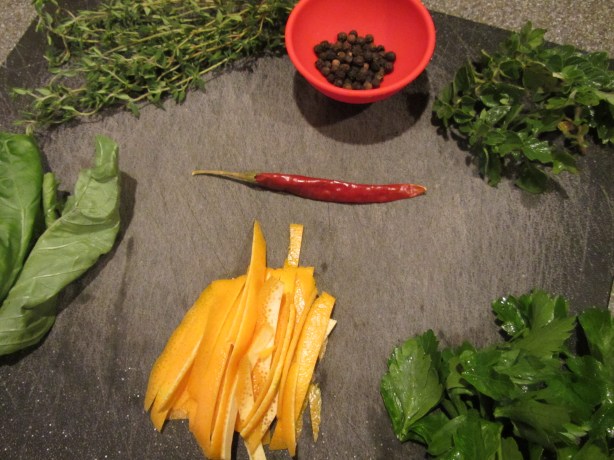
According to what he says in this episode, Alton prefers to marinate his broiled chokes (above) in herb oil. His oil can be made by heating to 200 degrees a pint of canola oil with a cup of olive oil in a saucepan. While the oil heats, add to a mason jar:  the zest from half an orange, 1/2 C fresh parsley, 1/2 C fresh thyme, 1/2 C fresh basil, 1/2 C fresh oregano, 1 dried arbol chile, and 1 t black peppercorns.

img_5424

Ingredients for Alton’s herb oil: fresh thyme, black peppercorns, fresh oregano, fresh parsley, orange zest, fresh basil, and a dried arbol chile.

Pour the warm oil over the herbs, letting the oil sit overnight; my oil got a little cloudy overnight, but later cleared again.

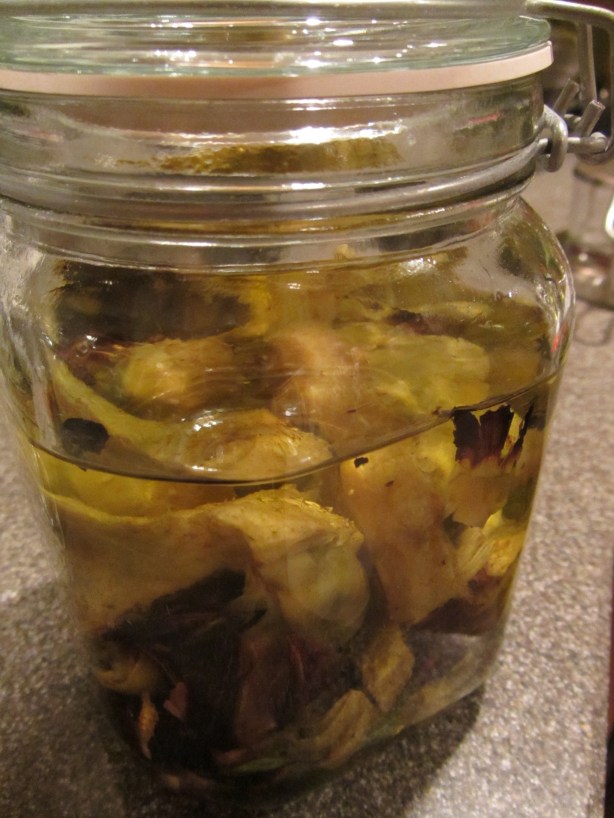
The following day, strain the herb oil by pouring it through cheesecloth into a jar containing your broiled chokes. Let the chokes marinate for a couple days before using.

And, what is Alton’s preferred use for his marinated chokes?

img_5472

Broiled chokes, after marinating for a couple days.

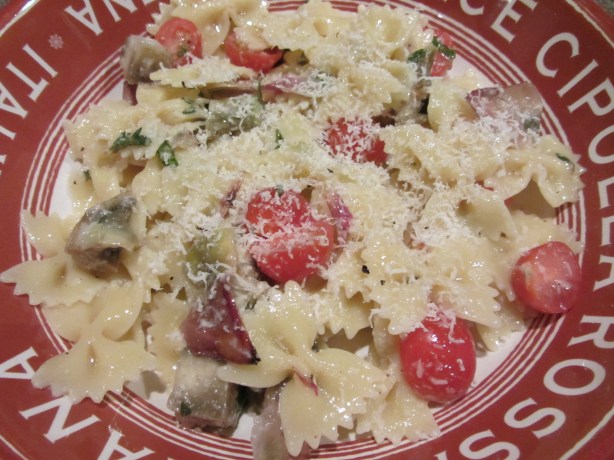
He prefers to make a pasta salad with bowtie pasta, the marinated chokes, some of the herb oil, red wine vinegar, small tomatoes, herbs, Parmesan, and pepper (he did not actually prep a pasta salad in the episode). I took his advice and tried his marinated, broiled chokes in such a pasta salad.

img_5473

A pasta salad made with Alton’s marinated chokes.

While the chokes were good, I cannot say that they were honestly worth all the effort. Honestly, I think the bottled, marinated artichokes from Costco are just as good as Alton’s, and for zero effort. While I am glad I now know how to prep an artichoke, I won’t be making these again.

Clotted Cream

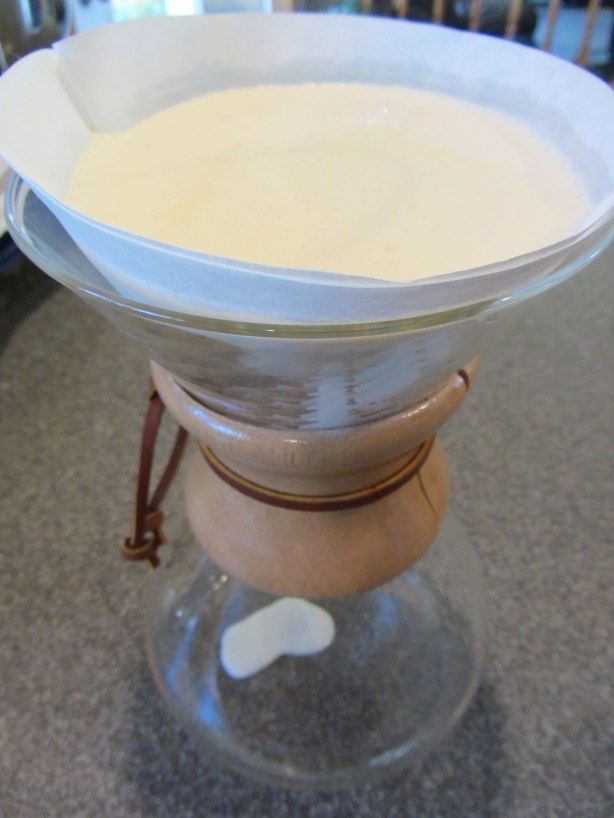
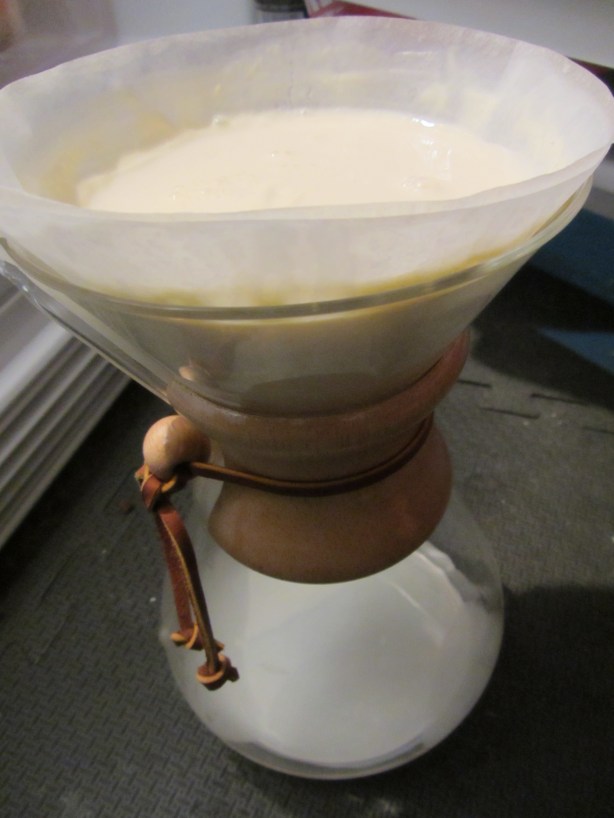
Though I heard of clotted cream, I had never had it before I made it for this episode of Good Eats. And, as recipes go, it does not get easier than this one. Place a paper coffee filter in a coffee filter basket, setting it over a bowl or measuring cup. Or, you can do as I did and use a Chemex coffee maker. Pour cream into the filter, filling it almost to the top.

img_5327

Cream poured into paper coffee filter, allowing whey to drain into container below.

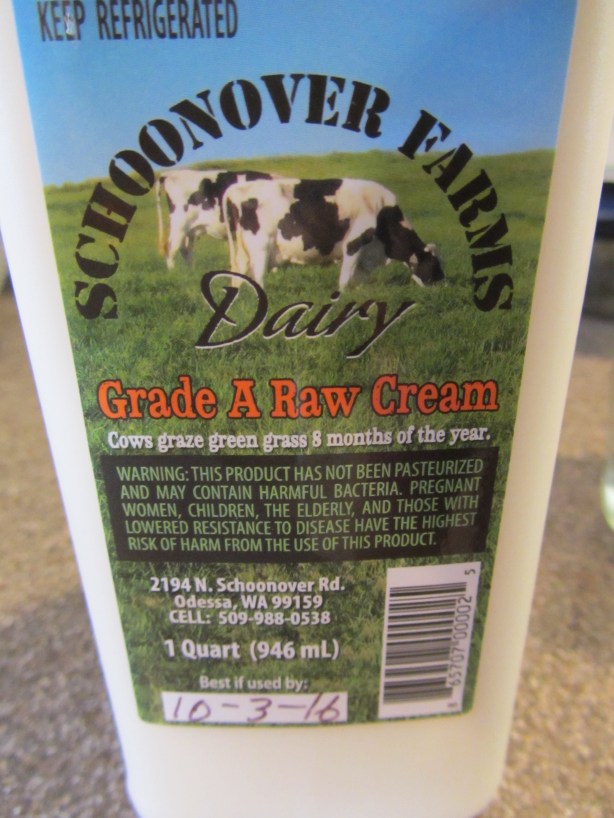
The key here is to use cream that is not ultra-pasteurized. I actually used raw cream.

img_5325

Raw cream.

Refrigerate the cream for 6-8 hours, allowing the whey to drain into the bowl, while leaving the thickened cream in the filter. Scrape the sides of the filter every two hours with a spatula until you have cream that is the consistency of softened cream cheese.

img_5341

Cream after being refrigerated for several hours.

Serve the clotted cream with fresh strawberries.

img_5358

Clotted cream with fresh strawberries.

I thought this was fun and easy to make, and the unsweetened cream paired well with sweet berries. I think I will make this again when the weather gets warm. Next time, I will probably opt for pasteurized cream, rather than raw, because the raw cream had a bit of an animal-like flavor. I served Alton’s clotted cream with the following recipe for macerated berries.

Macerated Strawberries

My mom used to make macerated berries quite often, but her version was quite different from Alton’s. While Alton’s version is wine-based, Mom’s version simply used balsamic vinegar and a little bit of sugar and black pepper. Mom usually made these in warmer months, serving them as a light dessert after dinner. Trust me… balsamic vinegar pairs wonderfully with strawberries. For Alton’s macerated stawberries, pour a bottle of red wine into a large bowl, adding two pints of hulled/sliced strawberries.

Note:  Alton has an excellent trick for hulling strawberries – simply use the star tip for a decorating bag, twisting it into the top of the berry and pulling the hull out. Works great!

To the berries, add 1/4 C orange blossom honey, 1 t lemon zest, and 1 t black pepper. If you want softer berries, also add 1 1/2 C sugar (I added the extra sugar, as Alton indicated that you want softer berries for the next recipe).

Marinate the berries for two hours before serving.

img_5342

Berries after marinating for 2 hours.

I reserved half of these berries for the next recipe, while we ate the rest of these with Alton’s clotted cream. These berries were quite tasty, though I will say the dominant flavor was that of the wine. I have to admit that I would choose Mom’s macerated berries any day over Alton’s. So, if you want good macerated berries, try Alton’s. If you want great macerated berries, try Mom’s.

Strawberry Pudding

Of the recipes in this episode, this is the one I most excited to make. It just looked like it would be fun. For this one you’ll need 1/2 a recipe of Alton’s macerated strawberries and 16 slices of potato bread, with four of the slices buttered on one side (I halved this recipe since I only needed two servings).

You will also need four 13.5-ounce cans with both ends removed, along with four of their lids. Finally, you need four full soda cans and a sheet pan lined with parchment paper. To begin, use the empty cans to cut a round out of each slice of bread. Cut the buttered slices last, leaving the rounds in the bottom of the cans, butter side up.

Top each buttered round with ~2 T of macerated strawberries, topping with another layer of bread. Alternate the berry and bread layers, finishing with bread.

Place the can lids on top of the last bread layer and weigh the lids down with the full soda cans. Refrigerate the cans for eight hours.

Transfer each can to a plate, using a spatula. Carefully slide each can off, and remove the can lid. Pipe whipped cream or serve clotted cream on top of the puddings.

img_5383

Strawberry pudding after removing can/lid. Topped with clotted cream.

These were fun to make, super easy, and pretty. And, honestly, you could make this with any fruit. I am not quite sure why this dessert is called a “pudding,” but we really enjoyed it. This is one I will be making again for sure. We don’t have kids, but I would imagine kids would really have fun with helping to make this too.

Glazed Strawberries

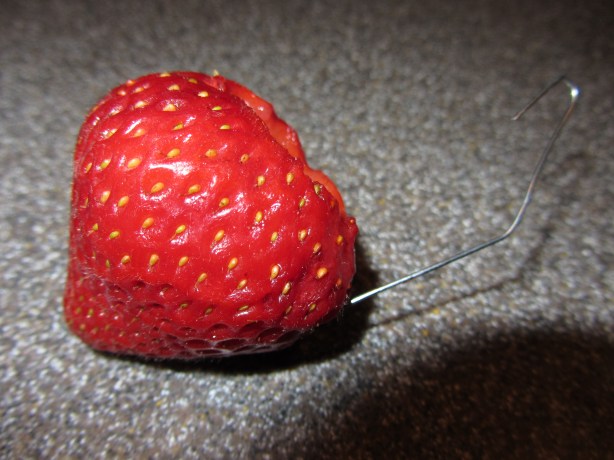
This recipe is not posted online, but Alton prepped these berries in the episode. Using an unfolded paperclip, pierce the big end of a strawberry.

img_5411

Unfolded paperclip in a strawberry for dipping.

Dip each berry in 1 C of apricot preserves melted with 1 T orange liqueur.

Let the berries cool slightly. Devour.

img_5415

Glazed strawberries.

These were easy and really delicious. They are sweet and slightly tart, with just a hint of orange. They also look super pretty, as the glaze gives the berries a very nice sheen, enhancing their red color. These would be super pretty on a plate at a party. I highly recommend these.

Chimney Tuna Loin

After I watched episode 68, I realized I was going to have to do some serious hunting to find high-quality tuna loin to sear. We live inland, so it can be challenging (and sometimes expensive) to find certain ingredients. I decided to ask the resident ceviche expert of my town where I could purchase sushi grade tuna; his expression told me all I needed to know, and I realized I would have to give in and order some fish online. A few days later, a cooler arrived at my door with a pound of fresh tuna from California.

I was struck by one thing when I first looked at this recipe online – this recipe gets great reviews. Ideally, when preparing tuna, you want to eat it the day it is purchased, but you can store it for a day or so by wrapping it in plastic and placing it on crushed ice in a perforated tub; place the perforated tub inside a second tub to catch any draining liquid, and change the ice 1-2x per day.

To sear your tuna, you will need natural chunk hardwood charcoal and a chimney starter. Fill your chimney starter to the brim with charcoal and spritz some newspaper with canola oil, placing the newspaper under the chimney starter; the oil will slow the burning of the paper. Light the newspaper with a lighter and let the fire build until it is very hot and the coals have gone down about 50%.

While your fire is heating up, trim your tuna into blocks that are about 4x4x2 inches, removing any bloodline.

img_5386

My tuna, cut into two blocks for searing.

For a marinade, combine 1/2 C soy sauce, 1/2 C honey, and 1/4 C wasabi powder, reserving 4 ounces of the marinade for a dipping sauce later.

Place the fish into the marinade for 1-4 hours. Alton marinated his fish for an hour in the show, so that is what I did. When ready to cook, drain the marinade from the fish and roll the fish in sesame seeds, coating four sides.

Place an oiled grill grate over the top of your chimney starter and add your fish. You will want to sear your fish for approximately 30 seconds per side, scraping any burnt sesame seeds off the grate each time you turn the fish.

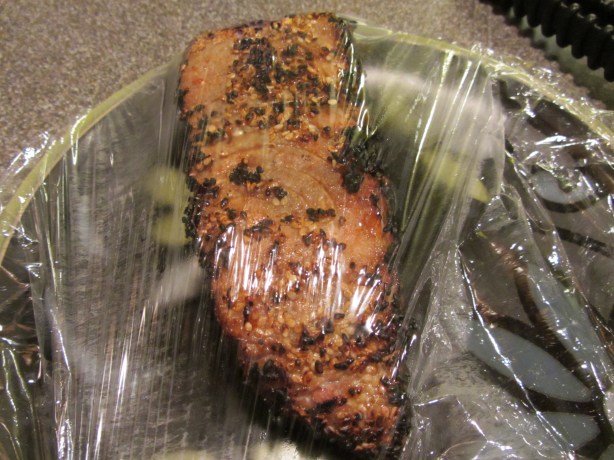
Place the fish on a clean plate and tightly cover it with plastic wrap for 3 minutes. You can serve the fish immediately, or you can wrap it in fresh plastic and refrigerate for up to three days.

img_5398

Seared tuna, covered in plastic for 3 minutes.

Slice the fish thinly just prior to serving, and eat with the reserved marinade as a dipping sauce.

img_5399

Seared tuna, thinly sliced.

This was kind of a special dinner for us since we paid more than we normally would for fish. My fish appeared to be cut as more of a steak, rather than as a center cut of loin, so it was tricky to cut the fish into a uniform block for even cooking. If anything, my fire was possibly a little too hot, as my sesame seeds were really burning, so I would maybe let my fire go a little longer next time before commencing cooking. The marinade/dipping sauce was really zippy, packing quite a punch of heat from the wasabi.

I was happy with the quality of the fish I purchased, as it had zero fishy flavor and a nice red interior. This is one I would really like to try again, but it would probably be reserved for special occasions since the main ingredient is expensive and difficult to find where I live. However, if you happen to live where you can easily find fresh tuna, I would definitely suggest trying Alton’s seared tuna. No matter what, it was fun to try!

It’s hard to believe that this post will finish up five seasons of Good Eats – only nine more seasons to go! So, what did Alton choose to finish up his fifth season with? Potatoes were the choice for this season finale, and if you recall, they were also the subject of the second episode of Good Eats. It’s only fair for the mighty potato to star in two episodes since there are so many things you can do with it, such as…

Leftover Baked Potato Soup

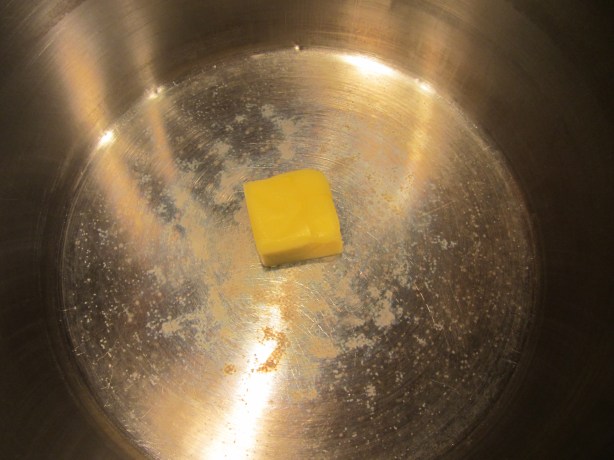
First up was Alton’s potato soup. This soup comes together pretty quickly, so you can easily make it on a weeknight. Begin by melting 3 T butter in a pot.

img_5279

3 T butter

Add 1 1/2 C diced leeks, 1 1/2 T minced garlic, and some Kosher salt. Sweat the leeks until they are translucent and add 6 C chicken stock to the pot, increasing the heat to a simmer.

While the liquid simmers, press four baked russet potatoes through a ricer into a bowl. Though the online recipe says you should peel the potatoes, Alton did not peel his potatoes in the episode.

Pour 1 1/2 C buttermilk into the riced potatoes, whisking. The starch from the potatoes will prevent the buttermilk from curdling when it is added to the hot stock. Also whisk 1/2 C sour cream and 1/2 C grated Parmesan into the potato mixture.

By the time you are done prepping the potatoes, the stock should be simmering nicely on the stove. Add the potato mixture to the hot stock, and bring the soup back to a simmer.

Just before serving, stir 2 T sherry vinegar into the soup.

img_5291

Sherry vinegar, to be stirred in right before serving.

Garnish the soup with Kosher salt, pepper, and chopped chives.

img_5293

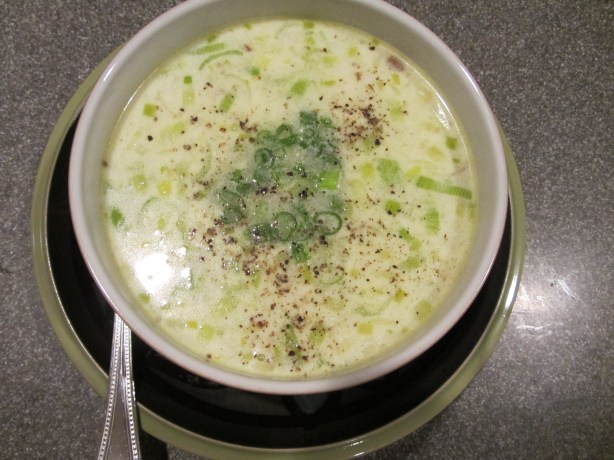
A bowl of Alton’s potato soup with Kosher salt, pepper, and chives.

I fixed this soup for us two nights ago after baking my potatoes earlier in the day. The soup itself really takes no time at all to make. We liked this soup, though I prefer potato soup that is a bit thicker and that has chunks of potato. I did like the tang this soup had from the vinegar, buttermilk, and sour cream, and leeks always pair well with potatoes. Overall, I’d say this was good but not spectacular. I give it an ‘A’ for flavor, but only a ‘C’ for texture/consistency.

Cold-Fashioned Potato Salad

Just as with potato soup, you couldn’t very well have a potato episode without including a recipe for potato salad. This was one of those recipes where I got hungry watching Alton make it. Begin by placing 2 1/2 lb small red potatoes in a pot, covering them with cold water.

img_5216

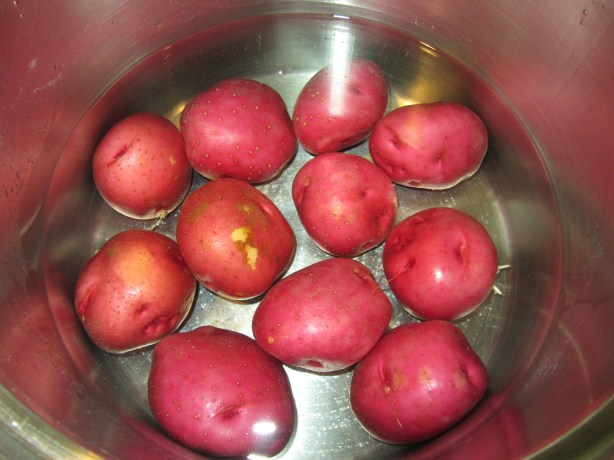
2 1/2 lb red potatoes covered with cold water.

Bring the water to a boil, and then drop the heat to a simmer. Check the potatoes after 5 minutes, and every 3 minutes thereafter for doneness; you should be able to stick a skewer through a potato with no resistance. If you cook your potatoes too quickly or for too long, their skin will crack. I thought my potatoes were done after about 20 minutes of cooking. Drain the water from your potatoes and immediately place them in ice water for 2-3 minutes to halt their cooking.

Again, drain the potatoes. According to Alton, you should be able to easily remove the skins of your potatoes by simply rubbing them in a tea towel, but this was not the case for me, and I ended up using a peeler. Either way, once your potatoes are peeled, thinly slice them; if you have an egg slicer, that will work well for this. Place your still-warm potato slices in a large Ziploc bag, add 3 T cider vinegar, seal the bag tightly and place it in your refrigerator overnight.

The following day, combine in a bowl:  3/4 C mayonnaise, 1/2 t dry mustard, 2 t minced garlic, 1 T minced tarragon, and 1/4 C chopped parsley.

img_5226

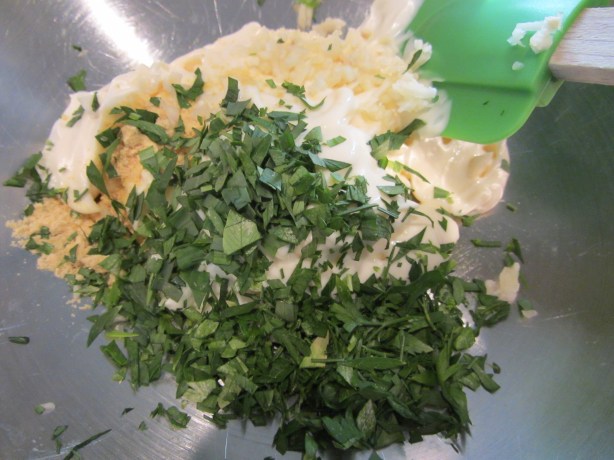
Mayonnaise, dry mustard, garlic, tarragon, and parsley.

Once combined, add 1/4 C chopped cornichons, 1/2 C minced red onion, and 1/2 C thinly sliced celery.

Give everything a good stir and fold in the potato slices, along with their vinegar. Season to taste with Kosher salt and pepper.

Remember how my potato skins did not come off very easily? Yeah, I’m pretty sure that’s because I didn’t cook them quite long enough. I loved the combination of flavors in this potato salad, but my potatoes were a little too toothsome. It seems to me that most people generally prefer either creamy potato salads or German-style potato salad. I felt that this recipe would really please both camps, as it is both creamy and acidic. The dry mustard and red onion give the salad a nice bite, while the celery and cornichons lend a good crunch. I also really liked the anise-like flavor from the tarragon. This is a winning potato salad – just be sure to cook your potatoes long enough. Doh!

Potato Roesti

I really did not know what a roesti (“roshe-ti”) was until I watched this episode. Basically, it is like a hashbrown that contains onions and is tender on the inside. I made this for breakfast for us last weekend, as it seemed like a perfect breakfast before a 14-mile run. You will start by grating 3 Yukon Gold potatoes and 1 onion. Spin the potatoes and onion in a salad spinner, getting rid of as much moisture as possible.

This recipe makes four servings, and Alton recommended seasoning/cooking each serving separately, as the salt will pull moisture out of the potatoes. Since I knew we had a long run ahead of us, I divided the mixture into only two portions. While you melt 1/2 T butter in a nonstick skillet, season 1/4 of the potato mixture with Kosher salt and pepper. Add the seasoned potato mix to the melted butter, using a spatula to form a thin, round cake. You should hear a light sizzle when you press the cake with a spatula.

Cook the roesti for 7 minutes or until golden; now it is time to flip. Cut 1/2 T butter into chunks and disperse it on top of the roesti. Slide the cake onto a pan lid, using the lid to flip the cake back into the pan, butter down.

Cook the roesti for ~5 more minutes, or until golden brown. If you want to serve your cakes all at once, you can keep them warm in a low oven for ~20 minutes while you cook the other cakes. Serve the roesti with sour cream.

img_5263

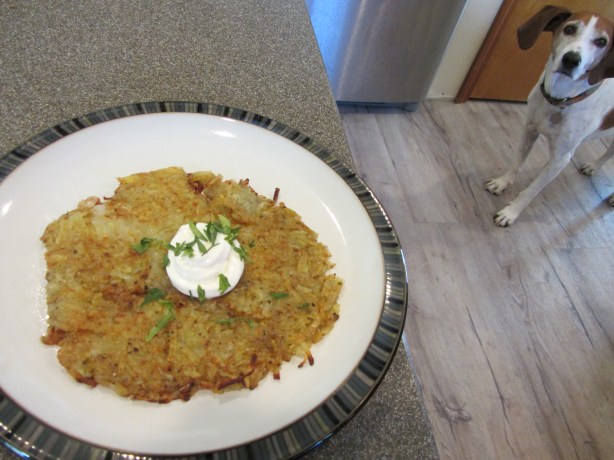
Roesti with sour cream.

We thought this was tasty. At first, we thought it was possibly undercooked inside, but then I read that a roesti is supposed to be tender inside. I liked the additional flavor the onion added to potatoes, and the crispy exterior. I like sour cream, but wasn’t sure how I would like this combo; it turns out that sour cream really did pair nicely with this. The one thing I will say is that we had some GI issues as the day progressed, and I have to wonder if they could have been from the roesti. This did make for a tasty breakfast, so I think I will have to give it another go and hope for the best. With that… onto the 6th season!

Clams on the Half Shell with Fresh Mayonnaise

Once again, with this episode, my Good Eats project has led me to prepare a food item at home that I have never before prepared. This, to me, is the best part of this project, as I am learning to cook things I potentially would never have otherwise attempted. Clams, this time, were the subject of my exploration.

Though I have eaten other shellfish on the half shell (namely oysters), clams on the half shell were new to me. Really, this isn’t so much a recipe, but rather more of a method. Here’s a link to Alton’s recipe. All you really need for this preparation are fresh, live clams and a batch of Alton’s mayo, which I made previously. When eating raw clams, you want small clams (like littlenecks), as they are more tender than larger clams. When purchasing clams, you want to go to reputable seller and you want to purchase clams that are closed, very hard, and that sound like rocks when you tap them. My grocer had to special order littleneck clams for me and they seemed to be pretty fresh. Clams do sometimes open a little bit, even when they are alive, but they should close if you tap them; discard any clams that do not close when tapped. Also, it really is ideal to purchase clams the day you plan to serve them. Store them in your refrigerator before use in an open container that has been topped with a wet paper towel. When ready to serve your clams, dump them in a colander and give them a good rinse.

img_5186

Littleneck clams after being rinsed off.

Wipe off any additional grit in a clean tea towel. Next, set them in the freezer for 30 minutes before shucking, as this will make the process easier.

img_5187

Littlenecks, ready to be wiped dry in a tea towel before going in the freezer for 30 minutes.

To shuck, insert a butter knife into the groove at a “corner” of the shell, working the knife between the sides of the shell and prying it open.

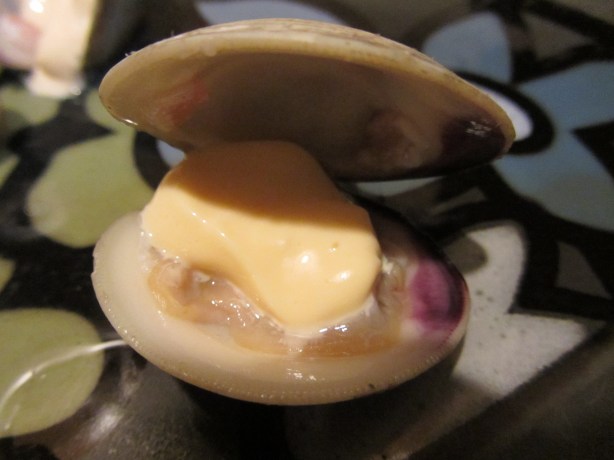
Detach the meat from the shell by scraping it off of both sides of the shell with the knife, leaving the meat in the bottom side of the shell. Set your clams on a serving plate, topping each clam with some of Alton’s mayo.

img_5191

Not the greatest photo, but a shucked littleneck with Alton’s mayo.

My shells were really lopsided and toppled a bit, so setting them on a bed of greens may make a more attractive presentation. We ate our raw clams as an appetizer one evening, having just a handful or so each. When I eat raw shellfish, I prefer to have condiments, so I liked the addition of Alton’s mayo, which I love anyway. Since I’m a newbie to prepping raw shellfish, I get a little nervous when I am eating them at home, so I think I would have enjoyed raw clams more if I were eating them in a restaurant. Overall, I’ll say that we thought they were good, but not fantastic, and I don’t know that I’ll be jumping to prepare them again anytime soon.

Radonsky for the New Millennium 

For the second recipe in this episode, Alton used cherrystone clams, which are larger than littlenecks. I could not find cherrystone clams where I live, so I ended up using manila clams for this one.

img_5265

My manila clams.

As with the recipe above for clams on the half shell, you will want to shuck your clams, but for this preparation you will only want to detach the clam meat from one side of the shell. You will also want to discard the empty half of the shell from each clam.

img_5268

Shucked clams.

Mix together 1/4 C flour, 1/4 C breadcrumbs, 1 T freshly grated Parmesan, black pepper, and Kosher salt. Sprinkle the flour mixture liberallly over the shucked clams.

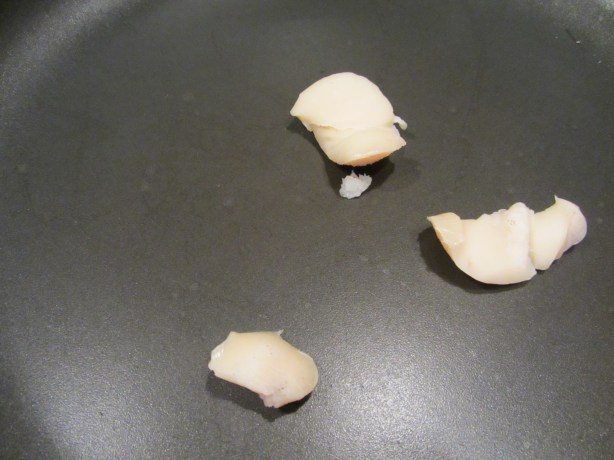
Melt 3 T bacon fat in a skillet over medium-high heat; we keep bacon fat in the refrigerator for occasions such as this.

img_5267

Bacon fat in the pan.

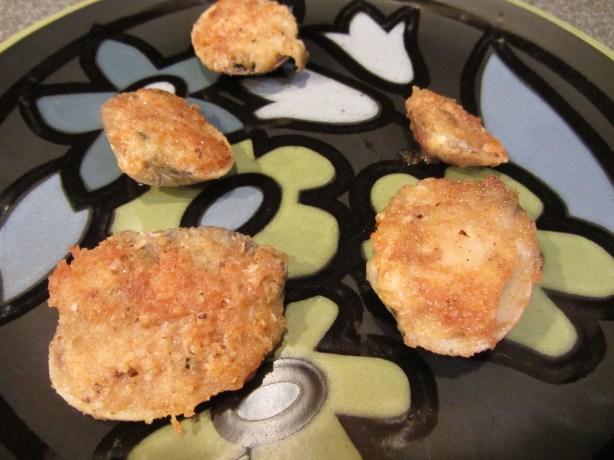
When the bacon fat has melted, fry the clams, shell side up, until they are golden brown and their shells have lightened in color.

img_5272

Clams frying in bacon fat.

Serve the clams with malt vinegar and parsley.

img_5275

My fried clams.

So, I really thought I would like these better than the clams on the half shell, but it turned out that we both found the clams to be too strong in flavor. I liked the crispy coating on the clams and the tang from the malt vinegar, but the clams I used were extremely briny in flavor and had a strong aftertaste that lingered. Perhaps this recipe would have been better with littlenecks? If I were to make this again, I would try it with littlenecks, or cherrystones if I could find them.

Clam Chowder

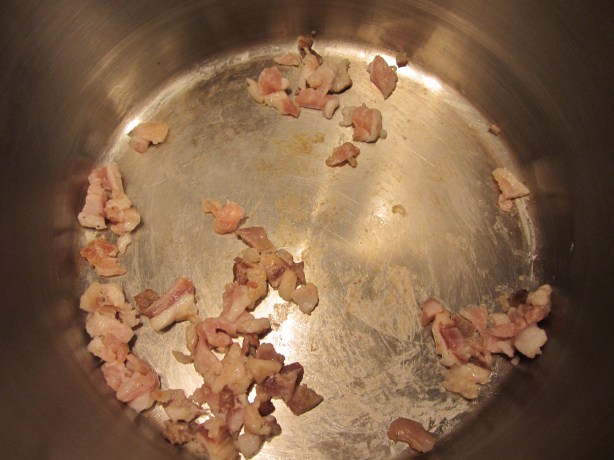
A clam episode would not be complete without a recipe for clam chowder. We always seem to eat more soup in the fall, so clam chowder seemed like a perfect thing to eat on a fall evening, though I am still clinging to the idea of summer. This recipe begins by rendering the fat from 3 ounces of salt pork or bacon over medium heat; I used Alton’s bacon that I made previously.

img_5192

Bacon fat rendering.

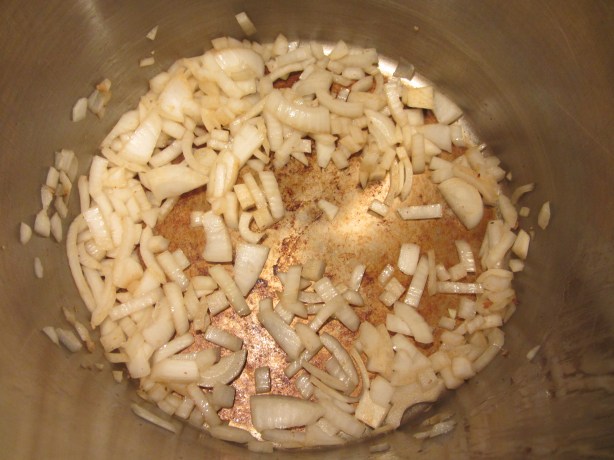
Once the fat is rendered, remove the meat pieces from the pan and save for another use. Add 1 1/2 C chopped onion to the pork fat and cook until translucent.

img_5195

Onion added to bacon fat.

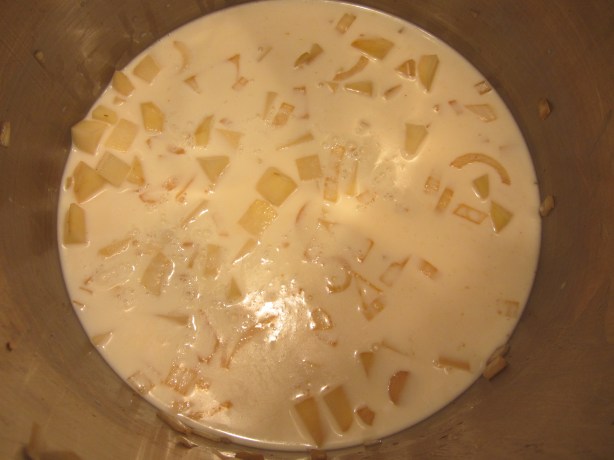
Next, add 6 C of cubed russet potatoes, peeled (this is about 4 medium or 3 large russets). Add whole milk to the pan, just to cover the potatoes.

img_5197

Potatoes and whole milk added to pot.

Meanwhile, drain and reserve the juice from 14 ounces of canned clams, and chop the clam meat. You will want to have at least 1 C of clam juice; if you do not, add water to make 1 C of liquid.

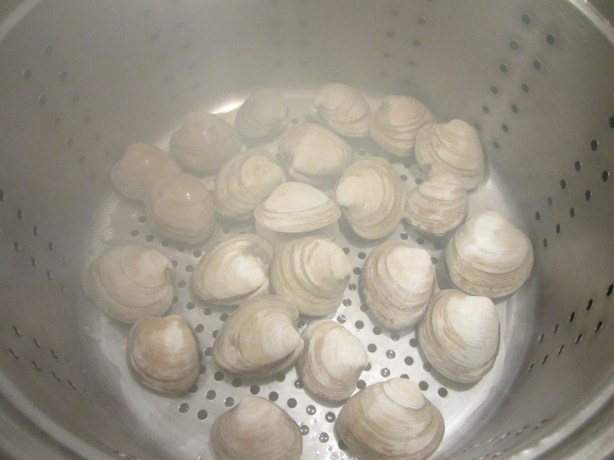
Pour the clam juice into the bottom of a steamer and steam 12 clams over the clam juice, checking on them after 5 minutes.

img_5205

My clams, steaming over canned clam juice.

Remove the clams as soon as they open, as they will become tough if overcooked. Save the steaming liquid!

img_5208

Steamed clams.

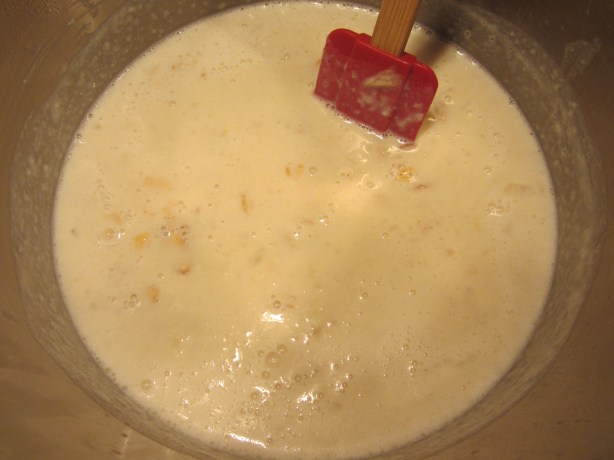
When the clams are steamed, use an immersion blender to blend the potato mixture to your desired consistency – I left some lumps in mine.

To your blended soup, add ~1/2 of the steaming liquid and taste it. Alton cautioned that the steaming liquid can be quite salty, so you want to add it gradually. I wound up adding all of my steaming liquid, as it did not make my soup overly salty. Fold in your chopped canned clam meat.

img_5210

Canned clams and steaming liquid added to soup.

Top the soup with black pepper, sour cream, parsley, and grape tomatoes, and serve with steamed clams on the side.

img_5214

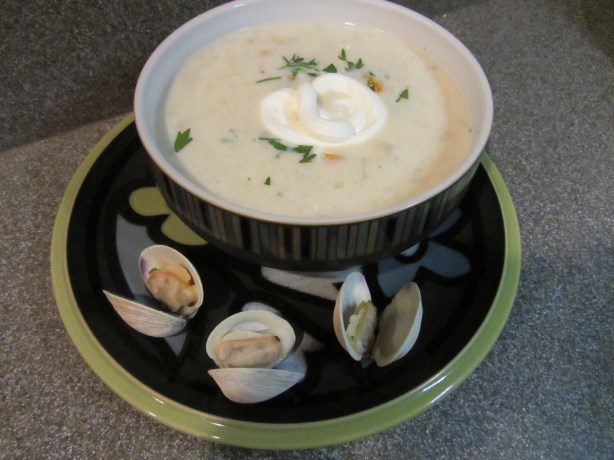
Clam chowder with parsley, pepper, tomatoes, sour cream, and steamed clams.

We both thought this chowder was great. It had lots of clam flavor and pieces, along with plenty of potatoes. Ted even declared this one of the best clam chowders he has had. I don’t know if serving the steamed clams on the side is even necessary, though it does make for a nice presentation. I was not sure about serving the soup with sour cream and tomatoes, but I actually quite liked the garnishes. I will make this one again. It makes for an easy weeknight meal.

Now seemed like a good time for me to do another Good Eats special episode. The second special episode, “Down and Out in Paradise,” has a tropical theme, so I wanted to prep all of its recipes while it is still summer. This is an episode that I clearly remember watching when it originally aired, watching it along with my dad. With a whopping eight recipes, this episode took a little time to complete, but it was a fun one.

Coconut Shrimp with Peanut Sauce

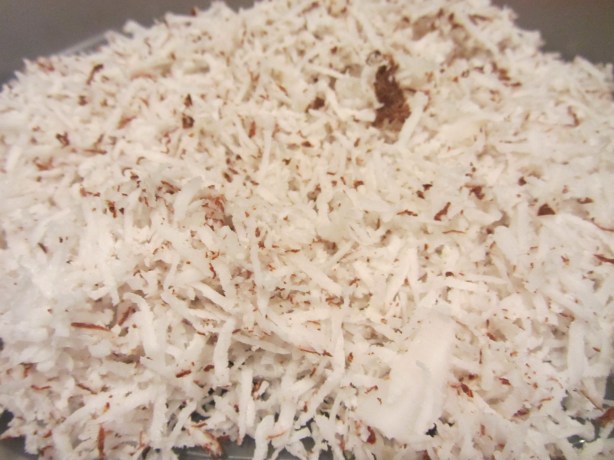
First up, a shipwrecked Alton prepared coconut shrimp in his island abode. While you could use shredded coconut from the grocery store for this recipe, if you really want to make it Alton’s way, you will roast and shred your own fresh coconut. To do this, place a whole coconut in a 350-degree oven for 30 minutes, which should cause the shell to crack. Wrap the cooked coconut in a towel and whack it on a hard surface to fully crack the shell.

Using a sharp knife, score the coconut flesh in quarters and remove it from the shell; it is okay if the brown membrane remains. I found that it was difficult to remove the coconut from the shell, while Alton made it look super easy. Once you have all of your fresh coconut meat, you can grate it by hand or in a food processor, or you can store the meat for a week in the refrigerator, covered with cold water.
IMG_5090

Shredded fresh coconut.

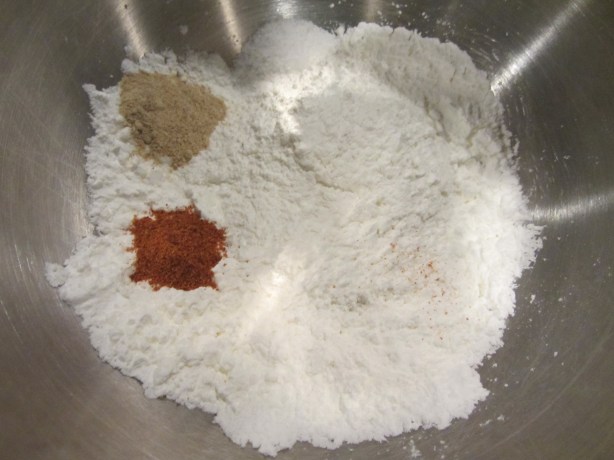
Additionally, for this recipe you will need 15-20 count shrimp (cleaned and de-veined), cornstarch, Kosher salt, white pepper, cayenne pepper, egg whites, and peanut oil. Begin by combining 1/2 C cornstarch, 1/4t Kosher salt, 1/4 t white pepper, and 1/4 t cayenne pepper in a bowl.
IMG_5088

Cornstarch, Kosher salt, white pepper, and cayenne.

In a separate container, lightly beat 4 egg whites. While you heat peanut oil to 350 degrees on the stove, you can prep your shrimp for frying by coating them in the cornstarch mix, dipping them in egg whites, and subsequently dipping them in your shredded coconut.

Fry the shrimp in the peanut oil for about three minutes, or until golden brown.

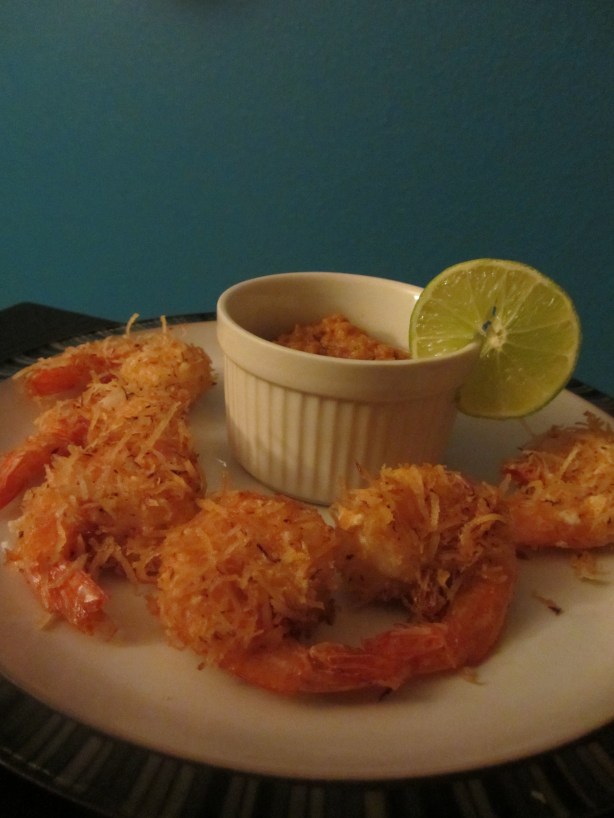
Serve the shrimp with Alton’s peanut sauce and lime wedges.
IMG_5105

Coconut shrimp with peanut dipping sauce.

Alton did not prepare the peanut sauce in the episode, but the recipe can be found with the shrimp recipe. To make the peanut sauce, combine in a food processor 1/4 c chicken stock, 3 ounces coconut milk, 1 ounce lime juice, 1 ounce soy sauce, 1 T fish sauce, 1 T hot sauce, 2 T chopped garlic, 1 T chopped ginger, 1 1/2 C peanut butter, and 1/4 C chopped cilantro.

I am not the biggest shrimp fan, but I thought this recipe was pretty fantastic. The coconut coating was super crispy and light, while the shrimp were tender, and the peanut sauce was spicy, tangy, and a great accompaniment. I plan to make this one again for sure.

Chocolate Coconut Balls

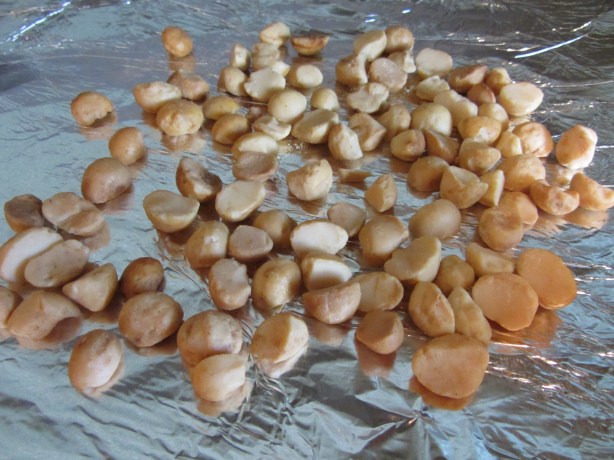
Keeping with the coconut theme, the second recipe in this special episode was for chocolate coconut balls. Coconut-wise, Alton did not specify that you use fresh coconut in this recipe. I happened to have some leftover fresh coconut from the coconut shrimp recipe, so I used the rest of that, along with some store bought shredded coconut. You will also need toasted macadamia nuts, which you can toast in a 325-degree oven for about 10 minutes, or until golden brown. In case you do not already know, macadamia nuts are toxic to dogs, so be sure to keep these away from your pups.
IMG_5148

Macadamia nuts, after toasting in the oven.

Dump 1/2 pound shredded coconut in a bowl, along with 1 C toasted macadamia nuts, chopped. Add 1 C sweetened condensed milk and 1 1/2 t almond extract. Using your hands, mix everything really well and form the coconut mixture into 3/4″ balls, setting them on a foil-lined baking sheet. This mixture is quite sticky and you really need to compress it to form it into balls.

Let the formed coconut balls sit at room temperature for four hours to dry out.

IMG_5154

Coconut formed into balls.

Once dry, dip the balls in 12 ounces of semisweet morsels melted with 1 T shortening.

Let the balls sit until the chocolate has set up.

These are quite a tasty treat, tasting a lot like a Mounds candy bar. The macadamia nuts add a nice crunch, though I don’t know that I could discern what type of nut is in these. The coconut stays fairly moist and the chocolate sets up fairly well. My mom has a huge sweet tooth and recently had back surgery, so I took a couple of these balls to her yesterday to cheer her up. She dove right in and seemed to like them quite a lot. This is an easy recipe for a fun treat.

Island Ceviche with Pickled Onions

Of all the recipes in this episode, the ceviche recipe was definitely the one I was most excited to try. I absolutely love ceviche, first having it years ago with my dad at a restaurant called Aqua in San Francisco; I was amazed at the light, bright flavors in ceviche, instantly becoming a fan. We are very lucky now because we have an excellent ceviche restaurant in our town, which was opened just a few months ago by Chad White, a chef who competed on the last season of Top Chef. I was seriously excited to try my own hand at ceviche in my own kitchen, and Alton’s recipe seemed like a good place to start. To start, cut 1/2 pound of firm white fish into bite-sized pieces. Place the fish, along with 1/2 pound of bay scallops into a bowl with 6 ounces of fresh lime juice. Toss the fish to coat and refrigerate overnight. The online recipe tells you to sear the fish in a pan, but Alton did not do that in the episode.

When I went to finish prepping my ceviche, some of my scallops still looked raw in the middle, so I left my fish in the lime juice longer. Once your fish is ready, drain the lime juice from the fish and add 1 medium papaya, peeled, seeded, and diced. Also add 2 seeded and diced plum tomatoes, 4 seeded and diced serrano peppers, 1 C diced sweet onion, 1/2 C chopped cilantro, and 1 seeded and diced jalapeno. Toss to combine.

Add 1 T white wine Worcestershire (this is now sold as a marinade for chicken), 1 T Mexican hot sauce, and 2 oz tomato juice.

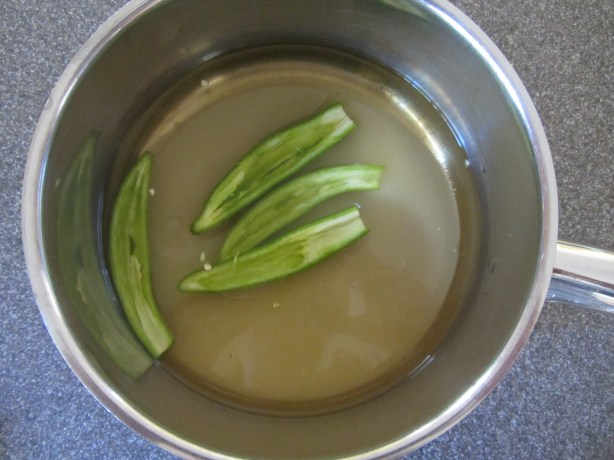
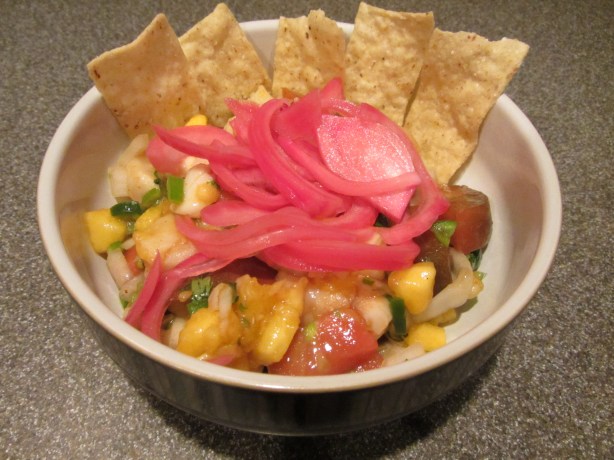
Serve the ceviche in empty papaya skins, along with pickled red onions. Though Alton did not make the pickled onions in the episode, his recipe is included with the fish recipe. For his onions, bring 8 oz champagne vinegar to a boil, along with 1/2 C sugar and 2 seeded serrano peppers.
IMG_5017

Serranos, sugar, and champagne vinegar.

Pour the hot vinegar over 2 sliced red onions.

When I served our ceviche, I skipped using the papaya skins as bowls, and served tortilla chips on the side.
IMG_5051

A bowl of Alton’s ceviche with pickled onions and tortilla chips.

We really liked the overall flavors in this ceviche, though we should have purchased higher quality fish. While the scallops were nice and mild, our fish was slightly “fishy.” I would like to try this again with high quality fish. Definitely do not skimp on the quality of fish if you choose to make this. I liked the inclusion of the papaya in this recipe and the pickled onions are a great garnish. With all of the peppers in this, it does have a decent amount of heat, but it is not overpowering. I think this recipe is probably amazing, but I just couldn’t get past my fishy fish.

Papaya Soup

You can’t really have an island-themed episode without including some recipes that center around tropical fruit. Enter:  papaya soup. When watching Alton prepare this recipe, I was not quite sure what I would think of it. I opted to prep it as a side dish for us. When purchasing papayas, look for fruit that is about 80% yellow and without large discolorations or bruises. If you plan to let your papayas ripen on the counter at home, set them stem side down for even ripening. For this soup, you will need 4 papayas (I opted for two since I was only prepping two servings), fresh mint, 3 limes, 2 lemons, fresh berries, fresh ginger, sugar, and water.

IMG_5132

Ingredients for papaya soup: papayas, lemons, limes, fresh mint, berries, and ginger. Not pictured: sugar and water.

Begin by peeling, seeding, and dicing your papayas, dividing the fruit evenly in your serving dishes. Add 2 T chopped mint.

IMG_5134

Fresh papaya.

IMG_5136

Fresh papaya and mint.

Meanwhile, dissolve 1 C sugar in 1 C boiling water. Once the sugar is dissolved, add the juice of 3 limes and 2 lemons.

Pour the hot sugar/citrus liquid over the fruit and mint; I opted not to use all of the liquid, as it just seemed like too much for the amount of fruit I had. Add some fresh berries and chopped ginger for garnish, and serve.
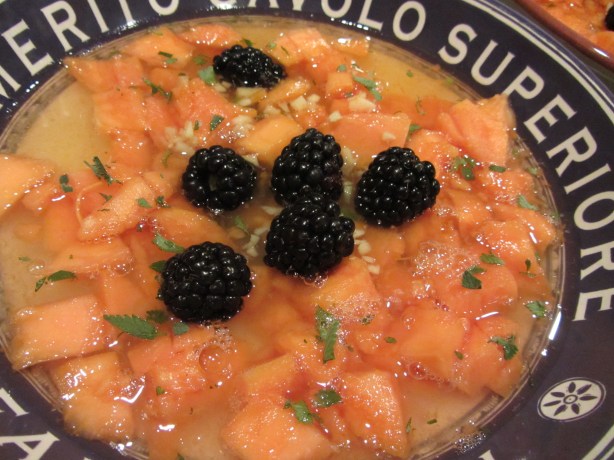
IMG_5141

Alton’s papaya soup, garnished with berries and fresh ginger.

We both were pleasantly surprised by this dish. Though this was sweet, the sweetness was nicely balanced with the tang from the lemons and limes. The fresh ginger also really helped to cut the sweetness. Having not cooked much with papaya, I really liked the fruit in this dish. Honestly, you could serve this as a light dessert in the summer also. This is definitely an unusual dish that is pretty, interesting, and comes together in a matter of minutes.

Mango Salad

There is no online link for this next recipe, but I’ll write it up as Alton made it in the episode. I am an absolute mango freak, so I knew I’d really like this one. Toss together 2 diced mangoes, 1 sliced red onion, the juice of 1-2 Key limes (I used bottled juice), 1 T fresh mint or basil (basil for me), black pepper (a fair amount), and some feta cheese.

Let sit at room temperature for 1 hour before serving. This was a great salad, which we ate alongside the coconut shrimp.

IMG_5087

Completed salad with feta.

This salad has the sweetness of mango, the bite of red onion, the tang of lime, the saltiness of feta, and the spice from pepper. In a nutshell, it has a little bit of everything. Super tasty.

Mango Chutney

I grew up eating chutney, as a condiment on my grandma’s curry. Though I never knew my grandmother, my parents served her curry recipe to me from an early age, and it has been a favorite meal of mine for years. A blend of spices, onions, raisins, and apples, this wonderful curry is served over rice with bacon, hard-boiled egg, banana, peanuts, bean sprouts, and chutney as condiments. I do not recall ever eating homemade chutney when having curry, so I was really stoked to see how homemade chutney would pair with Grandma’s classic. So, last week I whipped up a batch of Alton’s chutney. The ingredients needed for Alton’s chutney are vegetable oil, chile flakes, red bell pepper, red onion, mangoes, fresh ginger, brown sugar, curry powder, mango juice, cider vinegar, macadamia nuts, golden raisins, white pepper, and Kosher salt.
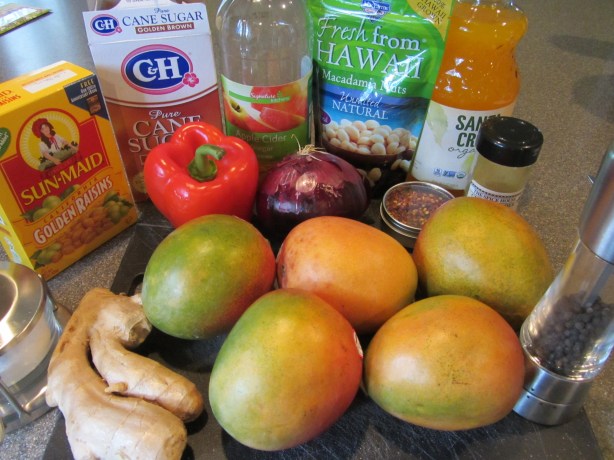
IMG_5054

Ingredients for chutney: Kosher salt, golden raisins, ginger, brown sugar, red bell pepper, cider vinegar, red onion, macadamia nuts, chile flakes, mango juice, curry powder, pepper, and mangoes.

First, heat 3 T vegetable oil in a pan and add 1/2 t chile flakes, cooking until fragrant.

IMG_5056

Chile flakes heating in oil.

Add 1 C diced red bell pepper and 2 C diced red onion, and sweat over low heat for about 5 minutes.

Next, add 4 pounds mangoes, diced, along with 1/4 C minced ginger. Cover the chutney and allow it to cook for three minutes, or until the mangoes soften.

Stir in 1/2 C brown sugar, 1 T curry powder, 8 ounces mango juice (I used a mango lemonade), and 4 ounces cider vinegar. Simmer the chutney for 30 minutes, stirring occasionally.

Finally, add 1/2 C golden raisins and 1/2 C toasted/chopped macadamia nuts (you can toast them at 325 degrees for about 10 minutes). Season the chutney to taste with white pepper and Kosher salt.

IMG_5071

Raisins and macadamia nuts stirred into chutney.

This recipe makes a fairly large batch of chutney, so I opted to divide mine among small jars to freeze. Of course, I had to try the chutney over Grandma’s curry.
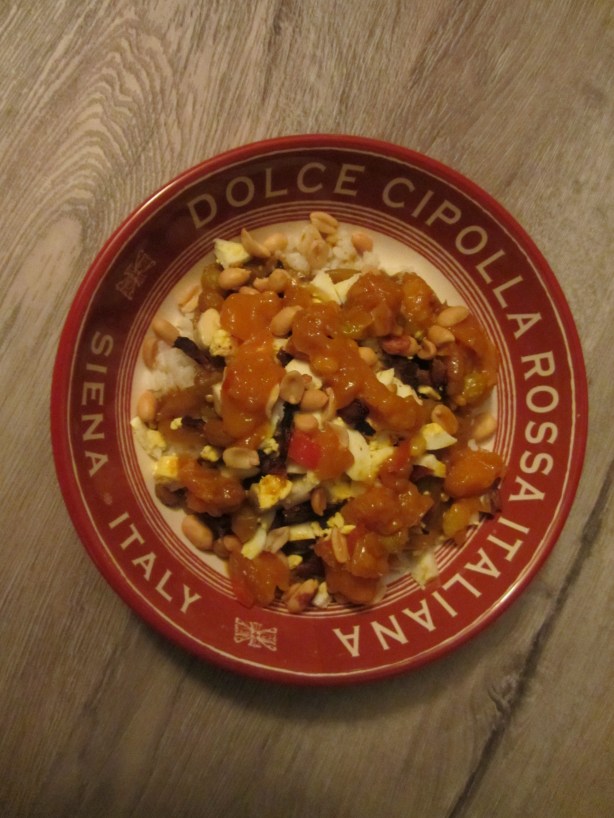
IMG_5181

Alton’s chutney over my grandma’s curry.

Let me tell you, this chutney is fantastic. It is sweet, tangy, tart, and bright, with a faint hint of heat. Honestly, I think it makes my grandma’s curry better than ever. I am anxious to share it with my parents to see what they think. You really could use this curry in a variety of ways – using it anywhere you would use other condiments. I will absolutely make this again.

Spicy Pineapple Slices

Recipes don’t come much easier than this one. Simply peel, core, and slice pineapple, sprinkling it evenly with Kosher salt, pepper, and chili powder.

Grill the slices until tender and warm.
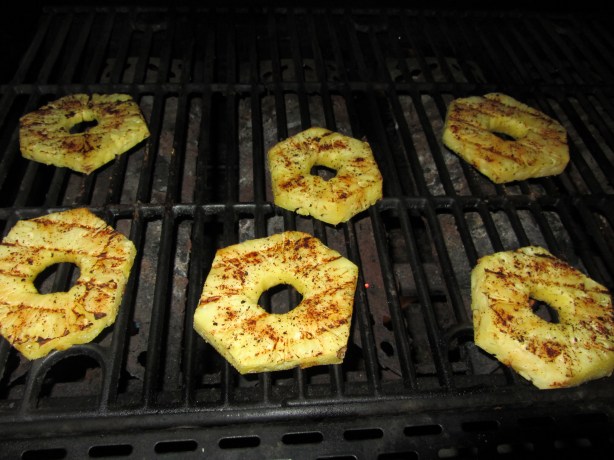
IMG_5167

Pineapple slices on the grill.

We ate this as a side dish, alongside sandwiches, and we both thought it was great.

IMG_5172

Delicious grilled pineapple.

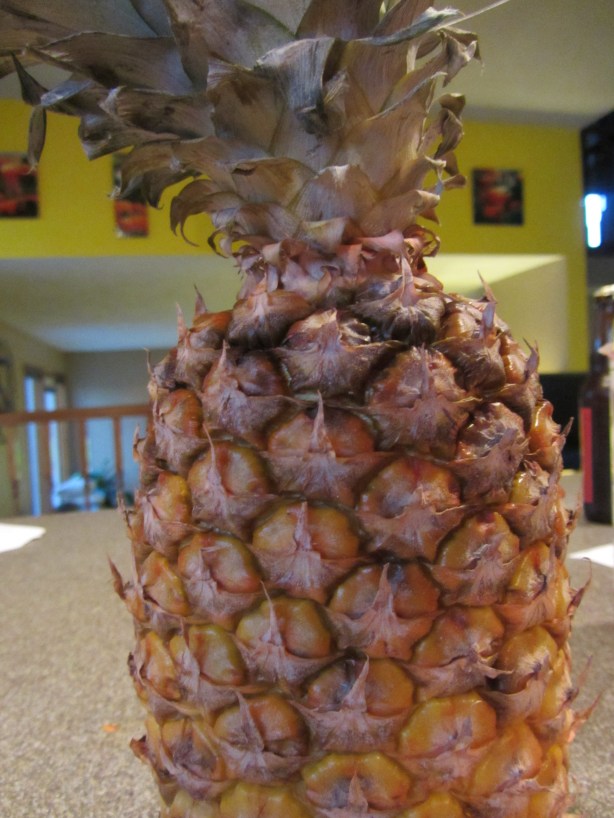
The heat of the chili powder is fantastic with the sweetness of the fruit. What are Alton’s tips for selecting pineapples?  First, pick fruit that sounds solid when you thump it. Also, look for large fruit that is about 50% yellow and 50% green, as pineapples do not ripen further post-harvest. Small crowns are desirable because large crowns indicate that a pineapple has used up its sugars.
IMG_5161

Large pineapple, small crown. About 50/50 yellow/green.

Sweet and Sour Pork

Last, but not least, Alton’s sweet and sour pork finished out this episode. Note that there is another recipe online for coconut macaroons, but Alton did not make those in the episode, so I did not make them either. You will have to start Alton’s sweet and sour pork the night before you plan to serve it. Start by making a marinade of 2 t minced garlic, 1 T minced ginger, 2/3 C soy sauce, 1/4 C flour, and 1/4 C cornstarch.

IMG_5075

Garlic, ginger, soy sauce, flour, and cornstarch combined for marinade.

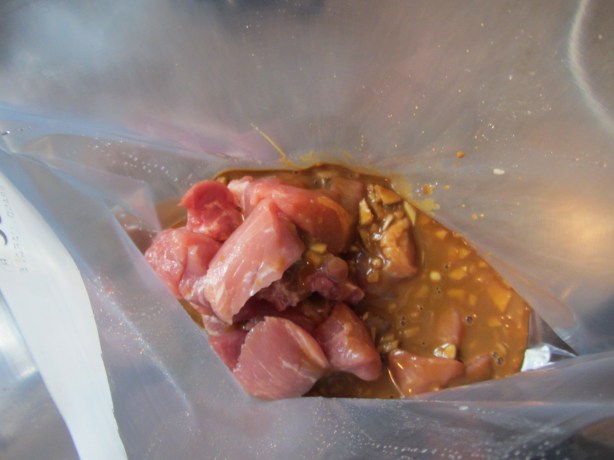
To the marinade, add 1 pound of cubed pork that has been seasoned with Kosher salt, and allow the meat to marinade overnight.
IMG_5078

Pork in marinade overnight.

The following day, drain the marinade from the pork and dredge the pork cubes in flour that has been seasoned with salt and pepper.

Fry the pork in 375-degree peanut oil until golden brown, and set aside.

In a skillet, heat 1 T peanut oil with 2 t sesame oil. Add 1/3 C each of diagonally sliced carrot, diced onion, and diced celery.

IMG_5108

Celery, onion, carrot, red bell pepper, and green bell pepper.

IMG_5120

Onion, celery, and carrot, sauteeing in oil.

Cook the vegetables until they are translucent. Add 1/3 C diced red bell pepper, 1/3 C diced green bell pepper, and 1 C chopped pineapple.

IMG_5123

Bell peppers and pineapple added to pan.

Next, add the fried pork to the pan, along with a mixture of 1 C ketchup, 1/4 C red wine vinegar, 1/4 C sugar, and 1 1/2 ounces honey.

IMG_5124

Sauce and pork added to pan.

Cook over low heat until the pork is tender and heated through.

IMG_5126

Cooked until pork was heated through.

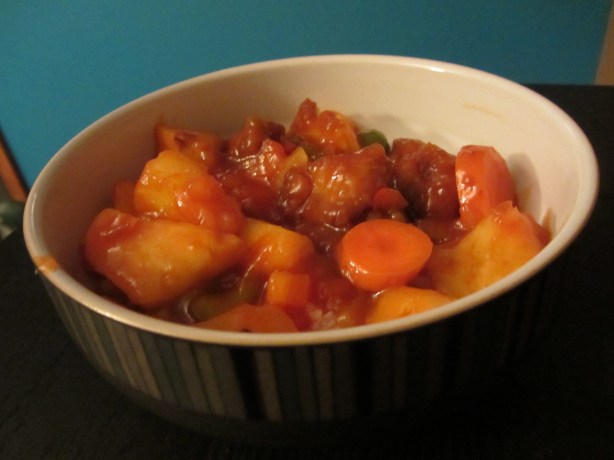
I served Alton’s sweet and sour pork over rice and we thought it was really good.
IMG_5128

Alton’s sweet and sour pork over rice.

The pork was tender inside and slightly crispy on the outside, but far from greasy. The sauce was a perfect blend of sweet and sour flavors. Alton’s version of this classic is a good one.

Baked Macaroni and Cheese

Next up in my blog project was Alton’s recipe for baked macaroni and cheese. Last fall, Alton posted an updated version of this recipe on his web page, and I went ahead and made it, despite knowing it would be coming up later in my project. Yes, I usually try to wait to make the Good Eats recipes until their time arrives in sequence, but last fall was a rough time and I was searching for the highest calorie recipes I could find. Ted had lost 35 pounds from his skinny runner/cyclist frame, due to complications from cancer treatment, so I was on a mission to fatten him up. When Alton’s baked macaroni and cheese showed up in my Facebook feed, it was just perfect timing. Knowing this recipe was good, I was excited to make it again – this time for my blog.

Cheese-wise, you will need 12 ounces of grated cheddar cheese for Alton’s recipe.

IMG_4950

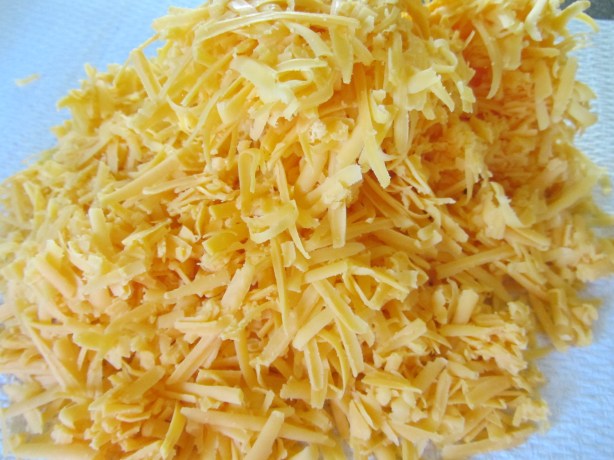
12 ounces of grated cheddar.

Begin by cooking 1/2 pound of elbow macaroni in salted water for six minutes. Drain the pasta and rinse it with cold water to halt the cooking process.

IMG_4953

1/2 pound of elbow macaroni, cooked for 6 minutes and rinsed under cold water.

Next, melt 3 T butter in a pan over medium heat, and whisk in 3 T flour. Cook this mixture until it is sandy in color.

Add 1 T powdered mustard, 1/2 t paprika (I used hot, smoked paprika), 1/2 C chopped onion, 1 bay leaf, and 1 t Kosher salt, whisking to incorporate.

Slowly add in 3 C whole milk, whisking until thickened, which will take several minutes.

Discard bay leaf. In a small bowl, lightly beat one egg. Temper the egg by whisking in 2 T of the hot milk sauce. You can now add the egg to the pan of hot sauce and it will not curdle.

Whisk in 3/4 of the grated cheese until melted.

IMG_4967

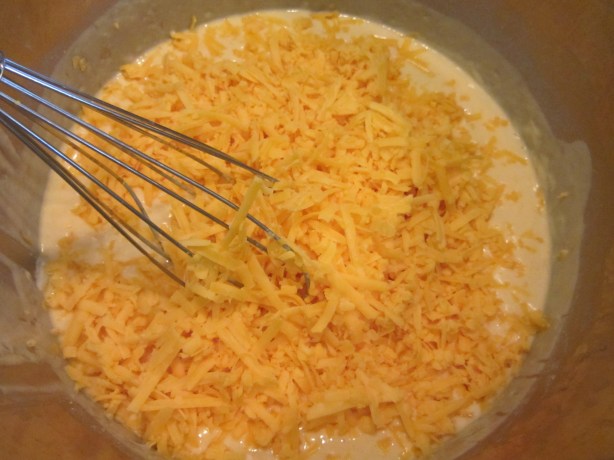
3/4 of cheese being added to sauce.

Fold the cooked noodles into the cheese sauce and pour into a 2-quart casserole dish. Sprinkle the remaining grated cheese over the top of the casserole.

Finally, combine 1 C panko bread crumbs with 4 T melted butter, and sprinkle the buttered crumbs evenly over the surface of the casserole.

Bake the macaroni and cheese at 350 degrees for 30 minutes. Let the macaroni and cheese sit for a few minutes before serving.

IMG_4988

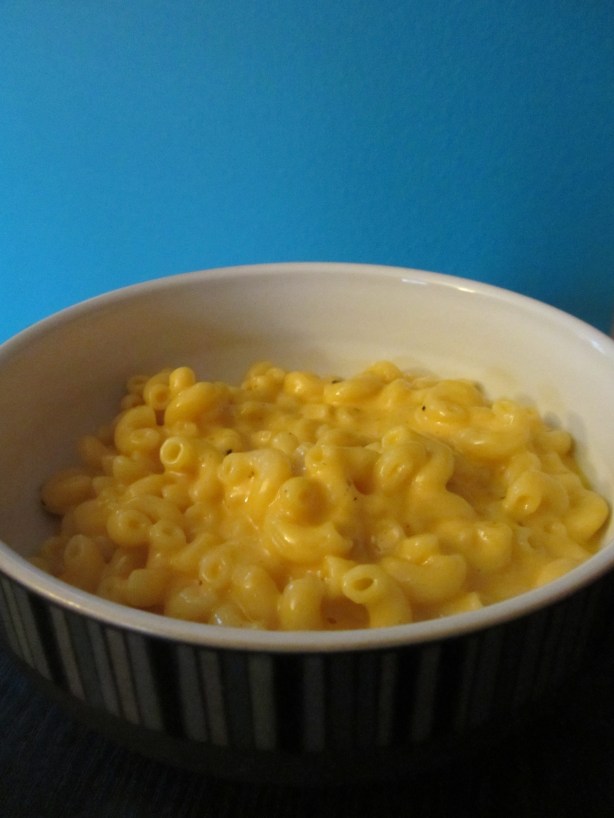
Alton’s baked mac and cheese.

As I said before, this macaroni and cheese is not low-cal, but it is quite delicious. While the noodles remain “toothsome,” the sauce is rich and cheesy with a little bite from the powdered mustard and paprika. The crispy panko topping is the icing on the… mac and cheese? For mac and cheese fans, this is a sure hit.

Stove Top Mac-n-Cheese

As if one great macaroni and cheese recipe weren’t enough, Alton also has a stove top version of America’s greatest casserole. For this recipe, you will need eggs, evaporated milk, hot sauce, powdered mustard, Kosher salt, pepper, elbow macaroni, butter, and cheddar cheese.

IMG_4928

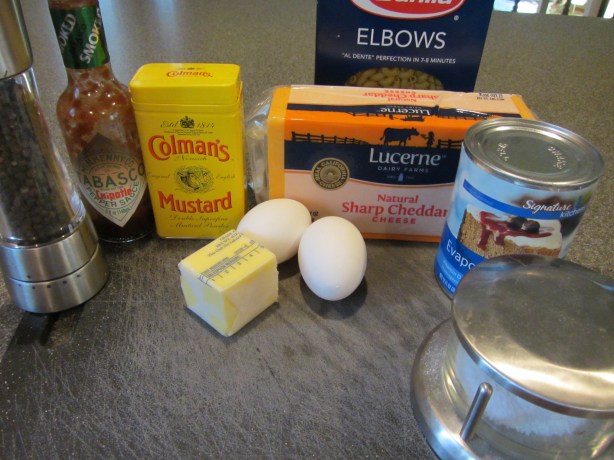
Ingredients for Alton’s stove top mac and cheese: pepper, hot sauce, powdered mustard, butter, eggs, cheddar cheese, elbow macaroni, evaporated milk, and Kosher salt.

Begin by grating 10 ounces of cheddar cheese.

IMG_4929

10 ounces of grated cheddar cheese.

Next, whisk 2 eggs in a bowl and add 6 ounces of evaporated milk. Add 1/2 t hot sauce, 3/4 t powdered mustard, 1 t Kosher salt, and some pepper.

Set the sauce aside while you cook 1/2 pound of elbow macaroni in salted water until al dente. Drain the pasta and place it immediately back in the pan, stirring in 4 T butter until melted.

IMG_4940

Butter added to hot elbow macaroni.

On a low burner, add the egg mixture to the noodles, along with the grated cheddar cheese. Cook and stir until the sauce is smooth.

IMG_4949

Alton’s stove top mac and cheese.

Honestly, we thought this mac and cheese was great, especially for the time and effort required. I actually thought this recipe had stronger cheese flavor than Alton’s baked version. I did, however, miss the crispy panko topping. Next time I make mac and cheese, I think I will opt for this version because it is easier, faster, and on par with Alton’s baked recipe – I just might add some buttered, toasted panko to the top. I will be making this again for sure.

Next Day Mac and Cheese “Toast”

In case macaroni and cheese was not sinful enough, Alton decided to make it that much richer with this recipe for fried macaroni and cheese. I made this with leftovers from Alton’s baked macaroni and cheese. Begin by combining 1 C flour, 1 t salt, and 1 t cayenne pepper.

IMG_4990

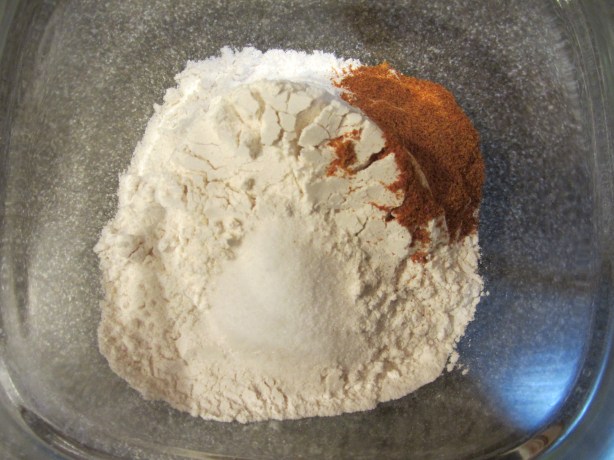
Flour, salt, and cayenne.

Slice your cold leftover macaroni and cheese into individual servings and coat each piece in the flour mixture. Next, dunk each piece in beaten egg. Finally, dip each slice in panko bread crumbs.

While you are preparing your macaroni and cheese, heat peanut oil to 375 degrees on the stove.

IMG_4995

Peanut oil, heating to 375.

When the oil has reached its temperature, fry the macaroni and cheese slices until golden brown and crispy.

Sprinkle the slices with Kosher salt and hot sauce before serving.

IMG_5006

Alton’s fried macaroni and cheese.

This was delicious. The already wonderful, cheesy, rich macaroni and cheese was enhanced with a golden, crispy fried crust all around. If you have leftover macaroni and cheese, frying it makes an extra special treat, and who couldn’t use a treat now and then?

It’s been a while since I last posted. While I actually prepared the recipes from this episode of Good Eats weeks ago, I am only just now having time to sit down and actually write them up. Since I last made a post, we have left town a couple times, Ted finished up chemo and had scans (clear – yay!), we hosted a clear scan party, and my mom ended up in the hospital/had surgery. Hopefully things will slow down here at some point!

Anyway, the subject of the 64th episode of Good Eats was squash, and particularly winter squash. Needless to say, this episode would have been more ideal if it had popped up during cooler months of the year. Thankfully, you can purchase winter squash at any time of the year.

Squash Soup

First up in this episode was Alton’s squash soup. Alton used two Kabocha squash to make his soup, though he stated you could use any hard winter squash; I could not find Kabocha squash at my store, so I used acorn squash.

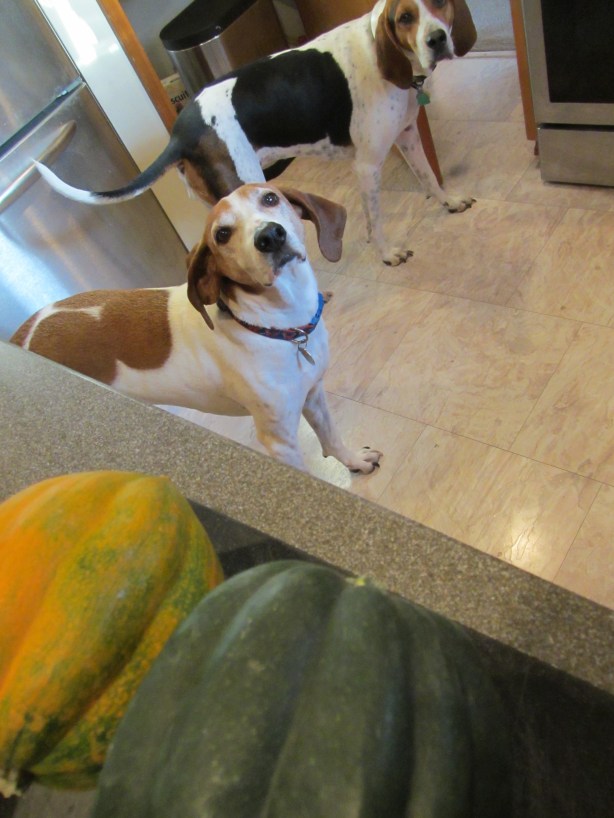
IMG_4843

The hounds, checking out my acorn squash.

You first need to quarter your squash and remove the seeds. Alton quartered his squash by hitting a vegetable cleaver with a wooden mallet.

IMG_4844

Quartered acorn squash.

Brush the squash quarters with melted butter, sprinkle them with Kosher salt and pepper, and stick them in a 400-degree oven.

IMG_4848

Quartered acorn squash, brushed with melted butter and sprinkled with pepper and Kosher salt.

According to Alton, your squash should be tender and roasted within 25 minutes, but my squash took nearly an hour to become tender.

IMG_4851

Squash, after roasting for almost an hour.

When your squash are cool enough to handle, use an ice cream scoop to remove their flesh. You will need six cups of cooked squash, and the easiest way to measure this is using displacement. You can do this by putting the squash in a large measuring vessel with 1 1/2 C chicken stock; when the liquid line hits 7 1/2 C, you know you have 6 C of squash. Dump the squash/stock in a pot and add 1 1/2 C additional chicken stock, 4 T honey, and 1 t grated ginger.

IMG_4853

Squash in soup pot, along with chicken stock, honey, and grated ginger.

Heat the soup over medium-high heat until bubbles begin to form on the surface, and process the soup with an immersion blender until smooth. Finally, finish the soup by stirring in 1/2 C heavy cream, 3 big pinches of Kosher salt, 2 small pinches of white pepper, and 6 grates of nutmeg on a microplane grater.

Simmer the soup over medium heat until it is heated through. Serve in bowls with sour cream. We ate this soup with goat cheese toasts on the side.

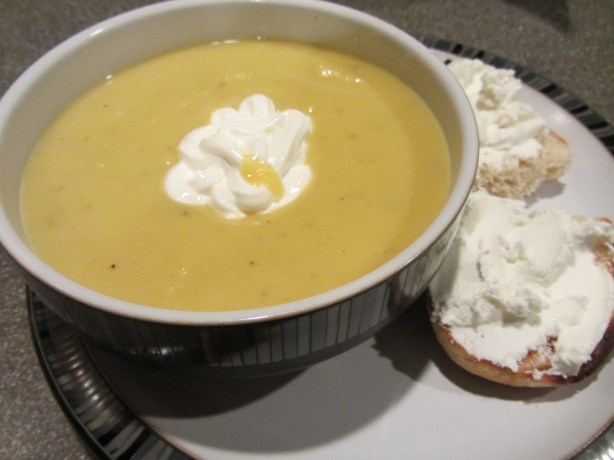
IMG_4862

Finished squash soup with sour cream.

Ted is not particularly fond of squash, but he thought this soup was “pretty good.” Honestly, I found this soup to be a little too sweet, so I would consider cutting down on the honey. The sour cream does help to cut the sweetness also. This would be a perfect soup for a chilly night, so it did not seem apropos when we were eating it in the heat of summer. This is a good, easy, traditional squash soup, and it would come together in minutes if you prepped the squash ahead of time.

Butternut Dumplings with Brown Butter and Sage

Of the recipes in this episode, I was most excited to make Alton’s squash dumplings. For this recipe, you will need a one-pound butternut squash.

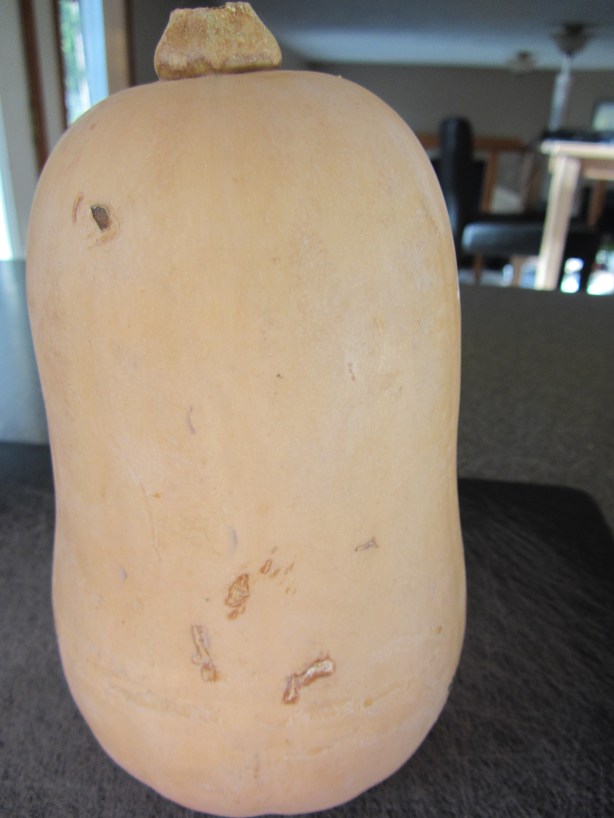
IMG_4863

A one-pound butternut squash.

Halve the squash, remove the seeds, brush the flesh with olive oil, and sprinkle them with Kosher salt and pepper.

IMG_4867

Halved squash, brushed with olive oil and sprinkled with Kosher salt and pepper.

Roast the squash in a 375-degree oven for 45 minutes, or until tender. When you put the squash into the oven, also add 4 medium russet potatoes to the oven, taking care to prick their flesh with a fork first.

IMG_4866

4 medium russets, skin pricked with a fork.

While your vegetables are roasting, you can gather your other ingredients:  Kosher salt, 1 1/2+ C flour, and an egg, lightly beaten with a pinch of nutmeg.

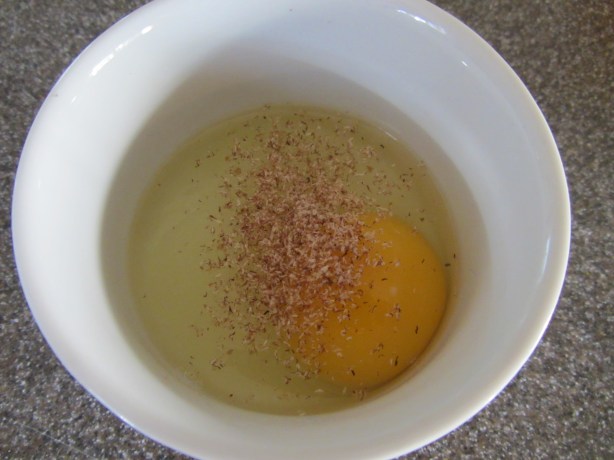
IMG_4869

One egg, to be beaten with a pinch of nutmeg.

Once the vegetables are cool enough to handle, mash the flesh of the squash together with the flesh of the potatoes, mashing only until combined.

Using a wooden spoon, stir the egg and 1/2 C flour into the squash/potato mixture. You want to add flour gradually until you have a dough that is slightly wet, but not sticky.

While Alton only needed a small amount of flour to get his dough to the proper consistency, I ended up needing over 5 C of flour to get my dough to the point where I could handle it; several online reviewers had this same problem. Once your dough is ready, bring a pot of salted water to a boil. On a floured surface, turn out your dough and divide it into eight equal balls.

One at a time, roll each ball into a 1/2-inch thick snake, and cut each snake into 1/2-inch pieces.

At this point, you can cook the dumplings or place them on a floured baking sheet and freeze for later use. To cook the dumplings, add them to the boiling water in batches, removing them from the water as they float to the surface. To cease cooking, place the boiled dumplings immediately in ice water before drying them on a tea towel.

Next, heat a skillet over high heat, adding 1 T softened butter. Once the butter is melted, add 2 chopped sage leaves and 1 C of the boiled/cooled/dried dumplings. Cook the dumplings until they are golden brown and crispy on all sides.

Serve the dumplings with lots of Parmesan cheese and pepper.

IMG_4900

A bowl of dumplings with Parmesan and pepper.

We really liked these dumplings, though they definitely needed a healthy sprinkle of Kosher salt in addition to the Parmesan and pepper. The dumplings are fairly dense, but delicious with their crispy exteriors and softer interiors. The dumplings are slightly sweet and pair greatly with the savory browned butter, sage, and Parmesan. I will say that the process of making the dough was much more tedious than Alton demonstrated in the show, but we ended up with enough dumplings for at least three meals. I foresee making these again, especially in the Fall.

Pumpkin Bread

Last up in this episode was Alton’s pumpkin bread recipe. Ideally, for this recipe you will want to use fresh pumpkin, but I had to settle for canned pumpkin since it was the middle of July. Either way, you will need 3 C of pumpkin; if using fresh pumpkin, grate the flesh. You will also want to toast 1 C of pumpkin seeds for 5 minutes at 400 degrees. I purchased pumpkin seeds that were already toasted. In a bowl, sift together 2 C flour, 2 t cinnamon, 1/2 t Kosher salt, 1 t baking soda, and 1/4 t baking powder.

In a separate large bowl, beat 3 eggs and gradually add 1 1/2 C sugar.

IMG_4908

3 eggs, beaten with 1 1/2 C sugar.

Once the sugar is incorporated, slowly whisk in 3/4 C vegetable oil. Finally, add 1 t vanilla extract.

Fold the pumpkin mixture into the egg mixture, along with the cup of toasted pumpkin seeds.

IMG_4914

Pumpkin and pumpkin seeds added to egg mixture.

Finally, add the dry ingredients to the wet mixture, and fold everything together. Pour the batter into a nonstick loaf pan and bake at 325 degrees for 75 minutes, or until the tip of a paring knife comes out clean.

Cool the bread in the pan for 15 minutes before turning the bread onto a rack to cool completely. If you prefer to make muffins instead of bread, divide the batter among muffin tins and bake for 30 minutes at 325 degrees.

IMG_4926

Alton’s pumpkin bread.

This is a very delicious pumpkin bread, but I really did not care for the texture of the pumpkin seeds. I found the pumpkin seeds to be very chewy from absorbing the moisture of the bread. I definitely plan to make this bread again, but I will be omitting the seeds. The bread itself has just the perfect amount of sweetness, is very moist, and has loads of pumpkin flavor.

In Season 1 of Good Eats, chocolate was chosen as the subject of the final episode, which I wrote about here. That episode featured a couple of chocolate desserts that used chocolate chips. Again, chocolate is the star of the 63rd episode, but this time the recipes utilized cocoa powder as the source of chocolate.

Baking with cocoa powder always makes me nervous since we have two dogs. Years ago, I made a chocolate cake from scratch and placed it INSIDE a kitchen cabinet. Imagine my surprise when Ted called to tell me that he had arrived home to find that Hitcher, our male hound, had jumped onto the kitchen counter, pried open the cabinet, and eaten the chocolate cake. Thankfully, Hitcher turned out to be just fine!

Cocoa Brownies

Naturally, the first recipe Alton tackled with cocoa powder was for a classic brownie. I have always found that brownies made from scratch with cocoa powder are much richer and have more intense chocolate flavor. For baked goods, Alton recommends that you use natural process cocoa, which is redder and more bitter than Dutch process cocoa. To make his brownies, preheat your oven to 300 degrees and spray an 8″ square pan with nonstick spray. Additionally, line the pan with parchment paper, allowing the paper to hang over two opposite edges of the pan; this will allow you to easily lift the brownies from the pan. The online recipe does not mention the parchment paper, but it really is a good trick.

IMG_4769

Pan sprayed with nonstick spray and lined with parchment paper to overhang on two sides.

When your pan is set, sift together 1 1/4 C natural process cocoa, 1 C brown sugar, 1 C sugar, 1/2 C flour, & 1/2 t Kosher salt.

Next, in a stand mixer with the paddle attachment, beat 4 eggs until light.

Add the sifted dry ingredients to the eggs, gradually incorporating them until smooth.

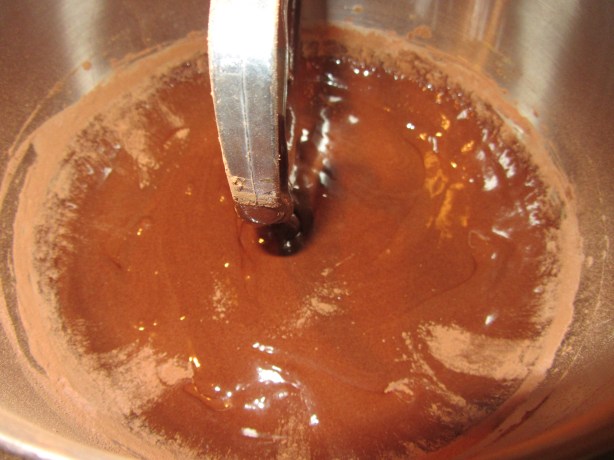
IMG_4780

Batter after incorporating dry ingredients.

Once the batter is smooth, add 2 t vanilla extract and 8 ounces (2 sticks) of melted butter; you will want to add the butter gradually and on low speed.

Finally, scrape the bowl and pour the batter into your prepared pan.

IMG_4802

Batter in pan, and ready to go in the oven.

Bake the brownies for 45 minutes before checking with a toothpick. You will want to remove your brownies from the pan when a little bit of crumb still sticks to the toothpick, which took about 49 minutes in my oven.

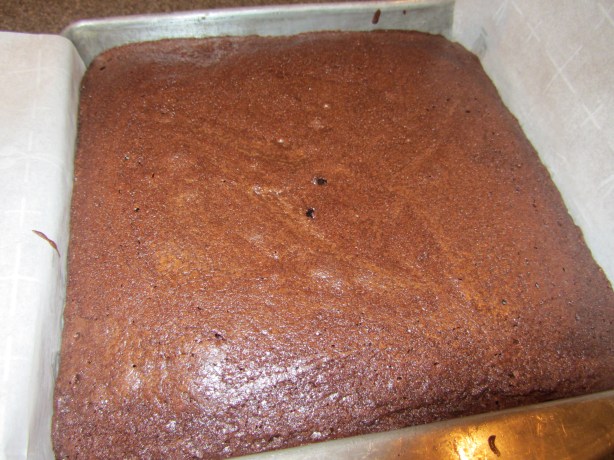
IMG_4803

My brownies, after baking for about 49 minutes.

In the Good Eats episode, Alton strictly tells you to remove the brownies from the pan as soon as they come out of the oven. He also tells you to immediately cut the brownies, using a pizza cutter.

Once cut, allow the brownies to cool completely on a rack. My brownies were a little tricky to cut, so I would probably let them cool for a few minutes out of the pan before attempting to cut them. These brownies are really good if you like your brownies to be super dark and rich. Seriously, you cannot eat a lot of these. These paired very well with vanilla ice cream, which helped to cut the chocolate slightly. Personally, I like brownies to be kept in the refrigerator… but that’s just me.

IMG_4812

These brownies pair greatly with vanilla ice cream.

Cocoa Syrup

Next up in Alton’s cocoa arsenal was his take on chocolate syrup. Growing up, I was always more of a hot fudge sauce girl, while my brother was a chocolate syrup fanatic. I was curious to see if homemade chocolate syrup would convert me to more of a syrup person. For this particular recipe, you will want to try to use Dutch process cocoa, as it works better in applications with low fat content. Honestly, I looked at three stores for Dutch process cocoa and could not find it, so I made my syrup with a cocoa powder that was a blend of natural and Dutch process cocoas. To make Alton’s chocolate syrup, begin by combining 3 C sugar, and 1 1/2 C water in a pan. Bring the sugar and water to a boil and add 2 T light corn syrup; this will prevent crystallization.

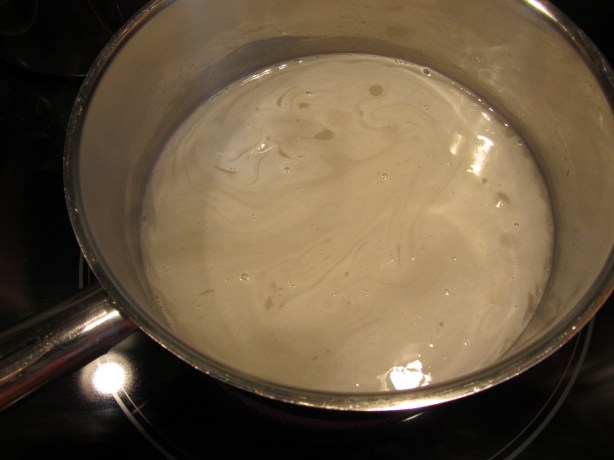
IMG_4833

Sugar, water, and corn syrup being brought to a boil.

To this, slowly add 1 1/2 C cocoa powder, along with 1/4 t Kosher salt. You will want to gradually whisk the cocoa powder into the liquid, which will take a little bit of time.

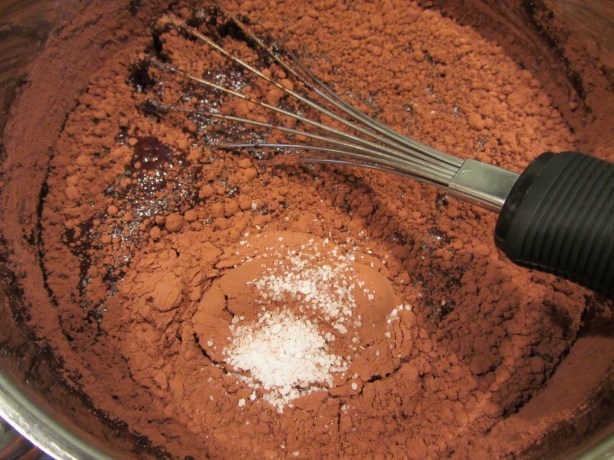
IMG_4835

Salt and cocoa powder, gradually being whisked into liquid mixture.

Finally, once all of the cocoa powder is incorporated, stir in 1 T vanilla extract.

Pour the syrup into a squeeze bottle and allow it to cool to room temperature.

IMG_4838

My chocolate syrup.

If you want to reheat your syrup, place the squeeze bottle in hot water for ~10 minutes. I served this chocolate syrup in the traditional way – over vanilla ice cream, and with cake on the side.

IMG_4840

Chocolate syrup over ice cream.

I have to admit that this syrup is pretty darn good, and much better than the stuff you can buy. The chocolate flavor is much more intense, and this tastes like a much darker chocolate than store-bought syrups. I also think this syrup is a bit thicker than other chocolate syrups I have had, which I like. If you’re a chocolate syrup fan, I’d certainly give this one a try. Note that this recipe makes a lot of chocolate syrup, but you could always cut the recipe in half.

Hot Cocoa

Last but not least, no cocoa episode would be complete without a recipe for hot cocoa. To make Alton’s hot cocoa mix, into a large, lidded container place 2 C powdered sugar, 1 C Dutch process cocoa, 2 1/2 C powdered milk, 1 t salt, 2 t cornstarch, and a pinch of cayenne pepper.

Place the lid on the container and shake the mixture to thoroughly combine.

IMG_4821

The shaken/combined cocoa mix.

To serve Alton’s cocoa, fill a mug 1/3 full with Alton’s cocoa mix and add boiling water just to cover the powder.

Stir the cocoa/water mixture to create a thick slurry. Finally, top off the mug with more boiling water and stir again to combine.

We do not typically drink a lot of hot chocolate, but this was pretty good. Of course, this isn’t really the season for hot chocolate either. We both really liked the addition of the cayenne (I added a pretty hefty pinch), which made this a little different from your typical hot cocoa. We had our hot cocoa with whipped cream because really, why not?
IMG_4830

Alton’s hot cocoa, served with whipped cream, of course.

I will probably make this mix again, though I will likely wait for colder weather to make it again. I have to say, though, that I have a serious hankering for some chocolate after typing up this episode. Though the brownies are long gone, we still have homemade chocolate syrup and hot cocoa mix, one of which I will probably be tapping into shortly!