Archive for the ‘Episodes by Season’ Category

Sweet or Savory Pâte à Choux

When I was in elementary school, a different kid in my class was tasked with bringing snacks for the class each week. No-bake cookies with chocolate and oats were in regular rotation because they were easy to make and most of the kids liked them. My mom usually sent me with cupcakes or other (baked) cookies. One girl’s mother scored massive points with all of the kids (and probably made all the other parents feel like slouches), as she always made homemade cream puffs.

Personally, I have never made cream puffs or eclairs… until now. Baking and pastry are definitely two of my favorite things, so I eagerly whipped up a batch of Alton’s Pâte à Choux yesterday. Pâte à Choux is a pastry dough that is designed to make pastries that can be filled; therefore, when you bake the dough, it is supposed to only form one or two large bubbles, as opposed to the numerous bubbles desired in certain breads and such. In order to create these large bubbles in the pastry, steam needs to be created. Bread flour, and especially bread flour for bread machines, is ideal for Pâte à Choux because it has the highest protein content of all flours, which allows it to absorb more liquid; more liquid equals more steam production. To make Alton’s Pâte à Choux, combine a cup of water and 6 T butter in a pan. If you are making savory dough, also add 1 t Kosher salt. Or, if you are making a sweet dough, as Alton did in the episode, add just a pinch of Kosher salt and 1 T sugar.

Bring this water/butter mixture to a boil over high heat. Meanwhile, weigh out  5 3/4 ounces of bread flour. I did not have bread flour for bread machines, so just used bread flour.

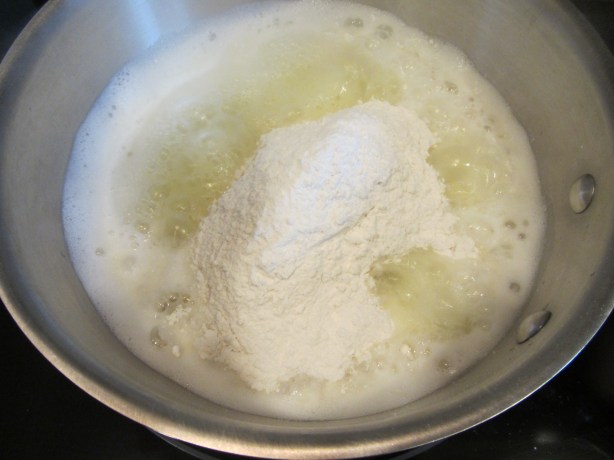
When the butter has completely melted and your liquid is boiling, add all of the flour, at once, to the pan.

IMG_5968

Flour added to boiling butter/water.

Stir the flour into the liquid with a spatula until a paste forms. Decrease the heat to low and continue to stir the dough until all of the flour is incorporated and the dough is no longer sticky. Turn off the heat and transfer the dough to the bowl of a standing mixer, setting it aside until it is cool enough to touch.

While the dough cools, place four eggs and two egg whites in a measuring cup; the egg yolks will act as an emulsifier in the dough, while the whites will give the dough structure.

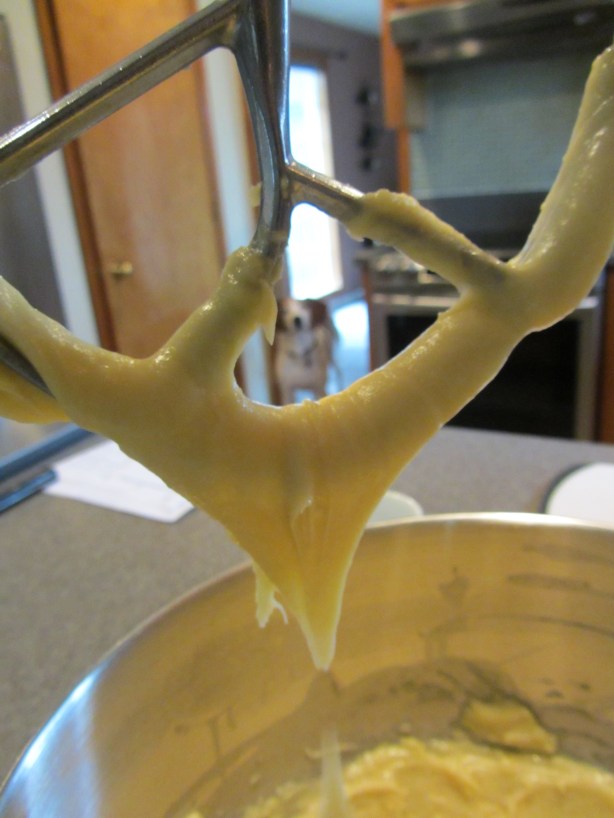
When the dough has sufficiently cooled, slowly add the eggs to the dough, keeping the mixer running. You want to continue adding egg until the dough hangs from the paddle attachment in a ‘V’ shape; for me, this required all of my eggs.

IMG_5978

Dough after adding all of the eggs. A perfect ‘V’ shape off of the paddle.

At this point, you can use your dough immediately, or you can let it rest at room temperature for a couple hours before using. When you are ready to use your dough, prepare a piping bag with a piping tip; Alton did not specify which tip to use, but I used one that was about 3/8″ in diameter and it worked fine. Large Ziploc bags work well for piping too – just snip off one corner, insert the inside part of the coupler, place your desired tip on top, and screw on the coupler ring.

IMG_5966

Ziploc bag turned into piping bag.

Preheat your oven to 375 degrees and line a sheet pan with parchment paper. If your parchment is sliding around, you can pipe a dollop of dough on each corner of your sheet pan, pressing the parchment down in the dough to keep it from sliding.

To make eclairs, pipe the dough into ‘S’ shapes, with the tail of each ‘S’ facing up toward you. With a wet finger, pat down the tails.

Alternatively, you can make cream puffs by piping the dough in concentric circle patterns, finishing in the center. Again, pat down any points with a wet finger.

IMG_5985

Dough, piped into concentric circles for cream puffs.

Place the eclairs (or cream puffs) in the center of the oven, increasing the temperature to 425 degrees, and setting the timer for 15 minutes. After 15 minutes, decrease the oven temperature to 350 degrees, and bake the eclairs for an additional 10 minutes. As soon as your eclairs/cream puffs are cool enough to handle, pierce them with a sharp paring knife to release excess steam.

IMG_5988

Piercing a hot eclair to release steam.

Cool the pastries completely.

At this point, you can bag and freeze the pastry shells for up to a month, bag and store them at room temperature for a week, or you can fill them with a filling of your choice. To do as Alton did in this episode of Good Eats, make vanilla pudding, using only 3/4 of the recommended liquid.

Then, using a small star tip and a piping bag, poke a hole in each eclair/cream puff, filling them with the pudding until the pudding starts to come out the end. Chill the filled pastries.

To bedazzle your eclairs/cream puffs with chocolate, melt 1 C chocolate chips with 1 t vegetable oil in a double boiler. Dip each pastry into the chocolate mixture. Or, you can pour your chocolate into a squeeze bottle and decorate them that way. I opted for the dipping method.

If you do not plan to eat your eclairs right away, keep them refrigerated. I made a mixture of eclairs and cream puffs, ending up with 17 eclairs and 6 cream puffs. I stuck most of my pastries in the freezer for later use, but filled several yesterday.

IMG_6003

Chocolate dipped eclairs.

I have to say that this is a great recipe. Not only are these delicious, but they are really super easy. My pastries turned out light, airy, and slightly crispy on the outside. The pastry itself was barely sweetened and each pastry had a perfect cavity inside for filling. The vanilla pudding was a super easy filling option, and the chocolate set up into a slightly crispy shell. This one is a keeper. For a different option, you could make ice cream sandwiches with cream puffs, splitting them in half. Or, you could make Alton’s savory Pâte à Choux, filling split puffs with a savory salad.

IMG_6007

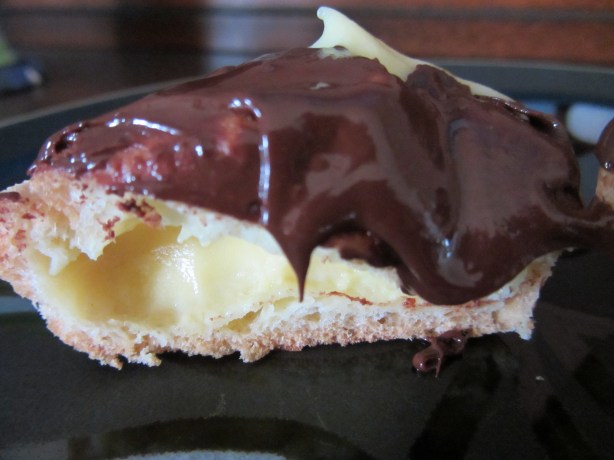
A cream puff, cut in half.

Funnel Cake

So, what else can you do with Pâte à Choux? Well, you always opt for funnel cake! To make this classic carnival/fair favorite, heat ~1 inch of vegetable oil to 375 degrees.

IMG_6011

Oil, heating to 375 degrees.

Using a #12 piping tip, pipe Pâte à Choux into the hot oil in a circular pattern. Cook the pastry until it is golden brown, flip it over, and cook until the second side is golden.

Remove the pastries to a rack over a sheet pan and dust them liberally with powdered sugar.

My funnel “cakes” turned out more like funnel “straws,” but they were still quite delicious.IMG_6018 I found that the pastry was too thick for the #12 tip, though I had set my dough aside for a while. Still, my pastries were like eating little fried pillows with powdered sugar. These were definitely tasty, though not as pretty as they should be.

I have never been the biggest fan of pork chops. I remember sitting at the kitchen table when I was little, staring down a seemingly gray hunk of pork my mom had cooked for dinner, and dreaming of dessert; looking across the round oak table, my brother’s face mirrored my own. To this day, my mom says she has never understood why neither of her kids liked pork chops. My mom has always been a great cook, so I doubt she cooked pork chops poorly. Still, my impression of pork chops was summed up perfectly by Lorelai Gilmore when she said that eating pork chops is like sucking on a Pottery Barn catalog. I mean, really… tell me that you have never had that exact experience. So, last night for dinner, I set out to see if I could finally find a pork chop I liked.

Stuffed Grilled Pork Chops

After watching this episode of Good Eats, I determined that I needed to head to the local butcher shop to get my pork chops. See, according to Alton Brown, all pork chops are not created equal. While all pork chops come from the back of the pig, shoulder and sirloin chops are particularly tough and require wet cooking methods. Center-cut pork chops are the best, and Alton’s favorite center-cut chops are rib cut chops because they are composed of one muscle, making them the best choice for stuffed pork chops. My butcher shop cut two chops for me, making them about two inches thick, which is perfect for Alton’s recipe. For these chops, Alton insists that you make a brine, as pork is inherently dry, and a brine will serve to impart both flavor and moisture. To make the brine, combine in a lidded container 1 C Kosher salt, 1 C dark brown sugar, 1 T black peppercorns, and 1 T dry mustard. Add 2 C of hot cider vinegar and shake the container to dissolve everything.

Set the brine aside for 5-10 minutes to let the flavors fully develop. Next, add a pound of ice to the brine, and shake the container again until the ice is almost melted.

Now you are ready to place your chops into the brine, ensuring that they are completely covered. Though I only had two pork chops, I needed the full amount of brine to cover my chops, so if you are cooking four large chops, you may need to double the brine. Refrigerate the chops for two hours in the brine.

Toward the end of your brining period, you can make your pork chop stuffing. For four pork chops, combine 1 1/2 C crumbled cornbread, 1/4 C halved dried cherries, 2 T golden raisins, 1/4 C chopped walnuts, 2 t sliced fresh sage, 1/2 t pepper, 1/2 t Kosher salt, and 1/4 C buttermilk.

Set the stuffing aside while you prep your brined chops. The online recipe tells you to rinse your brined chops, but Alton did not do this in the episode. I did pat my chops with paper towels to remove excess moisture.

Next it is time to cut stuffing pockets in your pork chops. To do this, Alton placed his pork chops in a bagel slicer, but I just held mine with one hand and cut with the other. Either way, place your chops fat-side up and insert a long, thin knife (preferably a boning knife) straight down until you hit bone. Angle the blade up toward the surface, creating a cavity in one direction. Turn the knife around and cut in the other direction. You can check to see that your cavity is large enough by feeling with your finger. There is a video of Alton cutting his pockets, which you can access from the recipe link above.

In the episode, Alton used a large plastic syringe, with the tip cut off, to fill his pork chop pockets with stuffing. I used a plastic bag that I cut the corner out of, creating a makeshift piping bag. Still, I found that I had to use my fingers to push the filling down into the pocket. I filled my pork chops with as much filling as I could, and I used all of it.

To grill your pork chops, you will want to preheat your grill to high heat for at least 10 minutes. Brush your chops with oil and place them on the middle burner for 2 minutes.

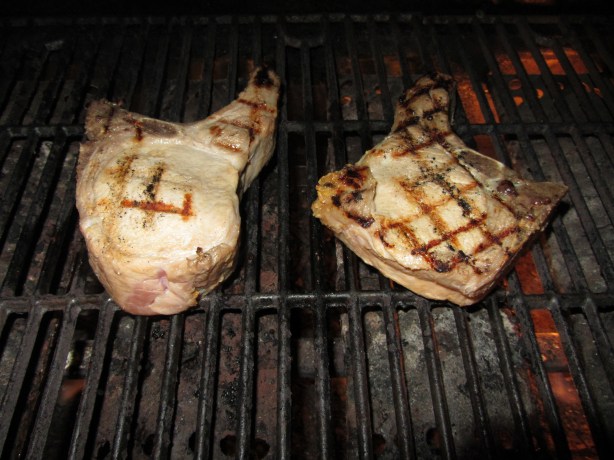
Rotate the chops 90 degrees and leave them for 2 more minutes; this will create nice criss-cross grill marks.

IMG_5949

Pork chops, turned 90 degrees and left for 2 more minutes.

Flip your chops, leaving them for 2 minutes.

IMG_5950

Pork chops, flipped after 4 minutes of cooking. Left to cook 2 more minutes.

Finally, rotate the chops 90 degrees for a final 2 minutes.

IMG_5951

Pork chops, rotated 90 degrees to cook for 2 final minutes.

You want to cook your chops to an internal temperature of 140 degrees. If your chops are not done, place them over indirect heat and cook them until they reach 140. My chops took quite a lot (20-30 minutes) of additional grilling to reach 140.

IMG_5952

Pork chop after cooking to internal temperature of 140.

So, how did Alton’s stuffed pork chops taste? These were the best pork chops I had ever had. The pork was tender and moist, and just slightly pink in the middle, and you could taste the seasoning from the brine. The filling was a delicious accompaniment, with tartness from the cherries, sweetness from the raisins, occasional bursts of sage, and crunch from the walnuts.

IMG_5954

Pocket of filling inside pork chop.

This is a must-do recipe, especially if you are a pork fan. I guess I need to call my mom to tell her I finally met a pork chop I liked.

P.S. A bonus tip from Alton:  If you ever need to know how much propane you have in your tank, you can check the level by pouring ~a cup of boiling water down the side of your propane tank. You can tell where the propane level is by feeling where the metal switches from hot to cold.

While my beer was fermenting from last episode, I got busy prepping the four recipes from the 75th episode of Good Eats. The main player in this episode is that famous star of the cocktail party:  dip. Alton raises the question in this episode of what, exactly, constitutes a dip. Is salsa a dip? Alton concludes that salsa is not, in fact, a dip. Why? It does not meet Alton’s dip criterion, which is that a dip must be able to travel from its vessel to your mouth without going “splat” on the floor. Sour cream and onions do, however, make a suitable dip, which is the first one up in in this episode.

Onion Dip from Scratch

Sour cream and onion dip, also known as “California Dip,” was apparently very popular in the 60s, and Alton’s take on it begins with a bowl containing 1 1/2 C sour cream and 3/4 C mayonnaise (I used homemade mayo).

img_5823

Sour cream and mayo (homemade) make the dip base.

The next step is to heat a medium skillet over medium-low heat, adding 2 T olive oil, 1 1/2 C diced onions, and a pinch of Kosher salt. The onions should be cooked until they are caramelized and golden, which will take about 20 minutes.

Once the onions are golden brown, set them aside to cool a bit. Finally, add the onions, 1/2 t Kosher salt, 1/4 t white pepper, and 1/4 t garlic powder to the sour cream/mayo bowl, stirring to combine.

img_5826

Caramelized onions added to dip base, along with Kosher salt, white pepper, and garlic powder.

This dip came together super easily and was quite addictive, and I served it with good bread, baby carrots, and bell pepper.

img_5829

Alton’s onion dip with veggies and bread.

The sweet caramelized onion flavor is just right with the tangy sour cream and creamy mayo, and it is easy to see how this would be a crowd favorite.

Hot Spinach and Artichoke Dip

Back when I did Alton’s episode on artichokes, I seriously questioned his judgement in not including a recipe for spinach/artichoke dip. Alas, I guess this dip episode explains why he did not. Spinach and artichoke dip is definitely one of my favorites, so I was excited to make Alton’s version. Alton has a newer version of this recipe on his web site, which I actually made for our neighborhood New Year’s Eve party this year. The big difference between the Good Eats recipe and the new recipe is that there is a higher ratio of cream cheese to spinach.

img_5843

Ingredients for artichoke/spinach dip: mayo, sour cream, frozen spinach, artichoke hearts, cream cheese, Kosher salt, garlic powder, red pepper flakes, and Parmesan.

For the original recipe, begin by combining 1/4 C mayo (I again used homemade), 1/4 C sour cream, and 6 ounces of cream cheese, warmed in the microwave.

Heat 1 C of chopped frozen spinach and 1 1/2 C frozen artichoke hearts  in a cup of boiling water until warmed through; I had to use canned artichoke hearts, so I did not heat them. Be sure to thoroughly drain the spinach, squeezing out any excess water.

To the mayo/cream cheese mixture, add the spinach and artichoke hearts, along with 1/3 C grated Parmesan, 1/2 t red pepper flakes, 1/4 t garlic powder, and 1/4 t Kosher salt.

img_5850

Spinach, artichoke hearts, Parmesan, red pepper flakes, garlic powder, and Kosher salt added to dip base.

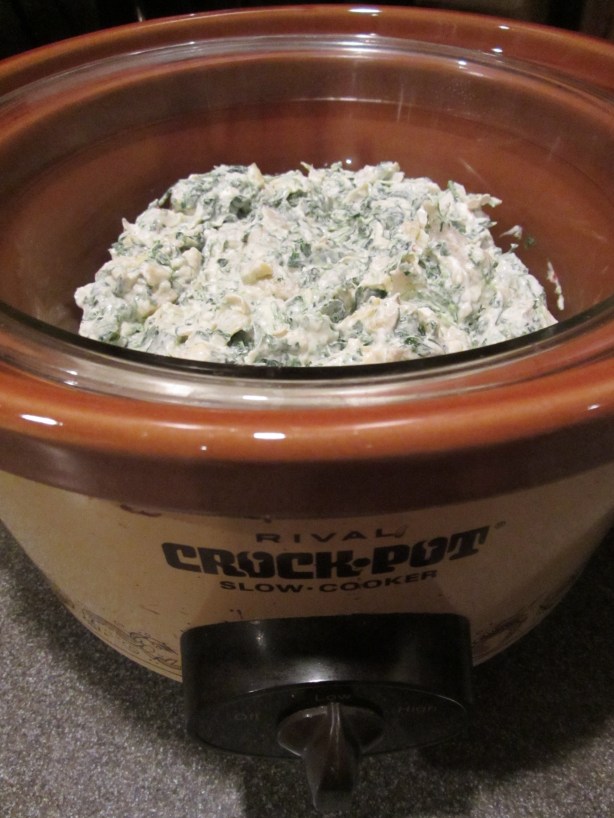
This dip is, of course, best served warm. You can keep the dip warm by putting about an inch of water into a Crockpot, setting the bowl of dip into the water. Set the Crockpot to low and it will keep the dip warm for serving.

img_5854

Spinach and artichoke dip, kept warm in a Crockpot.

We ate Alton’s artichoke dip with bread, crackers, and veggies.This dip creamy, tangy, has a touch of heat, and has a variety of textures.

img_5853

Spinach and artichoke dip.

I do have to say that I prefer Alton’s updated version of this dip over the original, as I like a greater ratio of dip base to artichokes/spinach. We also really appreciated the heat from the red pepper flakes in this recipe. This is one I will make again, albeit the updated recipe.

Guacamole

A dip episode would not be complete without a recipe for guacamole. We make guacamole pretty frequently, usually just tossing together some avocados, lime juice, Kosher salt, garlic, and sometimes some salsa. If I want to put more time into it, I go to a recipe my mom created that uses roasted tomatillos. To make Alton’s version, squeeze the juice of a lime into a bowl and add the flesh of three avocados, tossing the avocados to coat them thoroughly and prevent browning.

Drain the lime juice from the avocados, reserving it for later.

img_5863

Lime juice drained off of avocados and set aside for later.

To the avocados add 1/2 t Kosher salt, 1/2 t cumin, and 1/4 t cayenne pepper. Mash the avocados with the seasonings, using a potato masher.

Once you have your desired consistency, add 1/2 an onion, chopped. Next, add 1 T cilantro, 1/2 of a seeded jalapeno, 1 clove of garlic, 1 T of the reserved lime juice, and 2 Roma tomatoes, seeded and chopped.

Mix everything together, press plastic wrap onto the surface, and let the dip sit in a cool place for two hours before serving.

img_5886

Alton’s guacamole.

Of course, we ate our guac with some tortilla chips. This guacamole was good, but it was nothing outstanding, and I wouldn’t go out of my way to make it again. I did like the additions of the tomatoes, onion, and jalapeno, as they added texture and flavor, but I thought it could use a touch more heat.Mom’s recipe remains my favorite, as those roasted tomatillos take guac to a new level.

Chicken Liver Mousse

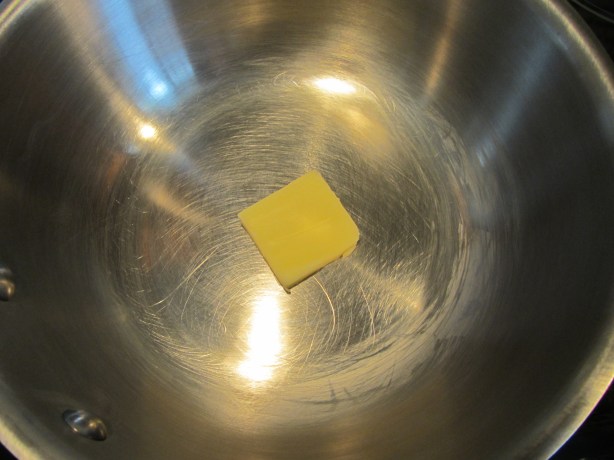
Last up in this episode was Alton’s chicken liver mousse, which was to be my foray into cooking with liver. I only made half a batch of this recipe, as it was just for the two of us and the shelf-life of this dip is only a couple days. For a full batch of the dip, heat a large saucier over medium heat and melt 2 T of butter.img_5891 To the melted butter add 2 C chopped onions, 1 chopped Granny Smith apple, 1 t fresh thyme, and a heavy pinch of Kosher salt. Cover the pan and let it cook until the contents are golden.

Next, add a pound of cleaned/drained chicken livers to the pan. I found chicken livers near the chicken in my grocery store. Honestly, I find chicken livers hard to stomach when they are raw; they just are not at all appetizing to me, and I may have gagged a little… just a little.

Anyway, stir the livers gently, cooking them until they are gray on the outside, but still pink on the inside; Alton says this will take about three minutes, but it took several minutes longer for my livers to be cooked. Once the livers are cooked, add 1/4 C brandy to the pan and simmer for a minute.

Remove the pan from the heat, letting it cool for five minutes. Once the liver mixture cools, puree it in a food processor until it is smooth.

In a separate bowl, beat a cup of heavy cream until it has soft peaks.

Finally, fold the whipped cream into the liver mixture in two installments.

img_5914

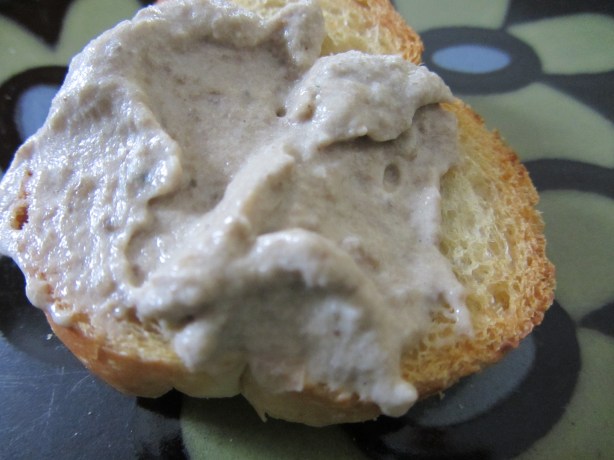
Alton’s chicken liver mousse on crispy baguette.

Serve immediately or cover and refrigerate for up to two days. We thought this was just okay. We have had other chicken liver pâtés that we have really enjoyed (in fact, we had a great one last week at a restaurant), but this one was not our favorite. The color of this mousse was sort of gray and unappealing, and Ted commented that he found the mousse overly sweet. Of the recipes in this episode, this one was our least favorite.

I didn’t really become a beer drinker until I was in my 20s. Growing up, the only beer I was really exposed to was what my dad drank, and he got on the microbrew bandwagon at the very beginning. I was pretty shocked when I had my first Budweiser at a wedding, as it was so thin and flavorless compared to the beer I had always known. I guess you could say I was destined to be a beer “snob” from the beginning. Since then, I have developed my beer palate substantially, and I enjoy quite a few styles of beer today.

Ted got into homebrewing before we were ever a couple. Over the years we have made several batches of beer together, some of which have been pretty good. Our worst homebrew was a blueberry beer that was my idea, and it involved infusing the beer with pounds of fresh blueberries. The beer was pretty terrible, and a complete waste of fantastic blueberries. Our kitchen was also a sticky, purple mess after bottling that beer, but the dog seemed to enjoy that part.

We also brewed a beer years ago for a local homebrew competition. This particular beer was infused with apricot kernels (again, my idea). We came home late one evening to find that the airlock on our glass carboy had become clogged with apricot kernels, leading to a beer explosion all over our bedroom. Yes, we kept the beer in our bedroom; our bedroom was the right temperature and we could keep the animals away from it. We spent hours that night cleaning beer and apricot kernels off of every surface. Our poor hardwood floors were just never the same.

Good Brew

Alton’s homebrew recipe from this episode of Good Eats was to be my first time brewing beer on my own (though Ted did help with some heavy lifting). This particular beer is made using malt extract, as opposed to all-grain brewing. All-grain brewing is more complicated because you convert the starches to sugars, while that step is done for you if you use malt extract. For this recipe, you will need to have the following hardware:  a 3+ gallon pot (actually, more like 5 gallon), a probe thermometer, a pair of nesting colanders/strainers, two lidded 7-gallon buckets with airlock holes (preferably with spigots), an airlock, plastic tubing, a bottle filler, bleach, bottles, and caps and a capper, if you are using them. For ingredients, you will need liquid pitchable yeast (I used a California ale yeast), 7 pounds of malt extract, 1/2 pound milled barley, 1 3/4 ounces of Kent Goldings hops, 1 ounce of Cascade hops, 7 pounds of ice, 4 gallons of spring water, and an additional pint of spring water. Note:  one gallon of the water, along with the pint, should be kept cold, while the rest of the water can be room temperature.

img_5786

Malt extract, milled barley, Cascade hops, Kent Goldings hops, and pitchable yeast.

To begin the brewing process, you will want to sterilize all of your equipment by pouring two ounces of bleach into your bucket, filling it with cold water. Dump all of your equipment (for today you will need your strainers, bucket lid, and airlock) into the bleach solution, letting it sit. The bathtub is a great place for this.

img_5785

Bucket and equipment being sterilized with bleach water.

Meanwhile, you can begin brewing by pouring two gallons of bottled water into your pot.

Add 1/2 pound of milled barley and turn the heat to high. Using your probe thermometer, monitor the temperature of your barley solution; you will want to bring the heat to ~150 degrees, then decrease the heat, allowing the temperature to continue to rise to 155 degrees. Maintain 155 degrees for 30 minutes. This part of the brewing process is called “mashing.”

When your timer has gone off, add another gallon of bottled water to the pot, along with your seven pounds of malt extract. Note:  Malt extract has the consistency of honey, so it is helpful to warm the malt extract in warm water to make it easier to remove from its container.

Increase the heat to high, bringing the mixture to a boil. If the mixture foams badly, decrease the heat until the foam settles, and raise it again.

Once you have reached a boil, decrease the heat to a simmer. Now it is time to add your flavoring hops, so add 1 ounce of Cascade hops and 3/4 ounce of Kent Goldings hops, cooking for 10 minutes.

After the flavoring hops, it is time to add the aroma hops (this is called dry hopping), so add the remaining ounce of Kent Golding hops. Turn off the heat, cover the pot, and let the mixture sit for five minutes.

While your brew is sitting, thoroughly rinse your bucket and all of your equipment to get rid of any bleach. Dump your seven pounds of ice, along with your cold water (1 gallon plus 1 pint) into your bucket.

Nesting your strainers over the top of your bucket, strain your mash into the ice/water in your bucket. This strained mash is called “wort,” which is young beer.

Take the temperature of your wort with a clean thermometer. Your yeast packet will tell you the temperature at which it can be added to your wort. In the episode, Alton’s wort was cool enough that he could add his yeast right away, but this was not the case for me. Since I was brewing late in the evening, I had to wait until the following morning to add my yeast. In any case, when your wort is cool enough for your yeast, mix the yeast and pour it into the wort – there is no need to stir or shake.

img_5818

Adding my yeast the following morning once my wort was cool enough.

Place the lid on the bucket, fill the airlock with water, and place your bucket in a cool, dark place. The airlock allows the fermenting beer to release pressure, so your fermenter will not explode.

img_5820

Airlock filled with water.

After seven days, time the bubbles in your airlock; if they are more than a minute apart, you are ready for the next step. I proceeded to the next step after eight days. On this day, you will need to sterilize your second bucket and its lid, your plastic tubing (if using), and your bottle filler, which you can do again with bleach/water. You will also need to sterilize your bottles, which I did by running them through the dishwasher with some bleach. If you are using bottle caps, you can sterilize them by boiling them in water in a saucepan.

img_5832

Bottle caps being sterilized by boiling them in water.

When all of your equipment is ready to go, bring a pint of water and 3/4 C sugar to a boil, allowing it to cook for five minutes.

img_5834

Sugar and water to be boiled for five minutes.

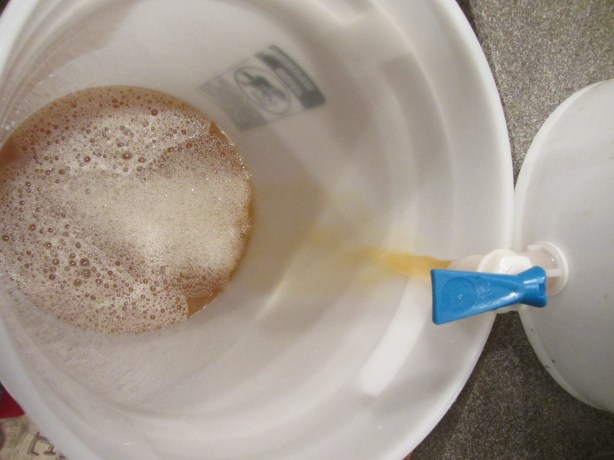
Pour the sugar solution into the bottom of your clean bucket. Using your plastic tubing, or a spigot if your bucket has one, transfer your beer from its original fermenter to your clean bucket that is holding the sugar solution.

img_5837

Beer being transferred to second bucket containing sugar solution.

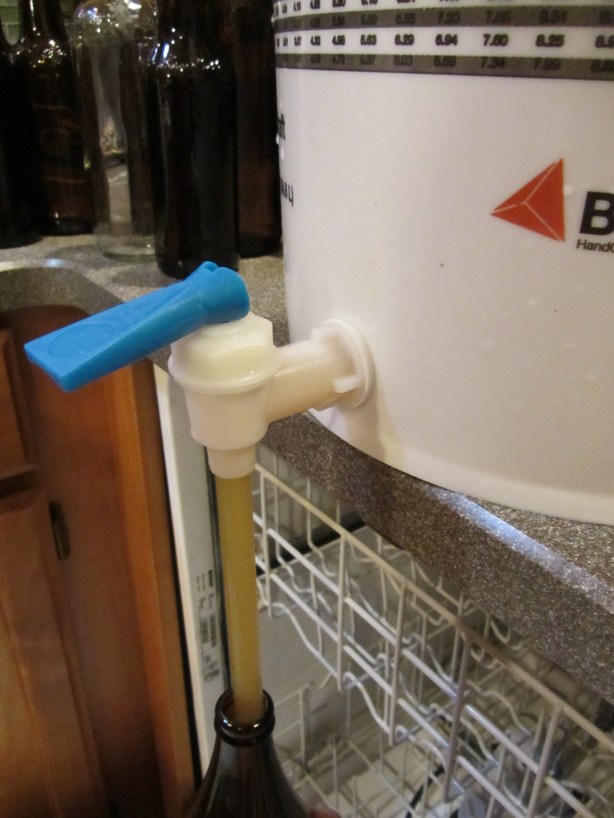
Finally, transfer the beer to your clean bottles, using your bottle filler.

img_5839

Beer being transferred from bucket to bottles, using bottle filler.

Cap the bottles and place them in a cool place for 7-14 days before trying.

I first tried my beer seven days after bottling, splitting a 22-ounce bottle with my brother. As I poured it, I was concerned that it would not have enough carbonation, but it was actually fine.

img_5890

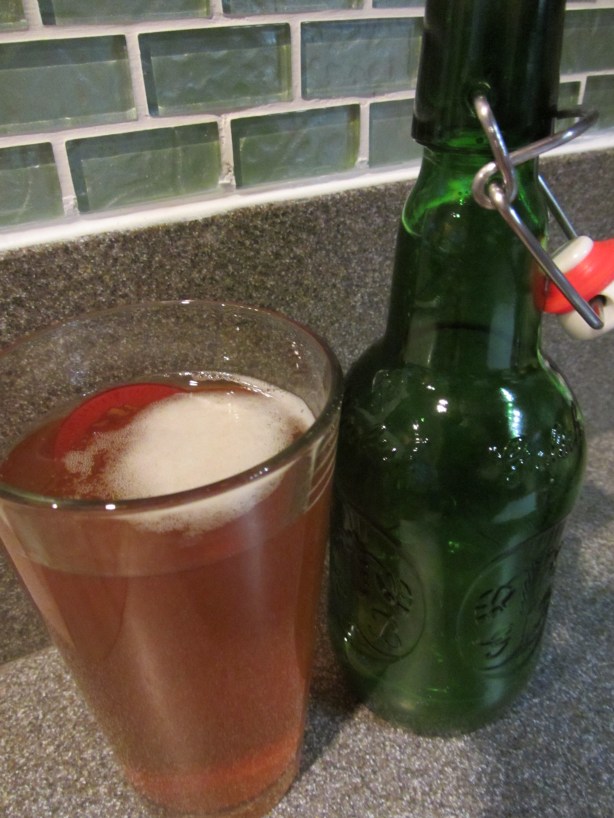
A bottle of Alton’s homebrew.

This beer is a sure-fire easy-drinking beer that could be enjoyed by beer drinkers of all types. This beer is golden in color, light, and has citrus notes that would make it refreshing on a hot day. And, the carbonation seems to be just about right. Overall, I am pretty pleased with this homebrew, and I would recommend Alton’s method for anyone looking to try homebrewing for the first time.

The 73rd episode of Good Eats is all about tomatoes and different uses for them. Seeing that Ted is not a huge tomato fan, I was not sure what he would think of some of these applications, but worst case scenario would see me stocking up heavily on lycopene. Alton went over some tomato facts in the episode, stating that there are six types of tomatoes we can get commercially – globe, plum, cherry, pear, grape, and currant (in order of size from largest to smallest). A beefsteak tomato is a red globe tomato that is extra large in size. Oh, and never store tomatoes in the refrigerator, as temperatures colder than 50 degrees permanently stop a component of tomatoes that gives them flavor.

Stuffed Tomatoes

For six servings of Alton’s stuffed tomatoes, cut the tops off of six large globe tomatoes, using a serrated knife. Scrape the seeds and pulp out of the tomato, using your fingers or a grapefruit spoon.

Sprinkle the tomatoes liberally with Kosher salt and invert them on a rack for 15 minutes; this will remove excess moisture from the tomato shells.

While the tomatoes drain, combine 2 C sauvignon blanc and 1 C hot water; add 3 C dried mushrooms to the liquid mixture to rehydrate.

While Alton used a blend of chanterelles, morels, and shiitakes, I only used shiitakes. Next, heat a large skillet, adding 2 T olive oil, 1 T minced garlic, 2 T minced shallots, and 1 C finely diced onion. Cook the onion until translucent.

img_5763

Garlic, shallots, and onion, cooking in olive oil.

Using your hands, squeeze excess moisture from the hydrated mushrooms, reserving the liquid. Chop the mushrooms and add them to the pan, cooking for five minutes over medium heat.

Add a cup of your reserved mushroom liquid to the pan and bring it to a simmer for five minutes. Follow this up with 1/4 t pepper and 1 chopped tomato. Finally, add 1 1/4 C panko breadcrumbs.

By this time, your tomato shells should have shed any excess moisture and you can use a measuring cup to fill the shells with the mushroom mixture.

For a final topping, combine 3 1/2 ounces of goat cheese with 1 T parsley, dividing this mixture evenly among the tomatoes. Place the stuffed tomatoes under a preheated broiler for 5-7 minutes, and enjoy!

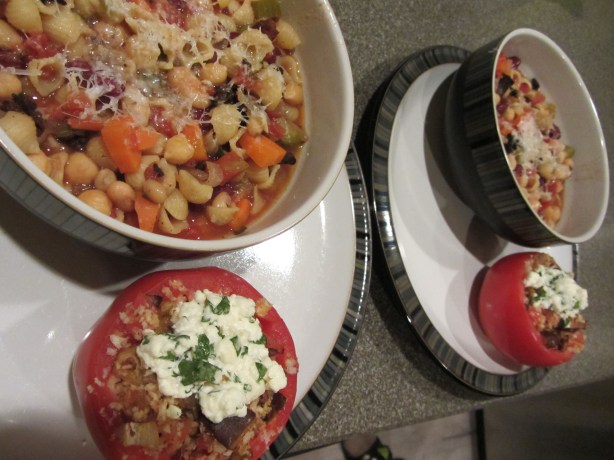
We ate Alton’s stuffed tomatoes as a side dish to my mom’s hearty minestrone soup.

img_5783

Stuffed tomatoes alongside hearty minestrone soup.

Ted thought this recipe was just OK, as he didn’t care for the tomato shells. As a tomato fan, however, I thought Alton’s stuffed tomatoes were delicious. The tomato shells maintained their texture and were far from soggy, contributing a bright tomato flavor. The mushroom filling had a fantastic umami flavor and slightly crunchy texture, and, well, who doesn’t like goat cheese? This recipe is a great blend of textures and flavors, and could be served as a vegetable side dish or as a vegetarian entree.

Tomato Sauce

I was curious to see how this episode’s tomato sauce would compare to Alton’s canned tomato sauce that I made over two years ago when I was writing up the second season of Good Eats. This episode is all about using fresh tomatoes, and this recipe calls for 20 fresh Roma tomatoes. In addition, you’ll need olive oil, fresh thyme, fresh oregano, Kosher salt, pepper, garlic, and onion.

img_5708

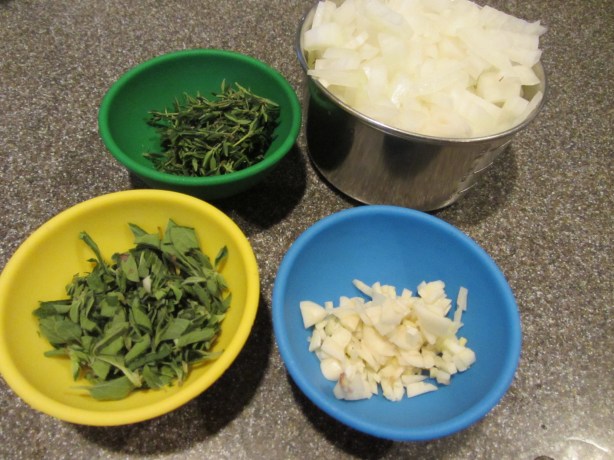
Garlic, onion, oregano, and thyme.

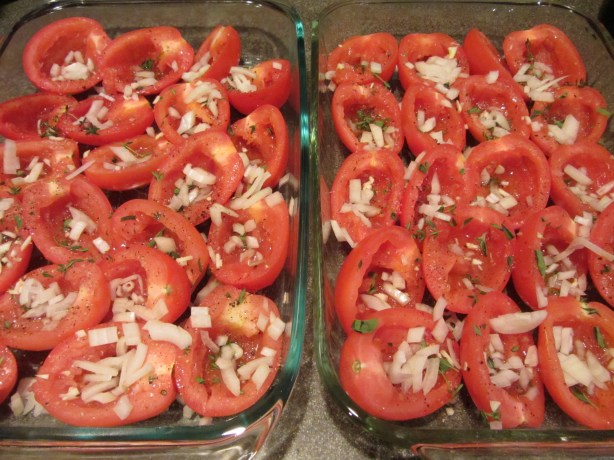
Begin by halving/seeding the Roma tomatoes, placing them cut side up in two 13×9-inch glass baking dishes.

Spritz (or, in my case, drizzle) the tomatoes with olive oil, and sprinkle them evenly with 1 T each of chopped fresh thyme and oregano. Alternatively, you can use 2 t of each herb, dried.

img_5710

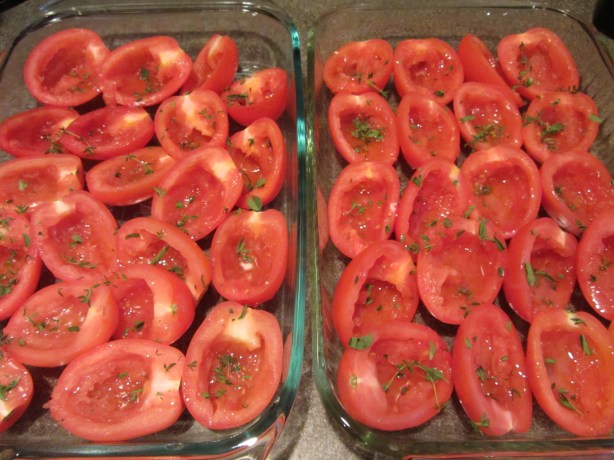
Tomatoes, drizzled with olive oil and sprinkled with oregano and thyme.

Sprinkle Kosher salt and 1/2 t black pepper over the tomatoes, along with 2 t minced garlic and 1 C finely diced onion (any type will work).

img_5711

Kosher salt, pepper, garlic, and onion added to tomatoes.

Stick the tomatoes into a 325-degree oven for two hours.

img_5714

Tomatoes after roasting for two hours.

After two hours, increase the oven’s temperature to 400 degrees for an additional half hour.

Remove the tomatoes from the oven and run them through a food mill (I have my mom’s ancient one that she used to use for applesauce) to get rid of their skins/seeds; you can do this directly over a medium saucepan. It will take a while to push them all through the food mill and you will get very little yield.

Add a cup of white wine (Alton used “cheap Chardonnay”) and bring the sauce to a boil over medium heat. Once boiling, decrease the heat and simmer the sauce for five minutes.

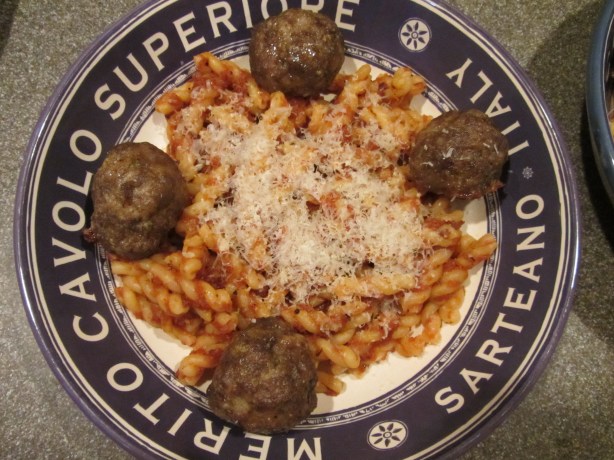
I served this tomato sauce over pasta, along with homemade lamb/beef meatballs (made by Ted) and Parmesan.

img_5732

Alton’s completed tomato sauce. with pasta and meatballs.

Honestly, I was disappointed in this sauce. This recipe made just enough sauce for a pound of pasta, and it was nothing special. The wine flavor seemed too prominent for my taste, so I would simmer it longer, if I were to make this again… which I probably will not do. I expected to prefer this sauce over the one from season two, especially since this one uses fresh tomatoes, but I would choose Alton’s canned sauce any day.

TBL Panzanella

The final recipe from this episode is for a TBL (tomato/bacon/lettuce) panzanella salad. In the episode, Alton demonstrates that this panzanella is a great alternative to a BLT sandwich, and that it showcases tomatoes very well. I love a good panzanella, or a good BLT for that matter, so I was enthusiastic about this recipe. Beginning the night before you want to eat this panzanella, cut a quart of 1-inch high-quality bread cubes, placing them on a pan to dry overnight.

The following day, cook six slices of bacon, saving the drippings. I used my bacon that I made from episode 59.

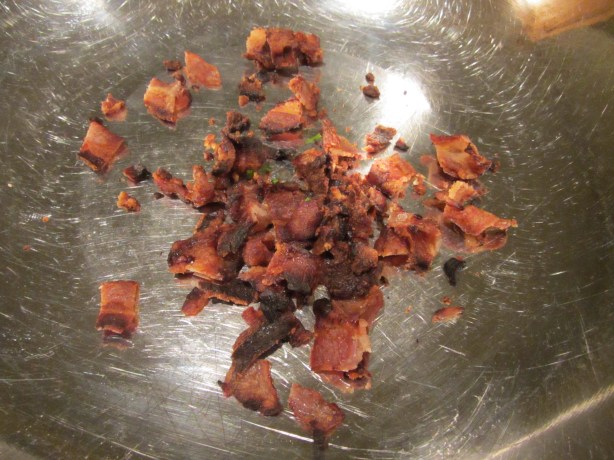
Cut the bacon into 1-inch pieces and place them into a large bowl.

img_5742

Chopped bacon.

In a separate bowl, toss the dried bread cubes with the warm bacon drippings.

img_5748

Dried bread cubes tossed with bacon drippings.

Next, sear 2 C of halved grape tomatoes in a hot pan, face down, for about five minutes. Add the seared tomatoes to the bacon bowl.

Halve 2 C of raw yellow pear tomatoes (I had to use yellow grape tomatoes), adding them to the bacon/tomato bowl. Next, add 2 C of chopped Romaine lettuce.

In a small lidded container, shake together 3 T olive oil, 1/4 C red wine vinegar, 1/4 t salt, and 1/4 t pepper.

img_5736

Olive oil, red wine vinegar, salt, and pepper for the dressing.

Combine the bread cubes with the rest of the salad and drizzle on the dressing. Finish the salad off by adding a chiffonade of fresh basil and mint.

I thought this was a really good panzanella salad. The bread cubes stayed crunchy, the bacon added meatiness, and the tomatoes gave a super fresh flavor. I thought the vinegar-based dressing paired well also.This is also a very colorful, pretty salad. To me, this is more of a warm weather meal, but we enjoyed it nonetheless. I think this still had a few too many tomatoes for Ted’s taste, but I may make this again for myself and enjoy it on a sunny day on the deck.

Do you ever have memories from childhood that seem incredibly prominent, such that you feel like they occurred with regular frequency? For some reason, I have a very strong memory of my mom making cheese souffle when I was little; the odd thing is that my memory makes me feel that this happened regularly, when, in fact, it may have only happened once or twice. I think I will have to call my mom later and have her set the record straight about her cheese souffle routine. Whether it happened once or many times, I remember sitting at the dining room table with my dad and brother, eagerly anticipating my mom’s arrival from the kitchen with her hot souffle dish. Would her souffle successfully rise and puff above the top of the dish? I recall a beautiful orange souffle, golden on top, with a perfect puffy “top hat.”

Cheese Souffle

Though I had consumed cheese souffle when I was young, I had never made one before I set out to prepare Alton’s souffle for our Saturday breakfast. Per Alton’s instructions, I preheated my oven to 375, which is his temperature rule for any souffle. For a souffle vessel, he recommends a 1.5-quart round souffle dish, preferably with an unglazed bottom (for heat penetration) and fluted sides to increase surface area; it just so happens that we have a dish just like this. First, I greased my souffle dish with cold butter.

img_5663

Souffle dish, greased with cold butter.

Next, I added 1 T of grated Parmesan to the dish, covering it with plastic wrap and shaking to coat the inside of the dish. I found that I actually needed a little more Parmesan to coat my dish, so I added some extra and shook again. Lining the dish with Parmesan gives the souffle something to “hold onto” as it climbs the walls. The souffle dish goes into the freezer while you prep everything else.

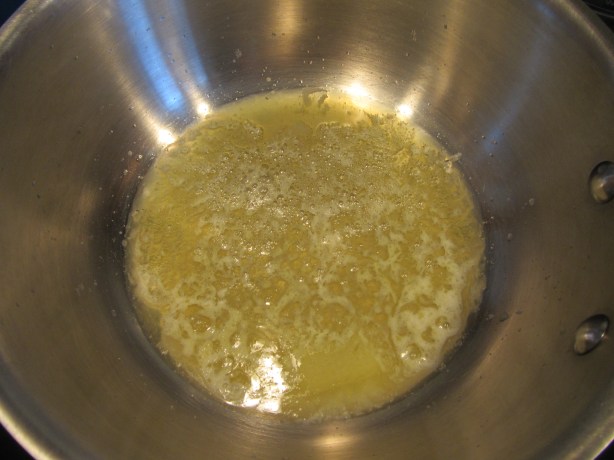
Alton’s recipe then calls for making a roux by melting 1 1/2 ounces of butter over medium heat, allowing the butter to cook until it stops bubbling, which means most of the water has been cooked out.

img_5680

Butter, cooking until it stops bubbling.

While the butter cooks, in a lidded container combine 3/4 ounce flour, 1 t dry mustard, 1/2 t garlic powder, and a heavy pinch of Kosher salt, shaking to combine.

You will also want to separate 4 egg yolks (you will need 5 egg whites later, so save the whites here), grate 6 ounces of sharp Cheddar cheese, and heat 1 1/3 C milk in the microwave.

When the butter has ceased bubbling, add the dry ingredients to the pan, whisking over low heat until you have a nutty aroma. To the roux, add the hot milk, whisking and increasing the heat.

Beat your egg yolks until light in color and turn the heat off under the roux. Temper the egg yolks by gradually adding small amounts of the hot roux, whisking. Once you have added about half of your roux, you can whisk the egg yolks into the roux pan.

Keeping the pan off of the heat, whisk in the grated Cheddar until you have a smooth mixture, which will take a few minutes. Set the base aside to cool.

Note:  To cut down on preparation time the day you are making your souffle, you can make the souffle base to this point and refrigerate it for up to a week; just be sure to press a layer of plastic wrap onto the surface to avoid having a “skin” form. If you do this, you will need to bring the base to room temperature before using. While your base cools to room temperature (or warms to room temperature if you prepared it in advance), beat 5 egg whites in a metal bowl, along with 1 T water and 1/8 t cream of tartar until you have stiff peaks.

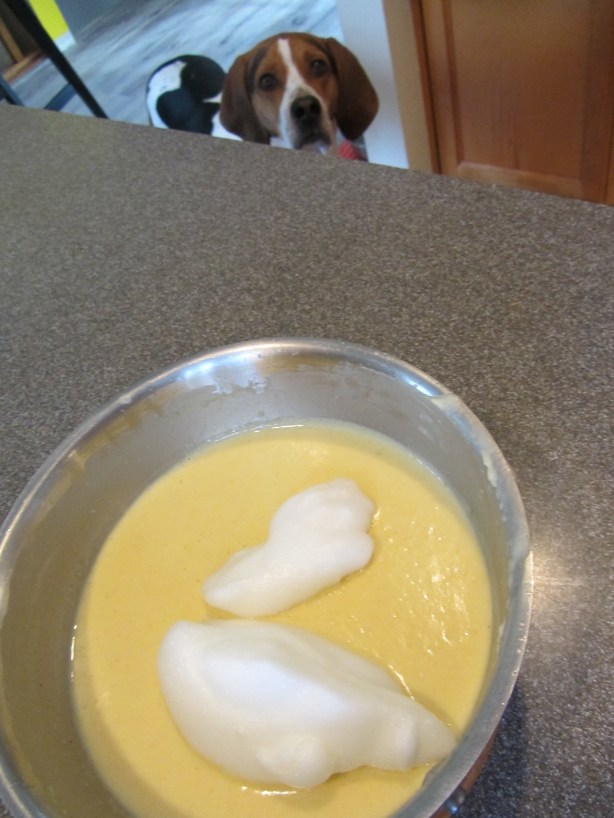
Stir 1/4 of your egg whites into your room temperature base, as this will lighten the base.

img_5691

Stirring 1/4 of the egg whites into the souffle base.

Gently fold the remaining whites into the base in three installments, avoiding deflating the foam by over-mixing.

Pour the souffle into the prepared dish and use your thumb to make an indentation all around the edge of the souffle, as this will help to form a nice “top hat.” Place your souffle dish in a pie pan (for ease of removal from the oven), and bake it for 35 minutes.

img_5697

Souffle in prepared dish.

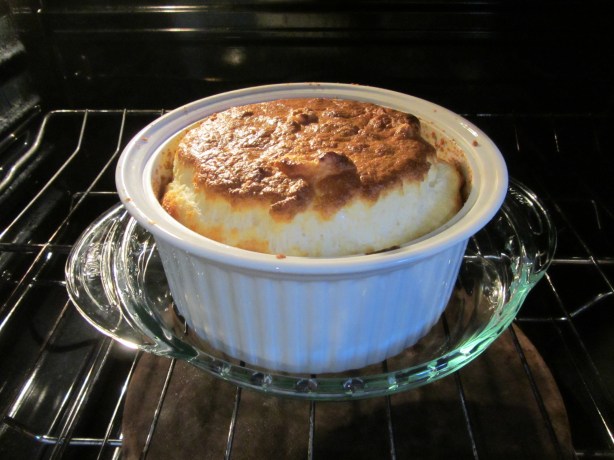
After 35 minutes, use a sharp paring knife to peek into the middle of the souffle – if there is a lot of liquid, place it back in the oven for 5 more minutes. My souffle seemed to be done after 35 minutes.

img_5698

Souffle after baking for 35 minutes.

Serve your souffle promptly. The nice thing about a cheese souffle is that you could eat it for any meal, but we had ours for breakfast before an 11-mile run.

Honestly, I was worried that my souffle was going to flop, as I felt that I had over-beaten my egg whites, but it actually turned out quite nicely. I do wish my souffle would have had a better rise above the top of the dish, but it still was nice and airy, and had a light crust on the outside. The cheese flavor was really prominent in this souffle and it had the texture of super light scrambled eggs. Souffles can be intimidating, but they are really not difficult, and Alton’s recipe seems to be one that works.

I am taking some liberties here and doing this special out of order, as this special episode was really the 7th one to air, but I’m writing it up as my third special. We wound up hosting Thanksgiving at our house this year, and the recipes from this episode composed a large portion of our Thanksgiving menu. Yes, I know Thanksgiving was quite a while ago, but it seems we’ve had non-stop things going on for the last several weeks. The premise of this special is that Alton intends to give you a solid, stress-free Thanksgiving menu, much of which can be prepared in advance. In the episode, he breaks down exactly when you need to complete each step of each recipe, so everything winds up on the table at the same time. I was slightly skeptical as to how well his schedule would actually work when put to the test. Without further ado, here are the recipes from Alton’s second Thanksgiving-specific special, along with his Thanksgiving schedule.

Butterflied, Dry Brined Roasted Turkey 

In the online recipe, the turkey and panzanella are written as one, but really you will begin prepping the turkey and two other menu items before you begin the panzanella, which I will write up separately below. Note that, for this recipe, you will need to have your bird thawed four days in advance. The ideal bird for this recipe is a 14-pound frozen turkey, which you can thaw, wrapped, in the refrigerator; allow one day for every four pounds.
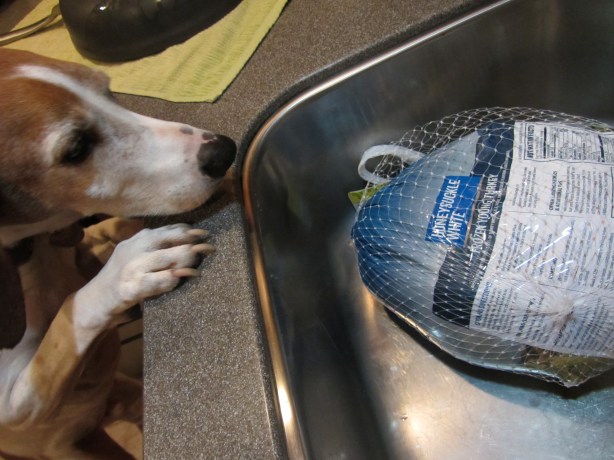
img_5514

My 14-ish pound bird.

If you really want to get fast/fancy, you can purchase a pump and thaw your turkey in a cooler next to your sink, placing the pump in the sink and covering it with cold water. Run the pump tube up into the cooler with the bird. Meanwhile, open the drain spout on the cooler, allowing it to drain into the sink. Make sure you reach equilibrium if you try this method, or you could end up with water all over the floor. If the cooler is draining too quickly, you can partially plug the hole with some foil. I opted for a third method and thawed my bird in a bucket of cold water, changing the water every couple hours, which took about eight hours. Four days prior to serving, make a dry brine by grinding 3 1/2 T Kosher salt, 1 1/2 t dry thyme, 1 1/2 t rubbed sage, 1 1/4 t black peppercorns, and 1 1/2 t allspice berries in a spice grinder.

Remove the neck and giblets from the bird, reserving them if you plan to make Alton’s gravy. Placing your turkey breast side down, use kitchen shears to cut up one side of the turkey’s backbone. Flip the bird 180-degrees and cut up the other side of the backbone, holding onto the neck. Save the bones for Alton’s gravy.

Flip your bird over, so it is breast side up and press the keel bone with the heels of your hands until it cracks and the bird flattens.

Sprinkle half of the dry brine on each side of the bird, patting it into the turkey. I know this sounds odd, but place your flattened bird, breast side up, on a parchment-lined sheet pan and let it age in your refrigerator for four days, uncovered.

The day you plan to serve your turkey, remove it from the refrigerator 3:40:00 ahead of meal time. Place the turkey in a 425-degree oven 2:05:00 ahead of serving; if you are also making Alton’s panzanella, you will place the bird directly on an upper oven rack without a pan, allowing the turkey’s juices to drip into the panzanella below. Otherwise, yeah, you will probably want to use a pan! When you have 1:35:00 to dinner, decrease the oven temperature to 350. You will want to continue cooking your turkey until it reaches 155-degrees in the deepest part of the breast. I will confess that I cooked my turkey until it was ~160 degrees.

img_5590

My completed turkey, after cooking to ~160 degrees.

Remove the turkey from the oven and let it rest under foil. My bird was done pretty much on schedule, so it had plenty of time to rest while we finished up other things.

img_5591

My completed turkey, after cooking to ~160 degrees… and a desperate dog.

Honestly, this is the easiest turkey you will ever make and it takes so little time. Also, we could not believe how much the spices from the dry brine (isn’t that really a cure?) had permeated the meat – so much flavor! This will be the turkey I make the next time I prep one. Yes, your oven does get slightly messy, but that is worth it. This is my new favorite turkey recipe.

Bourbon Pecan Pie

Okay, so this pecan pie recipe is awesome because you can make it up to two weeks ahead of time. I actually made this for us to eat the week after Thanksgiving, as we already had enough dessert contributions for our Thanksgiving meal (including a pecan pie!). The first step for Alton’s pie is to make his spiced pecans. Oddly, he did not actually demonstrate this recipe in the episode, though he did mention that you need the spiced pecans in your pie. So, I simply followed the online recipe for the spiced pecans, making a half pound of them.
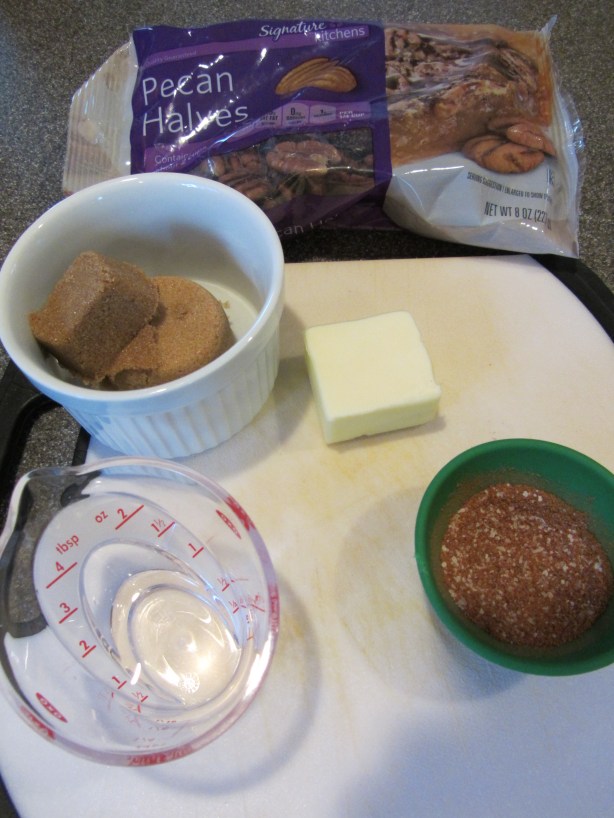
img_5614

Ingredients for spiced pecans: pecan halves, light and dark brown sugar, butter, water, and spice blend.

To make a half pound of spiced pecans, combine in a bowl 1/2 t Kosher salt, 1/4 t cumin, 1/4 t cayenne, 1/4 t cinnamon, and 1/4 t dried orange peel (I didn’t have this, so left it out).

Toast the pecan halves in a pan over medium heat until they smell toasted, and stir in 2 T butter.

Once the butter has melted, stir in the spice mixture.

img_5619

Spice mix added to buttered pecans.

Finally, add 1 T water, 1 T dark brown sugar, and 1/8 C light brown sugar. Stir until the nuts are coated evenly and spread them on a parchment-lined sheet pan to cool, breaking up any clusters.

Once your spiced pecans are complete, you are ready to make the rest of your pie, beginning, of course, with the crust. In a food processor, pulse 3 1/2 ounces plain pecan halves until fine. To your pecans add 6 oz flour, 4 T cold butter, 1/2 t Kosher salt, 2 T ice water, and 2 T bourbon, pulsing after each ingredient is added, and avoiding over-processing.

Flatten the dough into a disc and place it in a ziplock bag, refrigerating for 30 minutes.

img_5639

Dough flattened in a disc, and placed in a ziplock bag to cool.

Meanwhile, heat the oven to 350 degrees. Make the filling by melting 4 T butter. In a bowl, whisk together 3 eggs, 1/2 C sugar, 1/4 t Kosher salt, 1 t vanilla, 1 T bourbon, the 4 T of butter you melted before, and 6 ounces (by weight) of golden syrup; golden syrup can be tricky to find, so I ordered it online.

When your dough has chilled, cut the two opposing side seams of your ziplock with scissors. Open the bag and sprinkle both sides of the dough disk with flour. Cover the dough with the bag again and roll it into an 11-inch circle.

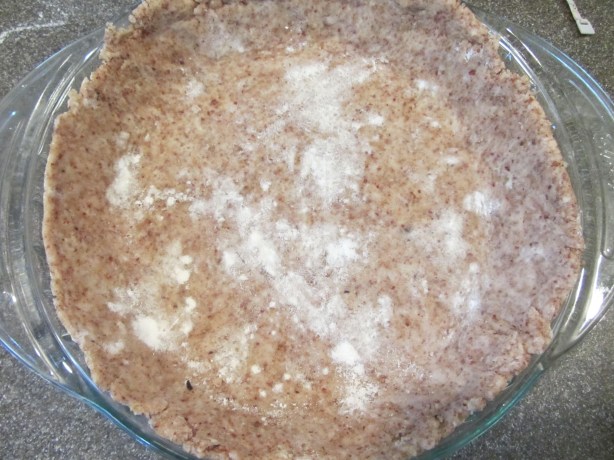
Alton recommends using a 9.5-inch fluted tart pan with a removable bottom, as you can simply place your dough circle onto the bottom of the pan, folding up the excess dough. When you place the bottom of the pan into the edges, you can simply unfold the excess dough, pressing it into the flutes. I, however, do not have a tart pan of that size, so I opted for a regular pie plate, transferring my dough circle by rolling it around a rolling pin. This dough is slightly sticky, so you do need to use flour.
img_5652

Crust, transferred to pie plate.

Regardless of which pan you use, press the dough into the pan before adding 6 ounces of your spiced pecans, chopped. Pour the filling mixture over the pecans and jiggle the pan to evenly distribute the nuts.

Bake the pie for 20 minutes. At this time, remove your pie from the oven, placing it on a rack. Decorate the top of your pie by placing spiced pecan halves around the edge of your pie – you will need about two ounces of spiced pecans for this.

Stick your pie back in the oven and bake it until the internal temperature is 200 degrees, which Alton says should take about 10 more minutes. If your oven is like mine, however, it will take 15-20 minutes of additional baking. Remove your pie from the oven and let it cool.

img_5657

Pie after baking to internal temp of 200.

If you are making it in advance, cover your cooled pie with plastic wrap and place it in the freezer for eight hours to two weeks. When you are approaching your serving time, remove your frozen pie from its pan and slice it; you can place it back in the pan. Refrigerate your pie until ready to serve. Alton guarantees that this pie will not seep or weep, and I can vouch for that. I never froze my pie, as we simply ate it once it had cooled down. Still, unlike many pecan pies, this one had a filling that maintained its shape and form.

img_5660

A slice of Alton’s pecan pie.

To boot, we really liked the bourbon flavor in this pie, which paired well with the spices from the pecans. The golden syrup also seemed to give more of a caramelized flavor versus using corn syrup. The crust in this recipe is crispy, light, and pretty savory, which we thought contrasted greatly with the super sweet filling. I will make this pecan pie again for sure, as it is probably the best pecan pie I have had.

Whipped Potatoes

Thanksgiving just wouldn’t be complete without some form of potato, right? This special episode featured Alton’s recipe for whipped potatoes. Like the other recipes in this episode, this is one for which much of the prep can be completed in advance. A full 24 hours ahead of serving time, you will want to peel four pounds of Yukon Gold potatoes, and slice them as thinly as possible; a mandolin makes this much faster, if you have one.

Place the potato slices in an 8-quart container, covering them with a gallon of cold water. Let the potato slices sit overnight, allowing the water to remove any excess starch.

You will not need to touch your potatoes again until 1:30:00 before serving time, which is when you will place your potatoes into a strainer (resist the urge to dump the potatoes into the strainer, as you want to avoid transferring all of that starchy water). Rinse your potato slices with clean water and spin them in a salad spinner to dry.

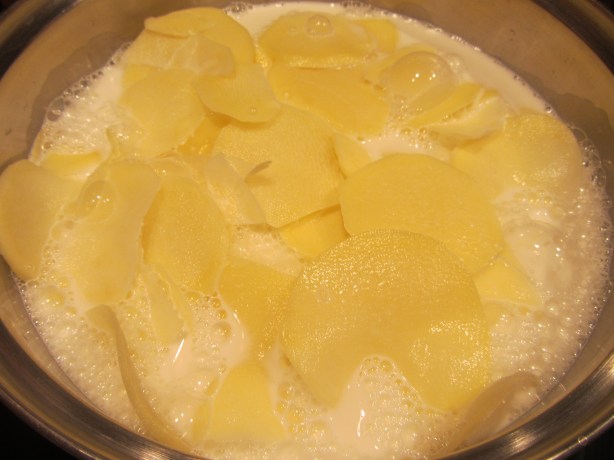
Transfer the potatoes to a large pot, covering them with a gallon of whole milk, and placing them on a burner over medium-high heat.
img_5580

Potatoes and a gallon of whole milk, placed on the stove.

Twenty-five minutes before your meal, drain your potatoes, reserving the milk. Press the potatoes through a ricer into your serving bowl, adding 4 ounces butter, 1 C of the reserved milk (you can use the rest of the milk for something like potato soup), and 1 T Kosher salt. Whip the potatoes with a hand mixer for 15 seconds. Yes, seriously, 15 seconds will do it. Resist the urge to blend the potatoes further, as they will become gummy. Sadly, because I was scrambling around on Thanksgiving, I forgot to take photos of my potatoes as I riced/whipped them, so I have no photos of my finished product. These potatoes seemed to be very popular around our Thanksgiving table, and I have to say that this is now my favorite mashed potato recipe. The potatoes were super light and fluffy, and had just the right amounts of butter and salt. Cooking the potatoes in milk gave them a very creamy mouthfeel and flavor. I highly recommend this recipe, and it will be the one I use when I next make mashed potatoes.

Roasted Root Vegetable Panzanella

As I mentioned above, this panzanella is designed to go along with (and cook with) Alton’s dry brined roasted turkey. While you begin prepping the turkey four days in advance, this panzanella only needs to be prepped 24 hours ahead of your dinner, so Alton covered this as the fourth recipe in the episode. So, 24 hours ahead, cut eight ounces of hearty multigrain or sourdough bread into 1/2″ cubes, leaving them on a sheet pan in a cold oven to dry out overnight.

At this time you will also want to mince two cloves of garlic, chop a red onion, and shred eight ounces of Brussels sprouts (this is super fast with the shredding blade in a food processor).

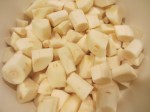
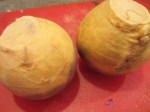
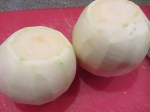
Place these prepped items into separate containers and refrigerate. Finally, peel 1 1/2 pounds each of parsnips and rutabagas, cutting them into chunks. Combine the parsnips and rutabagas in a container and place them in the refrigerator.

The following day, you will begin your panzanella when you pull your turkey out of the refrigerator, which will be 3:40:00 ahead of dinner. At this time, dump your rutabaga/parsnip combo into a large roasting pan, along with 2 t vegetable oil.

img_5570

Rutabagas and parsnips placed in roasting pan with vegetable oil.

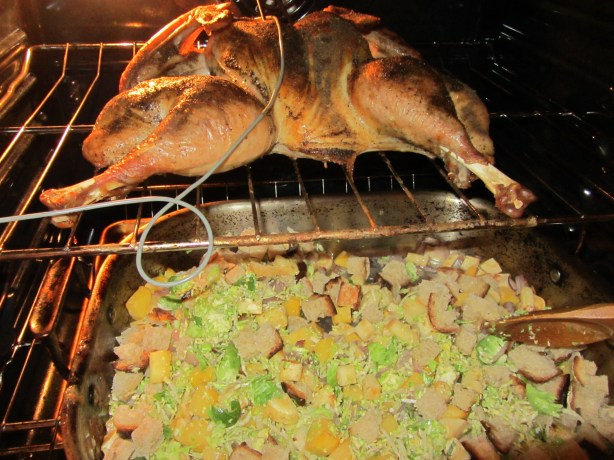
When you place your turkey in the 425-degree oven (2:05:00 ahead), also place your roasting pan into the oven, directly beneath your turkey; this will allow the turkey’s juices to drip into the vegetables. Once you have 1:35:00 to your planned dinner time, add the diced red onion to your roasting pan, tossing, and decrease the oven to 350 degrees.

img_5575

Red onion added to roasting pan.

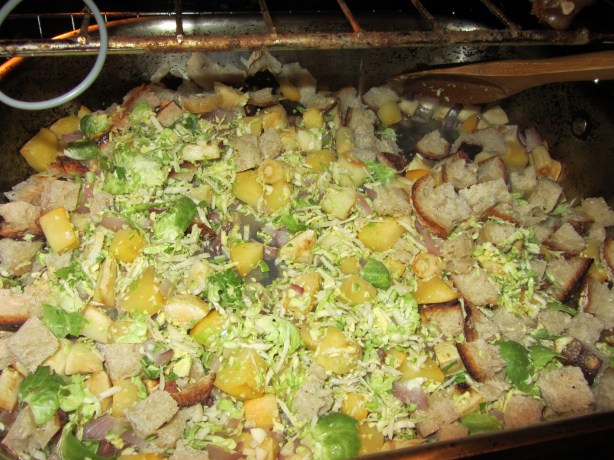
Forty-five minutes ahead, add your bread cubes, shredded Brussels sprouts, and garlic to your panzanella, tossing.
img_5588

Bread, sprouts, and garlic added to panzanella.

Thirty minutes before dinner, remove the roasting pan from the oven and add 1/4 C cider vinegar, 2 t fresh thyme, a pinch of Kosher salt, and some black pepper to the roasting pan.
img_5589

Cider vinegar, fresh thyme, salt, and pepper added to finish panzanella.

Toss everything around and transfer the panzanella to a serving bowl. The flavors in this panzanella were fantastic, but I was highly disappointed in the texture of the bread cubes. To me, a panzanella should have super crunchy bread cubes, but this bread was kind of soggy. I do intend to make this again, but I plan to toast my bread cubes in advance, and I will add them to the salad right before serving. Aside from the bread, the sweetness of the root vegetables was great with the slight tang of vinegar and bite of garlic/onion. I’m sure the turkey juices didn’t hurt the flavor at all either! Again, this is a delicious recipe, but it does need some help in the texture department. Cooking this with the turkey makes everything super easy, which is a huge bonus.

Turkey Giblet Gravy

Last, but not least, Alton had to include a recipe for gravy in his second Thanksgiving special, no? Remember the turkey neck and backbone that we saved from prepping Alton’s turkey four days before Thanksgiving? Well, we’re going to use them here, along with the giblets. Four hours before dinner heat 1 T canola oil in a pot over medium heat, adding the turkey neck and backbone.

img_5560

Turkey neck and backbone, cooking in vegetable oil.

Brown the bones, turning them often for about 5-6 minutes.

img_5561

Turkey neck and backbone, cooking in vegetable oil, turning often.

Once the bones are browned, add the giblets, a small onion, a carrot, a stalk of celery, and a heavy pinch of Kosher salt to the pan.

img_5563

Onion, carrot, giblets, celery, and Kosher salt added to bones.

Cook all of the vegetables until they are tender, which should take about five minutes. Next, add 1 t black peppercorns, 1 bay leaf, 1 sprig of fresh rosemary, 2 sprigs of fresh thyme, and 6 C of water.

img_5565

Peppercorns, bay leaf, fresh rosemary, fresh thyme, and water added to make stock.

Cover the pot, bringing it to a boil. Once boiling, remove the lid and decrease the heat, leaving the pot to simmer for 1 1/2 hours.
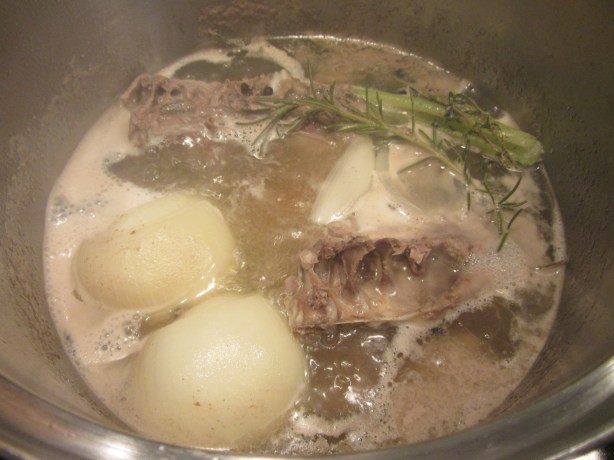
img_5566

Stock, after being brought to a boil.

Two hours prior to dinner, strain the stock, saving the giblets. You can discard the rest of the solids.

Once the giblets are cool, chop them finely. When you have 1:30:00 to dinner, pour 2 C of your stock into a saucier over medium heat. At this same time, pour 1/2 C of additional stock into a lidded container, along with 1 T flour, shaking to make a slurry.

Slowly whisk this slurry into the warm stock in the saucier.

Again, in your shaking container, combine another 1/2 C of cooled stock with 1 T potato starch, shaking.

Turn the burner off under your pan and allow your gravy to cool to below 190 degrees. Once below 190 degrees (which should be about 1:20:00 before your meal), turn the heat to low and whisk in the potato slurry. I had some trouble with this, as my slurry appeared to be quite lumpy, so I had to add some additional hot stock and re-shake my slurry. Once your slurry is incorporated, also add 1 t chopped fresh sage, 1 t fresh thyme, 1 t fresh rosemary, 1 t Kosher salt, and 1/4 t pepper.
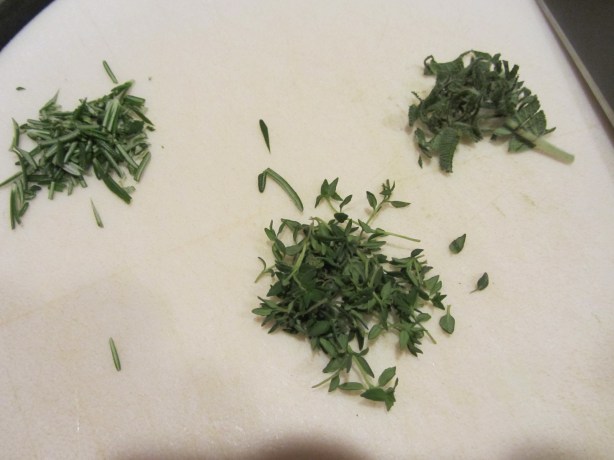
img_5587

Fresh rosemary, thyme, and sage to finish gravy, along with chopped giblets.

When your gravy has reached a simmer, stir in the chopped giblets and turn off the heat. When heated through, you can transfer your gravy to a thermos to keep it warm until you are ready to serve. I failed to get a final photo of my gravy, unfortunately. I am not a huge gravy person, but this one got some rave reviews at our house. The gravy seemed like it was going to be way too thin, but it did thicken up some. Flavor-wise, the gravy fans here really seemed to enjoy it.

So, to sum up Alton’s second Thanksgiving special, I have to say that I was quite pleased with all of the recipes, how they worked together, and his timeline was pretty spot on. If you follow his directions, you can have a pretty stress-free, well-timed Thanksgiving dinner with his five recipes here. While all of the recipes were honestly very good, I would absolutely not skip the turkey, potatoes, or pie. Below is a breakdown of my Thanksgiving Day Alton-based schedule, aiming for a 5:00 pm dinner. Honestly, it worked pretty darn well, and we were seated right around 5 o’clock.

1:00 PM – Start gravy stock.

1:20 PM – 1) Bird out of refrigerator. 2) Rutabagas and parsnips in roasting pan.

2:55 PM – Bird and vegetables in oven at 425 degrees.

3:00 PM – Strain gravy stock and cool giblets.

3:25 PM – 1) Add red onion to vegetables. 2) Decrease oven temp to 350.

3:30 PM – 1) Strain/spin potatoes. 2) Put potatoes in pot with milk. 3) Make gravy and transfer to thermos.

4:15 PM – 1) Add bread, sprouts, and garlic to vegetables. 2) Remove bird when it hits 160.

4:30 PM – 1) Add cider vinegar and seasonings to vegetables. 2) Rice potatoes and whip.

Fresh Yogurt

Yogurt is one of those things that I always feel I should eat more of than I do. I tend to go in spurts with yogurt, eating it frequently for a while, and then not at all. Alton’s yogurt episode began with homemade yogurt. I made homemade yogurt once years ago when I was in grad school, as part of my food microbiology lab course. All I really remember from that experience was that I had a lab partner from Mongolia who called himself “Woody,” I could barely understand a word he said, and our yogurt was very pink. Needless to say, I was hopeful that my Woody-less yogurt would be more successful. When making Alton’s yogurt, you can use any type of milk that you choose, but Alton opted for organic 2% milk in the episode of Good Eats. Alton did say that whole milk will result in looser yogurt, while skim milk will yield yogurt with a grainy texture. In addition to a quart of milk, you will need 1/2 C of powdered milk, 2 T honey, and 1/2 C of plain yogurt, containing live cultures.

img_5475

Ingredients for homemade yogurt: plain yogurt with live cultures, dry milk, honey, and milk.

Begin by pouring your milk into a saucepan, adding the powdered milk and honey.

Meanwhile, allow your yogurt to come to room temperature.

img_5482

Plain yogurt, being brought to room temperature.

Using a probe thermometer, heat the milk mixture to 120 degrees over medium heat. Remove the milk from the heat, and pour it into a clean cylindrical container, allowing it to cool to 115 degrees.

Once the milk has cooled, whisk about a cup of the warm milk into the yogurt.

img_5488

About 1 C of warm milk whisked into yogurt.

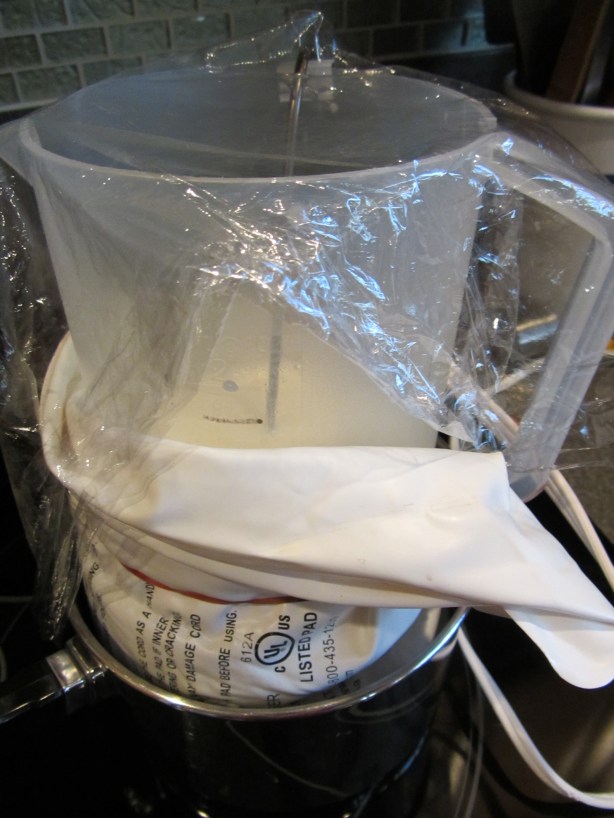
Then, whisk the yogurt/milk mixture back into the cylinder of milk. Wrap the cylinder in a heating pad that will maintain the yogurt’s temperature between 100 and 120 degrees; you can test your heating pad first by filling your cylinder with water.

img_5489

Yogurt added to milk and wrapped with heating pad to ferment for 6 hours.

Allow your yogurt to ferment for three to 12 hours, depending on how you like the texture of your yogurt; a shorter fermentation will yield looser yogurt, while a longer fermentation will give thicker yogurt. Alton did an even six hours in the episode.

img_5491

Yogurt, after fermenting for 6 hours.

Refrigerate your yogurt overnight before using.

img_5493

Alton’s homemade yogurt.

I thought this yogurt was fine, but really nothing special. If anything, I would have liked this yogurt to have had a thicker texture, so I would possibly ferment it a little longer if I were to make it again. Honestly, I wouldn’t go to the trouble of making this again when I can easily buy yogurt that I like just as much.

Thousand Island Dressing

So, really, Alton calls this dressing “Million Island Dressing” in the episode, and it is a good use for some of his homemade yogurt. To make his dressing, whisk together 1 C plain yogurt, 2 T vegetable oil, and 2 T tomato sauce.

img_5523

Yogurt, tomato sauce, and vegetable oil.

Once combined, add 2 t lemon juice, 2 t dry mustard, and 2 t sugar.

img_5525

Lemon juice, dry mustard, and sugar added to dressing.

Next, whisk in 1 t Kosher salt and 1/2 t pepper.

img_5526

Kosher salt and pepper added to dressing.

Finally, fold in 1/2 C diced onion, 1 T relish, 1 T chopped green olives, and 1 minced jalapeno.

I enjoyed this dressing more than I thought I would. It has a really good kick from the jalapeno, tang from the yogurt and lemon, and bite from the onion. It also adds a lot of texture to a salad. We actually liked this enough that I made it a couple times in one week for us to eat on our lunch salads. This is a really good salad dressing.

Tarragon Yogurt Sauce

If you are looking for another savory application for plain yogurt, this tarragon sauce is one to try. This sauce is very versatile and could be served over many things, including fish, eggs, and vegetables; in the episode, Alton says that his favorite use of this sauce is over braised carrots, so that is how I opted to use mine. For this sauce, begin by heating a saucier over medium heat, adding 2 T olive oil, 1/2 t Kosher salt, 1/2 C finely chopped onion, and 1 1/2 t minced garlic.

img_5530

Olive oil, Kosher salt, onion, and garlic in saucier.

I did not have a saucier until recently, but I inherited my parents’ copper-bottomed Calphalon saucier when my brother and I finished sorting through our parents’ belongings; thankfully, my parents are still living, but they really do not cook anymore. Yes, I have learned that a saucier is a very nice tool to have for a job such as this tarragon sauce. While your onion and garlic saute, combine 2 T cornstarch and 1 C chicken stock in a lidded container, and shake to combine. This slurry will help to thicken the sauce, and will also prevent over-coagulation of proteins, AKA curdling. Cream-based sauces have enough fat to prevent curdling, but yogurt-based sauces do not. Anyway, add the slurry to the pan, increase the heat, and add 1 1/2 T dried tarragon, whisking.

Remove the pan from the heat and temper 1 C of plain yogurt by gradually whisking in some of the sauce mixture. Finally, add the tempered yogurt to the pan, whisking.

Heat the sauce over low heat, just until warmed through. As I said before, we ate this sauce over carrots as a side dish.

The tarragon flavor in this sauce is quite strong, giving a real anise-like flavor, and you also really taste the yogurt. This is a sauce you could make with other herbs too; I think a dill version would pair terrifically with salmon. Either way, this is an easy sauce to dress up veggies or protein.

Yogurt Cheese

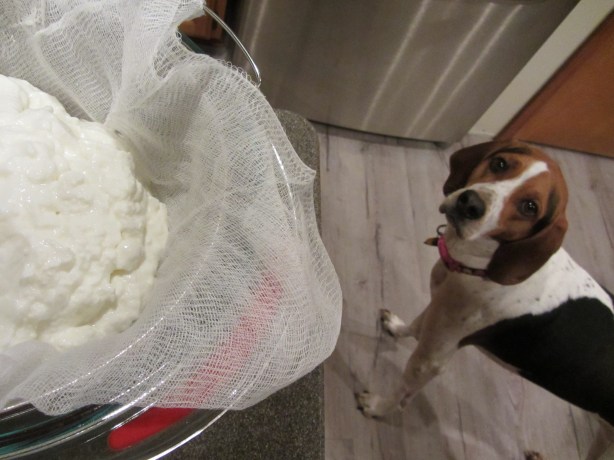
What is yogurt cheese? Yogurt cheese is yogurt that has been allowed to drain, removing whey. While cheese has had its whey removed, regular yogurt has not. Allowing yogurt to drain results in a thick yogurt that has a consistency similar to cream cheese. To make yogurt cheese, line a strainer with two layers of cheesecloth, setting the strainer over a bowl. Add a quart of plain yogurt to the strainer, folding the cheesecloth over the top.

img_5593

A quart of plain yogurt in a cheesecloth-lined strainer.

Weigh the yogurt down with the lid of a pot and a can, refrigerating it for four hours.

Yogurt cheese can be used plain as a spread, or in Alton’s recipe for frozen yogurt, which I will write about below. I tasted the plain yogurt cheese, but opted to use it for Alton’s other recipe; it tasted like plain yogurt… just much, much thicker.

Herb Spread

This herb spread is basically the same recipe as the one for yogurt cheese above, but with added seasonings. To a quart of plain yogurt (I used homemade) add 1 1/2 t cumin, 2 T chopped parsley, 1 t Kosher salt, and 1/2 t pepper.

img_5497

Cumin, parsley, Kosher salt, and pepper added to a quart of plain yogurt.

As with the yogurt cheese above, place a cheesecloth-lined strainer over a bowl and add the yogurt mixture.

img_5499

Seasoned yogurt poured in cheesecloth-lined strainer to drain.
Weigh the yogurt down with a pan lid and can, allowing it to drain for four hours in the refrigerator.

The resulting spread is tangy and has a punch of cumin, and it is great with crackers or on sandwiches.

img_5504

Herb spread with crackers.

Talk about an easy hors d’oeuvre, and it is even easier if you use store-purchased yogurt!

Lemon-Ginger Frozen Yogurt

This recipe is the perfect use for Alton’s yogurt cheese. Combine in a bowl 4 C plain yogurt cheese, 3/4 C sugar, 1/2 C light corn syrup, 2 t lemon zest, 1 T minced fresh ginger, and 3 T lemon juice.

Whisk the yogurt mixture until smooth and freeze in an ice cream mixture per the manufacturer’s instructions.

In the last few minutes of churning, add 1/4 C chopped crystallized ginger.

Freeze the frozen yogurt in the freezer until firm.

img_5606

Alton’s lemon-ginger frozen yogurt.

This frozen yogurt is super refreshing and reminds me of warmer weather (as I type this, it is snowy outside and the Christmas tree is illuminated). The first time we ate this frozen yogurt, the crystallized ginger seemed too chewy, but after freezing the yogurt for a longer period, the chewiness went away. I definitely foresee making this again, as it is packed with ginger and lemon flavor, and is a relatively healthy treat. This is worth making.


Artichokes were the star of the 70th episode of Good Eats. Alton first prepped artichokes in a traditional way, serving them cooked whole. There is no online link to this particular recipe, but I will spell it out as well as I can. This was my first time eating a whole artichoke in quite a long time, as my parents went through quite a phase with artichokes when I was a teenager. Seriously, we ate steamed artichokes a couple times a week for quite a while, and my brother and I were eventually completely burnt out. Having Alton’s version of the whole artichoke has rekindled my adoration for the thistle (FYI artichokes are thistles), and I will be serving them periodically as a side dish.

When selecting artichokes to eat whole, pick ones that are about the size of a large orange, are heavy for their size, and that have tight, crisp leaves.

img_5431

Whole artichokes.

Alton recommends storing them in the refrigerator in a 2-liter soda bottle that has been cut in half and placed back together to form a capsule. Prior to cooking your artichokes, dip them upside down in cold water, swirling them to release any debris in their leaves. Using an electric knife, cut off the tops and bottoms of the artichokes, saving the stems. Peel the stems prior to cooking and cook them with the artichokes; cooking the stems was new to me, but definitely worth it.

img_5432

Artichokes, tops and bottoms cut off, and stems peeled.

To cook the chokes, put 2 t Kosher salt in a wide stainless steel of anodized aluminum pot (artichokes can react with other metals, producing off-flavors and colors). Add the artichokes, stem side up and cover them with cold water by at least an inch.

The artichokes will float, but you can weigh them down with a steamer basket insert and a weight.

img_5436

Artichokes, weighed down with a steamer basket insert and weight.

Bring the water, uncovered, to a boil over high heat. Don’t forget to throw in the stems! Artichokes contain both chlorophyll and acids, which are normally separate. However, when you cook an artichoke, the acids and chlorophyll combine, producing compounds that will turn artichokes brown; these compounds are volatile, so you can let them evaporate by keeping your pot uncovered. If you do not want to watch the pot, you can insert your probe thermometer, setting the alarm for 210 degrees. Once your water is boiling, decrease the heat and let the artichokes simmer for 10 minutes. Test the artichokes by inserting a sharp paring knife into the stem end – if the knife goes in with little resistance and comes out clean, the artichokes are done.

img_5437

Artichokes, after being brought to a boil and simmering for 10 minutes.

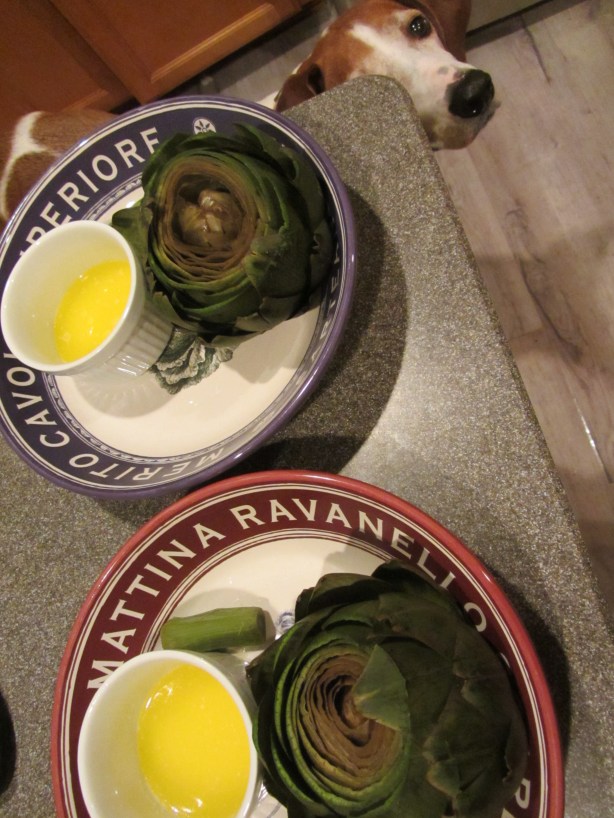
Drain your cooked artichokes in a foil-covered colander for at least five minutes before serving. To eat the artichokes, serve them next to lemon butter, dipping each leaf and scraping the “meat” with your teeth.

img_5441

Cooked artichokes, served with lemon butter.

Once you only have tiny leaves remaining, pull the leaves apart, exposing the hairy choke inside.

Pressing down on the choke with one hand, use a sharp paring knife to cut around the base, just under the dark green line.

img_5447

Using a sharp knife to cut around beneath dark green line.

Pull the top off and discard, and remove any remaining hairy tufts. Eat the remaining base of the artichoke, dipping it in lemon butter.

We really enjoyed Alton’s preparation of whole artichokes, especially since neither of us had eaten on in years. In fact, we liked them so much that we cooked them a second time last week. And, the bases and stems are totally worth eating – good eats for sure!

Broiled Chokes

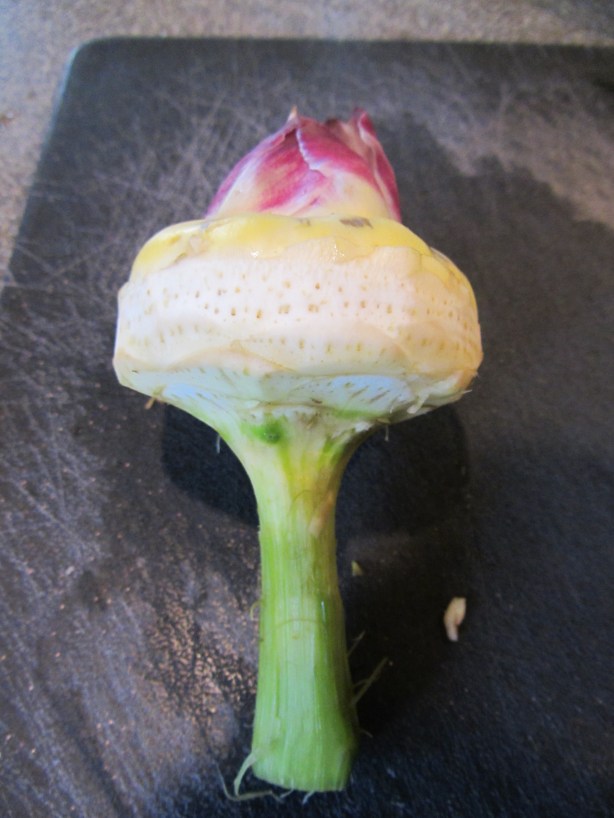
Alton’s second artichoke preparation is for broiled chokes. For this recipe you will need a grapefruit spoon, a serrated knife (preferably electric), a vegetable peeler, two containers of acidulated water (water with lemon juice added), and a cutting board. Holding a whole artichoke, first pull off and discard all of its leaves until you have just a purple interior remaining.

Run a vegetable peeler down the sides of the choke and the stem. Also run the peeler around the outside until you have a smooth surface. To help prevent browning, dip your utensils in one container of acidulated water between uses.

img_5453

Artichoke, after being cleaned up with a vegetable peeler.

Once your choke is clean, use an electric knife to cut it in half. Use a grapefruit spoon to pry out the hairy choke, which will probably take a few tries. Place the cleaned choke in the second container of lemon water while you clean the others.

When ready to use, drain the chokes and wrap them tightly in paper towels. Toss them with olive oil, Kosher salt, and pepper, and broil them, face-up, on a rack 5-6 inches below the heat for five minutes. Flip the chokes and broil for three minutes on the second side.

Eat the chokes as they are, or do as Alton did in the episode and marinate them in his herb oil, which I will write up below.

Herb Oil

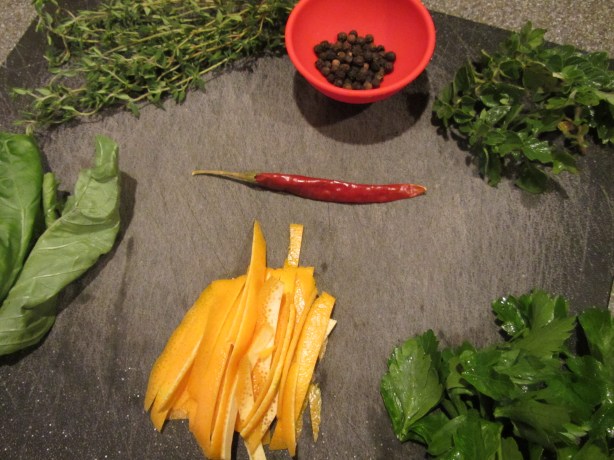
According to what he says in this episode, Alton prefers to marinate his broiled chokes (above) in herb oil. His oil can be made by heating to 200 degrees a pint of canola oil with a cup of olive oil in a saucepan. While the oil heats, add to a mason jar:  the zest from half an orange, 1/2 C fresh parsley, 1/2 C fresh thyme, 1/2 C fresh basil, 1/2 C fresh oregano, 1 dried arbol chile, and 1 t black peppercorns.

img_5424

Ingredients for Alton’s herb oil: fresh thyme, black peppercorns, fresh oregano, fresh parsley, orange zest, fresh basil, and a dried arbol chile.

Pour the warm oil over the herbs, letting the oil sit overnight; my oil got a little cloudy overnight, but later cleared again.

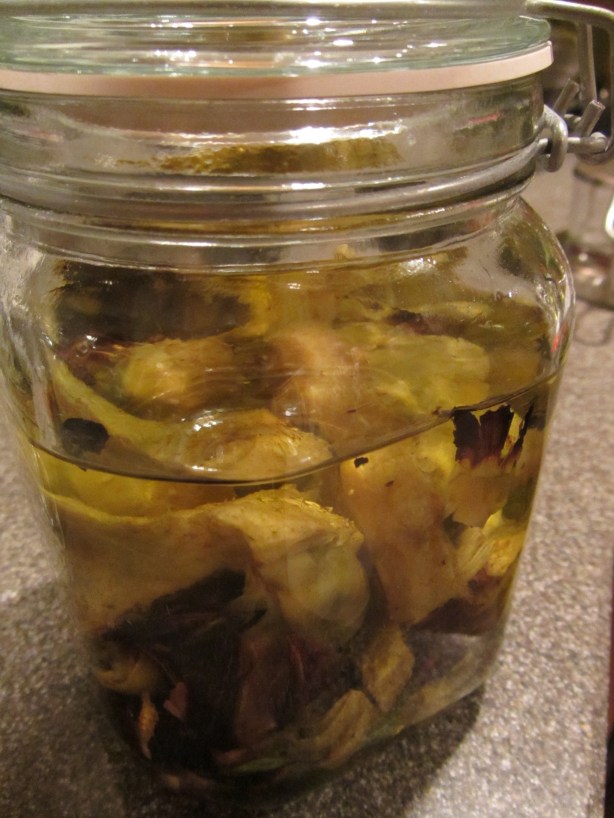
The following day, strain the herb oil by pouring it through cheesecloth into a jar containing your broiled chokes. Let the chokes marinate for a couple days before using.

And, what is Alton’s preferred use for his marinated chokes?

img_5472

Broiled chokes, after marinating for a couple days.

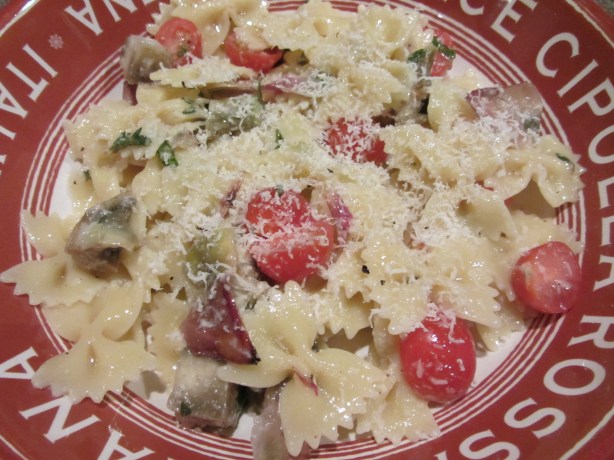
He prefers to make a pasta salad with bowtie pasta, the marinated chokes, some of the herb oil, red wine vinegar, small tomatoes, herbs, Parmesan, and pepper (he did not actually prep a pasta salad in the episode). I took his advice and tried his marinated, broiled chokes in such a pasta salad.

img_5473

A pasta salad made with Alton’s marinated chokes.

While the chokes were good, I cannot say that they were honestly worth all the effort. Honestly, I think the bottled, marinated artichokes from Costco are just as good as Alton’s, and for zero effort. While I am glad I now know how to prep an artichoke, I won’t be making these again.

Clotted Cream

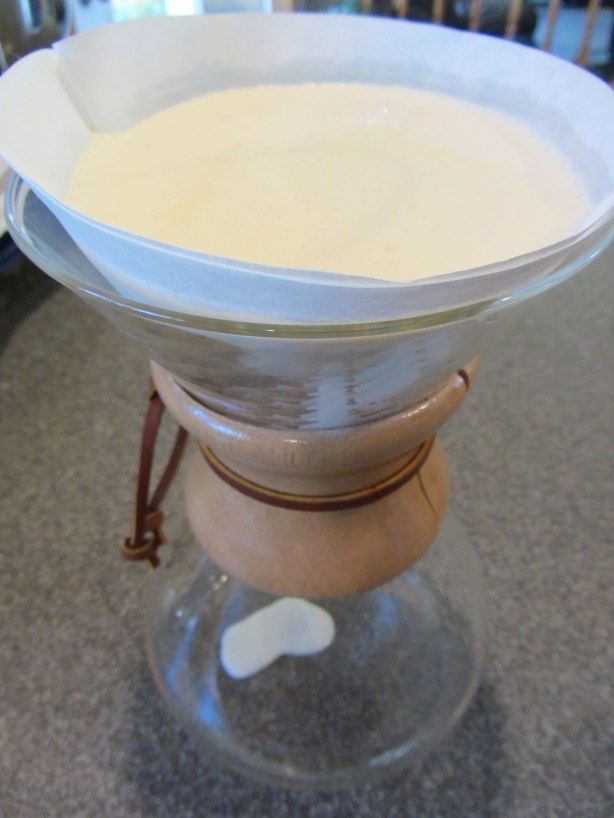
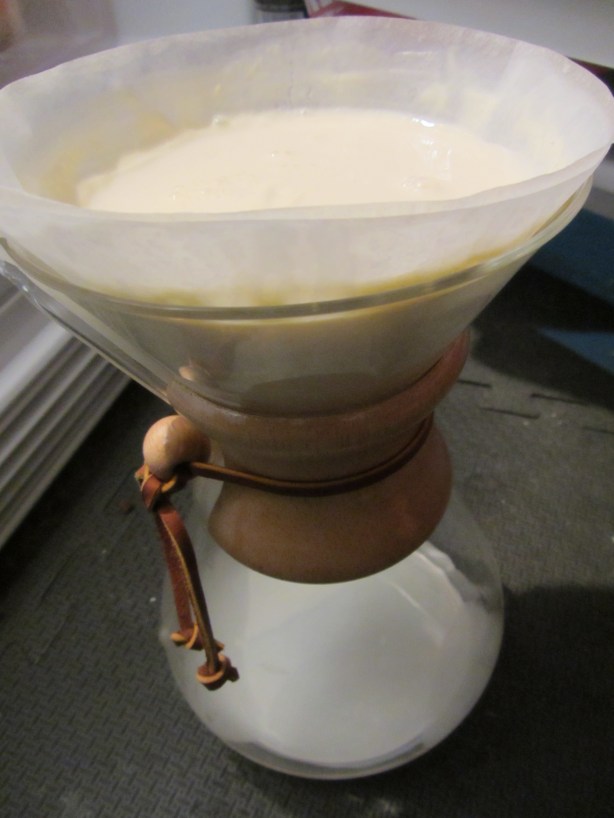
Though I heard of clotted cream, I had never had it before I made it for this episode of Good Eats. And, as recipes go, it does not get easier than this one. Place a paper coffee filter in a coffee filter basket, setting it over a bowl or measuring cup. Or, you can do as I did and use a Chemex coffee maker. Pour cream into the filter, filling it almost to the top.

img_5327

Cream poured into paper coffee filter, allowing whey to drain into container below.

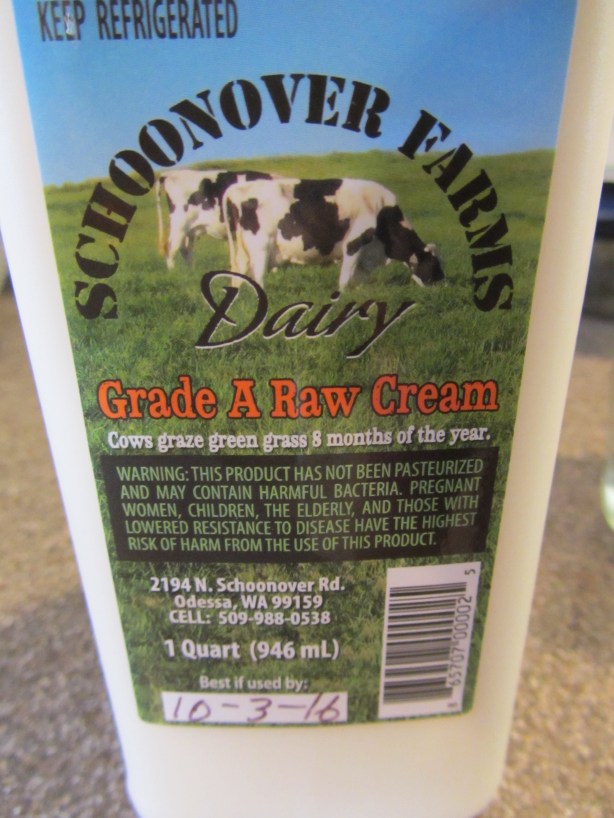
The key here is to use cream that is not ultra-pasteurized. I actually used raw cream.

img_5325

Raw cream.

Refrigerate the cream for 6-8 hours, allowing the whey to drain into the bowl, while leaving the thickened cream in the filter. Scrape the sides of the filter every two hours with a spatula until you have cream that is the consistency of softened cream cheese.

img_5341

Cream after being refrigerated for several hours.

Serve the clotted cream with fresh strawberries.

img_5358

Clotted cream with fresh strawberries.

I thought this was fun and easy to make, and the unsweetened cream paired well with sweet berries. I think I will make this again when the weather gets warm. Next time, I will probably opt for pasteurized cream, rather than raw, because the raw cream had a bit of an animal-like flavor. I served Alton’s clotted cream with the following recipe for macerated berries.

Macerated Strawberries

My mom used to make macerated berries quite often, but her version was quite different from Alton’s. While Alton’s version is wine-based, Mom’s version simply used balsamic vinegar and a little bit of sugar and black pepper. Mom usually made these in warmer months, serving them as a light dessert after dinner. Trust me… balsamic vinegar pairs wonderfully with strawberries. For Alton’s macerated stawberries, pour a bottle of red wine into a large bowl, adding two pints of hulled/sliced strawberries.

Note:  Alton has an excellent trick for hulling strawberries – simply use the star tip for a decorating bag, twisting it into the top of the berry and pulling the hull out. Works great!

To the berries, add 1/4 C orange blossom honey, 1 t lemon zest, and 1 t black pepper. If you want softer berries, also add 1 1/2 C sugar (I added the extra sugar, as Alton indicated that you want softer berries for the next recipe).

Marinate the berries for two hours before serving.

img_5342

Berries after marinating for 2 hours.

I reserved half of these berries for the next recipe, while we ate the rest of these with Alton’s clotted cream. These berries were quite tasty, though I will say the dominant flavor was that of the wine. I have to admit that I would choose Mom’s macerated berries any day over Alton’s. So, if you want good macerated berries, try Alton’s. If you want great macerated berries, try Mom’s.

Strawberry Pudding

Of the recipes in this episode, this is the one I most excited to make. It just looked like it would be fun. For this one you’ll need 1/2 a recipe of Alton’s macerated strawberries and 16 slices of potato bread, with four of the slices buttered on one side (I halved this recipe since I only needed two servings).

You will also need four 13.5-ounce cans with both ends removed, along with four of their lids. Finally, you need four full soda cans and a sheet pan lined with parchment paper. To begin, use the empty cans to cut a round out of each slice of bread. Cut the buttered slices last, leaving the rounds in the bottom of the cans, butter side up.

Top each buttered round with ~2 T of macerated strawberries, topping with another layer of bread. Alternate the berry and bread layers, finishing with bread.

Place the can lids on top of the last bread layer and weigh the lids down with the full soda cans. Refrigerate the cans for eight hours.

Transfer each can to a plate, using a spatula. Carefully slide each can off, and remove the can lid. Pipe whipped cream or serve clotted cream on top of the puddings.

img_5383

Strawberry pudding after removing can/lid. Topped with clotted cream.

These were fun to make, super easy, and pretty. And, honestly, you could make this with any fruit. I am not quite sure why this dessert is called a “pudding,” but we really enjoyed it. This is one I will be making again for sure. We don’t have kids, but I would imagine kids would really have fun with helping to make this too.

Glazed Strawberries

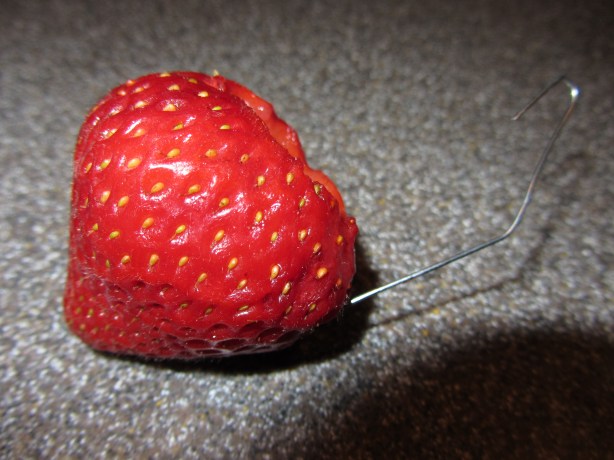
This recipe is not posted online, but Alton prepped these berries in the episode. Using an unfolded paperclip, pierce the big end of a strawberry.

img_5411

Unfolded paperclip in a strawberry for dipping.

Dip each berry in 1 C of apricot preserves melted with 1 T orange liqueur.

Let the berries cool slightly. Devour.

img_5415

Glazed strawberries.

These were easy and really delicious. They are sweet and slightly tart, with just a hint of orange. They also look super pretty, as the glaze gives the berries a very nice sheen, enhancing their red color. These would be super pretty on a plate at a party. I highly recommend these.