Archive for the ‘Episodes by Season’ Category

The Shrimp Cocktail

I had to make a decision here with my blog, as to whether to continue with the episodes in production order or in order of how the episodes aired. I chose to continue with the episodes by air date, which put my next episode as the shrimp episode. Shrimp, while I think they are okay, are not my favorite thing. I will almost always opt for other seafood over shrimp. This probably explains why I had never prepared shrimp prior to making this recipe from Good Eats.

To begin this recipe, Alton shows you how to clean and devein your shrimp by cutting along the back of each shrimp with small scissors. He gives a helpful tip to remove the veins (which are really the intestinal tracts) under water, as they tend to stick to everything. Alton really emphasizes the need to keep your shrimp very cold throughout every step of the shrimp cocktail process, so the shrimp are kept in a bowl of ice water while you devein them.

Cleaned shrimp.

Cleaned shrimp.

Once the shrimp are all clean, you combine Kosher salt, sugar, water, and ice cubes to make your brine. Alton says he makes his brine by running through one cycle of a coffee maker. I just dissolved my salt and sugar on the stove, let the brine cool slightly, and added my ice cubes. I poured the brine over my shrimp and put them in the refrigerator for 25 minutes.

Kosher salt and sugar, ready to be dissolved in some water to make a shrimp brine.

Kosher salt and sugar, ready to be dissolved in some water to make a shrimp brine.

While your shrimp sit in their brine, you make the cocktail sauce. You combine a can of drained tomatoes, chili sauce, horseradish, sugar, pepper, and Kosher salt in a food processor. I used my mini food processor that came with my immersion blender (Alton did this in the episode too), and it worked perfectly.
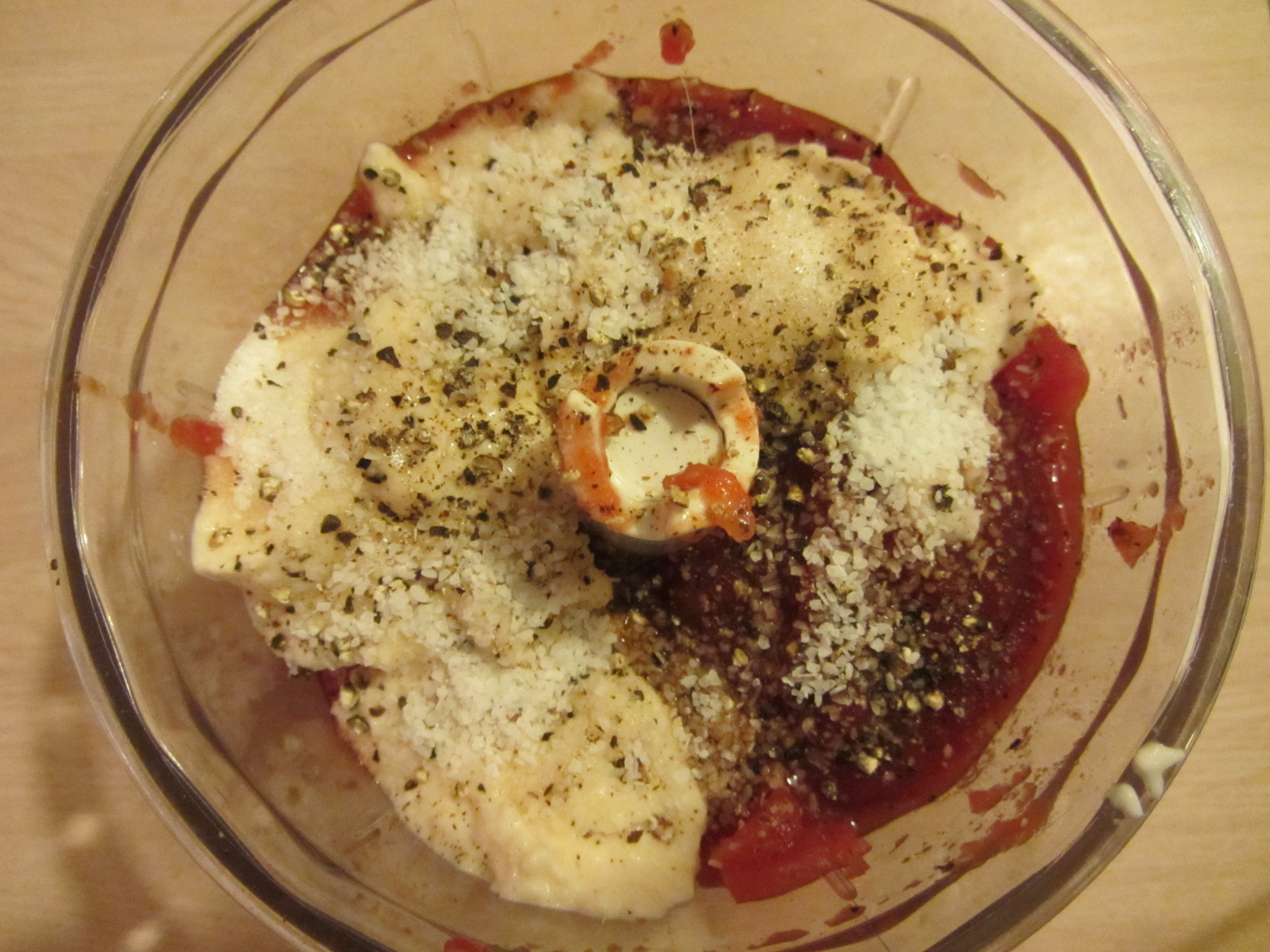
Canned tomatoes, chili sauce, horseradish, sugar, pepper, and Kosher salt.
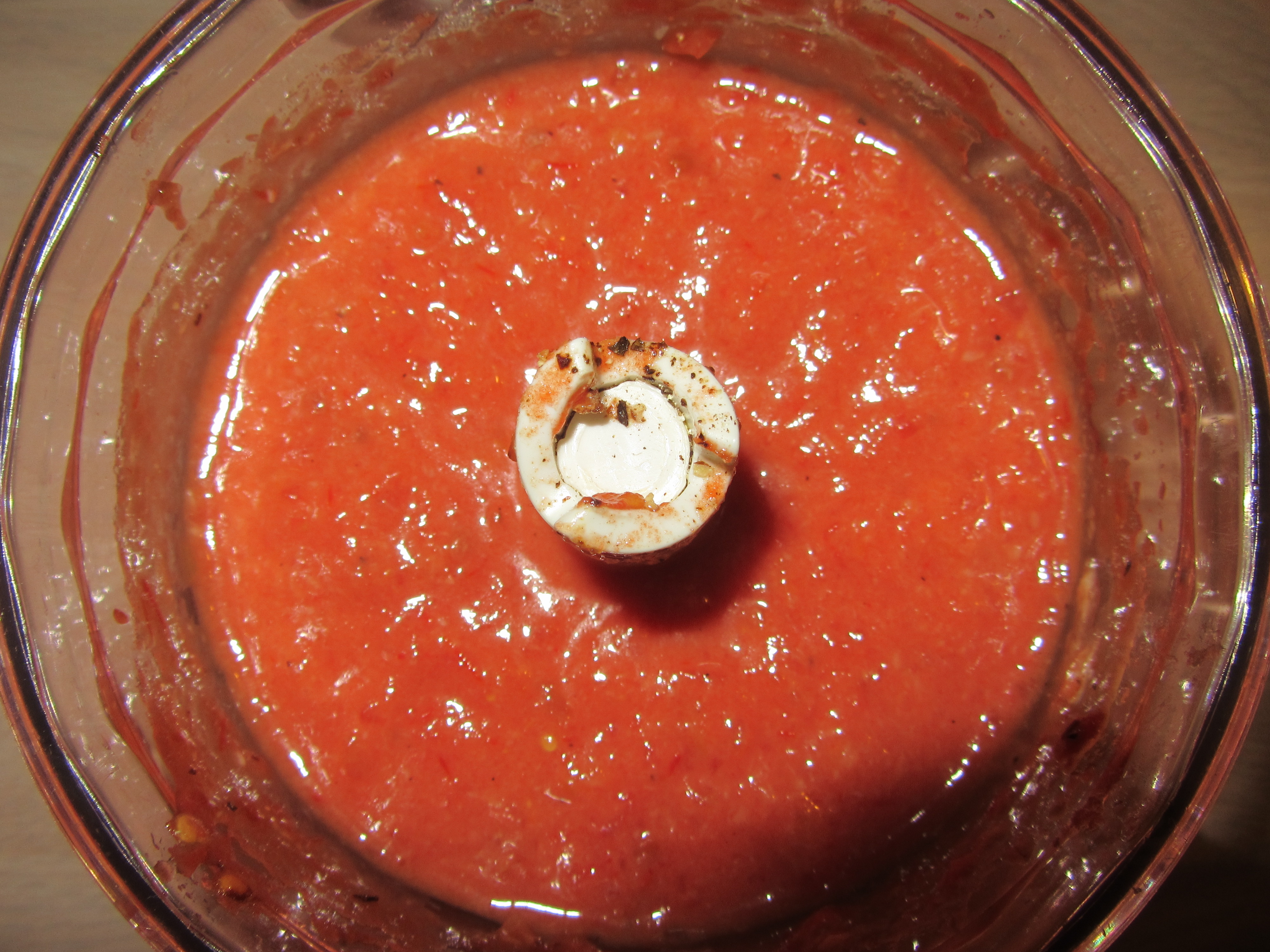
Canned tomatoes, chili sauce, horseradish, sugar, pepper, and Kosher salt.

Finished cocktail sauce.

Finished cocktail sauce.

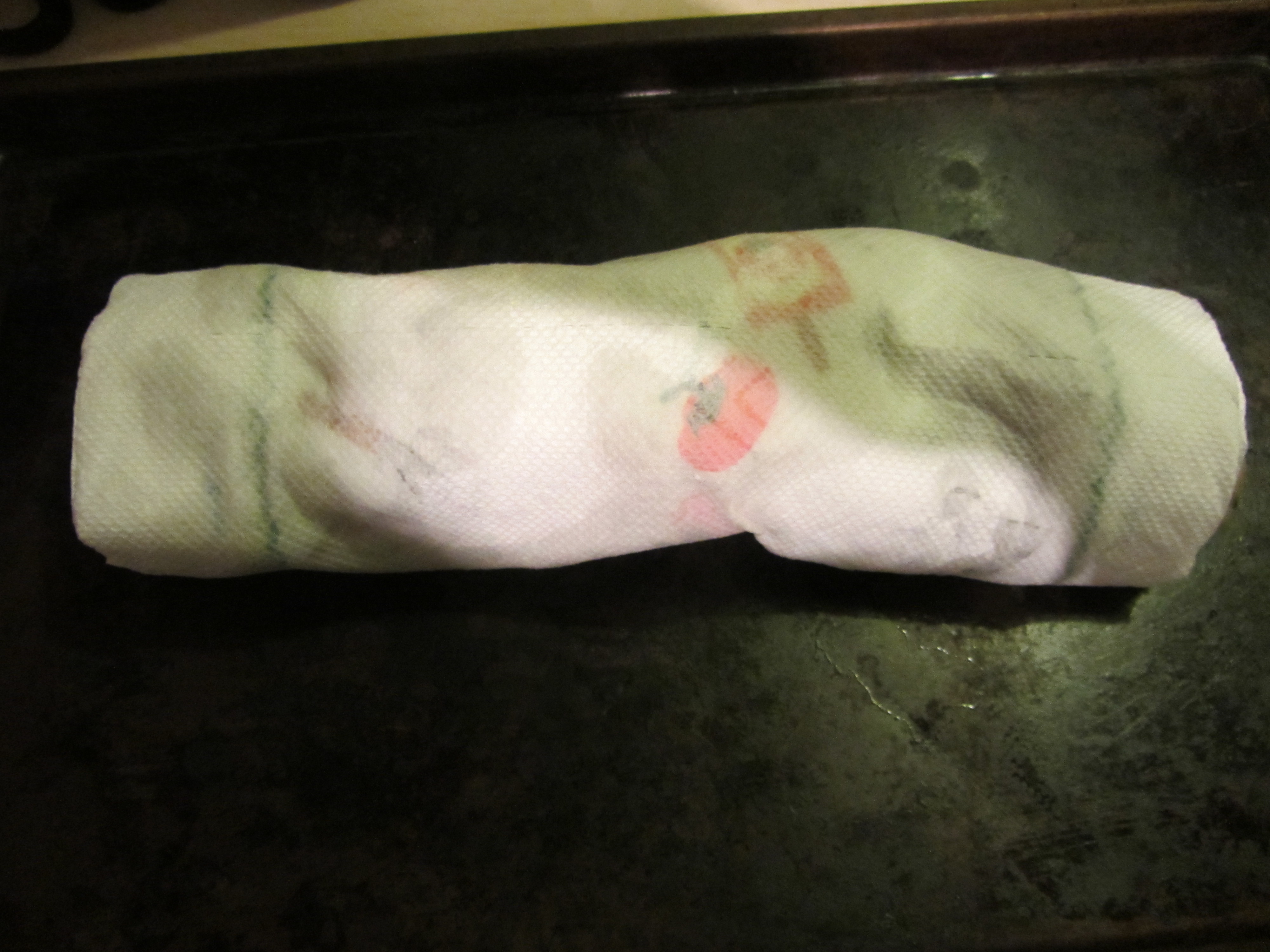
The sauce goes into the refrigerator while you finish your shrimp. After the brining period, you drain and rinse your shrimp. Alton tells you not to brine your shrimp for more than ~25 minutes. You then dry your shrimp in paper towels while you preheat your broiler with a foil-coated pan IN the oven.
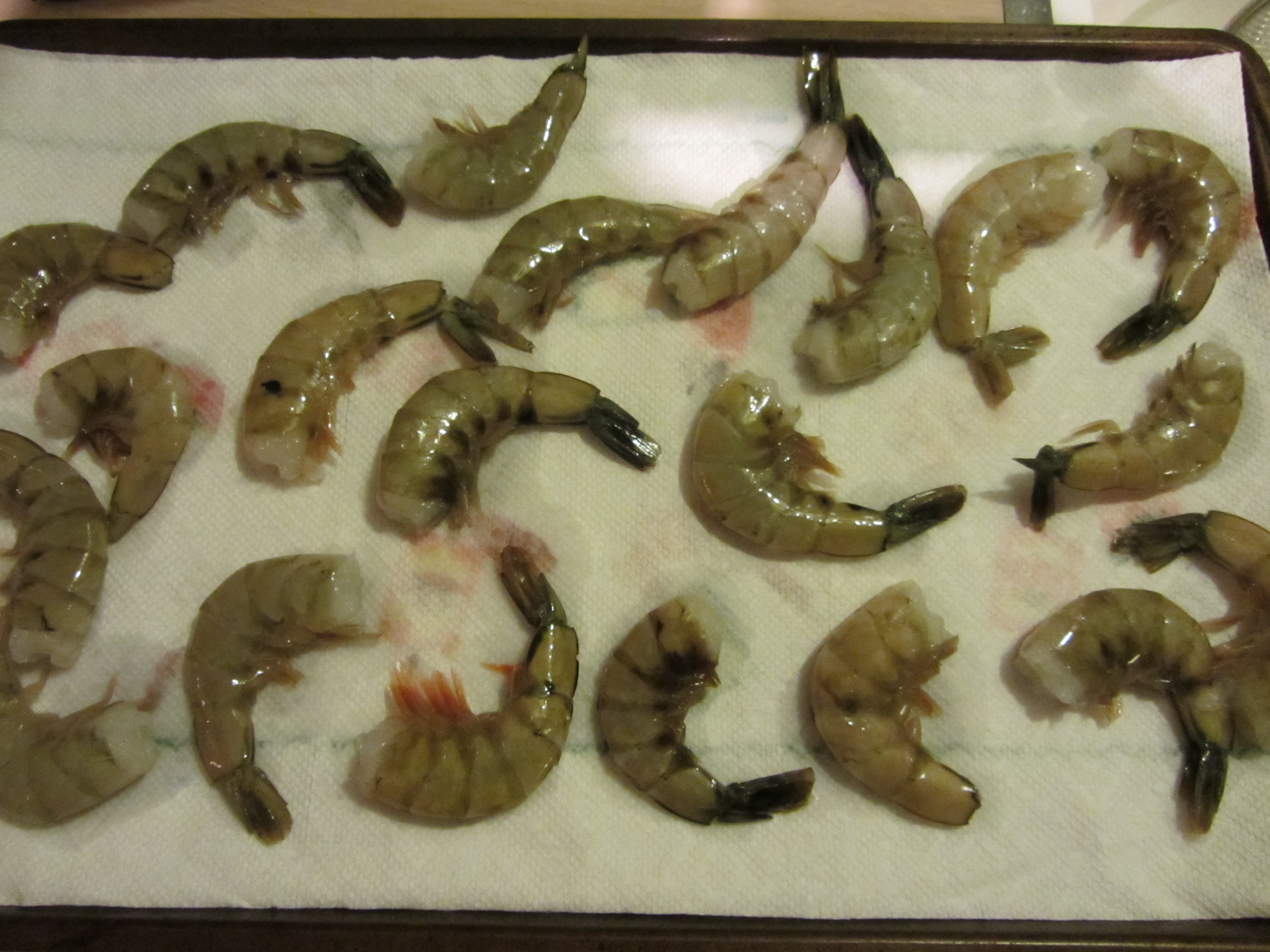
Shrimp after brining.
Shrimp after brining.

Shrimp, drying in paper towels.

Shrimp, drying in paper towels.

For this recipe, you want to place your oven rack in the position that is second closest to the broiler. Once the broiler is preheated, you toss your shrimp with some olive oil and sprinkle them with some Old Bay Seasoning. I love Old Bay Seasoning. Both my parents are from Maryland, and my grandma made the best crab cakes on the planet with a sprinkle of Old Bay.
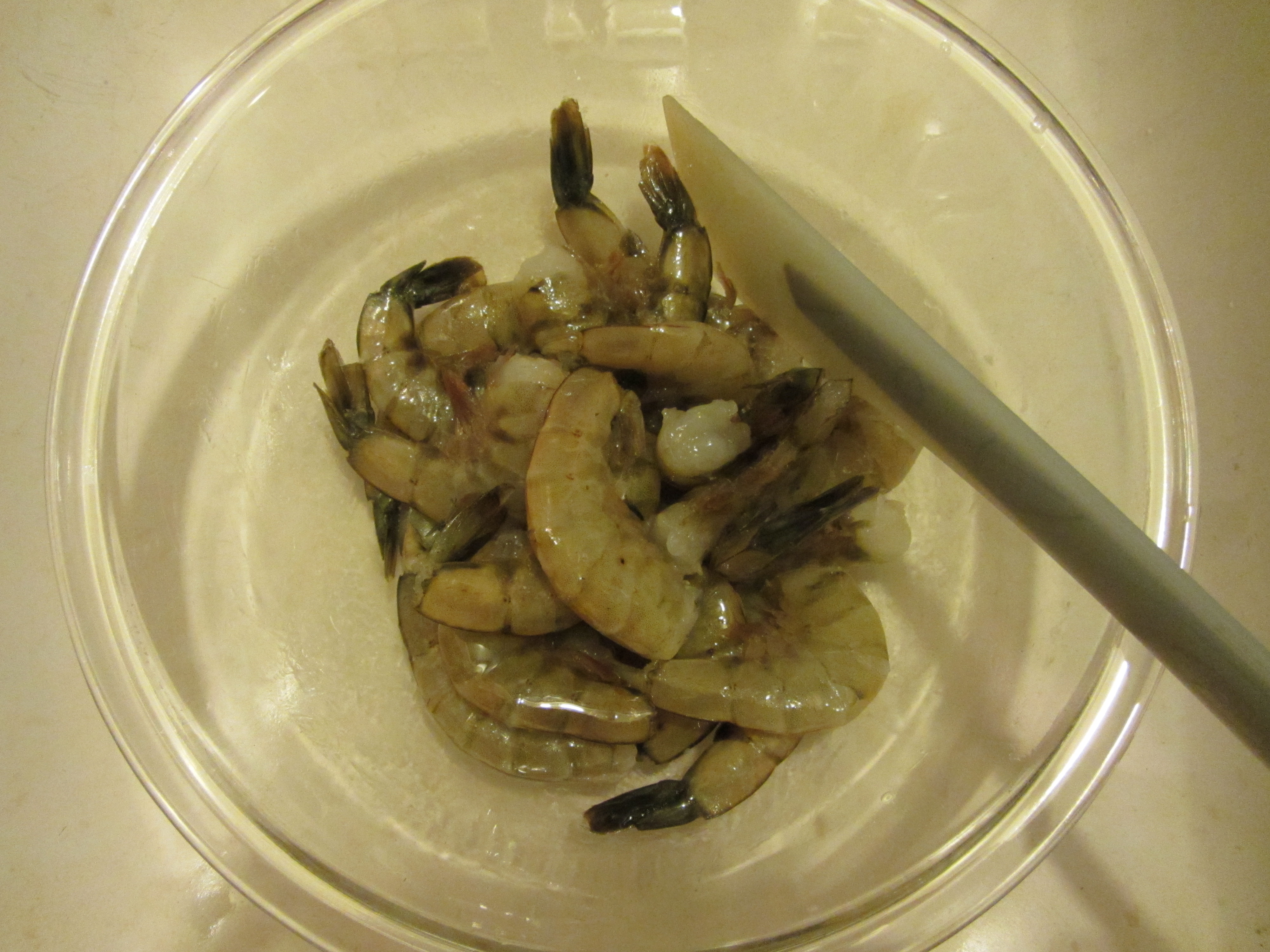
Shrimp coated with olive oil.
Shrimp coated with olive oil.

And a sprinkle of Old Bay.

And a sprinkle of Old Bay.

Shrimp with oil and Old Bay.

Shrimp with oil and Old Bay.

Once your shrimp are well-coated, you toss them, in a single layer, onto your hot pan in the oven, and they go under the broiler for two minutes. My shrimp were turning a nice shade of pink after two minutes. I flipped them over and threw them back into the oven for their additional one minute of cooking.
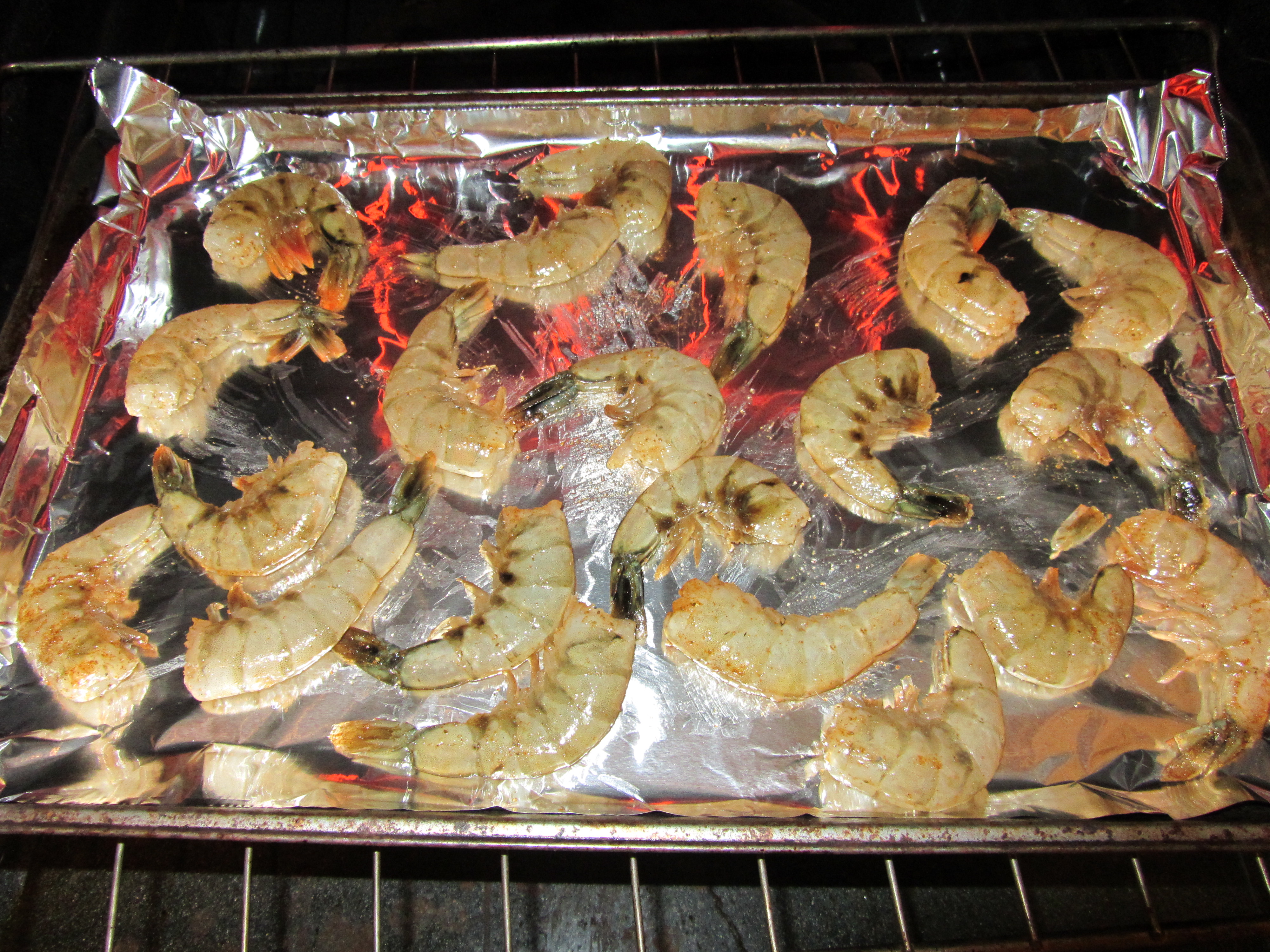
Shrimp into the oven on a pre-heated pan.
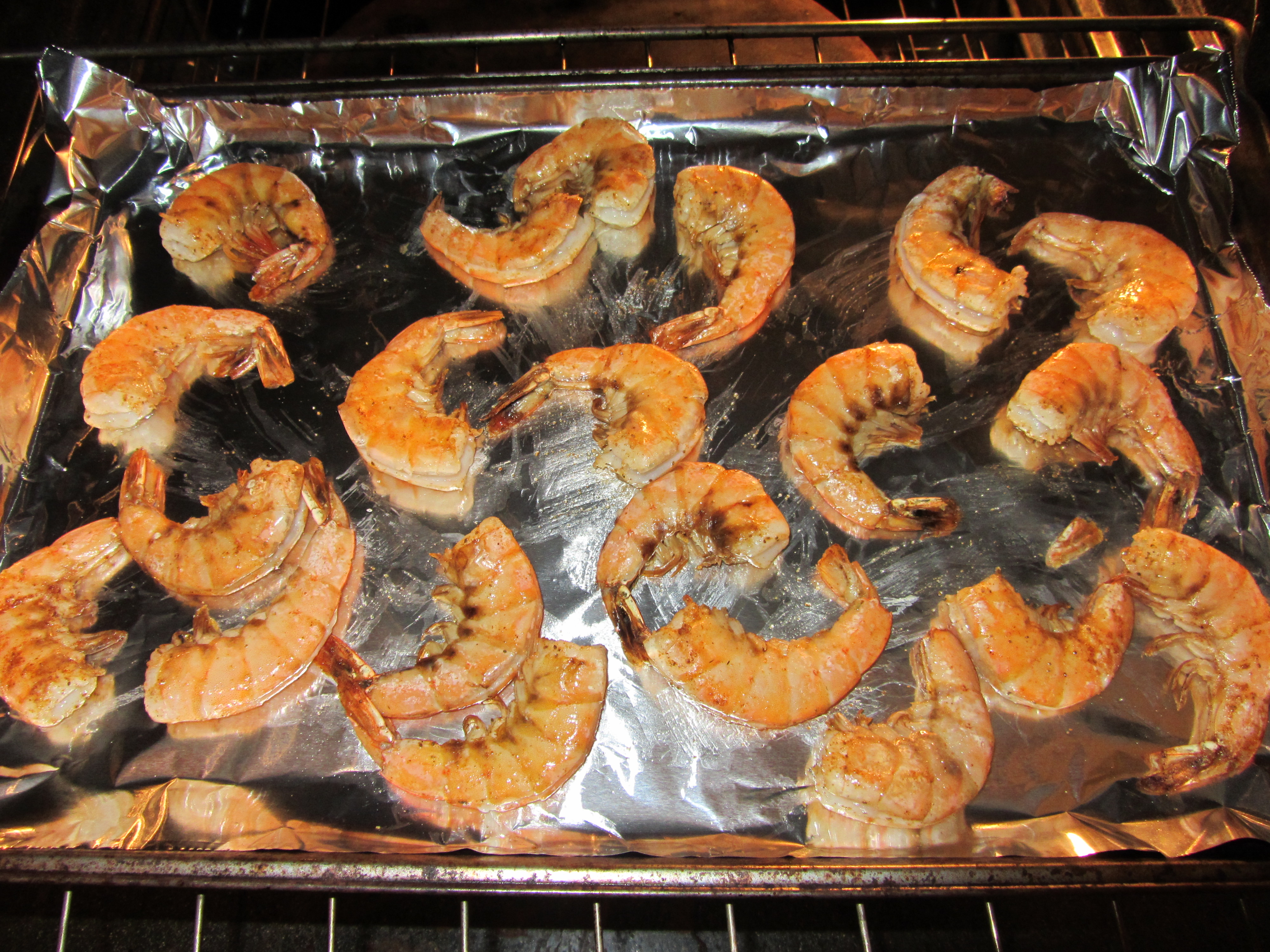
Shrimp into the oven on a pre-heated pan.

Shrimp after 2 minutes under the broiler.
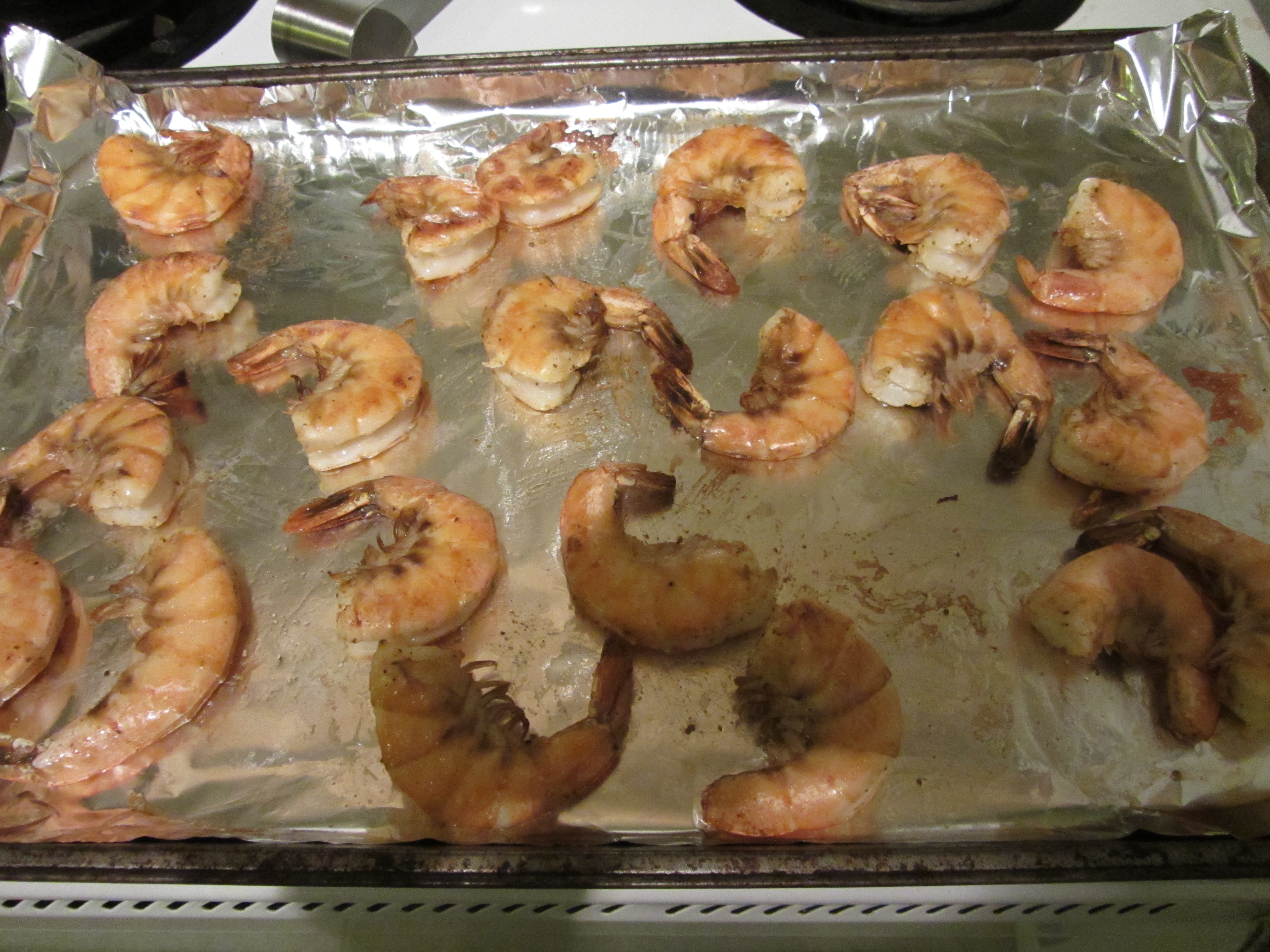
Shrimp after 2 minutes under the broiler.

Shrimp after being flipped for an additional minute under the broiler.

Shrimp after being flipped for an additional minute under the broiler.

As soon as your shrimp come out of the oven, you want to put them into a freezer-cold bowl and toss them around. The bowl then goes back in the freezer for 5 minutes, and then is transferred to the refrigerator.
Frozen bowl.
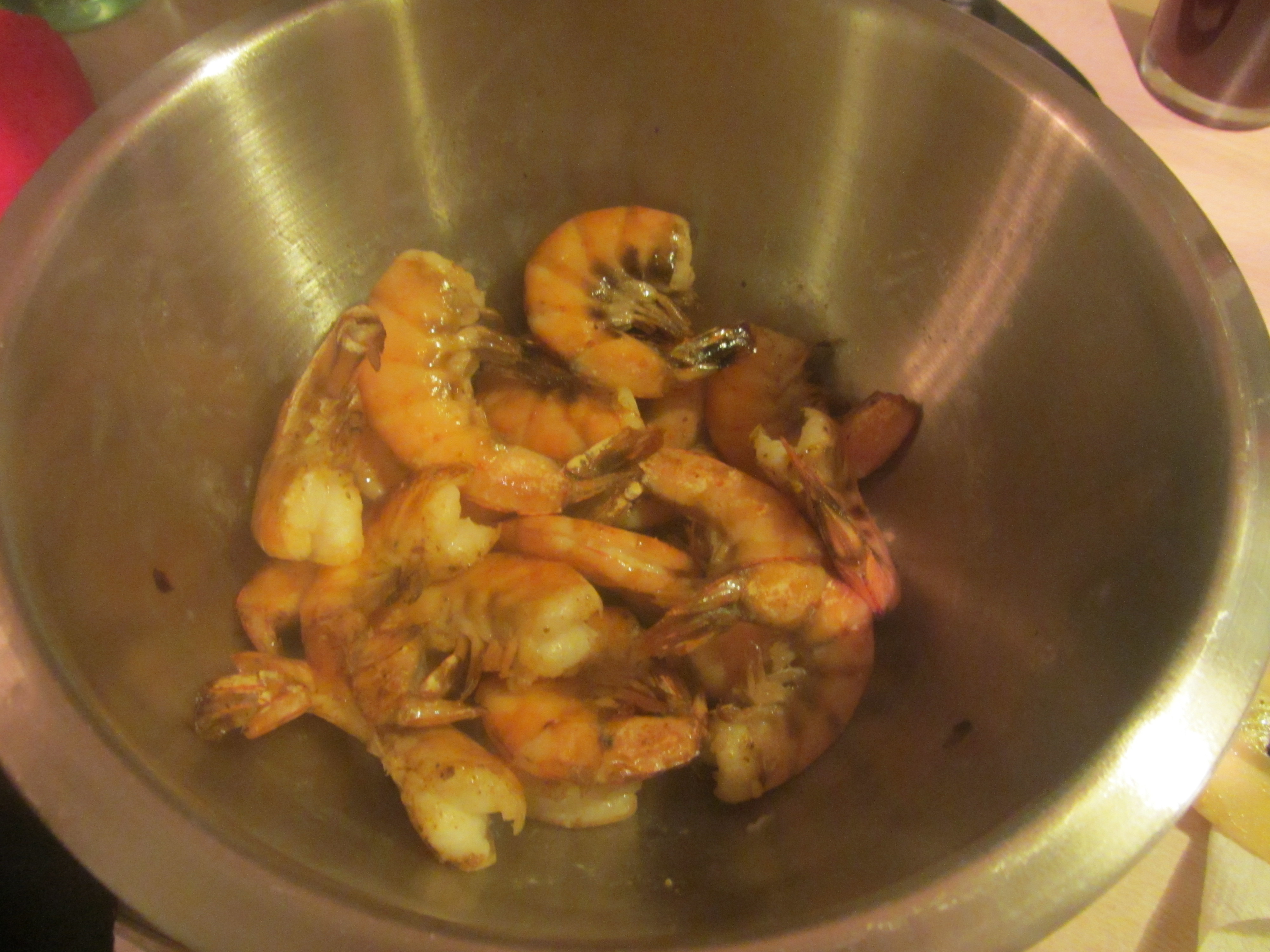
Frozen bowl.

Hot shrimp into the cold bowl.

Hot shrimp into the cold bowl.

Once the shrimp are thoroughly chilled, you recreate the classic shrimp cocktail presentation, filling a martini glass with cold cocktail sauce and placing shrimp around the rim of the glass.
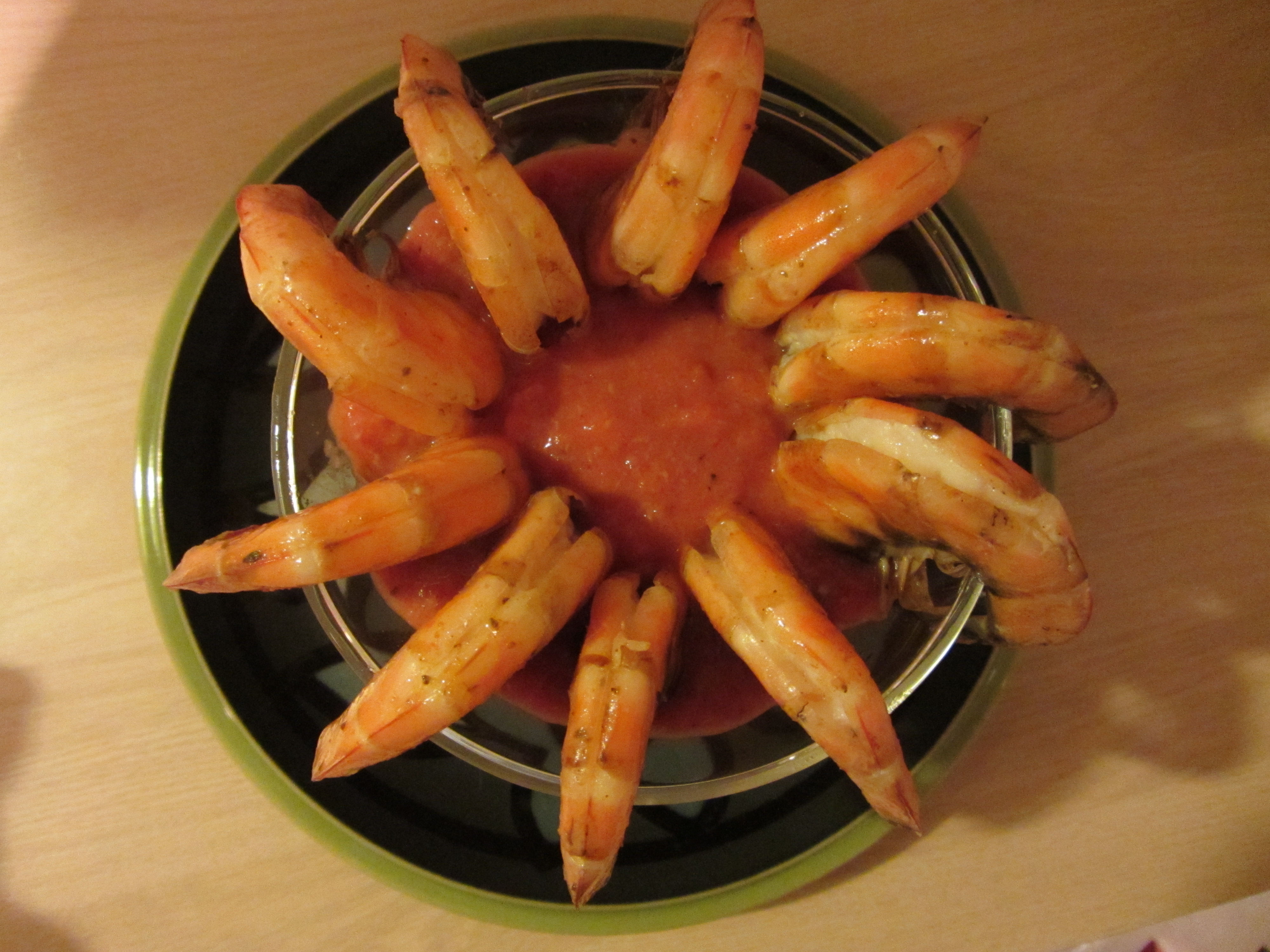
Completed shrimp cocktail.
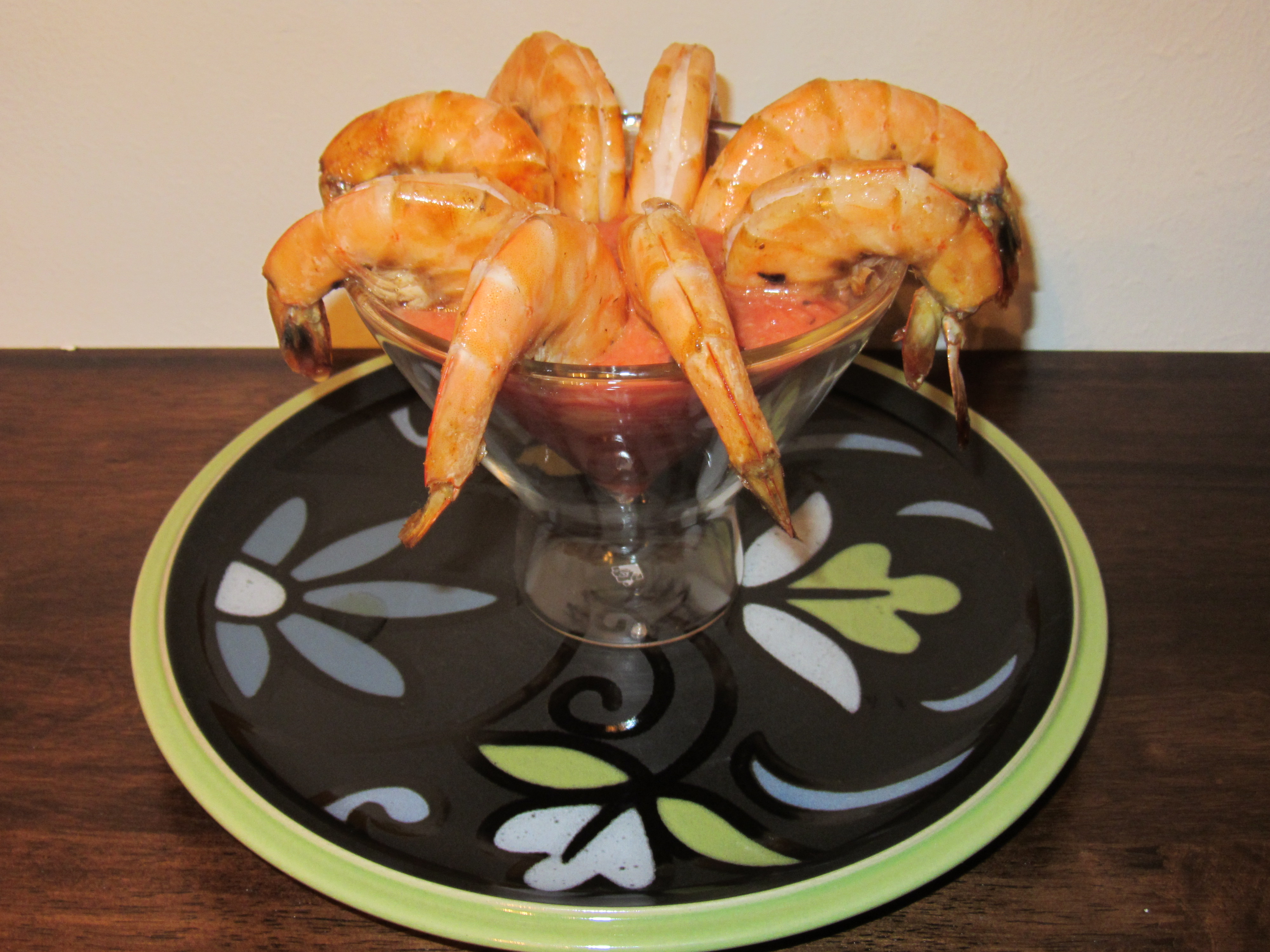
Completed shrimp cocktail.

Shrimp Cocktail.

Shrimp Cocktail.

My blogging helpers.

My blogging helpers.

We ate this shrimp cocktail for dinner one night last weekend. We loved the spicy kick of the cocktail sauce, though I am sure some people would find it to be too spicy. I found the heat of the horseradish to contrast nicely with the sweetness of the tomatoes and chili sauce. The shrimp had a nice texture that was far from the rubbery texture I have come to dislike in shrimp. Alton says dry heat methods are the best for cooking shrimp, and this recipe seems to confirm that. My husband thought this shrimp cocktail was delicious, and said this was the best cocktail sauce he had ever had.
It’s a Wonderful Waldorf

I live in Washington state. It is Fall. Could the timing be any better for me to happen upon the “Apple Family Values” episode of Good Eats? I love apples, but I sort of refuse to eat them in the summer. In fact, I see the commencing of apple eating as my concession that the fall season is indeed upon us. As a Washington apple eater, my new personal favorite apple is the SweeTango, though a good Honeycrisp is hard to beat. They are expensive, but so worth it.

I will admit that I was not overly enthused to make Alton’s Waldorf salad. My impression of Waldorf salad has always been that it is a dated, over-mayonnais-ed salad from a famous hotel. Boy was I wrong about this one, as Alton’s take is well worth making.

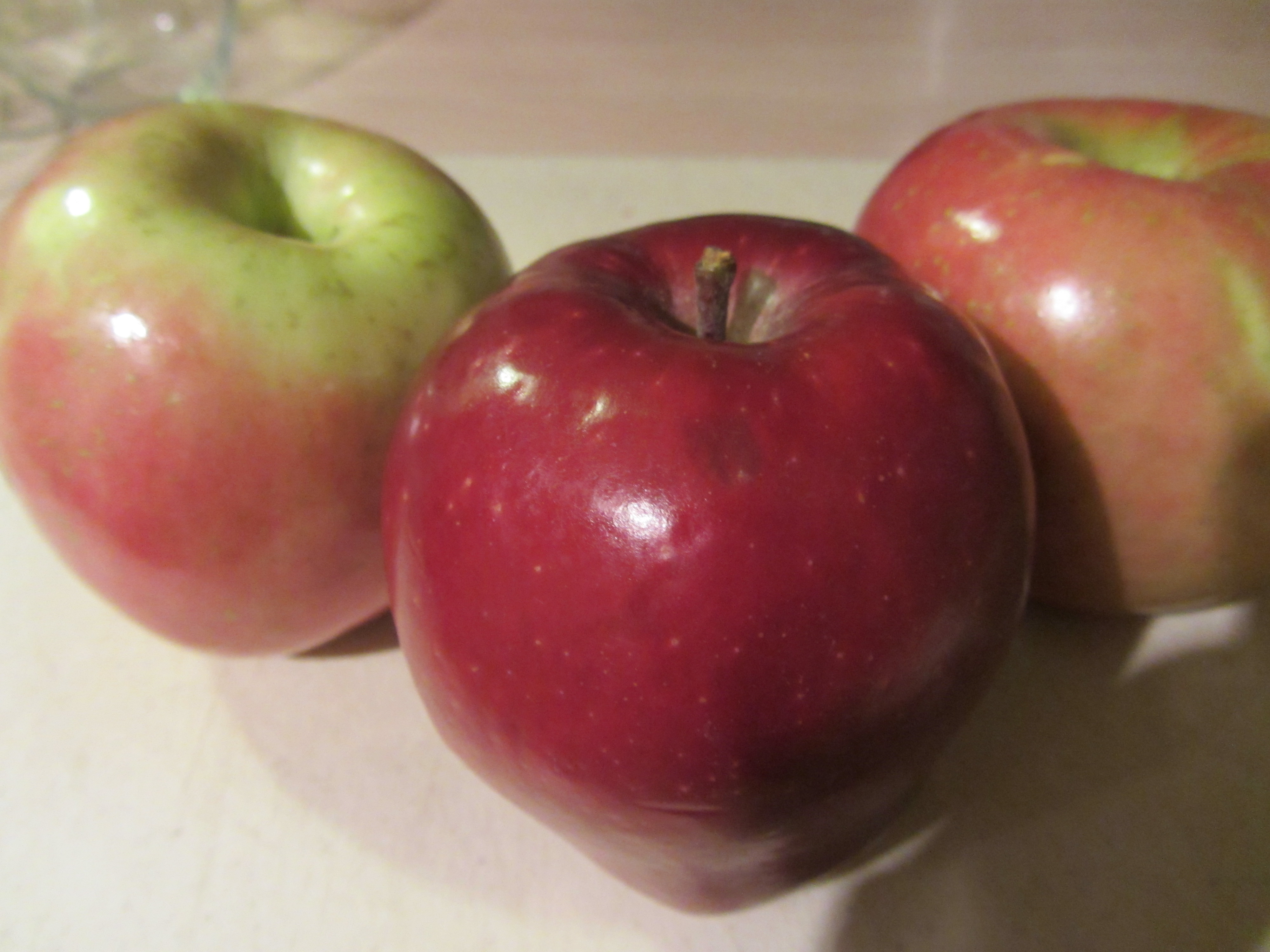
For Alton’s Waldorf salad, he recommends that you use three apples:  two Ginger Golds or Fujis and one Red Delicious. Ginger Gold apples are not readily available in our area, so I used Fuji apples in their place.

Two Fuji apples and one Red Delicious apple.

Two Fuji apples and one Red Delicious apple.

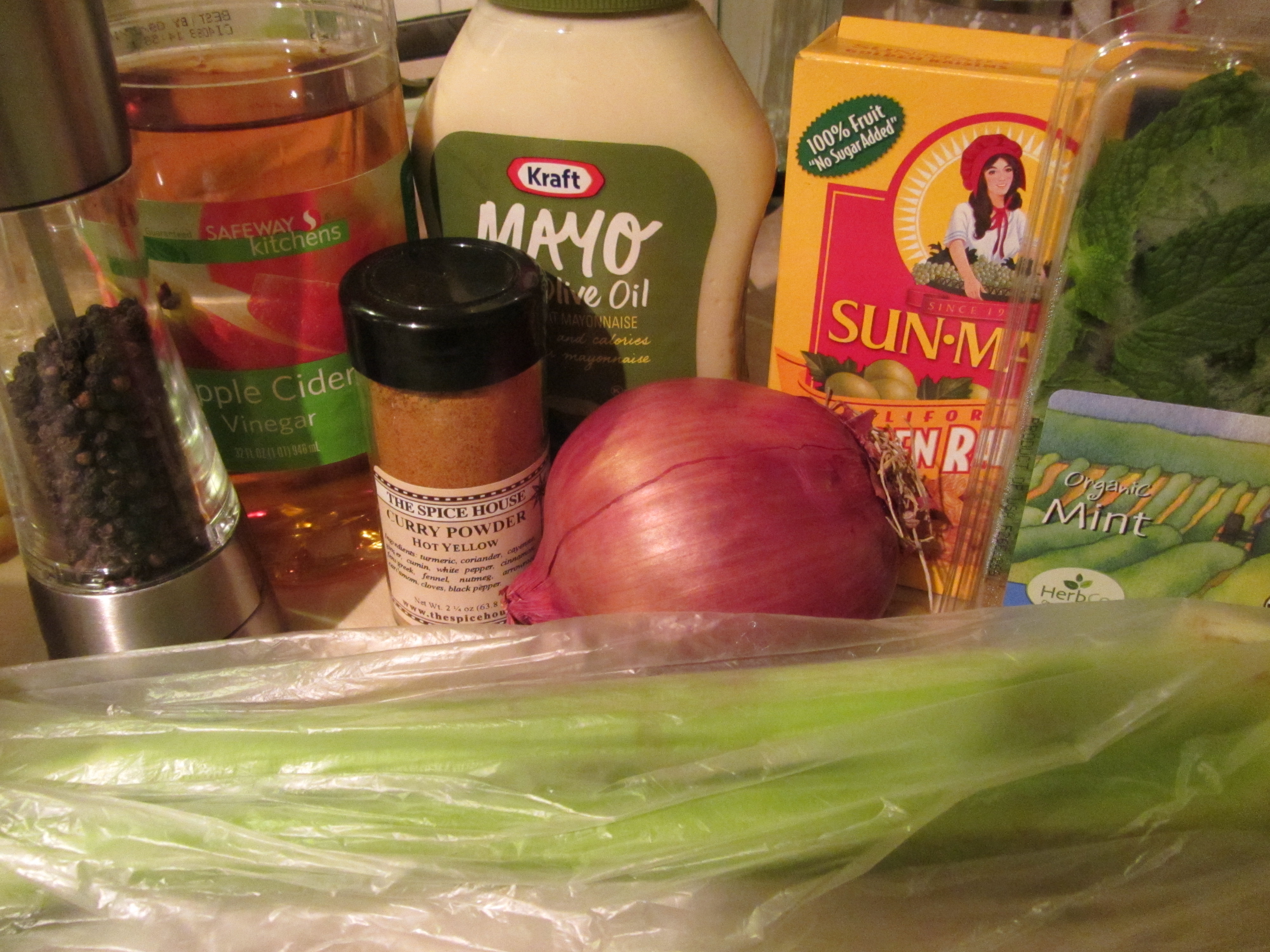
Ingredients for Waldorf salad (minus apples, toasted walnuts, and salt).

Ingredients for Waldorf salad (minus apples, toasted walnuts, and salt).

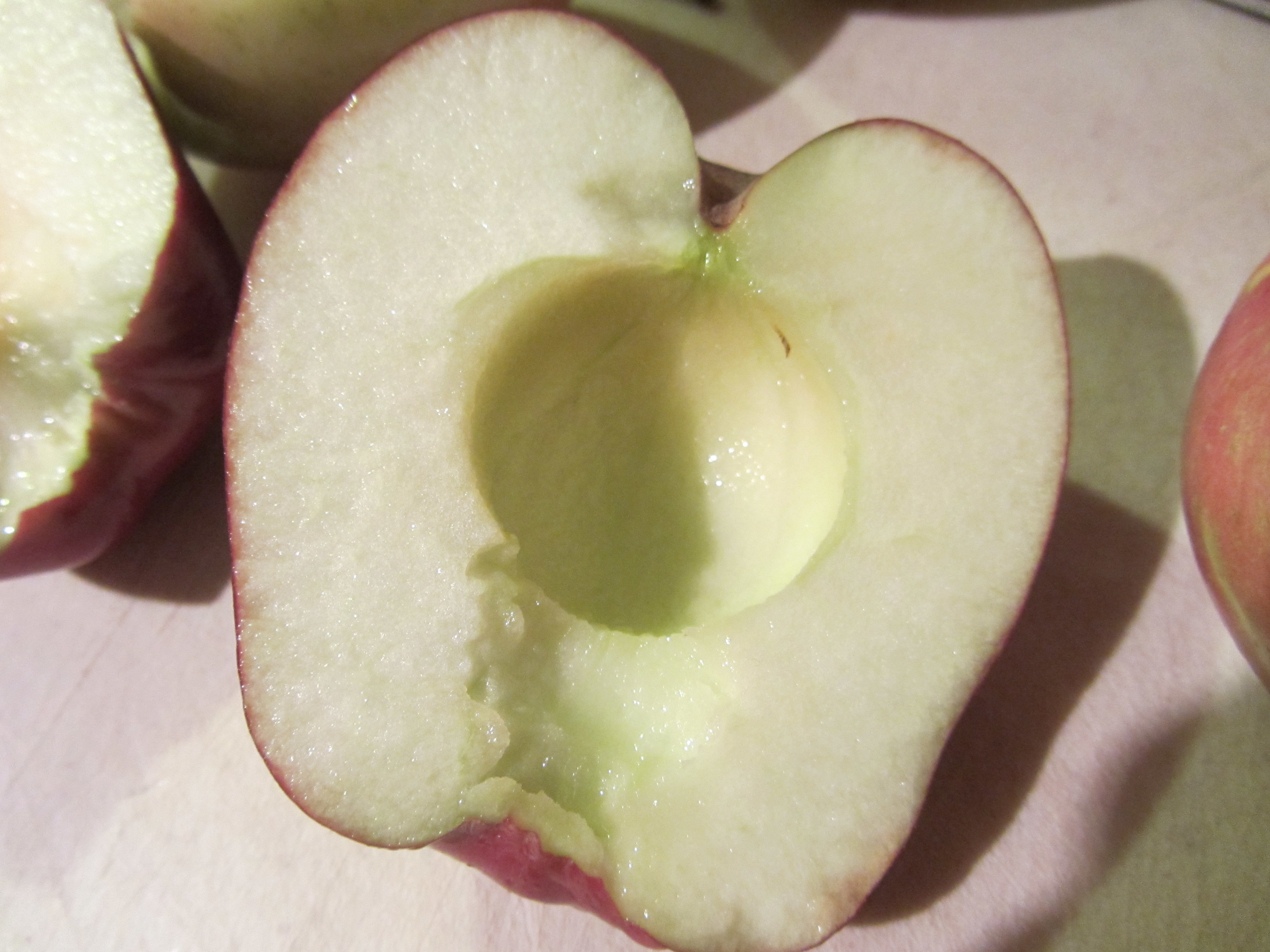
Alton suggests that you cut the apples in half, and use a melon baller to scoop out the core. This works like a charm, and I will be using this trick in the future.

Apple, cored with a melon baller.

Apple, cored with a melon baller.

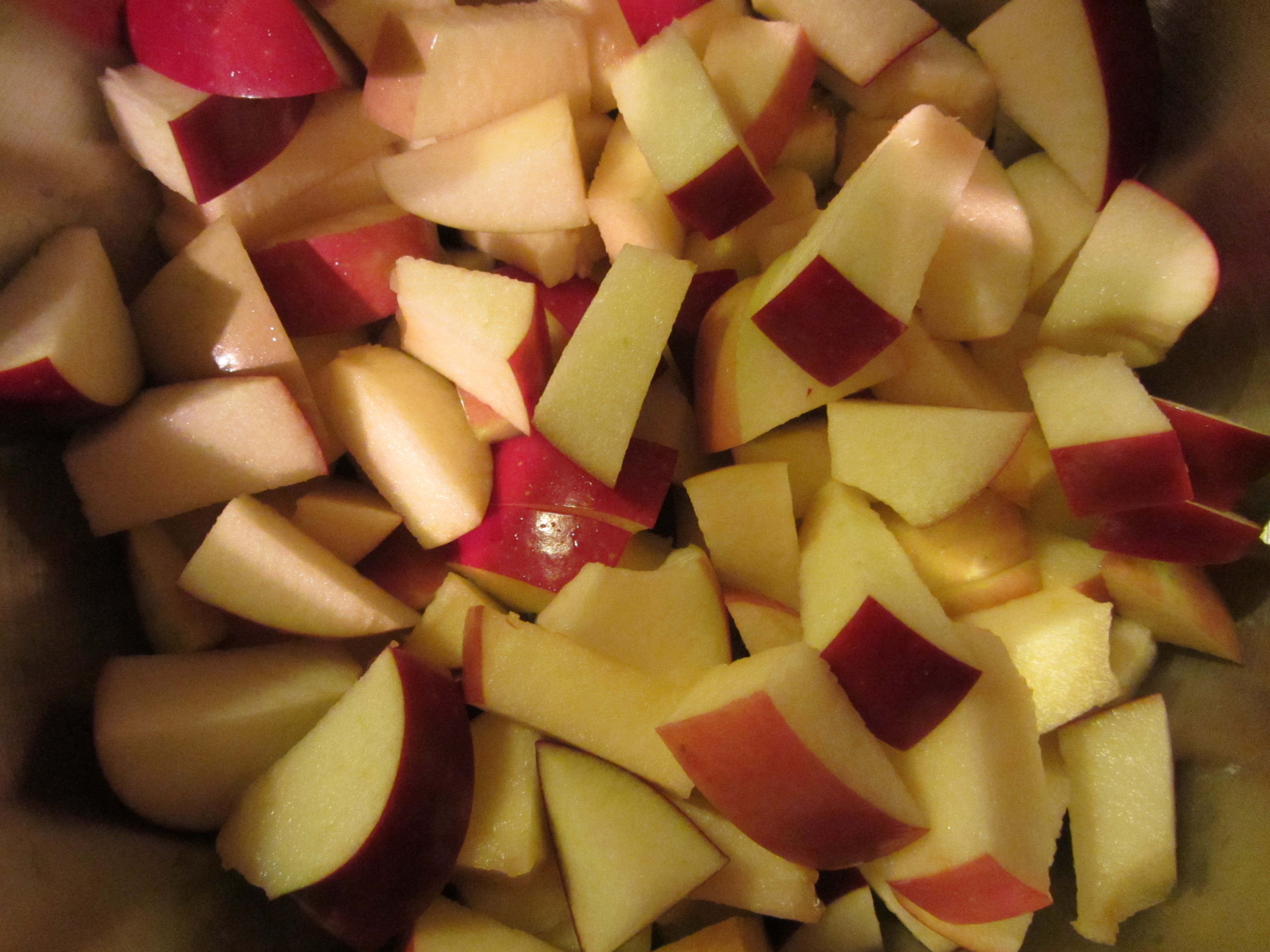
After coring and chopping the apples, you toss them with some cider vinegar.

Chopped apples, tossed with cider vinegar.

Chopped apples, tossed with cider vinegar.

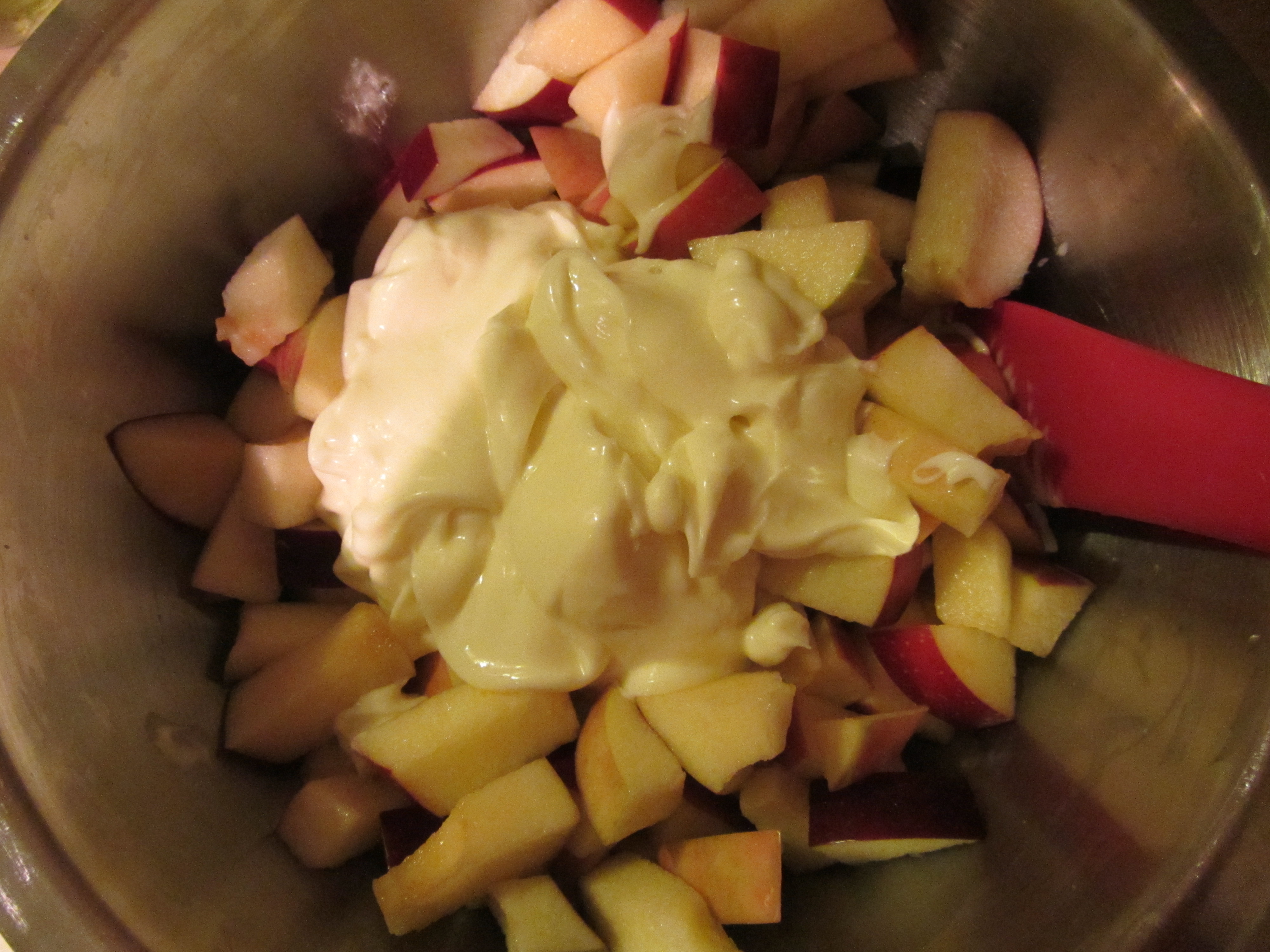
Following the vinegar, you add some mayonnaise to your apple mixture, tossing to make sure the apples are thoroughly covered.

Vinegar-coated apples with mayonnaise.

Vinegar-coated apples with mayonnaise.

Apples coated with mayo.

Apples coated with mayo.

You add some Kosher salt and pepper for seasoning.

Apples with vinegar, mayonnaise, salt, and pepper.

Apples with vinegar, mayonnaise, salt, and pepper.

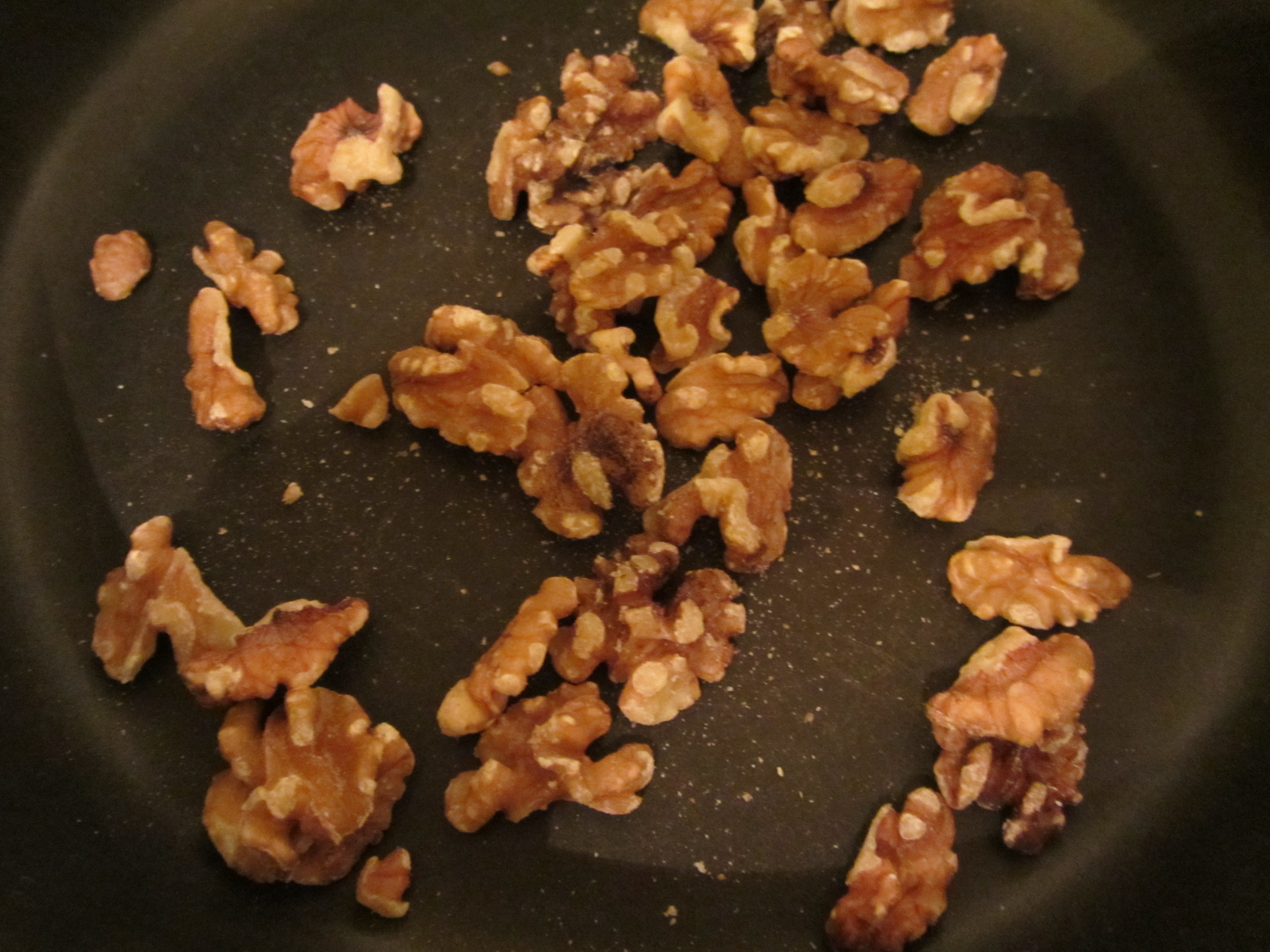
Meanwhile, you toast some walnuts on the stove, and throw them into the mix.

Toasting walnuts.

Toasting walnuts.

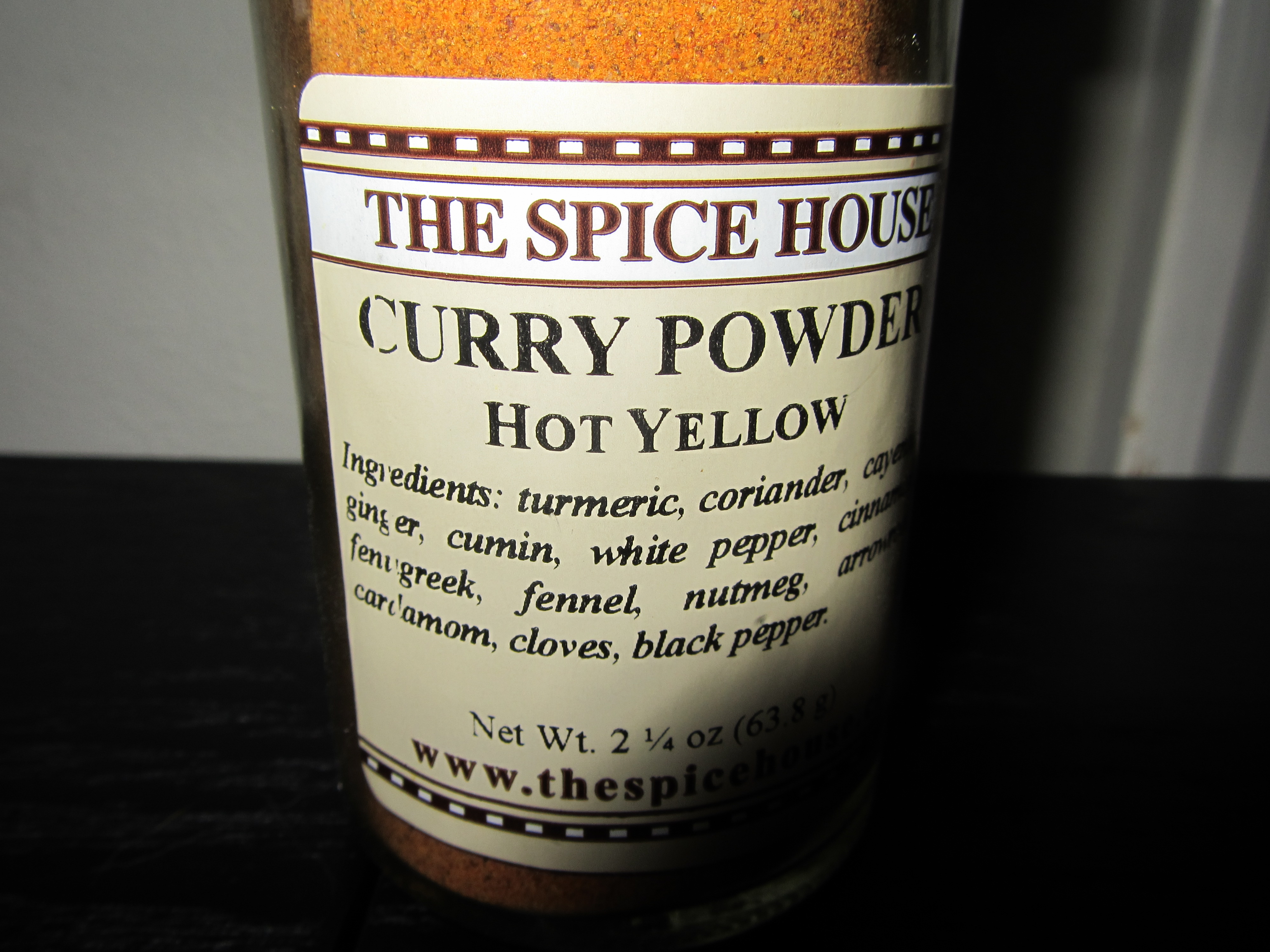
Next, you throw in some golden raisins, curry powder (I used hot curry powder for some extra kick, though maharajah curry would also be excellent), some celery, fresh mint, and red onion.

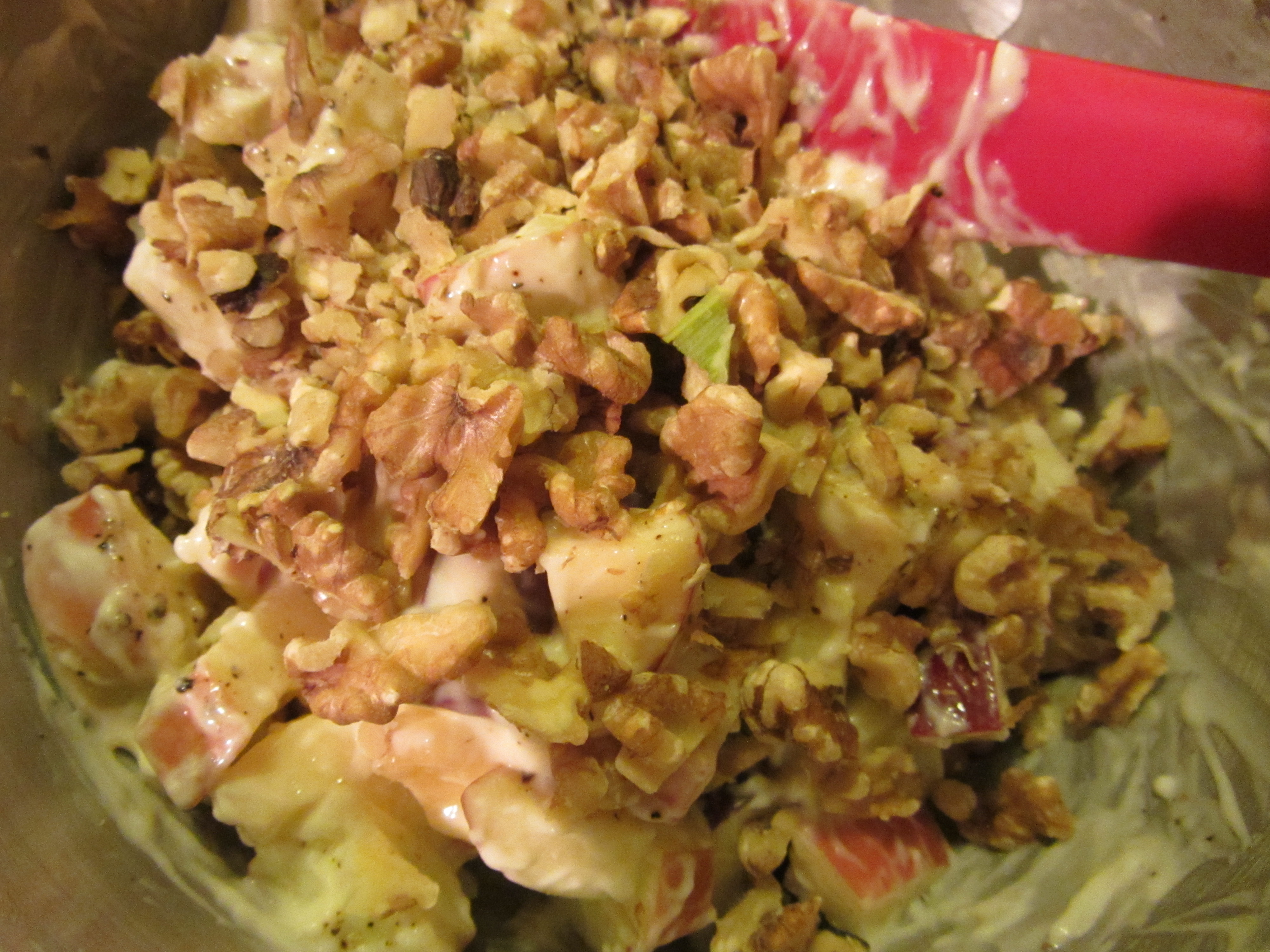
Apple mixture with toasted walnuts.

Apple mixture with toasted walnuts.

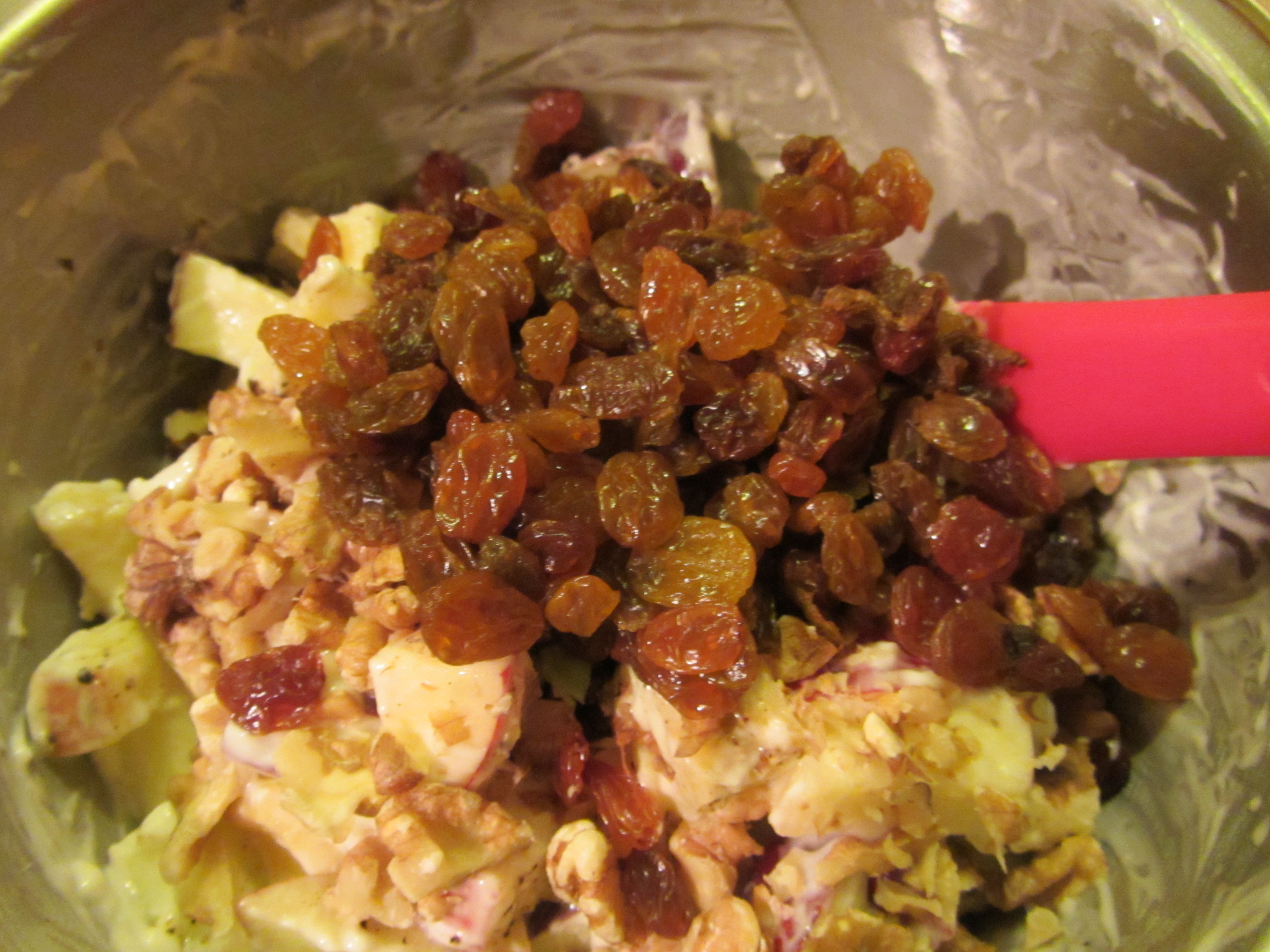
Apple mixture with walnuts and golden raisins.

Apple mixture with walnuts and golden raisins.

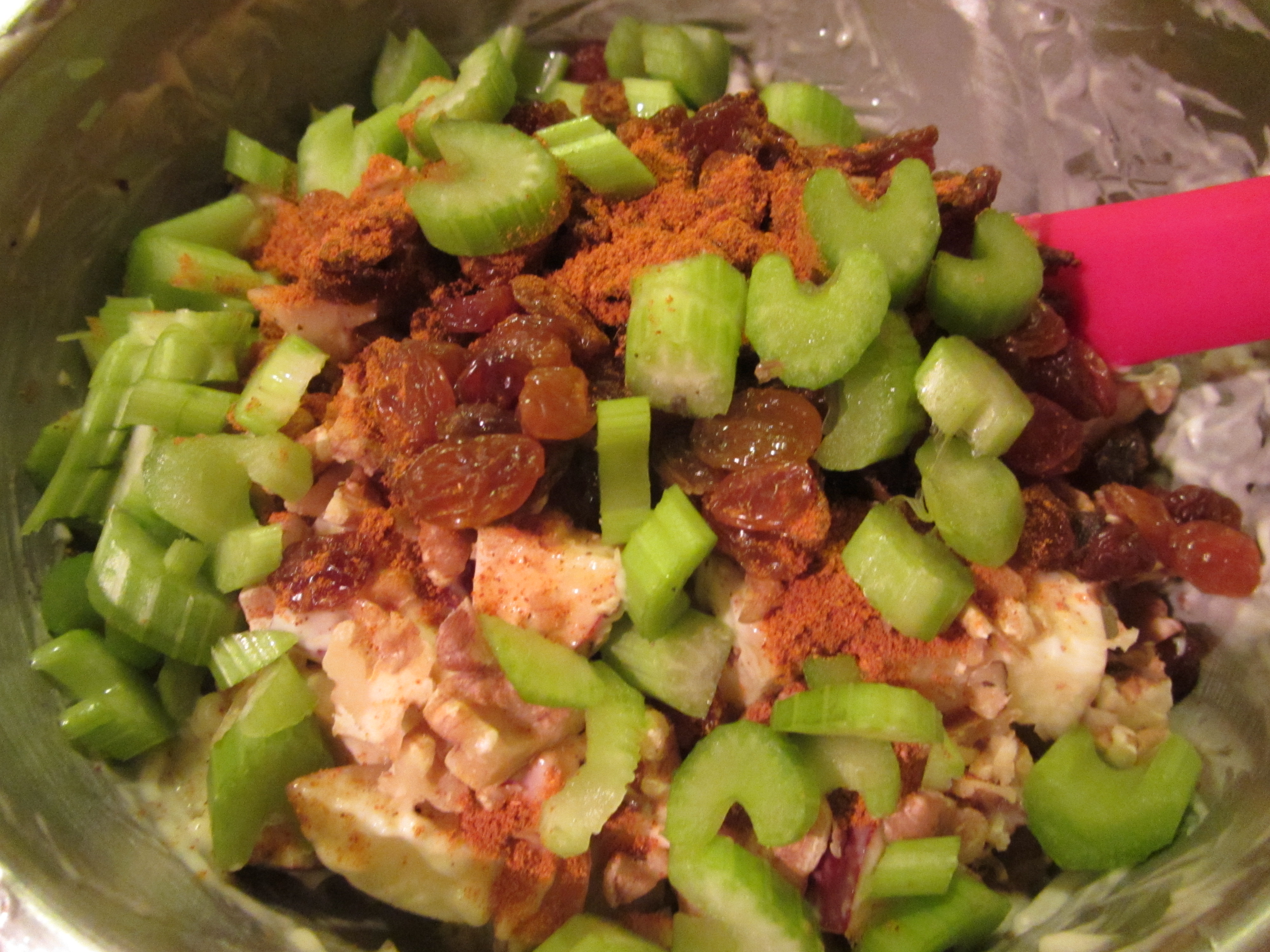
And some hot curry powder.

And some hot curry powder.

Plus some celery.

Plus some celery.

And some mint chiffonade.

And some mint chiffonade.

Some red onion tossed in.

Some red onion tossed in.

In the episode, Alton tells you to shred the red onion, while the online recipe calls for julienned red onion. I just sort of chopped my onions into thin strips. Also, the online recipe tells you to chill the salad for at least an hour prior to serving, but Alton does not mention this in the episode. I chilled my salad for 30 minutes, at the most.

The final mixture.

The final mixture.

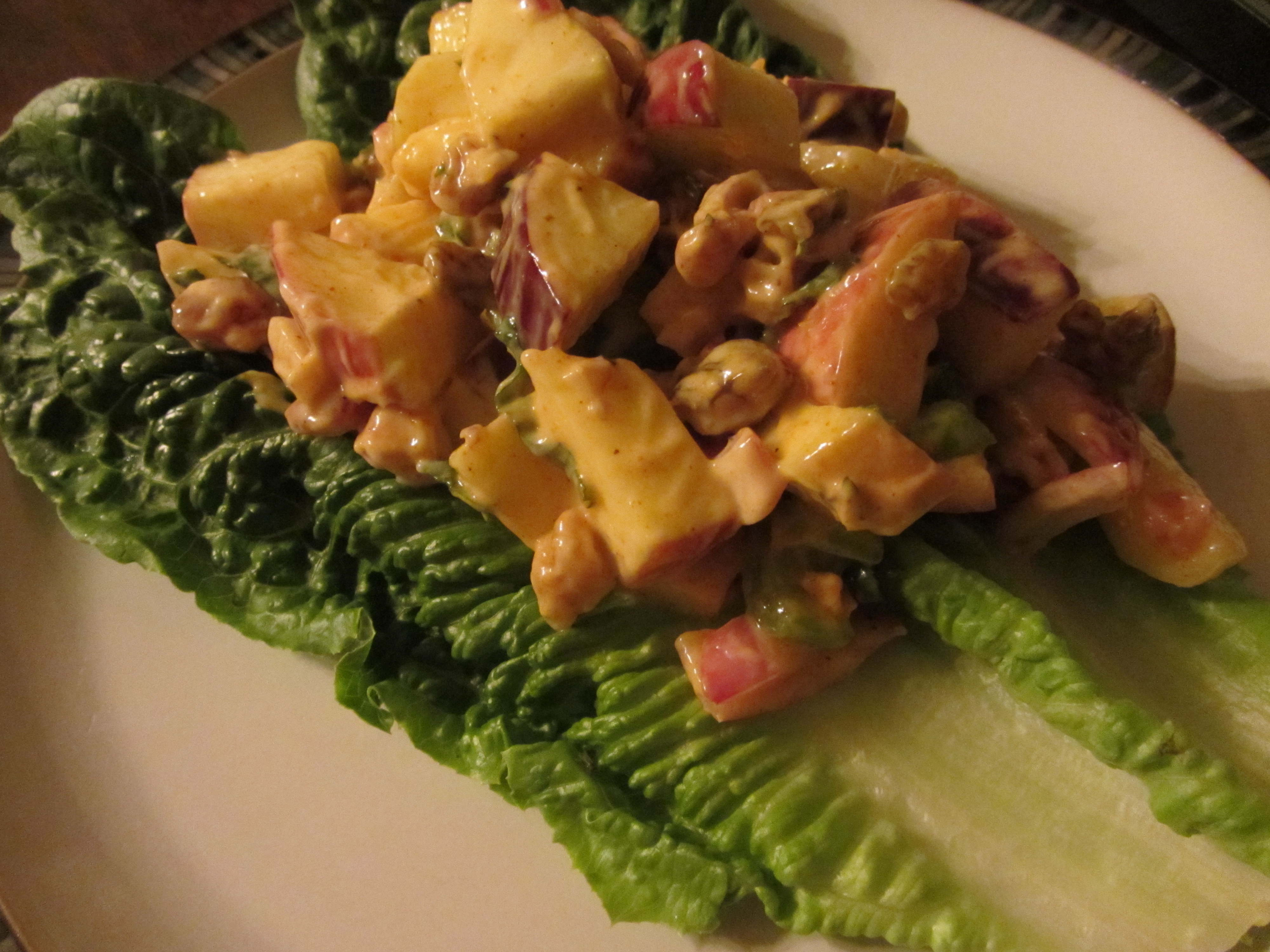
To serve the salad, you spoon it onto Romaine lettuce leaves.

Wonderful Waldorf.

Wonderful Waldorf.

We had this salad with a potato soup, but it could easily serve as an entree itself. I really loved this salad and will be making it again. It has so many wonderfully contrasting flavors and textures. The sweetness of the apple paired with the crunchy walnuts and celery, fresh mint, astringent red onion, and sweet-hot curry powder was delicious. My only complaint with this salad was that my red onion was quite strong, and almost overpowered some of the other flavors in the salad, but red onions tend to greatly vary in their potency. I also opted to use hot curry powder, as we tend to like a little spice in our food. I may have to try the Maharajah curry powder next time, as its sweeter flavor would probably pair nicely with the apples. Since we had the Waldorf salad as a side to our soup, we had leftovers. I anticipated that the texture of the salad would become one-note overnight, but the salad was just as good the following day, so do not be wary of having leftovers with this one.

10 Minute Apple Sauce

My mom used to make apple sauce in the fall. I remember her standing over the sink, her right arm spinning in circles as she turned the arm of her tattered food mill. Often, Mom would serve homemade (and sometimes store-bought) applesauce to my brother and me for breakfast. It was usually served in a bowl, and with a drizzle of heavy cream on top. I preferred my applesauce warm, and discovered that I liked it with a sprinkle of extra brown sugar. My mom could always make store-bought applesauce taste almost like homemade, with the additions of cinnamon, vanilla, and sugar.

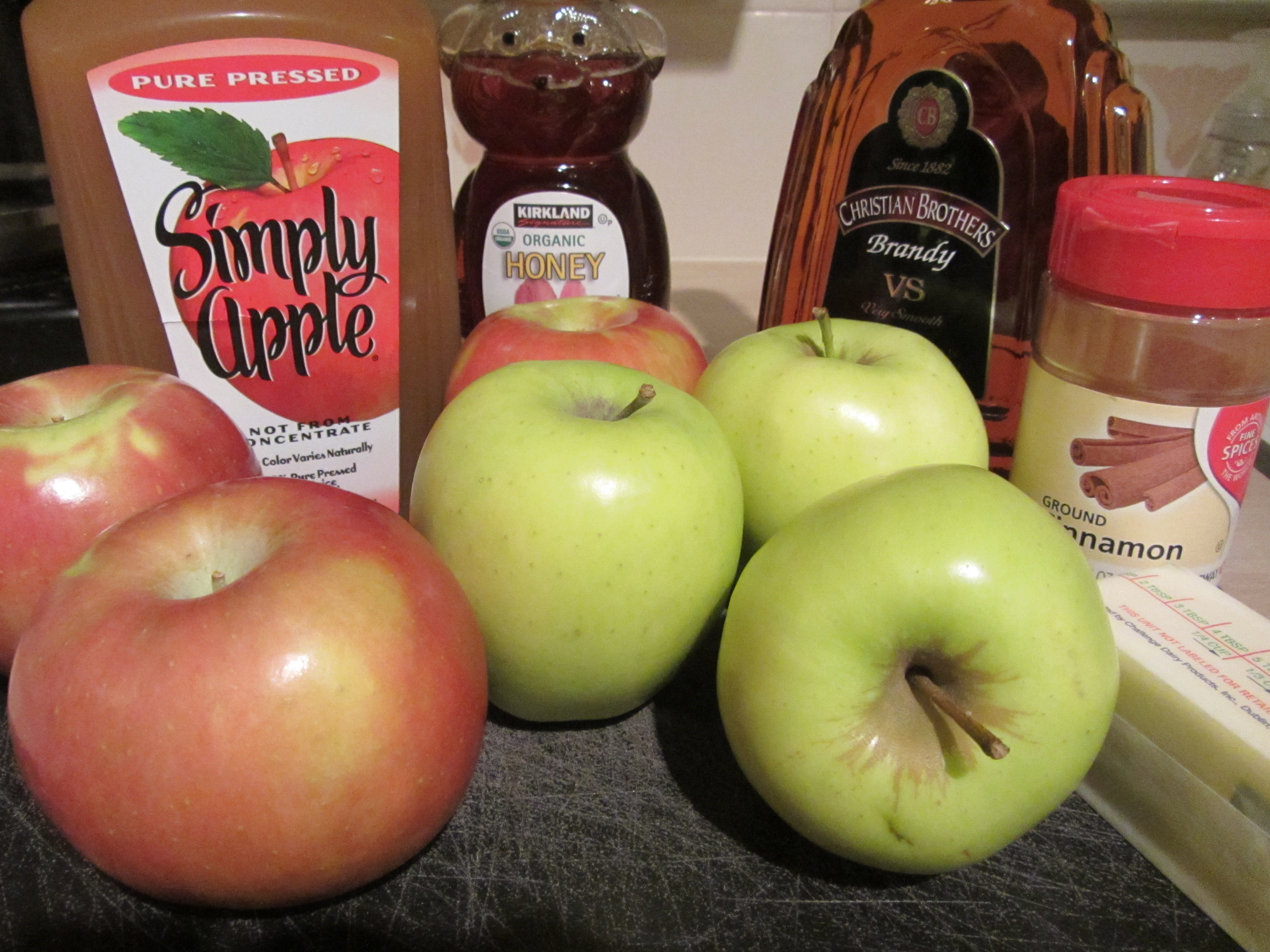
When I watched Alton prepare his 10 Minute Apple Sauce, I was skeptical that it could taste anything like my mom’s homemade applesauce. To begin, you combine unfiltered apple juice, cognac or brandy (I used brandy), butter, honey, and cinnamon in a microwave-save container that has a lid. To this liquid mixture you add six peeled, cored, and quartered apples (three Golden Delicious apples and three Fuji apples).

Golden Delicious apples, Fuji apples, unfiltered apple juice, honey, brandy, cinnamon, and butter.

Golden Delicious apples, Fuji apples, unfiltered apple juice, honey, brandy, cinnamon, and butter.

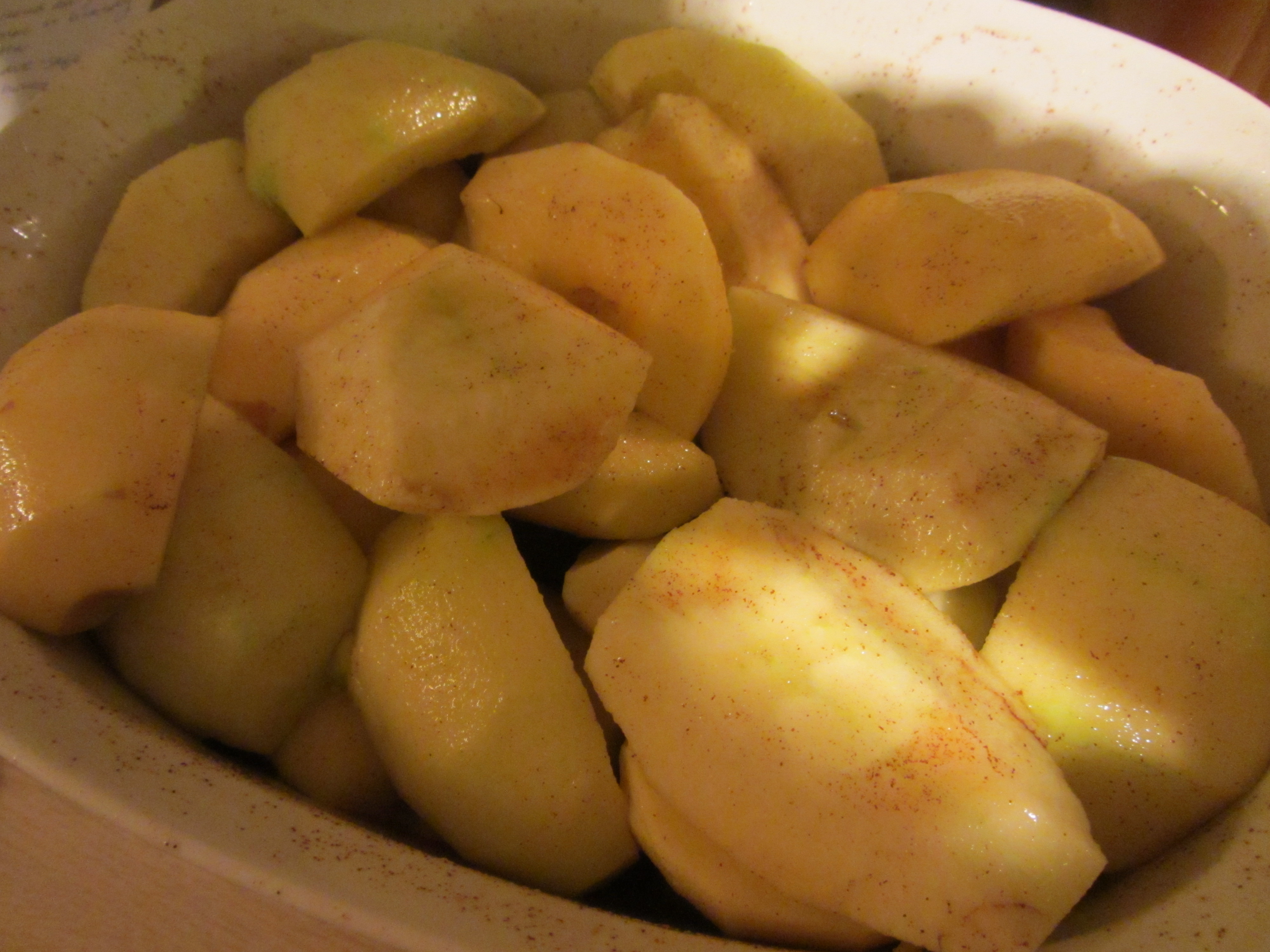
You put the lid on your container and give the entire mixture a good shake. Once everything is good and mixed, you open one corner of your lid and microwave the applesauce on high power for 10 minutes.

Apple mixture, prior to cooking.

Apple mixture, prior to cooking.

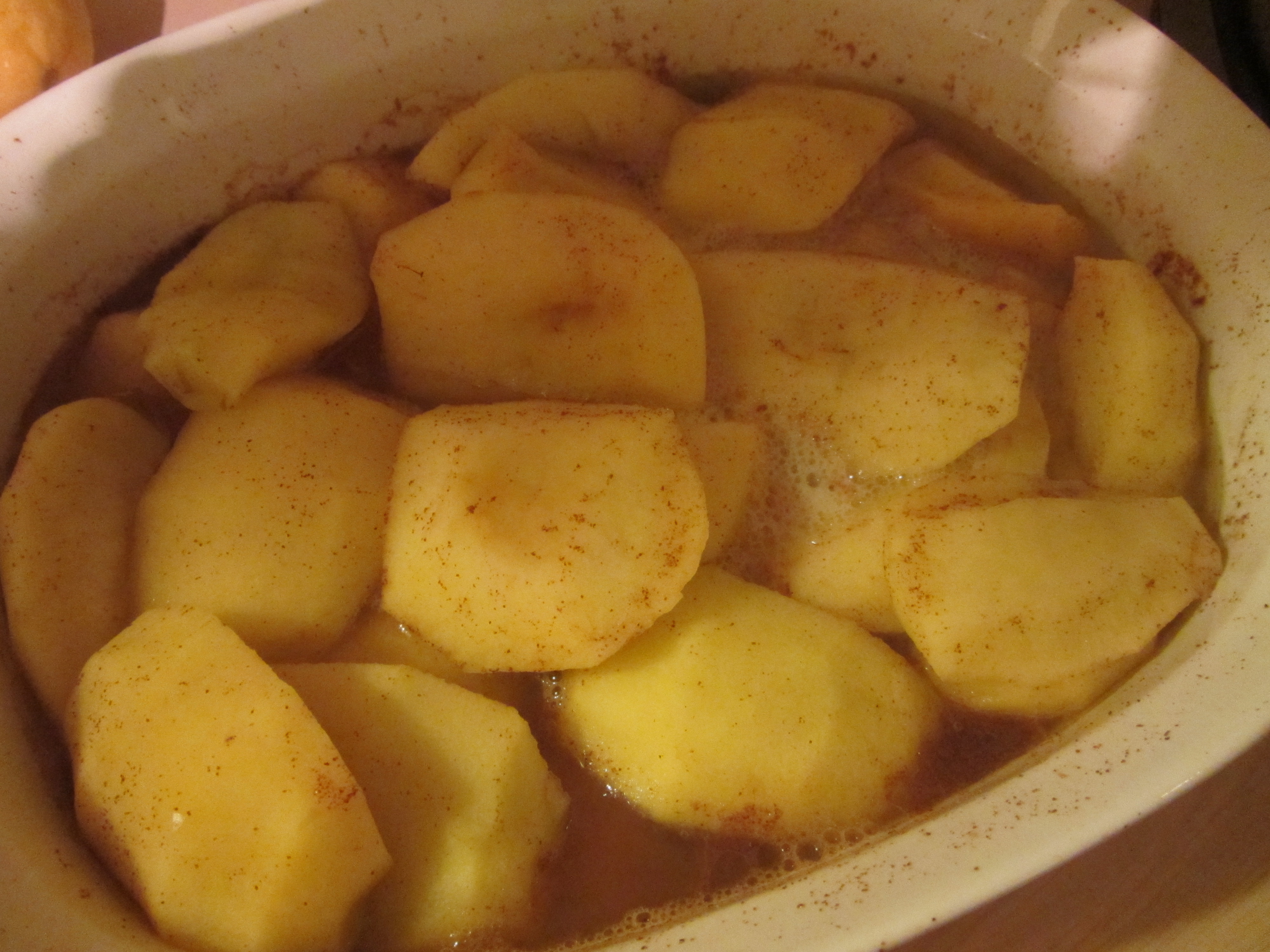
After cooking, you blend the mixture until it is “almost smooth.”

Apple mixture, after baking.

Apple mixture, after baking.

My immersion blender is one of my very favorite kitchen gadgets, but it happens to be quite unhappy at the moment. Our Coonhounds also happen to love the immersion blender (they come running), as they recognize that the sound of the whisk attachment often means whipped cream for them. Since the immersion blender is currently out of commission, I threw the entire apple mixture into the blender and blended it until it was nearly smooth.

Final applesauce.

Final applesauce.

Alton says that this applesauce will keep well in the refrigerator for two to three weeks. I guess that isn’t an issue when your applesauce is gone in two days. This is definitely the fastest and easiest applesauce I have ever made. Was it as good as Mom’s? Tough to say, but it was pretty darn good.

Baker, Baker

The final recipe in this episode is for baked apples. Yet again, I think of my mom when I think of baked apples. She would make baked apples for us for breakfast or dessert. Sometimes the apples were sliced prior to baking, while other times they were whole, as in Alton’s recipe in this episode.

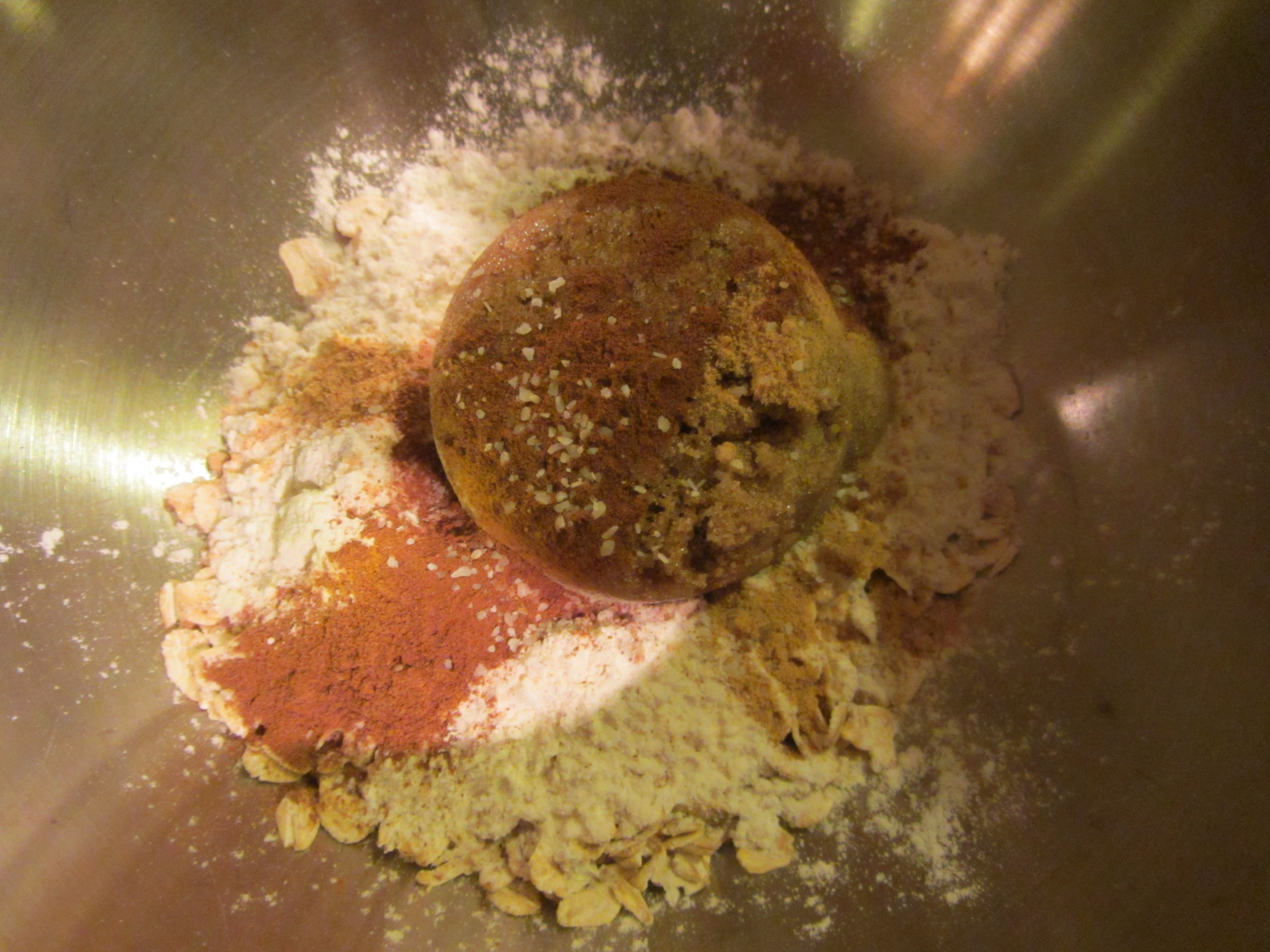
For these baked apples, you first combine your topping ingredients. In a bowl you combine oats, flour, light brown sugar, cinnamon, ground ginger, and Kosher salt.

All of the ingredients for baked apples.

All of the ingredients for baked apples.

Oats, flour, light brown sugar, cinnamon, ginger, and salt.

Oats, flour, light brown sugar, cinnamon, ginger, and salt.

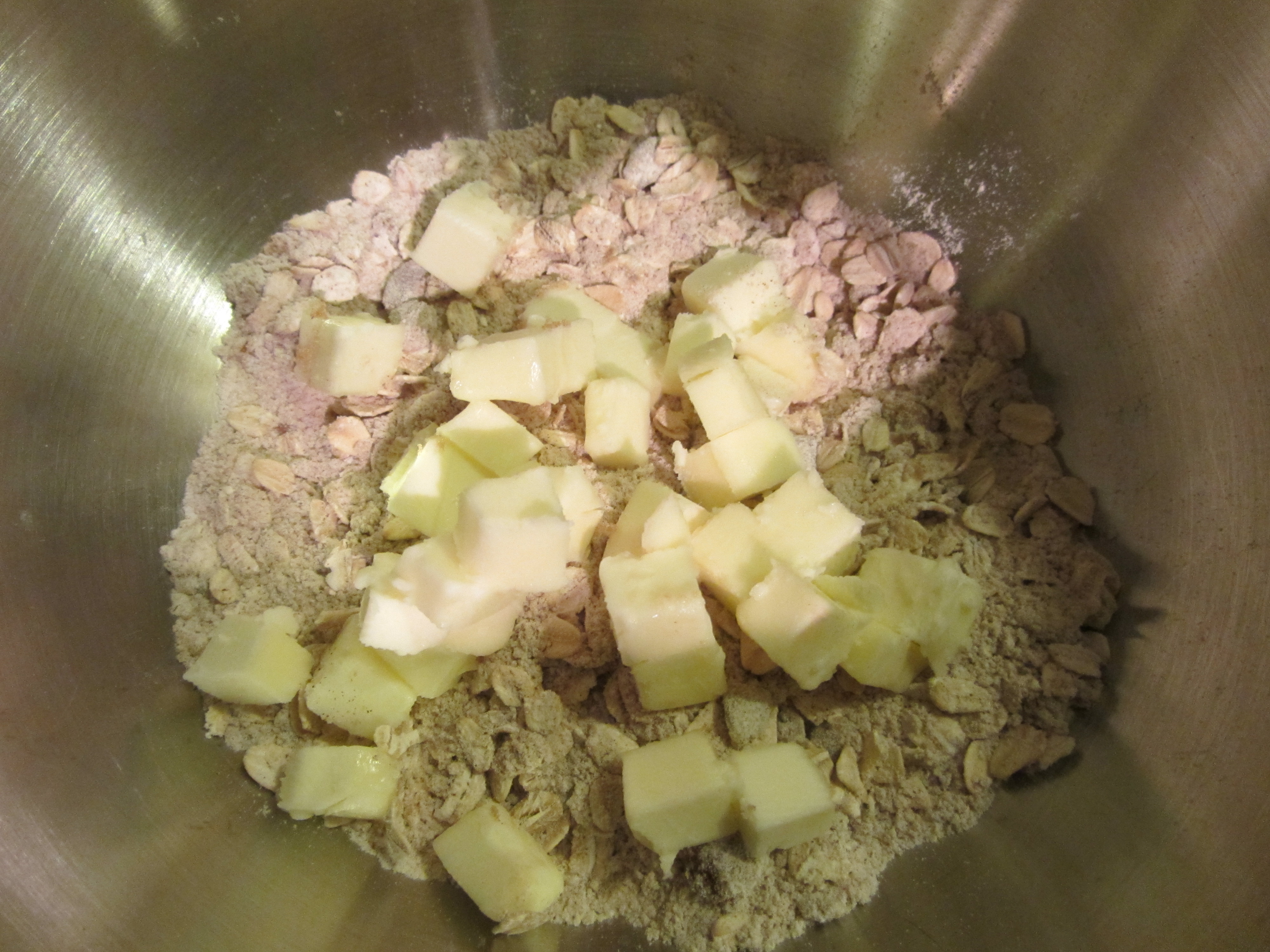
Into this mixture you add some butter with your hands, working until the mixture is crumbly.

And some butter.

And some butter.

Completed streusel topping.

Completed streusel topping.

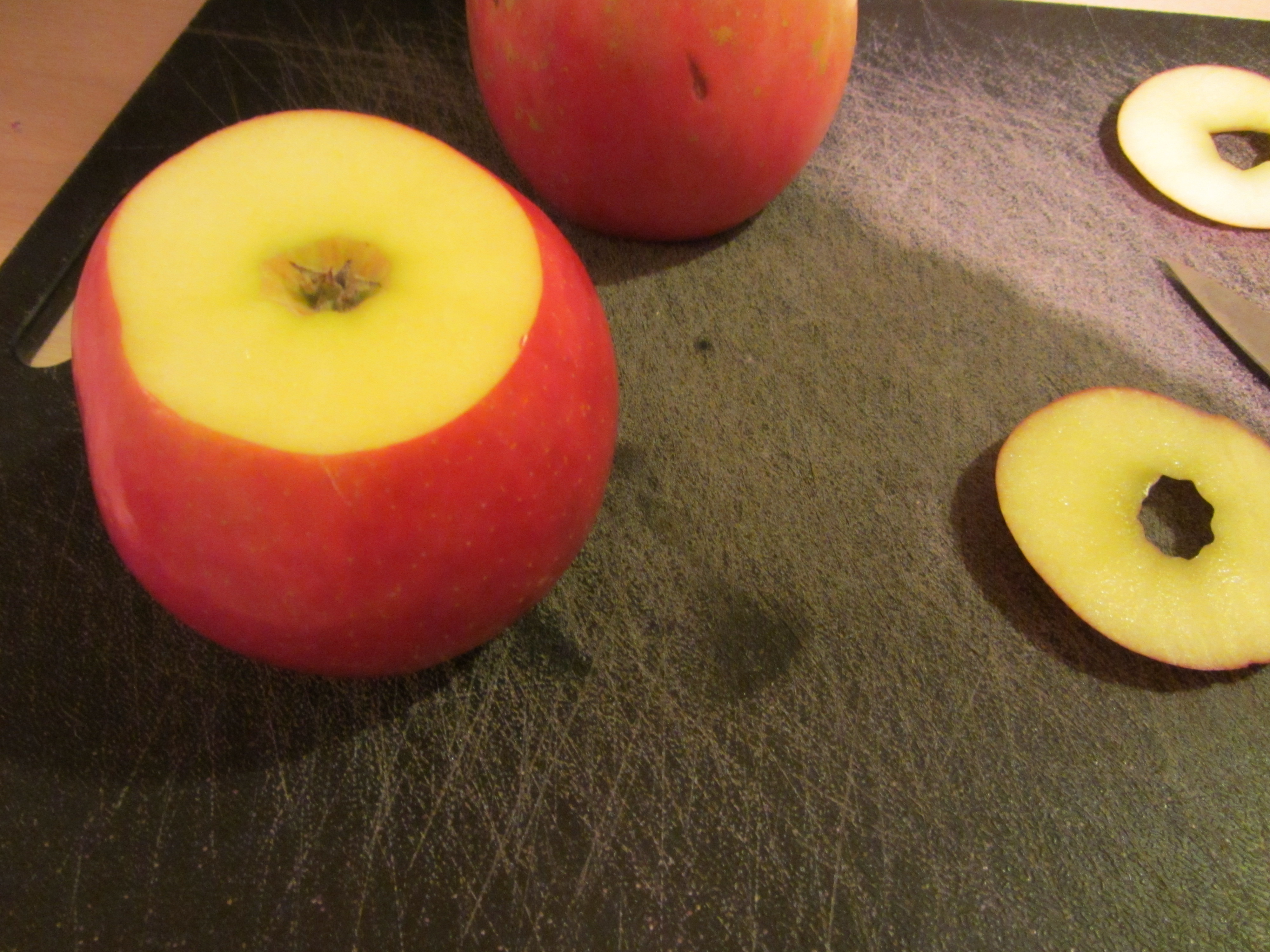
The topping mixture goes into the refrigerator while you prep your apples. For this recipe you want to use Braeburn or Fuji apples. I used Braeburns for this recipe. You first want to cut the bottoms off of your apples; this will give your apples a level, stable base while you work on them.

Leveling the apples.

Leveling the apples.

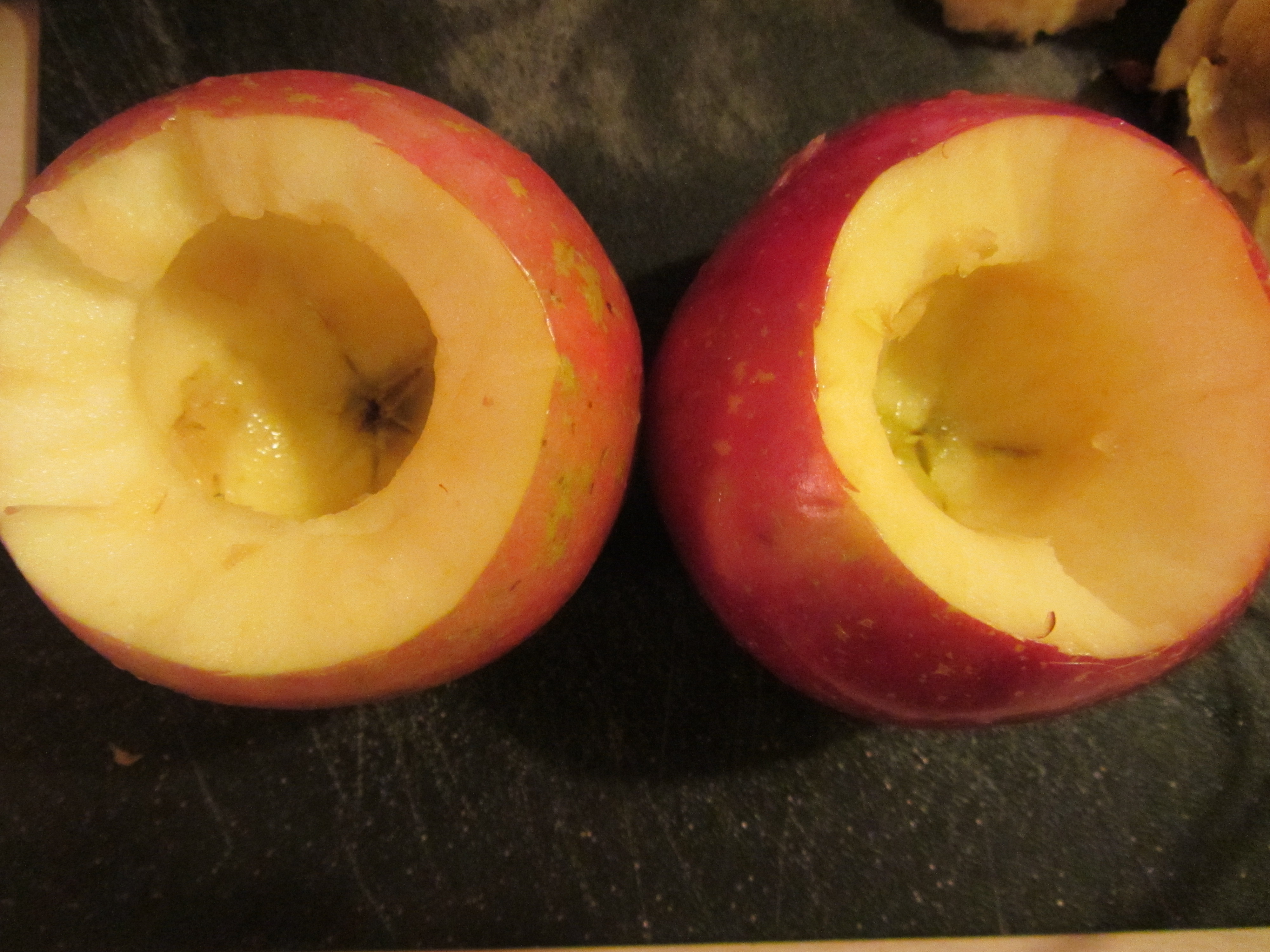
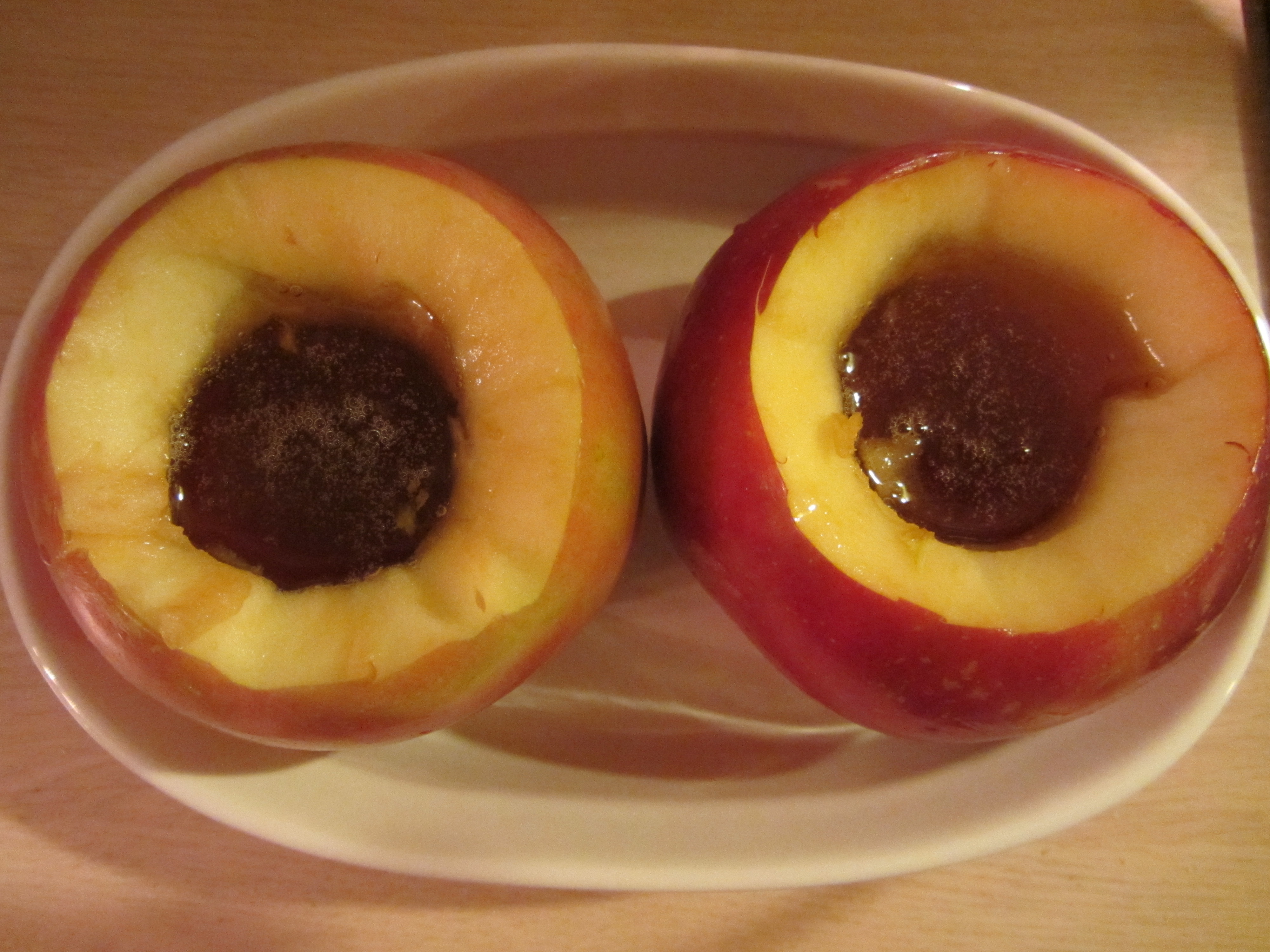
Once the apples are level, you carve off the tops of the apples, using a paring knife. A melon baller is then used to scoop out the seeds and core of the apples. Once cored, you fill the apple reservoirs with honey and sprinkle the tops with the topping mixture. You pack down the topping, and then sprinkle on additional streusel, taking care not to pack the second layer of topping.

Cored and ready to go.

Cored and ready to go.

Reservoirs filled with honey.

Reservoirs filled with honey.

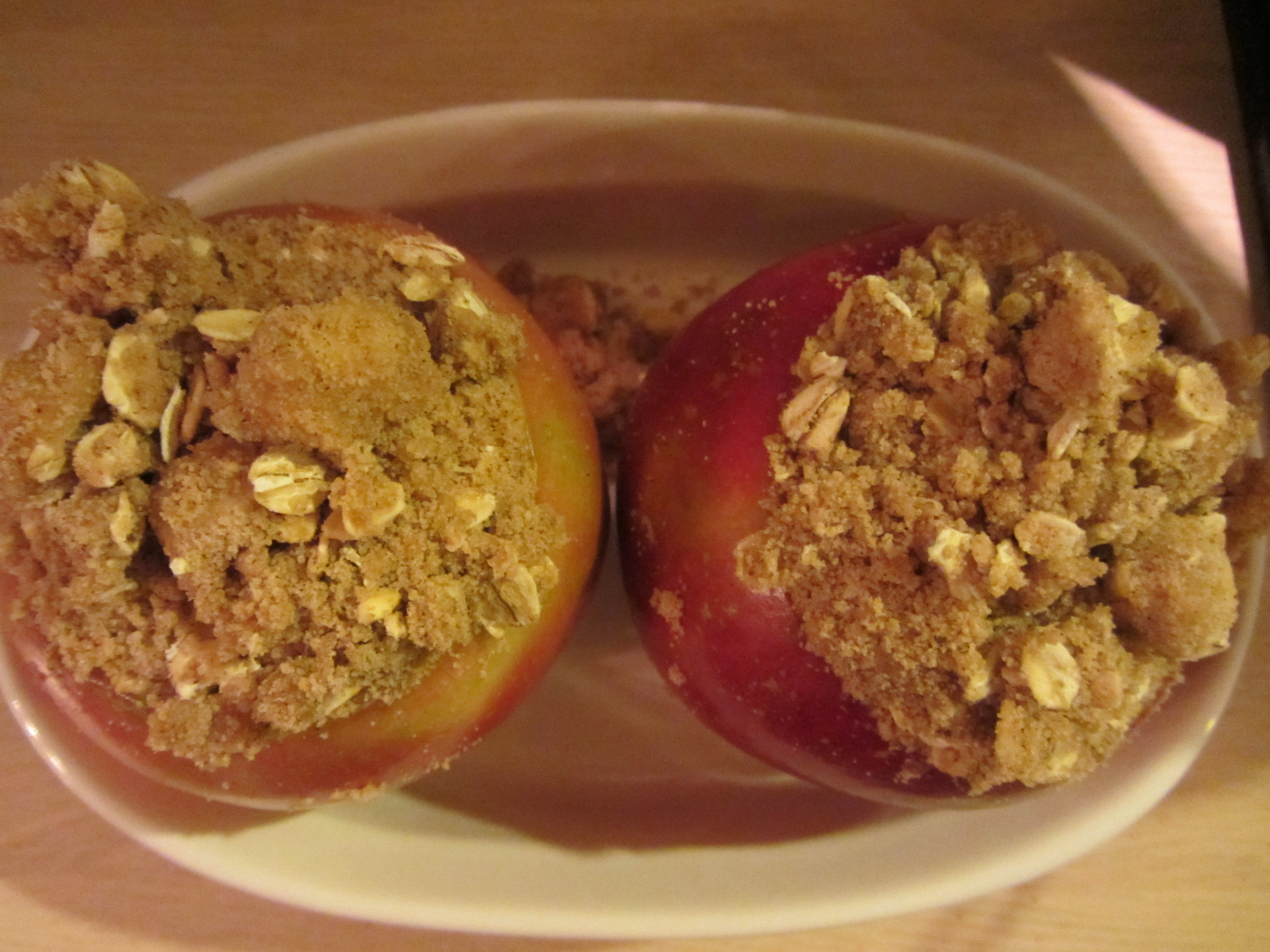
Apples topped with two layers of streusel.

Apples topped with two layers of streusel.

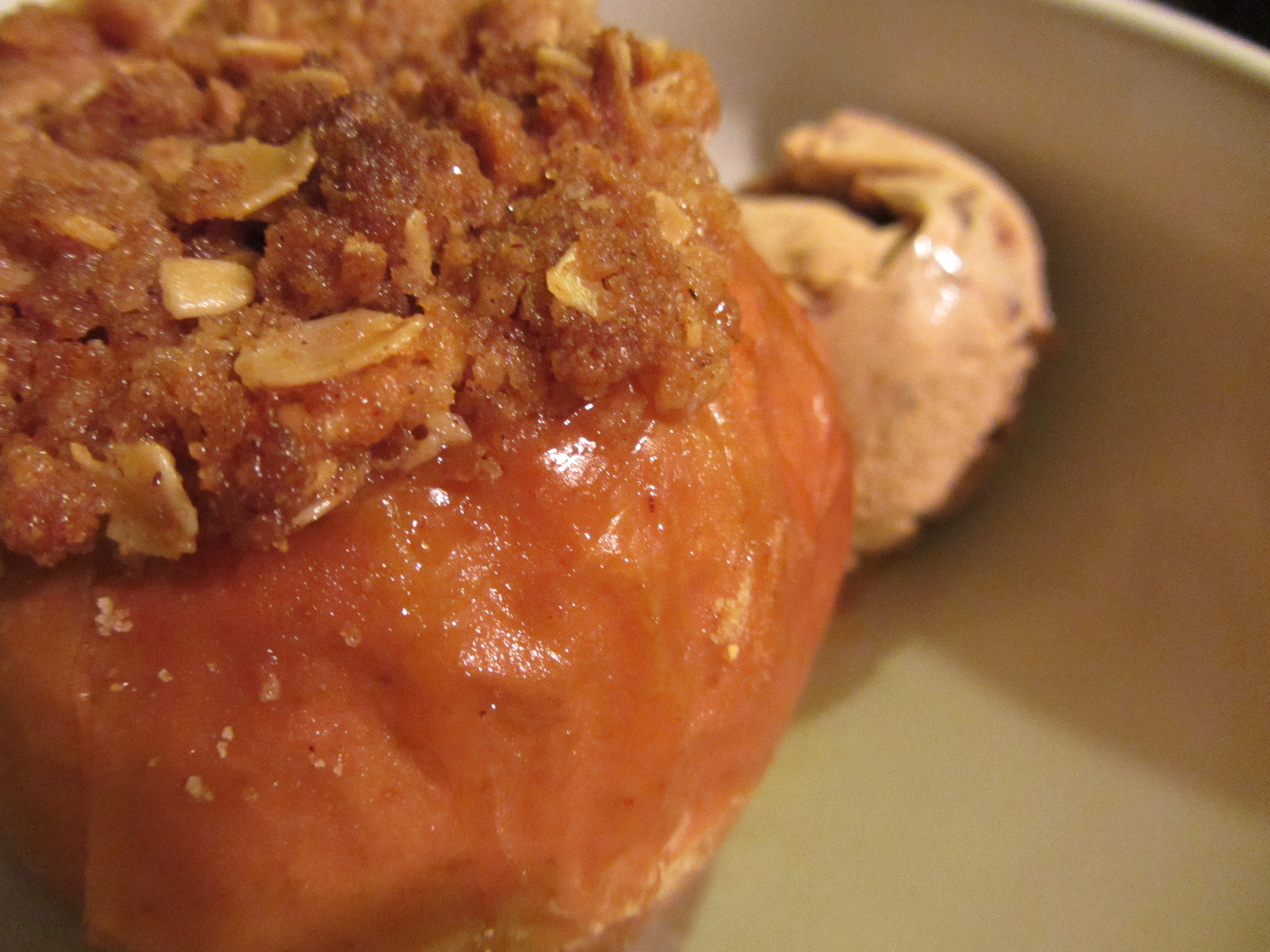
The apples are placed in a baking dish and go into a 350 degree oven for 40 minutes, or until they are tender when squeezed with tongs. The apples need to cool for about 10 minutes prior to eating. We ate ours with ice cream on the side.

Baked apples, served with ice cream.

Baked apples, served with ice cream.

This recipe does make additional streusel topping, so I made baked pears the following evening.

The streusel topping can also be used for pears.

The streusel topping can also be used for pears.

These baked apples have all of the flavor of homemade apple pie, yet they are so much easier to make. When served with ice cream, they are truly a treat. The apples are tender to the bite and filled with a glorious almost-caramelized filling. For an easy, yet indulgent, treat, these are a great way to go. I can say that I would gladly make any of these recipes again.


Fondue Vudu

Now that the fruitcake has officially all been eaten in our house, we’re on to the next logical task:  cheese! Cheese is absolutely one of my favorite things, and I will find any excuse to eat it. I have been known to reason that I need to eat more cheese because “I need more protein,” or because “Calcium is good for my bones.” I can also safely say that I like any and all types of cheeses. Well, except for Gjetost. I just can’t do Gjetost. Thank goodness my HDL is 119.

The first recipe Alton conquers in this episode of Good Eats is for cheese fondue. I will confess that I had made this fondue before, though I had not watched the episode prior to making the recipe. I did watch the episode before making it this time around. My family ate cheese fondue when I was growing up, especially when we went downhill skiing in the winter. I remember that my mom’s recipe always had a touch of Kirsch in it. Alton’s recipe also uses some alcohol, though his is in the form of hard cider and brandy.

To begin Alton’s recipe, you rub your fondue pot with a halved clove of garlic.

Garlic, hard cider, Gruyere, and Smoked Gouda.

Garlic, hard cider, Gruyere, and Smoked Gouda.

Alton recommends using an electric fondue pot, but we do not have one, so I used a standard fondue pot. Once you have thoroughly rubbed your fondue pot with garlic, you add hard cider, Kosher salt, lemon juice (Alton uses 1 T in the episode, while the online recipe calls for 2 T), and brandy. You bring this mixture to a simmer.

Pot rubbed with garlic and filled with hard cider, Kosher salt, lemon juice, and brandy.

Pot rubbed with garlic and filled with hard cider, Kosher salt, lemon juice, and brandy.

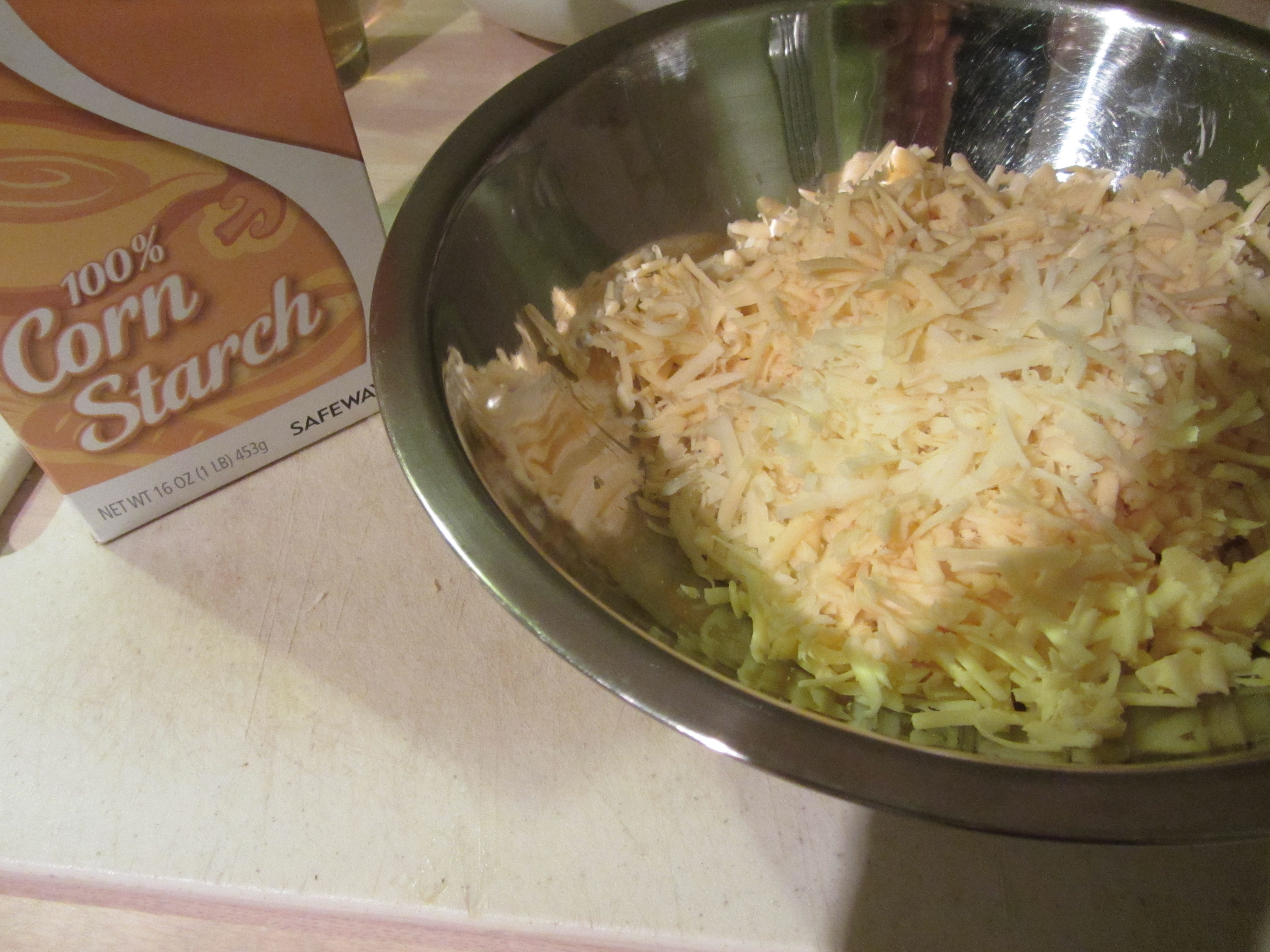
Meanwhile, you grate your Gruyere and Smoked Gouda, and toss the cheeses with 2 T of cornstarch (the online recipe calls for less cornstarch).

Grated Gruyere and Smoked Gouda.

Grated Gruyere and Smoked Gouda.

Cheese mixed with cornstarch.

Cheese mixed with cornstarch.

Gradually, handful by handful, you begin adding your grated cheese to the cider mixture.

Adding the first handful of cheese.

Adding the first handful of cheese.

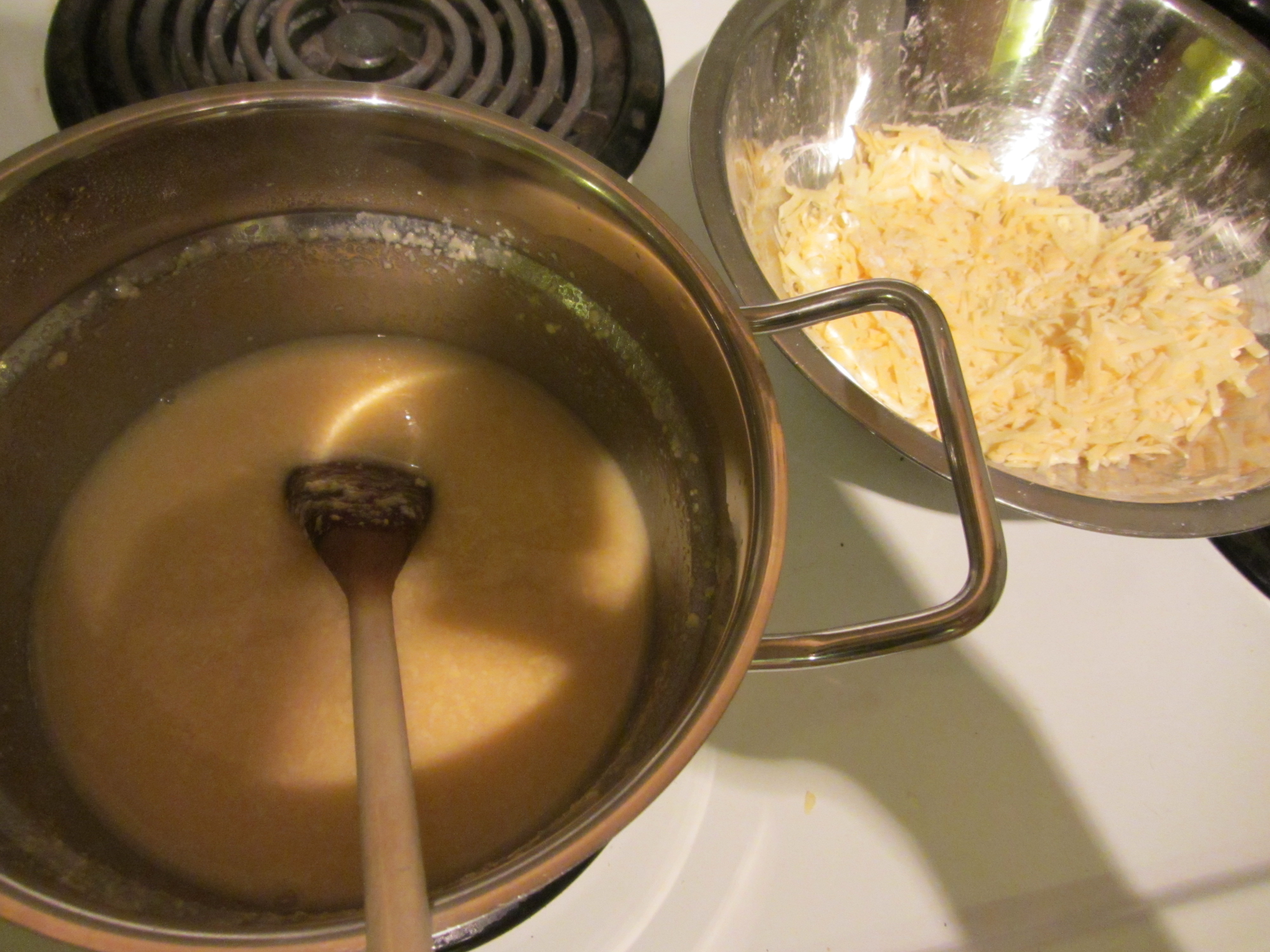
Alton stresses that you take this process slowly, allowing the cheese to melt completely and waiting for bubbles to break the surface before adding the next handful of cheese. I found that I actually needed to increase the heat a bit to get the cheese to completely melt and incorporate. Otherwise, little bits of cheese remained visible.

Adding cheese, handful by handful.

Adding cheese, handful by handful.

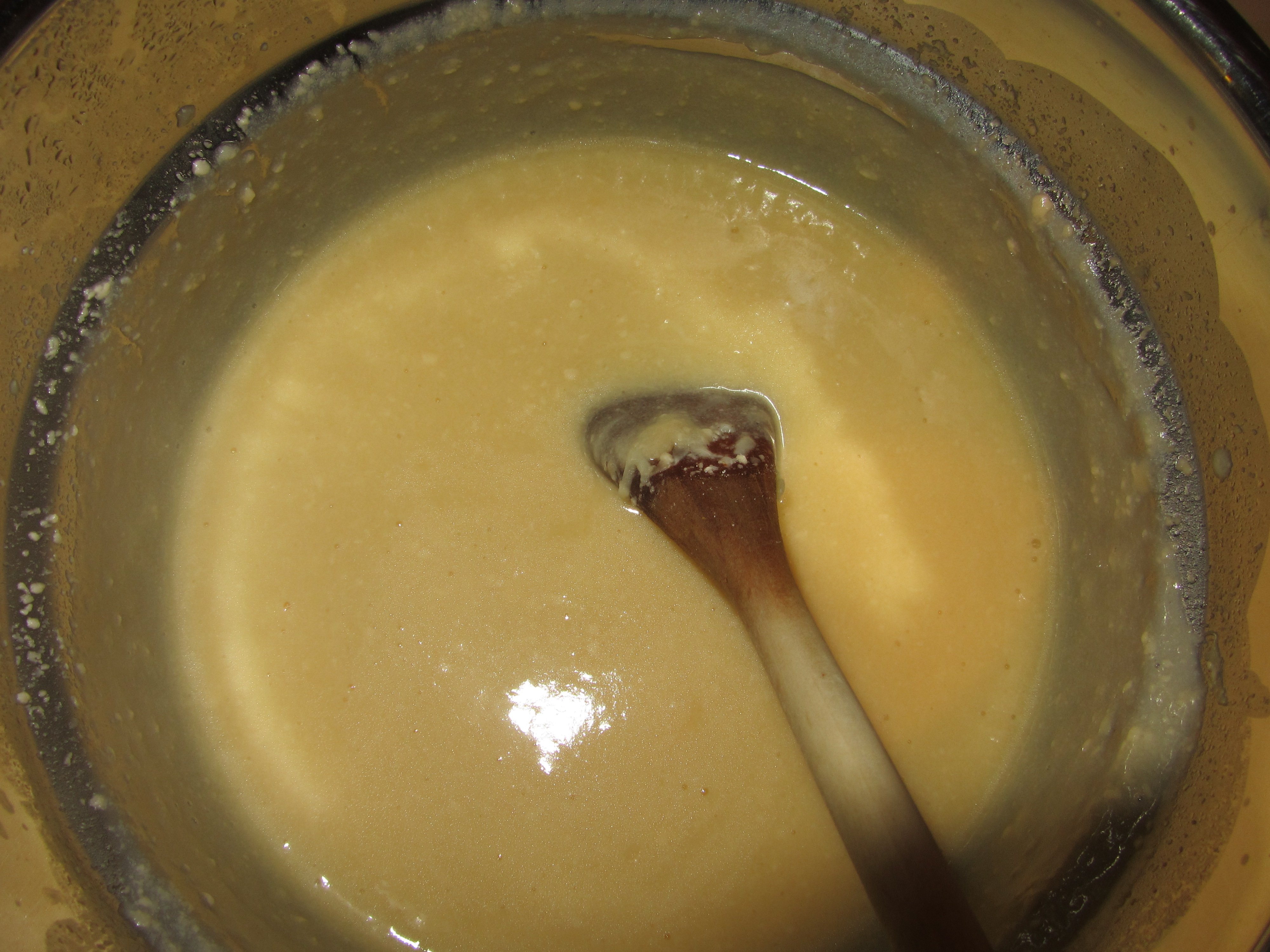
All of the cheese incorporated.

All of the cheese incorporated.

Once the cheese is all melted and smooth, you add a pinch of black pepper and 1/2 t (the online recipe calls for 1/4 t) of curry powder. Since we like heat, I chose to use hot curry powder.

Hot curry powder.

Hot curry powder.

Fondue with curry powder.

Fondue with curry powder.

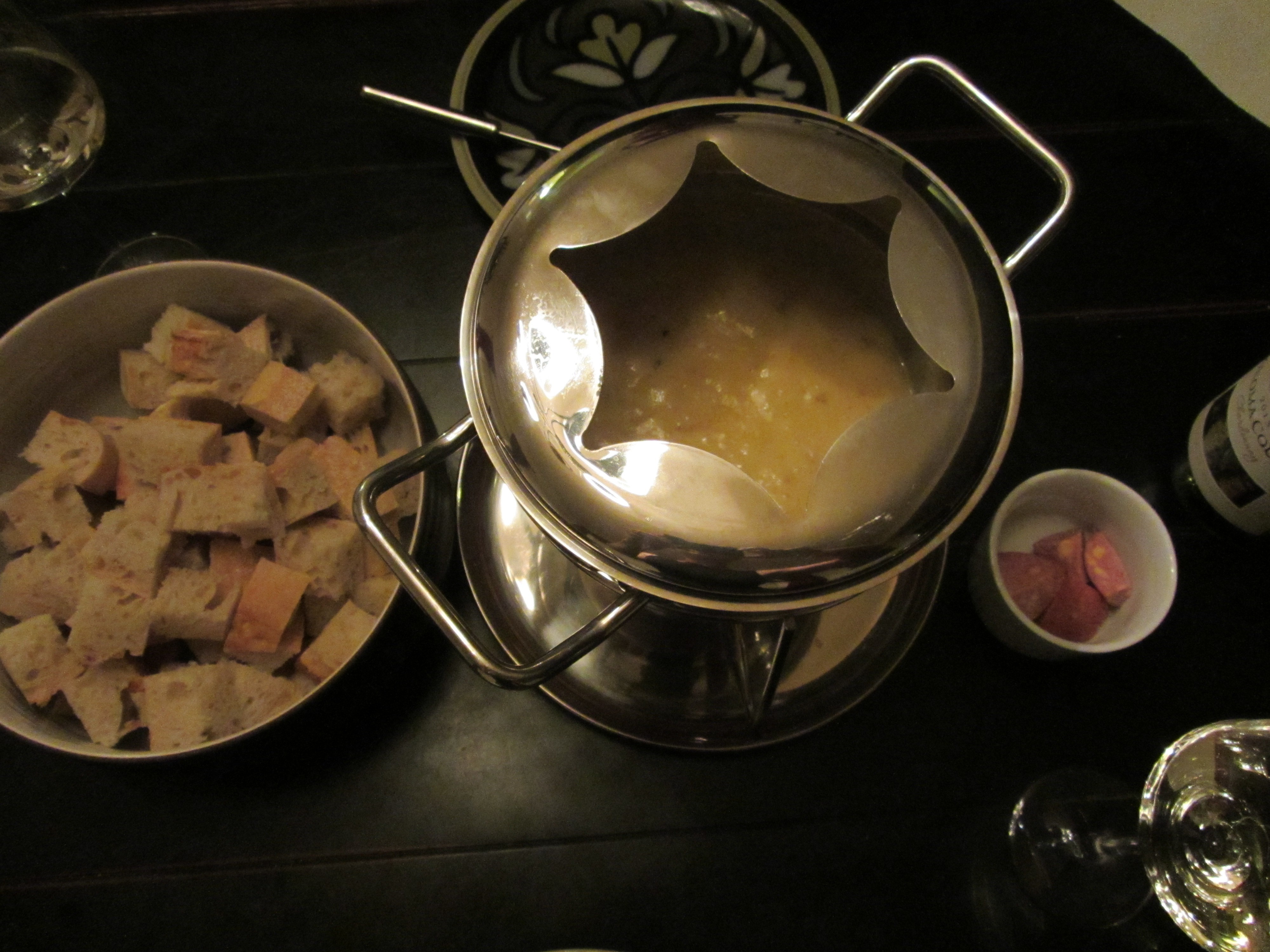
We ate our fondue with cubed bread and a little bit of cubed Summer sausage.

Fondue dinner spread.

Fondue dinner spread.

When we have had fondue in the past, we have also really liked to use apples or pears, though we did not do that this time around. We both really like the flavor of this fondue, which is why we have made it a few times now. My fondue ended up being much smoother this time around, which I assume could be due to the additional cornstarch in the episode recipe vs. the online recipe. The smokiness of the Gouda really comes through in this fondue, though it is not overpowering, and the sweetness of the cider is also evident. I find the flavors to balance well, with the sweetness of the cider, the smokiness of the Gouda, the subtle heat from the curry powder, the tartness of the lemon juice, and the salty/nutty flavor of the Gruyere. This is a super easy, but sinful, dinner to make. We like to have it on a day when we have done a good long run or bike ride! This will remain my go-to cheese fondue recipe, and I’ll be making it as Alton makes it in the episode.

Big Cheese Squeeze

The second recipe in the cheese episode is for a grilled cheese sandwich. Being the cheese lover I am, I’m a pretty happy girl if you put a grilled cheese sandwich in front of me, especially if the bread and cheese do the sandwich justice. For his sandwich, Alton tells you to heat two skillets (preferably iron) over high heat. Ideally, you want one skillet to be able to nest inside the other skillet. We happen to have two iron skillets that fit the bill perfectly.

Heating two cast iron skillets.

Heating two cast iron skillets.

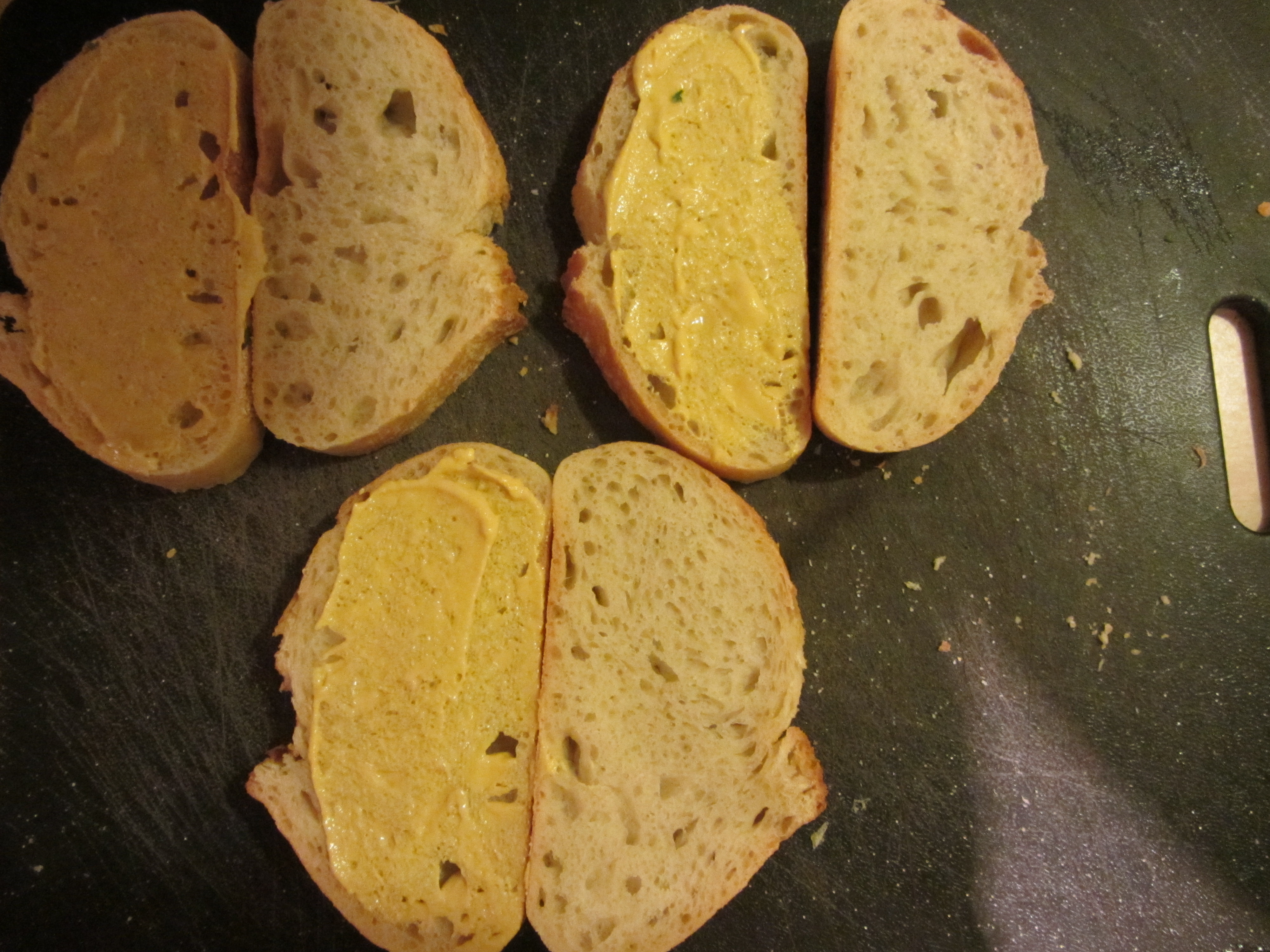
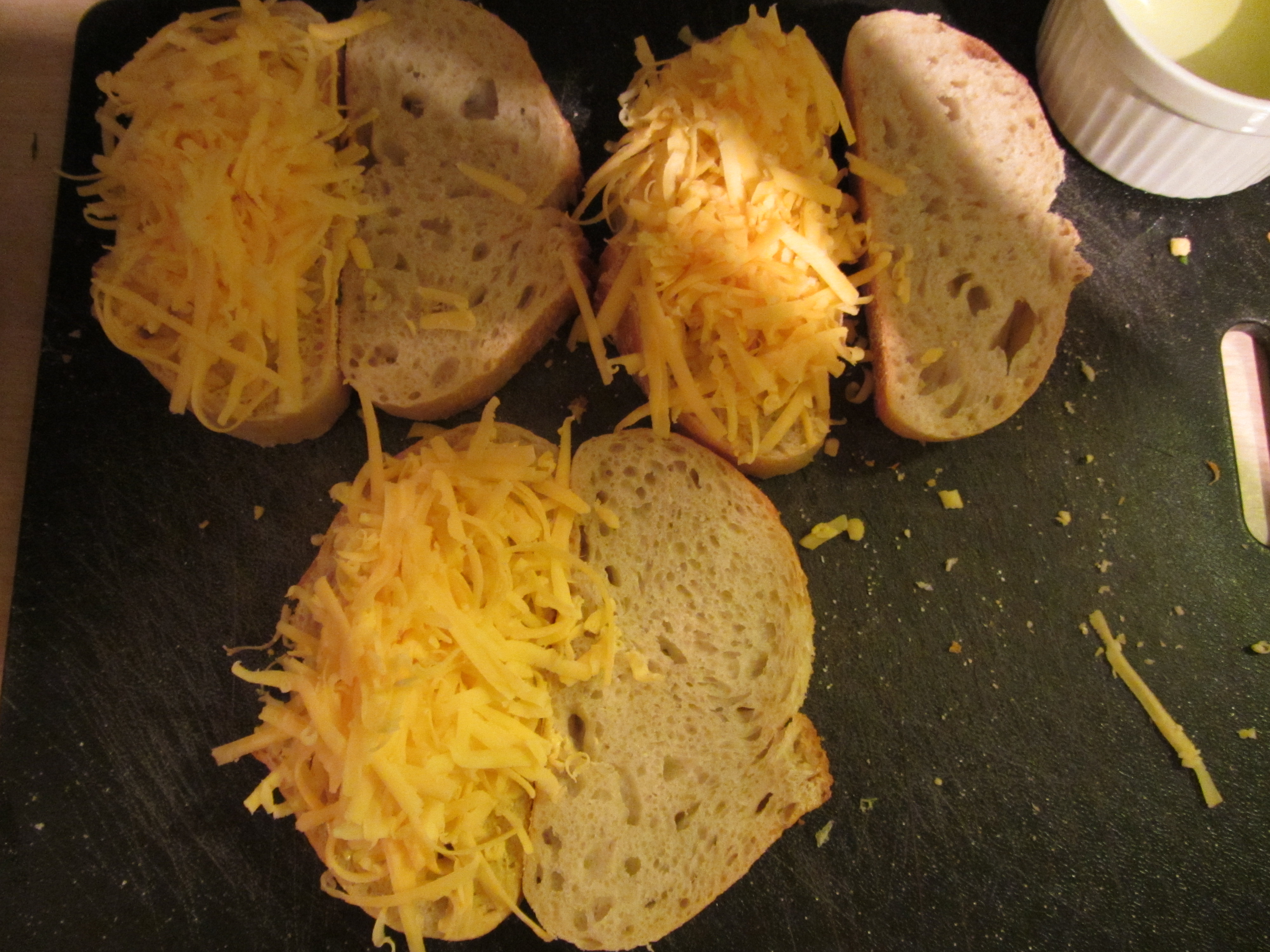
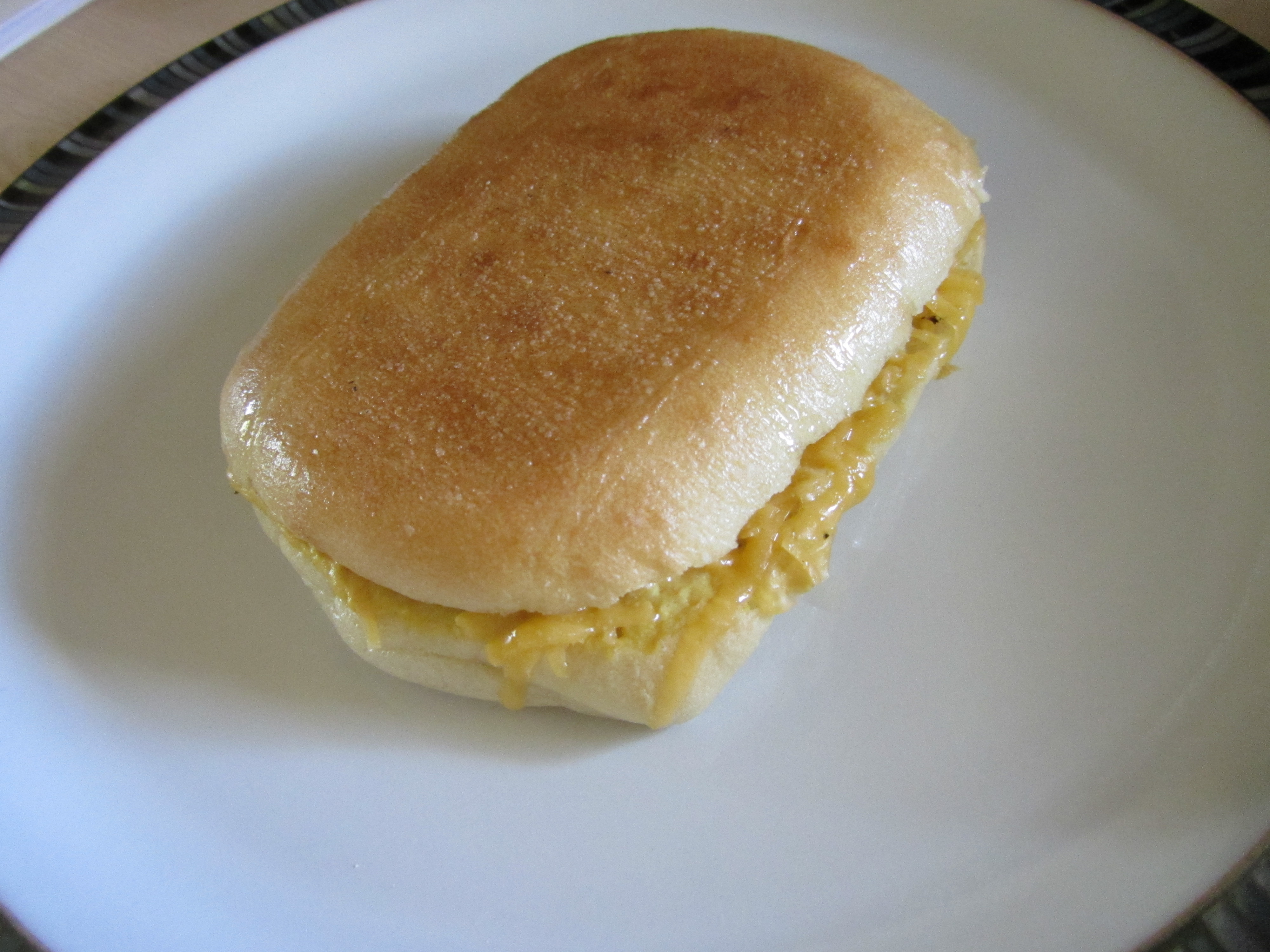
While your skillets heat, you grate a good handful of cheese (Alton uses Cheddar in the episode, so that is what I used) and spread Dijon mustard on one slice of bread. You top this with the cheese, grind some black pepper on top, and put the lid on your sandwich.

Mustard on the bread.

Mustard on the bread.

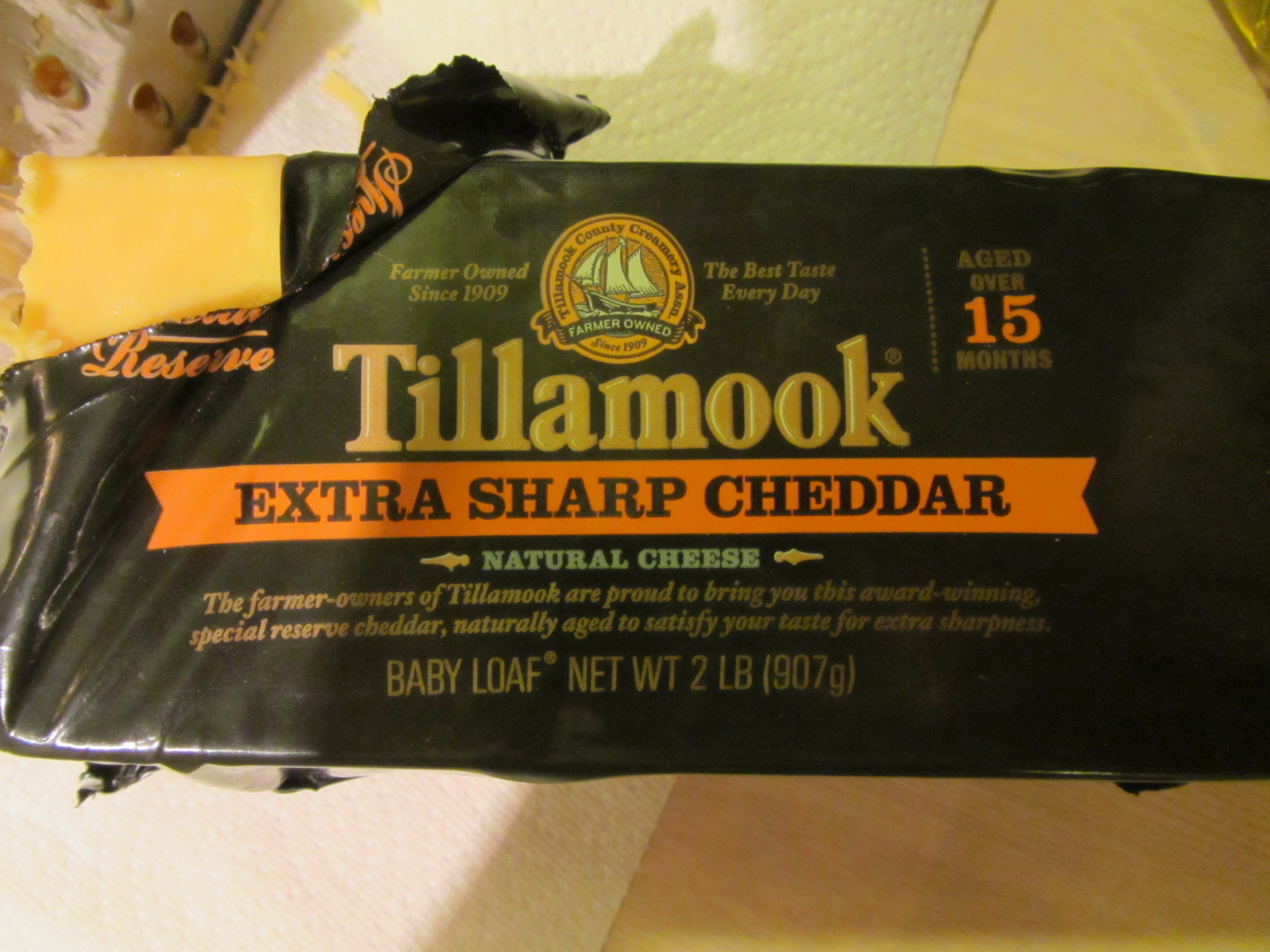
Extra sharp Cheddar.

Extra sharp Cheddar.

Cheese on the mustard-coated bread.

Cheese on the mustard-coated bread.

And some ground pepper.

And some ground pepper.

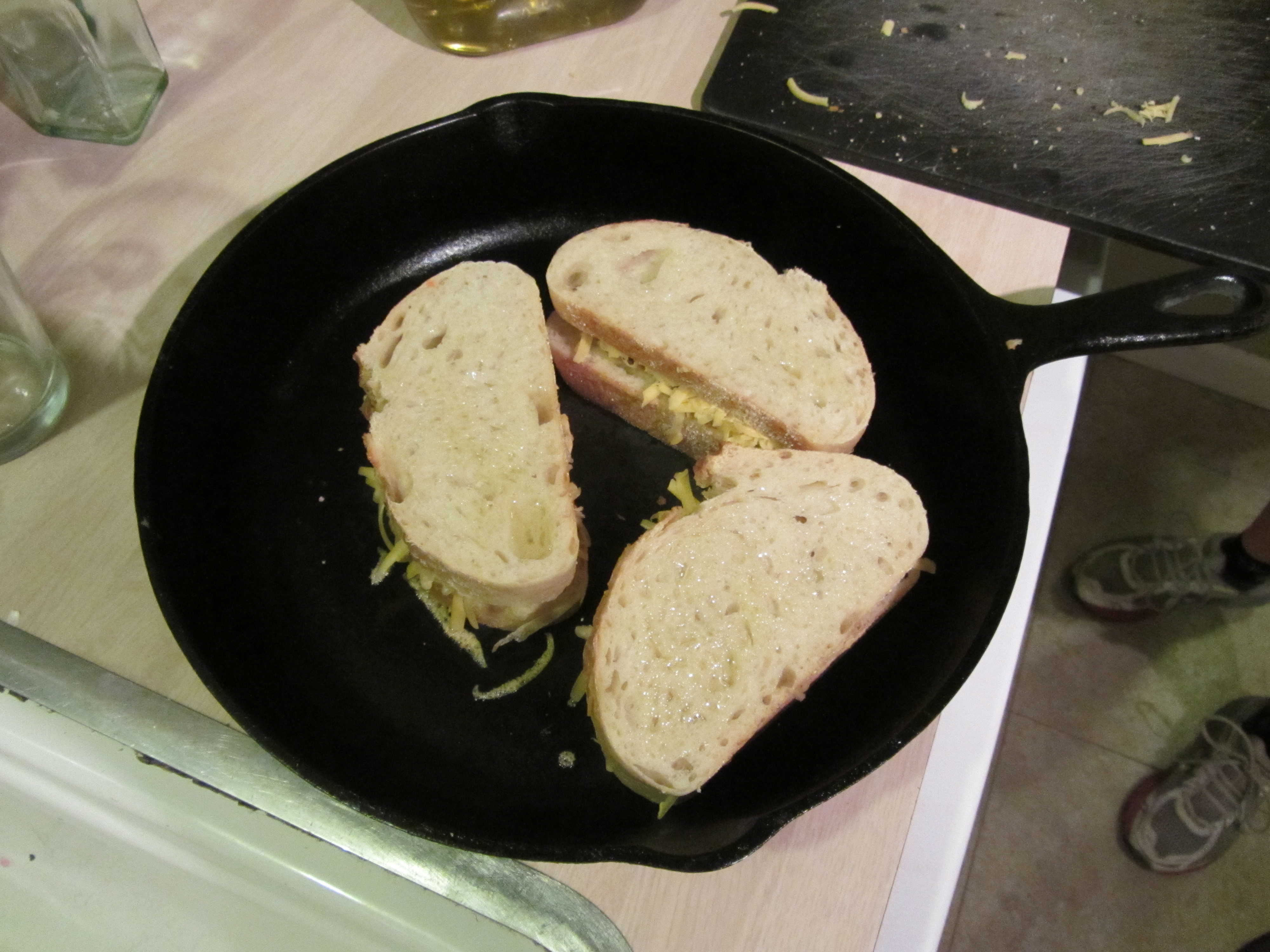
You then spritz olive oil onto the outer sides of the sandwich and onto the bottom of the smaller skillet. You remove the pans from the heat, place your sandwich in the larger skillet, and put the smaller skillet on top. In about three minutes, you should have the perfect grilled cheese sandwich.

Into the skillet, after being coated with olive oil.

Into the skillet, after being coated with olive oil.

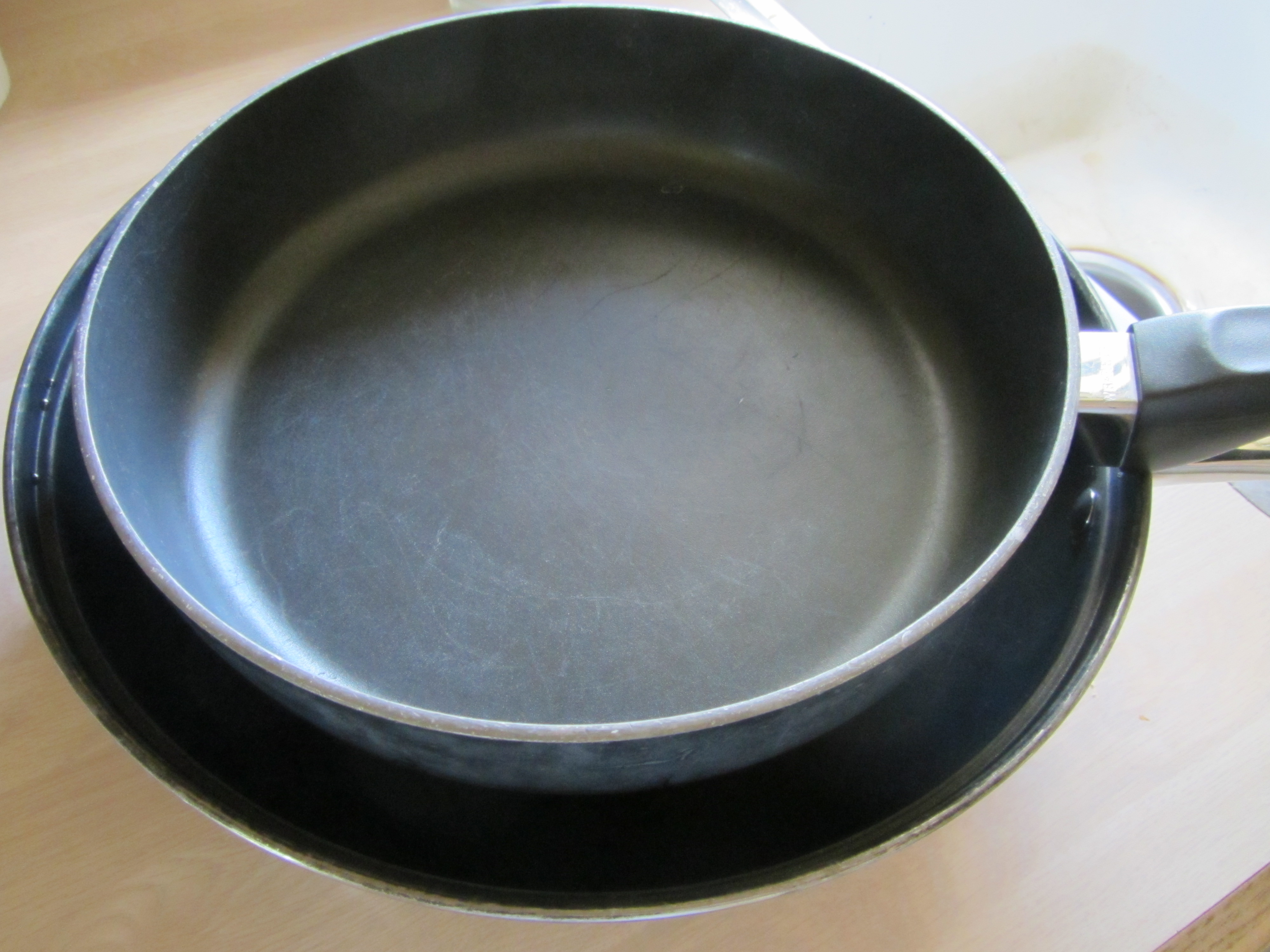
Nesting skillets.

Nesting skillets.

Nesting skillets.

Nesting skillets.

I have liked all of the recipes that I have prepared from Good Eats… until now. This recipe was just a complete flop for me. My skillets ended up being way too hot, and quickly burned the outside of my sandwich, and I did not actually turn the heat on under the skillets until I was completely ready to assemble my sandwich. I ended up throwing my sandwich away. Frustrated, and irritated to waste aged extra sharp Cheddar cheese, I opted to wait to try again another day. I tried this method again a few days later, opting for non-stick skillets this time, and heating them over lower heat for less time.

Bread with mustard.

Bread with mustard.

Bread with mustard and pepper.

Bread with mustard and pepper.

Bread with mustard, pepper, and cheese.

Bread with mustard, pepper, and cheese.

Oiled sandwich.

Oiled sandwich.

Nestled skillets.

Nestled skillets.

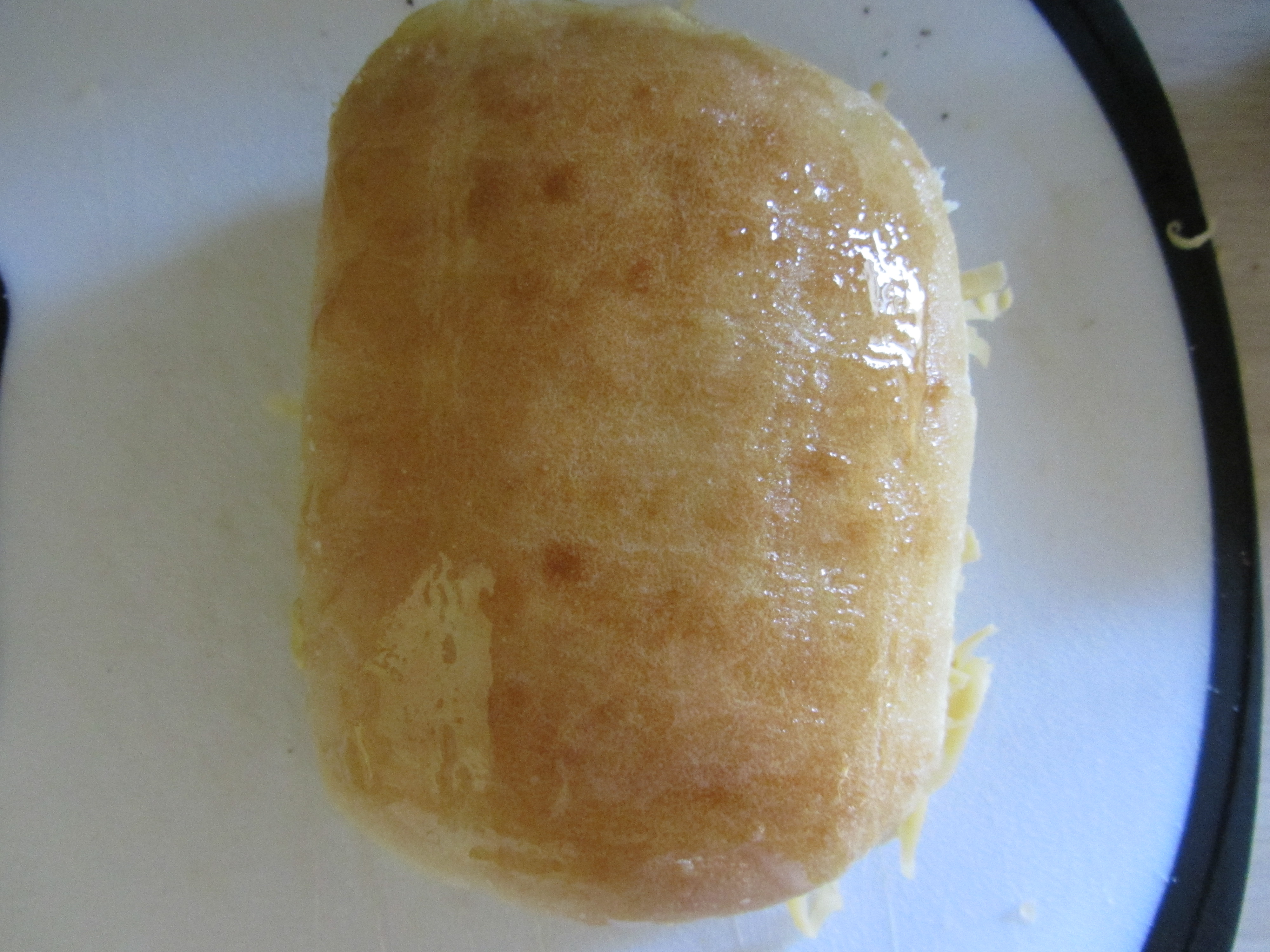
Guess what? This time, the skillets were not hot enough, so the outside of the sandwich got slightly browned, but the cheese was not thoroughly melted. Great.

Sandwich from skillets that were not hot enough.

Sandwich from skillets that were not hot enough.

I had to place them back over the heat and do it a second time. And, in that amount of time, I could have already eaten a perfectly good grilled cheese sandwich made the old-fashioned way. I will say that I liked the sandwich made with Dijon mustard and black pepper, though I had discovered that I liked the addition of mustard on my own a while ago. I will not be making a grilled cheese sandwich this way again. There is a reason that people have been making grilled cheese sandwiches the same way for years – because it works.

Free Range Fruitcake

The second season of Good Eats begins with Alton’s take on fruitcake. I don’t know about you, but when I think of fruitcake, I envision a cloyingly sweet, dense brick of a cake, filled with sticky globs of artificially bright, candied, green and red cherries. My mom says that she used to make fruitcake, though I never remember having hers. Due to the fact that I have not particularly adored the fruitcakes I have tasted in the past, it is not something I consume frequently, or even occasionally. In fact, I couldn’t tell you the last time I had fruitcake prior to making this recipe of Alton’s. I was excited for this one, as I was pretty confident I would like the resulting cake.

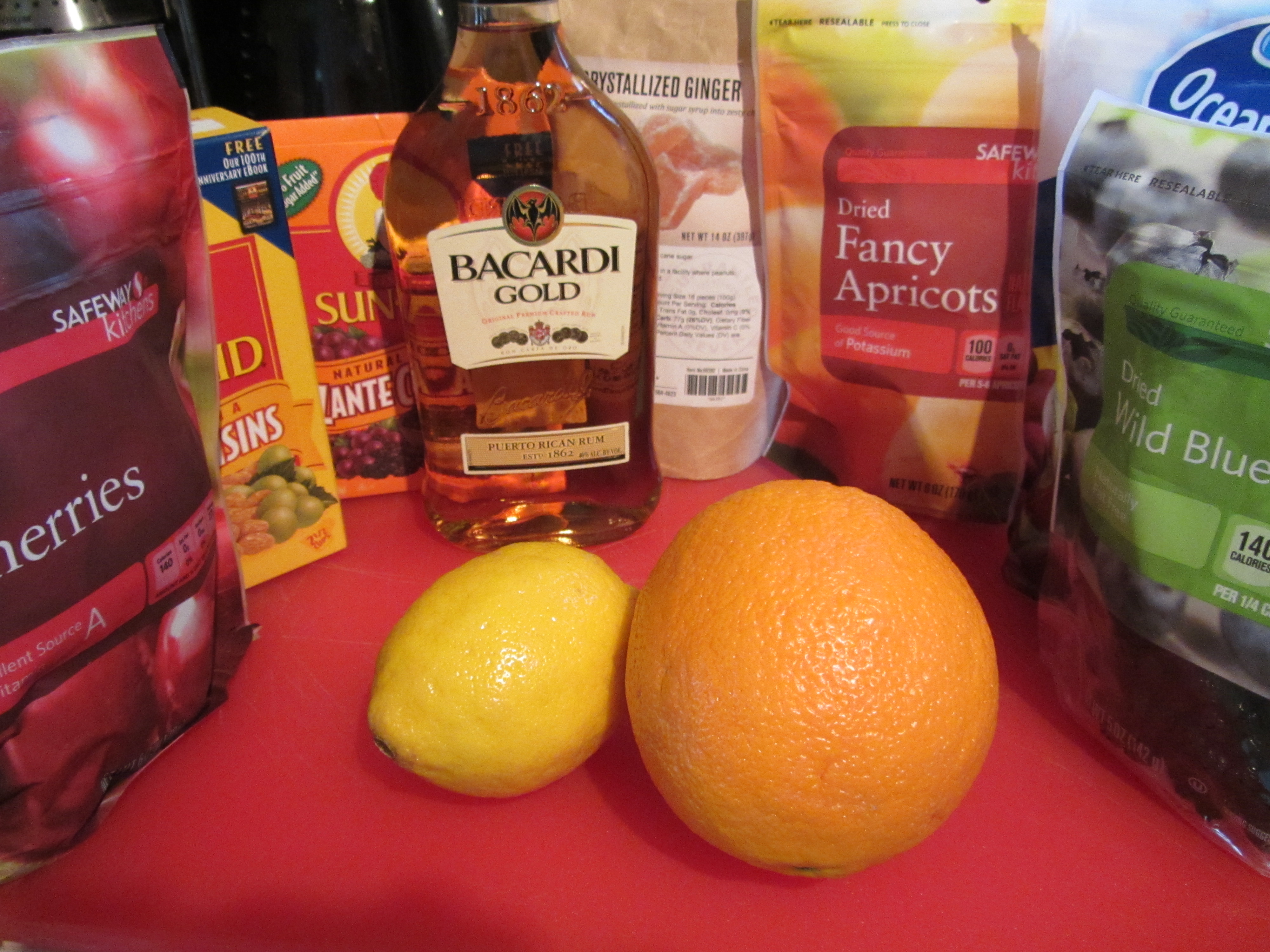
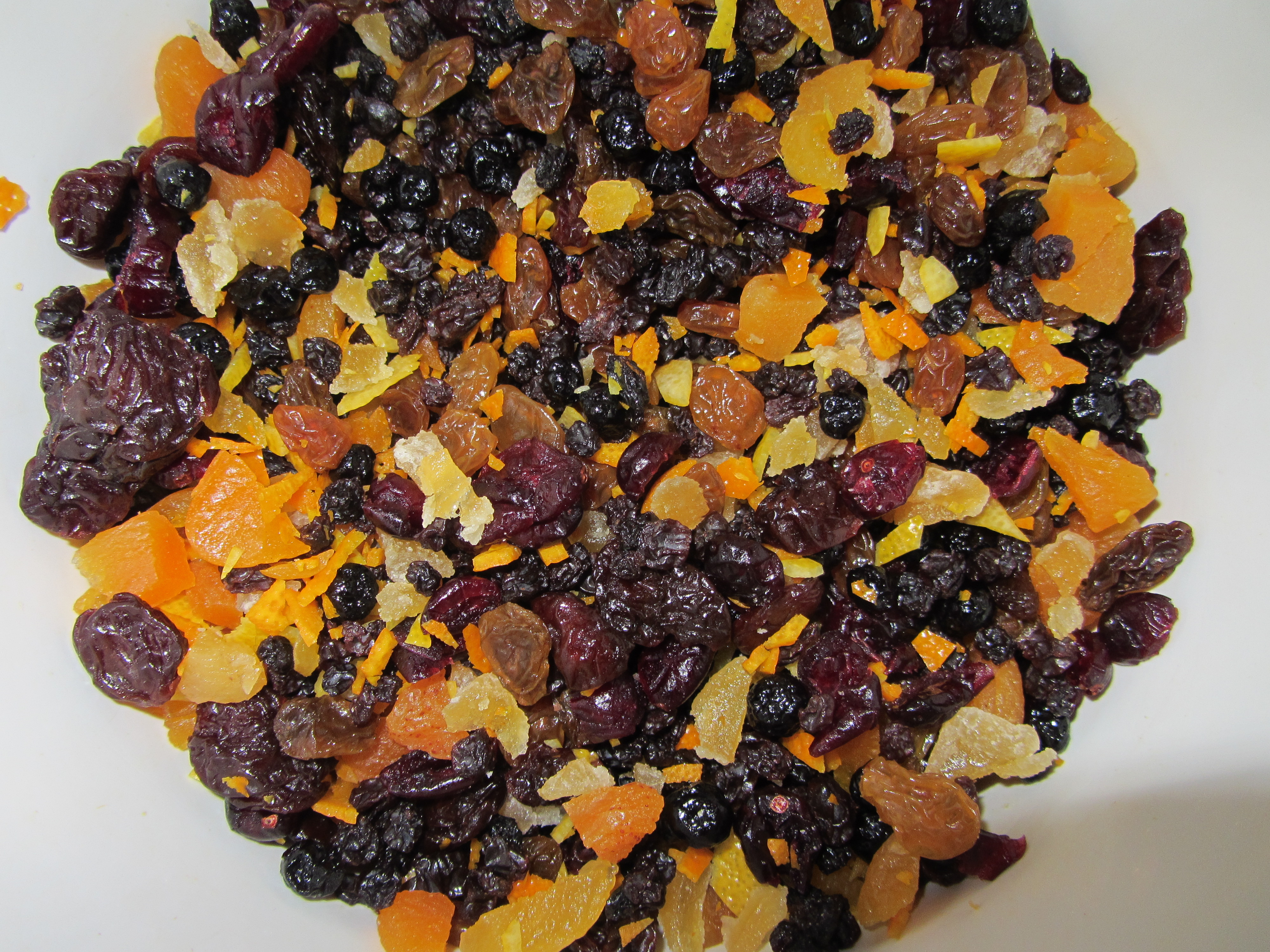
Alton’s fruitcake recipe begins with macerating in rum a plethora of dried fruit (golden raisins, currants, cranberries, blueberries, cherries, & apricots), along with lemon zest, orange zest, and candied ginger.

Ready to macerate.

Ready to macerate.

Golden raisins, currants, dried cranberries, dried blueberries, dried cherries, dried apricots, lemon zest, orange zest, and candied ginger.

Golden raisins, currants, dried cranberries, dried blueberries, dried cherries, dried apricots, lemon zest, orange zest, and candied ginger.

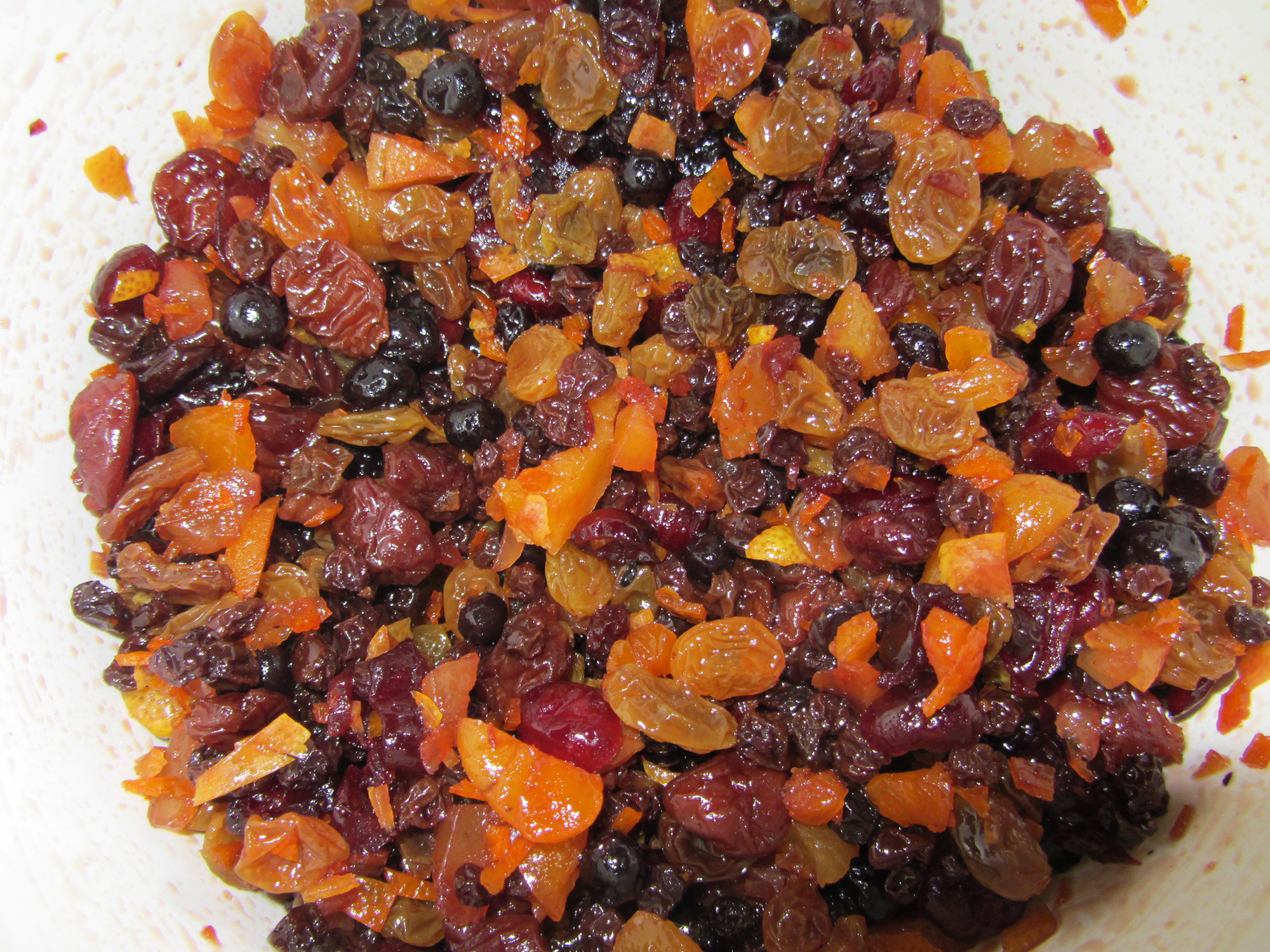
Soaking the fruit in the rum.

Soaking the fruit in the rum.

Ideally, you are to let the fruit sit overnight, though Alton says you can microwave the fruit and rum for 5 minutes, if you are short on time. I took the time to soak my fruit overnight, as I knew the result would be much better that way. Sure enough, the fruit had soaked up much of the rum, and was visibly plump when I checked it the next morning.

Fruit after soaking overnight.

Fruit after soaking overnight.

The next step was to toast my pecans. Though Alton recommends using freshly shelled nuts, my grocery store did not have pecans in the shell, so I bought the pre-shelled variety. I toasted them for 15 minutes at 300 degrees, just as Alton specifies in the episode.

Toasted pecans.

Toasted pecans.

Next, I ground some whole cloves and allspice berries in my mortar and pestle, and I added this to a large pot with my macerated fruit.

Allspice and cloves.

Allspice and cloves.

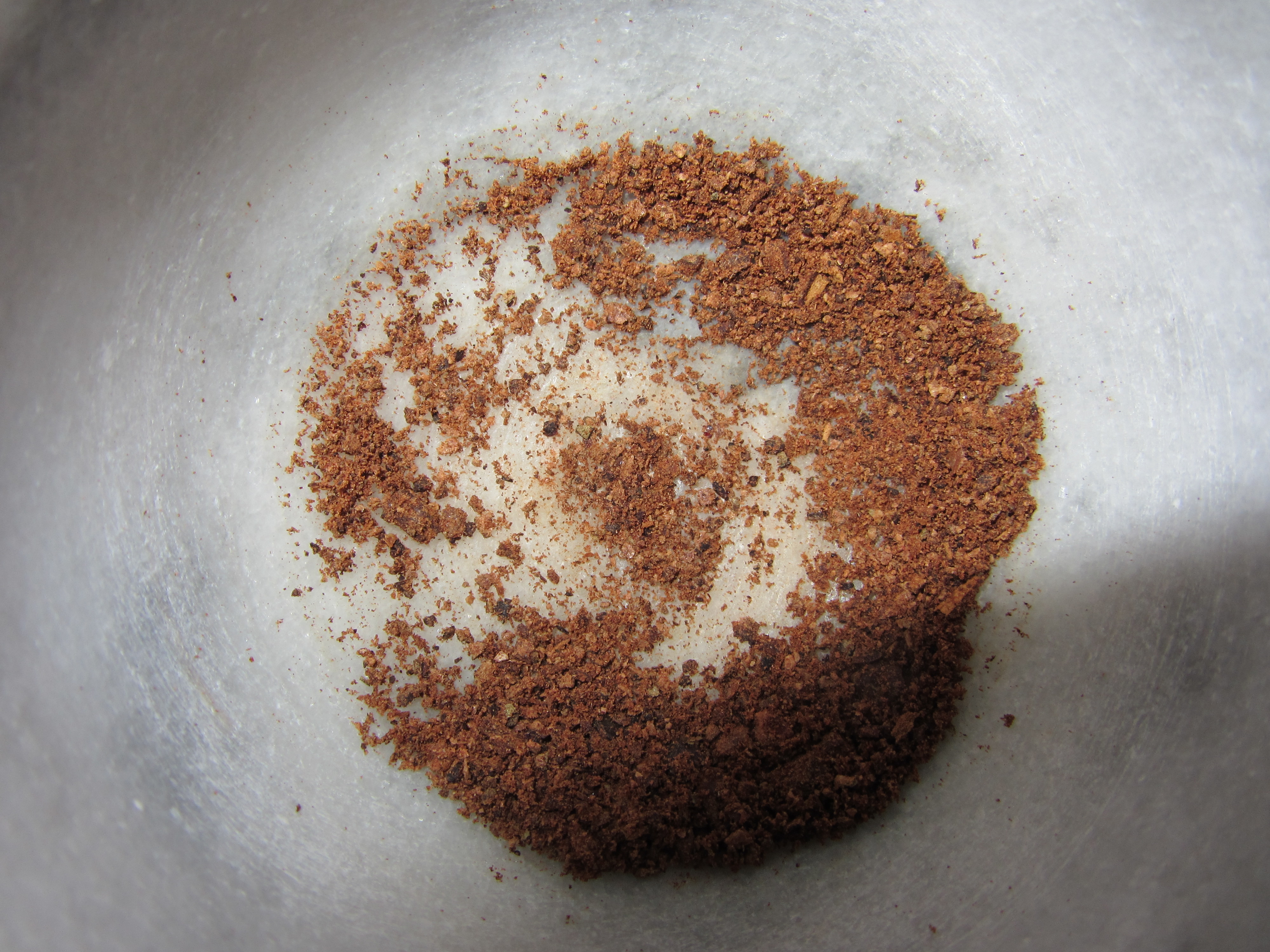
Ground allspice and cloves.

Ground allspice and cloves.

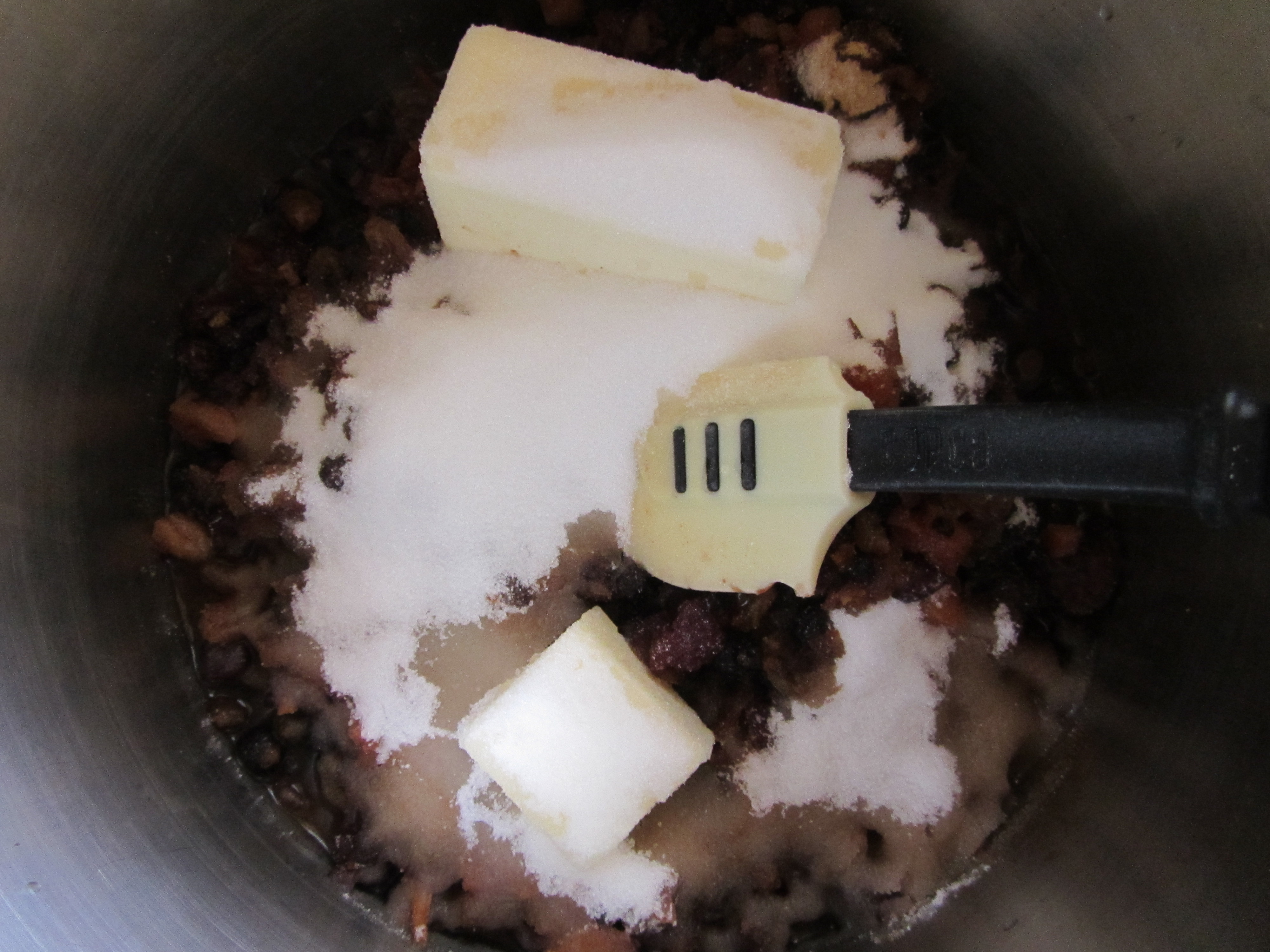
To this mixture, I added cinnamon, ginger, butter, apple cider (the recipe calls for unfiltered apple juice), and sugar.

Macerated fruit, spices, butter, sugar, and juice.

Macerated fruit, spices, butter, sugar, and juice.

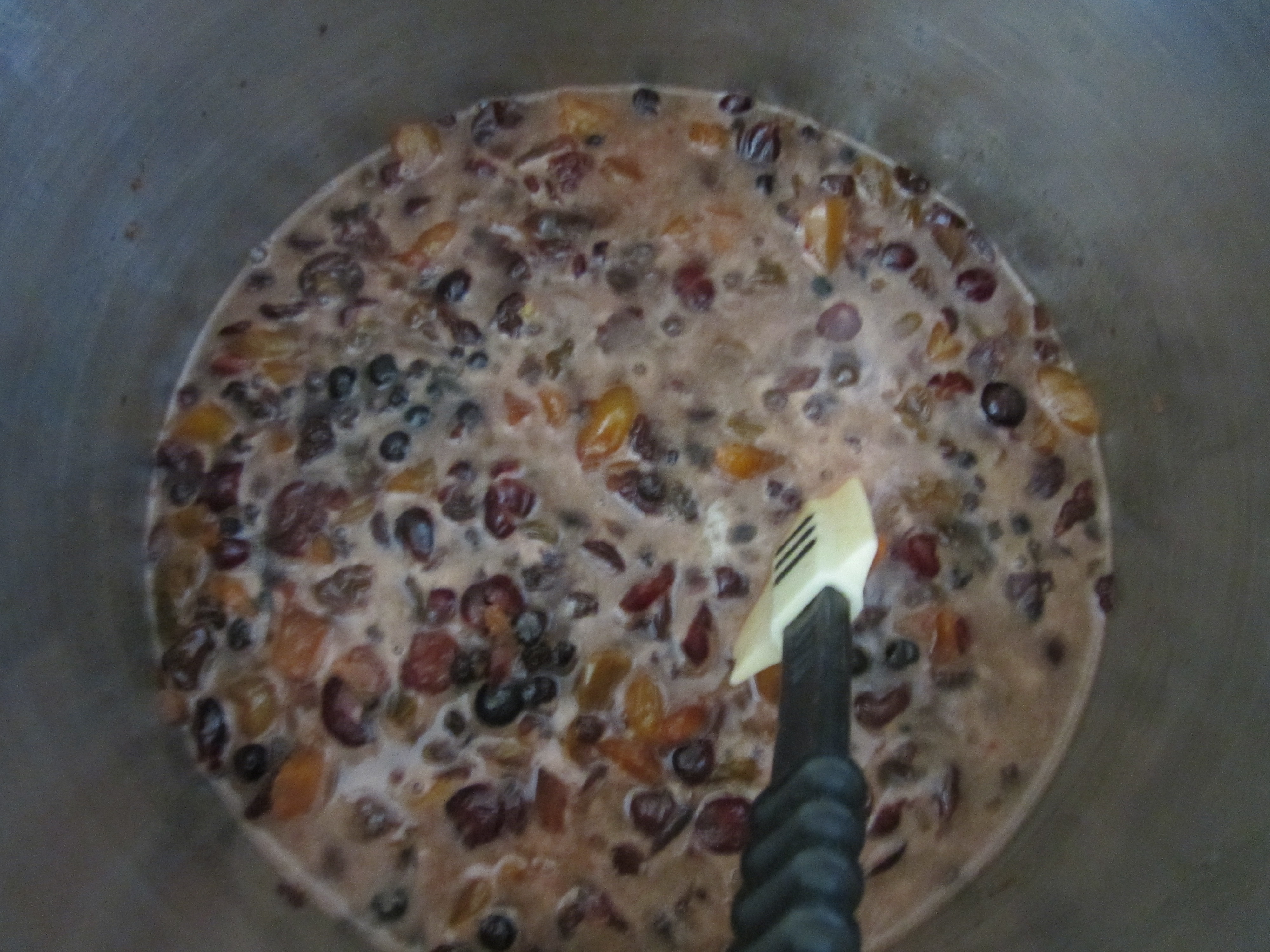
I brought my mixture to a boil, decreased the heat, and simmered it for a good 15 minutes. Alton then tells you to let this mixture cool for ~15 minutes.

The whole fruit mixture.

The whole fruit mixture.

After simmering.

After simmering.

Once cool, you sift in your dry ingredients, stirring quickly to avoid incorporating a lot of air into the batter.

Dry ingredients sifted in.

Dry ingredients sifted in.

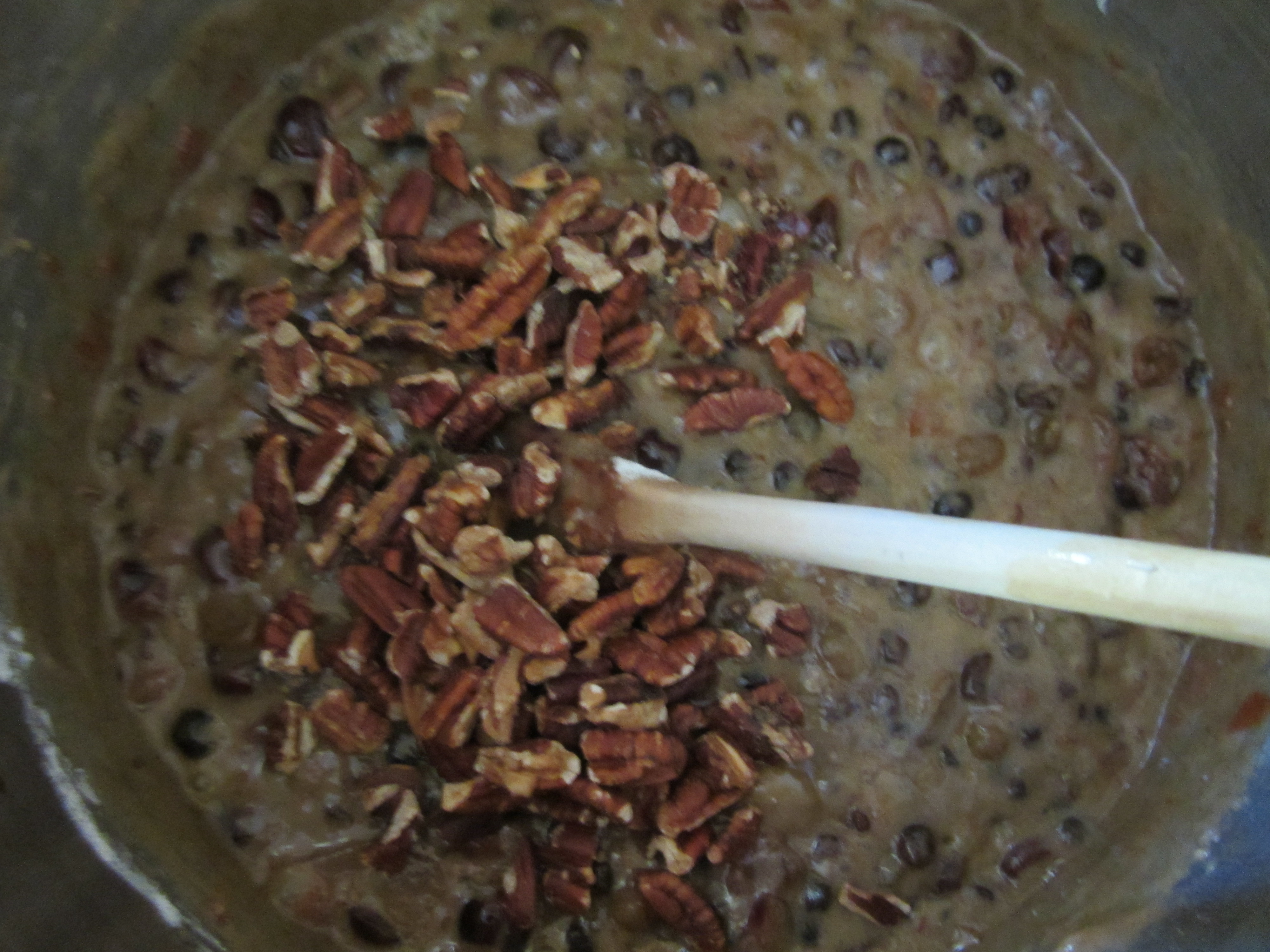
Two eggs are added, one at a time, followed by the toasted pecans, and the batter goes into a loaf pan.

Folding in the pecans.

Folding in the pecans.

Batter into the pan.

Batter into the pan.

One tip Alton mentions in the episode (that is not mentioned in the online recipe) is to place a pan of hot water on the oven rack below the cake while it bakes. This is to keep the top of the cake from cracking. Once the cake is done (mine took 56 minutes), you spray it with brandy and allow it to cool completely before removing it from the pan.

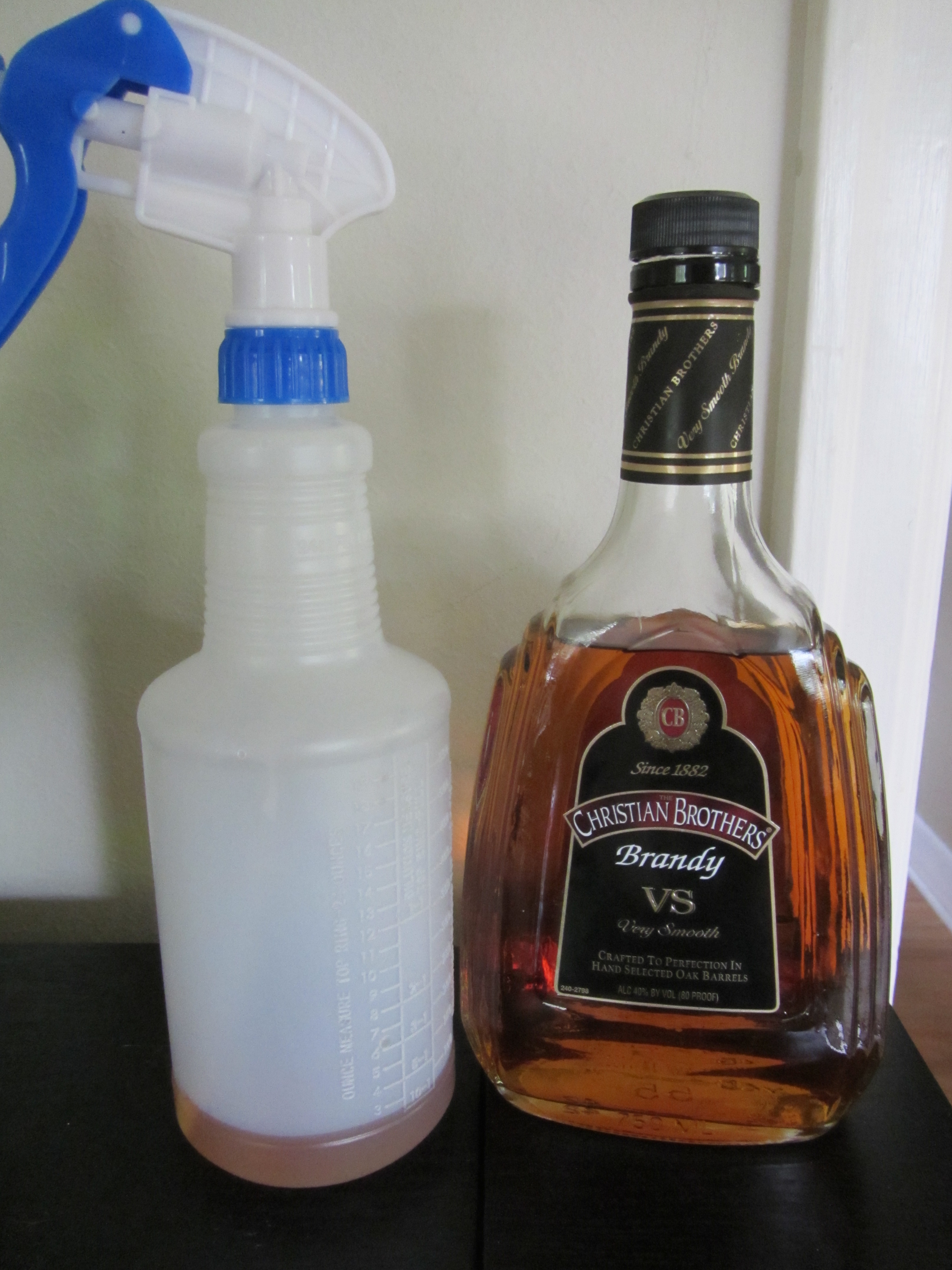
Brandy to spritz.

Brandy to spritz.

It took hours for my cake to cool completely since it was so dense and had baked for nearly an hour. Once the cake is completed, Alton tells you to store it in an airtight container, checking it every three days. If the cake is dry, you spritz it again with more brandy. The cake will keep for at least two weeks.

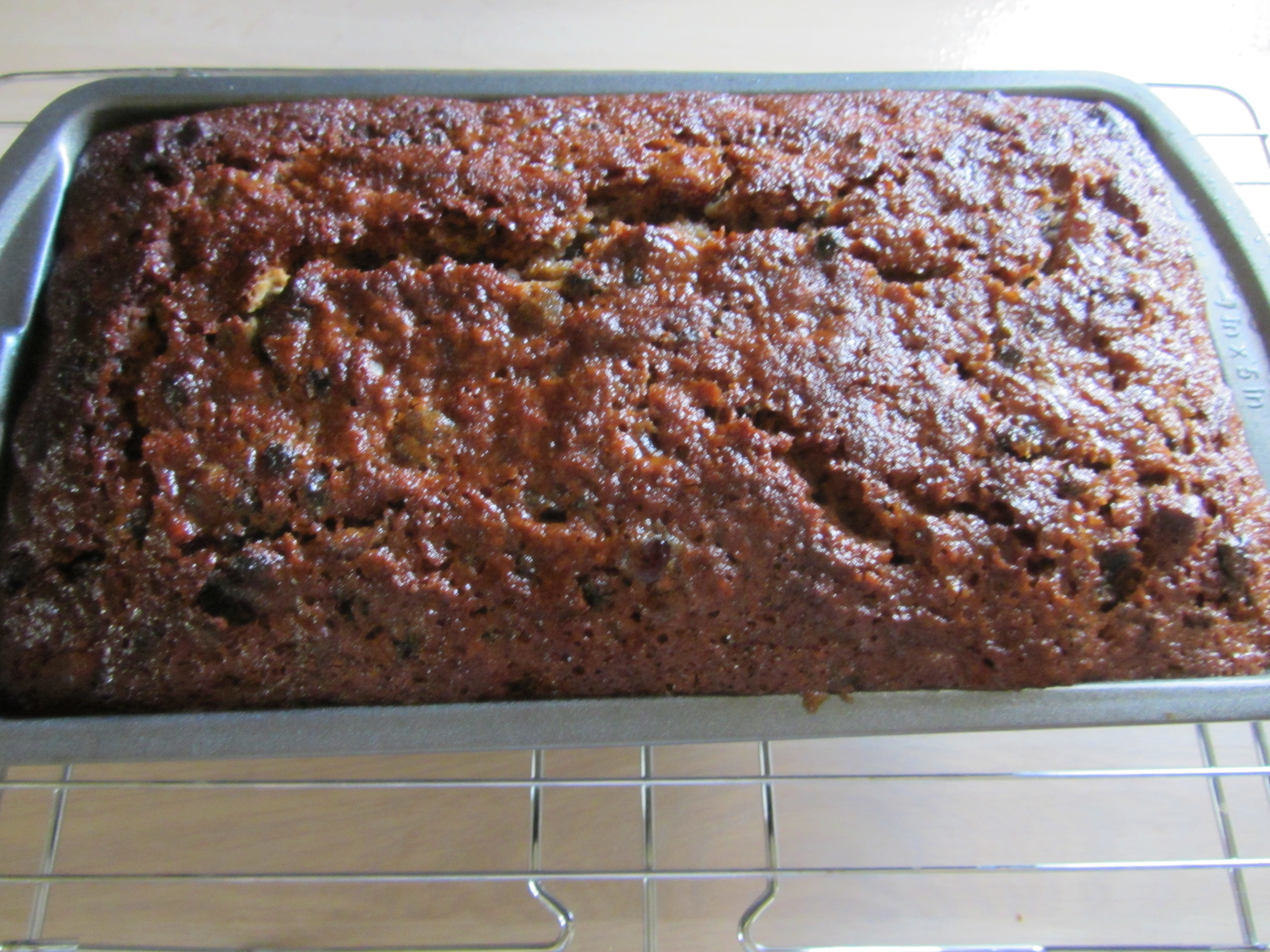
Spritzed cake right out of the oven.

Spritzed cake right out of the oven.

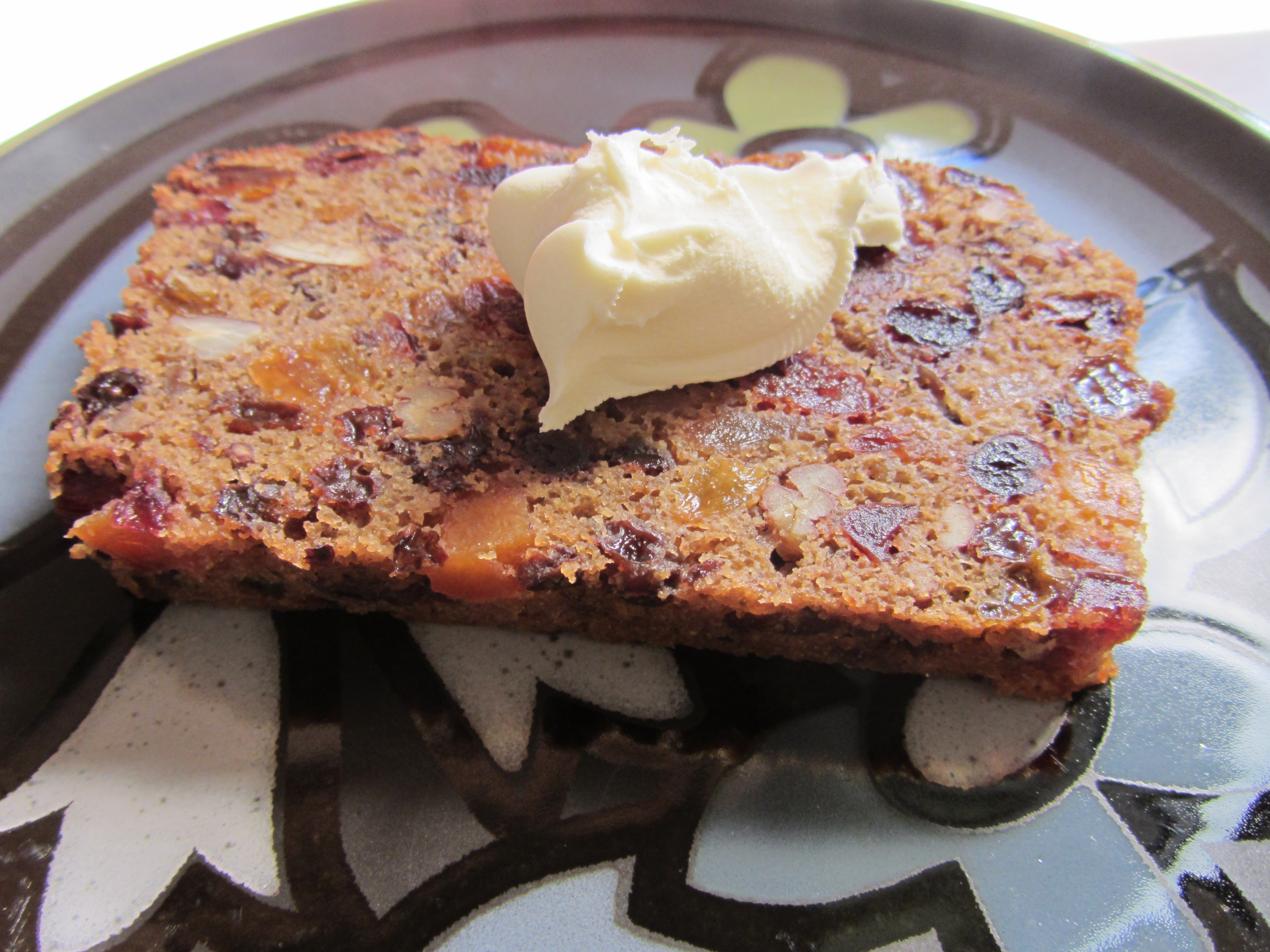
We broke into our cake the day after I made it, serving it the way Alton recommended, which was toasted and topped with mascarpone cheese. It was dense, sweet (but not overly so), super moist, and had loads of fruit flavor. It was also quite boozy!

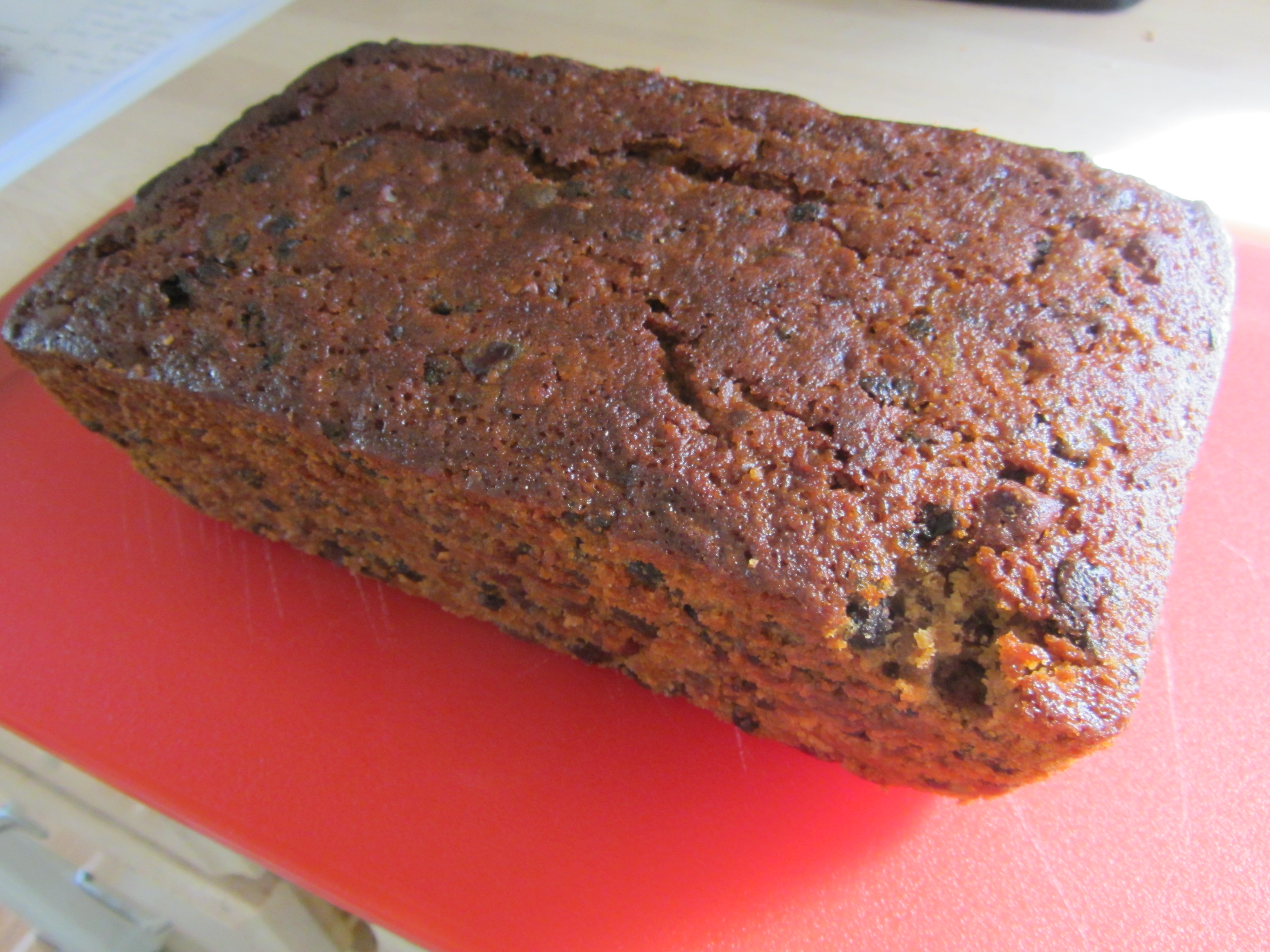
Completed cake, ready for slicing.

Completed cake, ready for slicing.

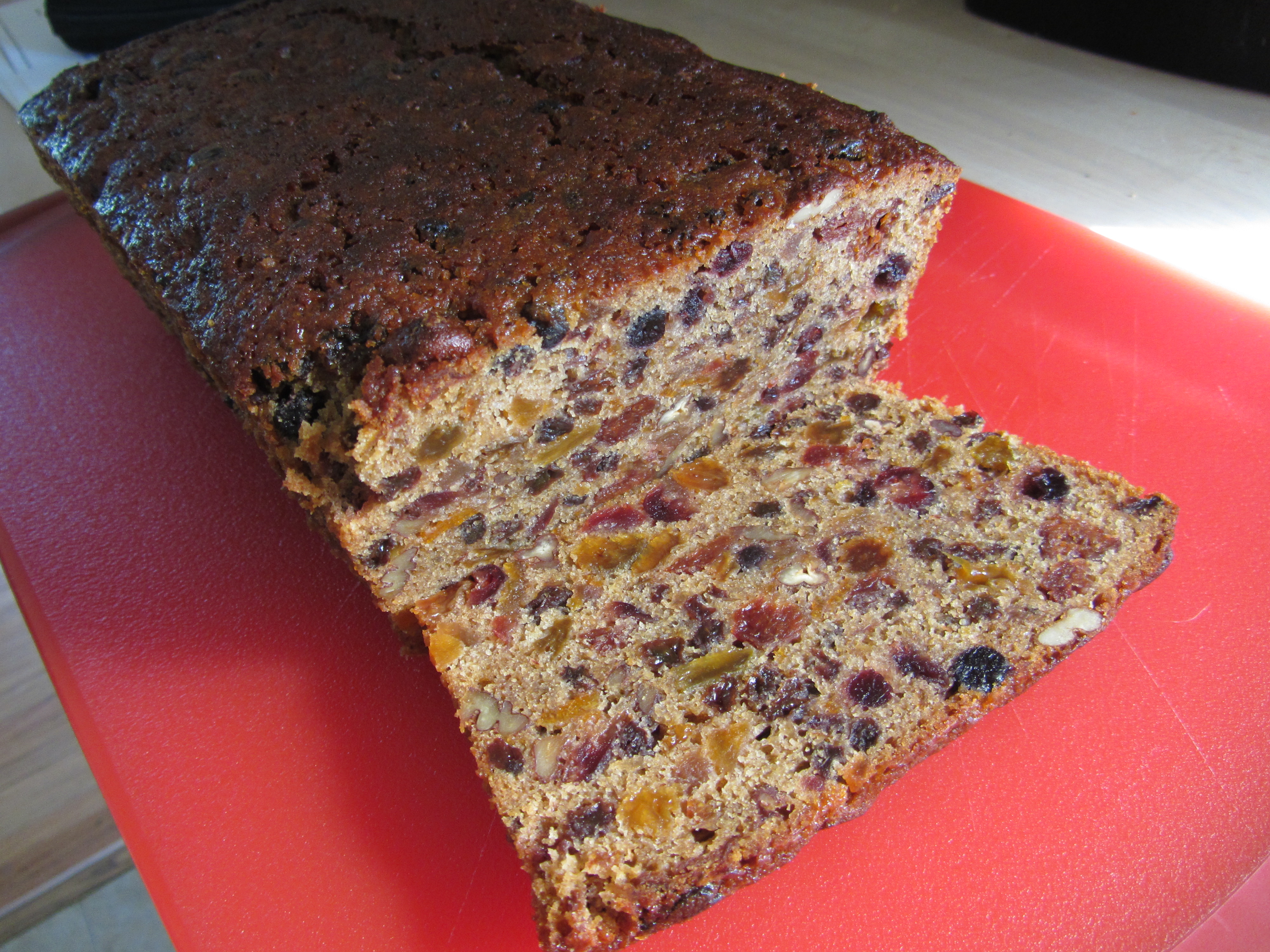
Loaded with fruit.

Loaded with fruit.

Toasted with mascarpone cheese.

Toasted with mascarpone cheese.

I shared some fruitcake with my parents also, and they both highly enjoyed it, saying they preferred it untoasted. As it sits, my cake was made 10 days ago, and we still have a hunk of it left. It has only gotten better since I first made it. This would be perfect to start a couple weeks before Christmas. I highly recommend this fruitcake recipe. It is perfect for a special occasion, and would also make a nice holiday gift, especially if you made it in mini loaf pans.


Chocolate Mousse

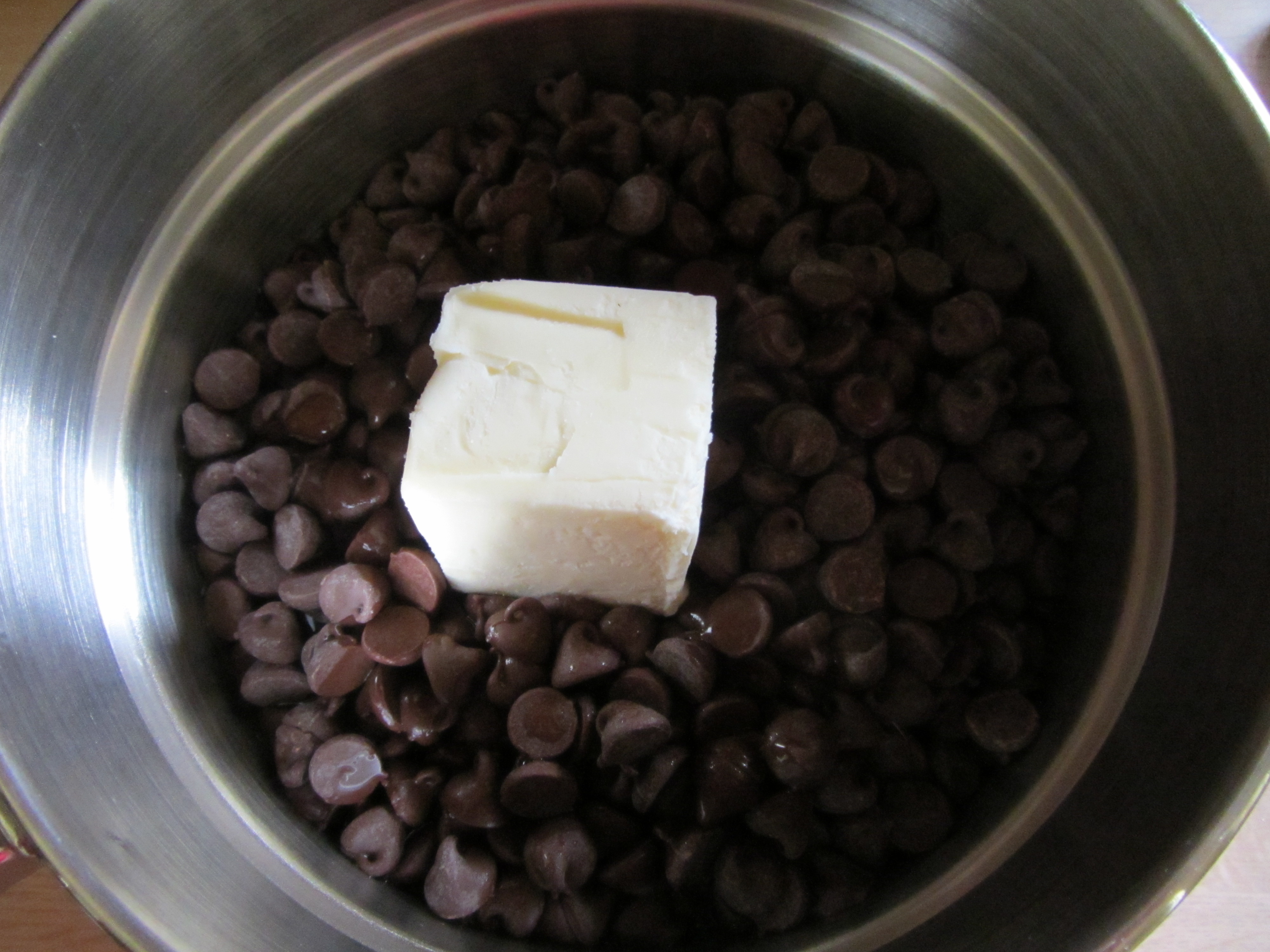
Because I am human, I could not help but be excited for the recipes in the 13th Good Eats episode. I mean, who doesn’t like chocolate? The first recipe Alton conquers in the episode is his Chocolate Mousse. With a short prep time, and only six ingredients, this is a dessert that is fit to be made anytime. You start by combining semi-sweet chocolate chips, a pinch of Kosher salt (guess this makes it seven ingredients), espresso, dark rum, and butter in a double boiler.

Chocolate chips, butter, salt, espresso, and rum.

Chocolate chips, butter, salt, espresso, and rum.

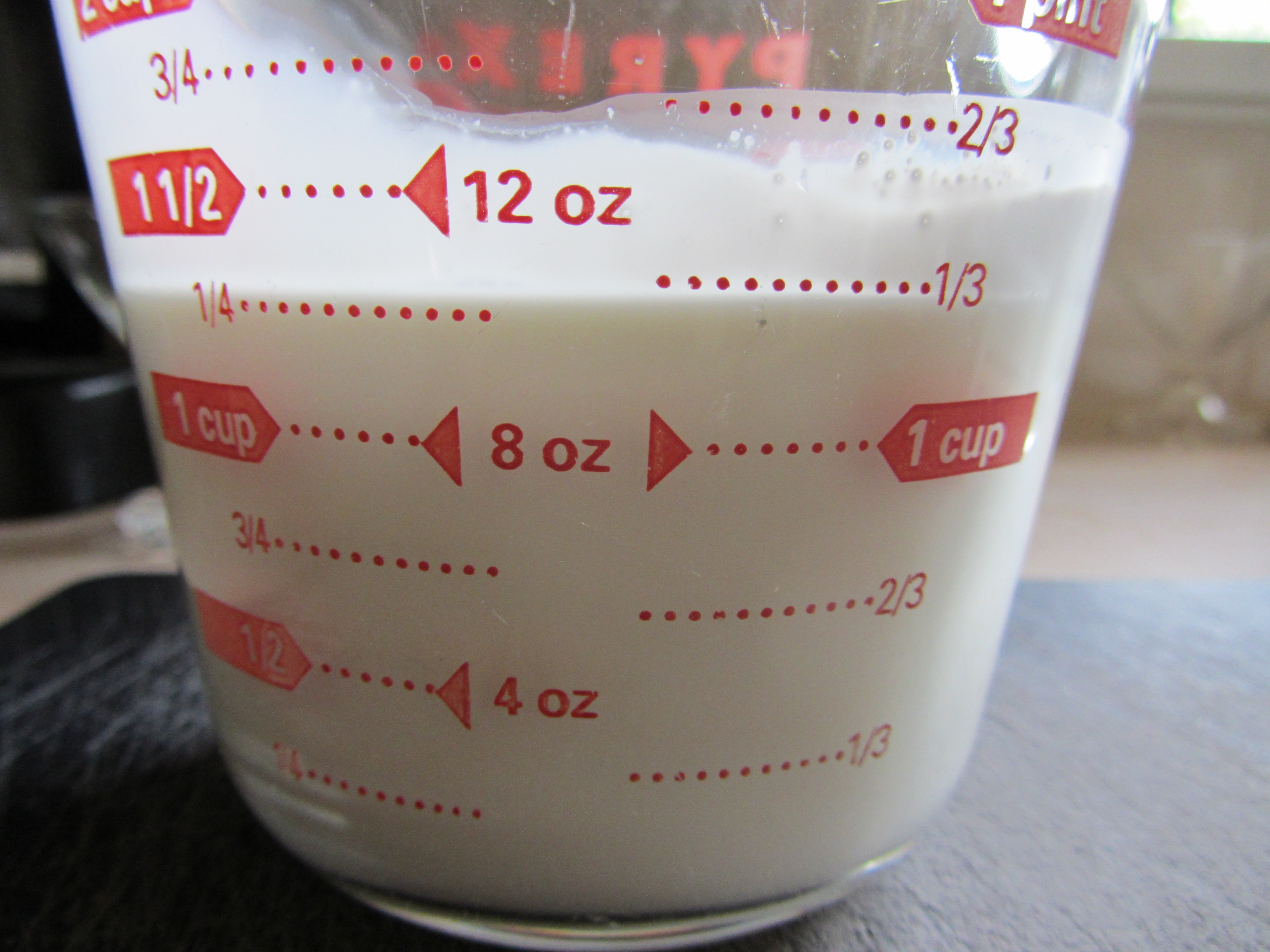
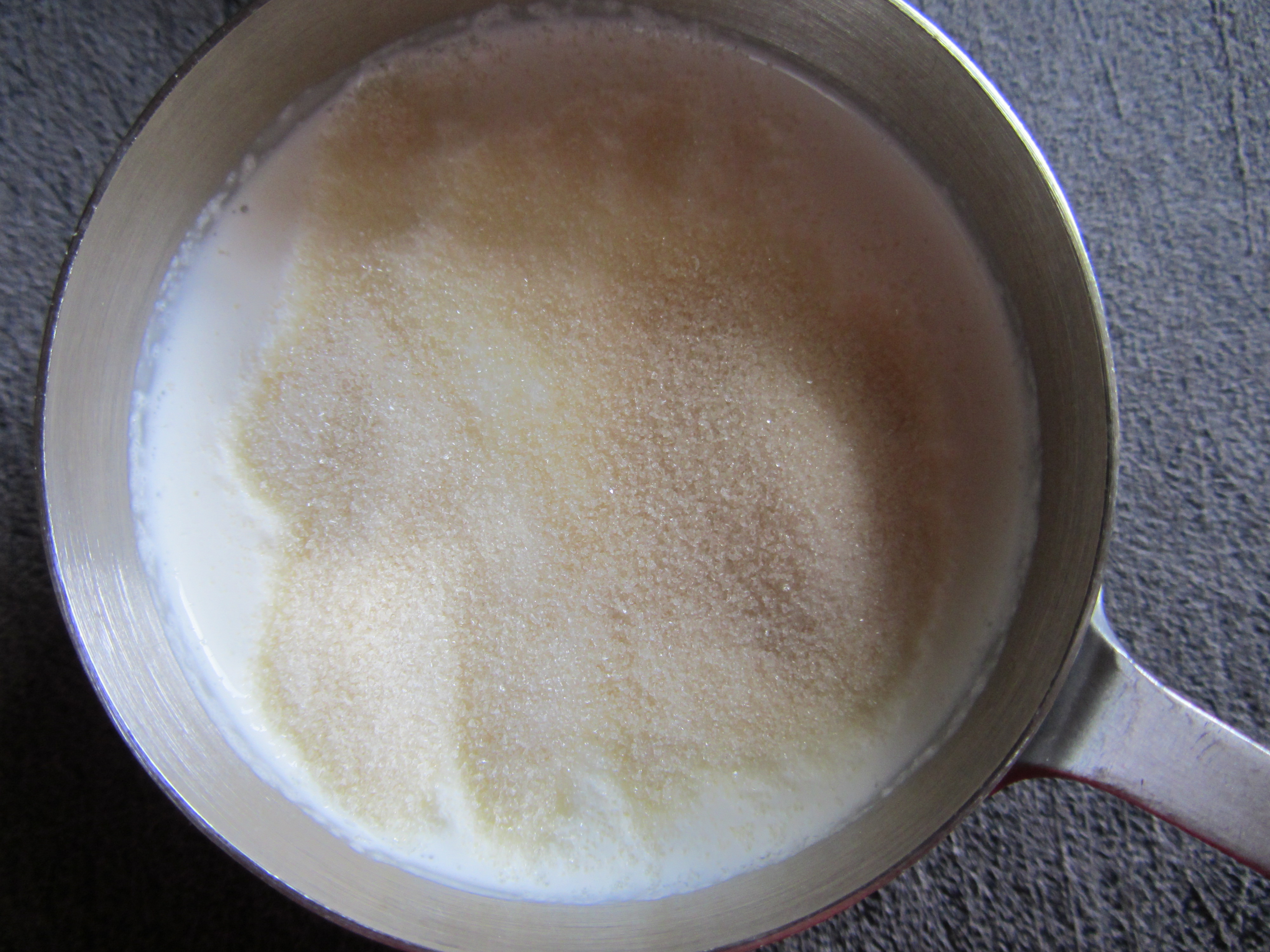
While the chocolate is melting, you measure 1 1/2 C of heavy cream in a liquid measuring cup, pouring a couple of ounces of this into a metal measuring cup. Note:  The online recipe calls for a total of 1 3/4 C of cream, while Alton uses a total of 1 1/2 C in the episode. I went with the 1 1/2 C of cream, per the episode.

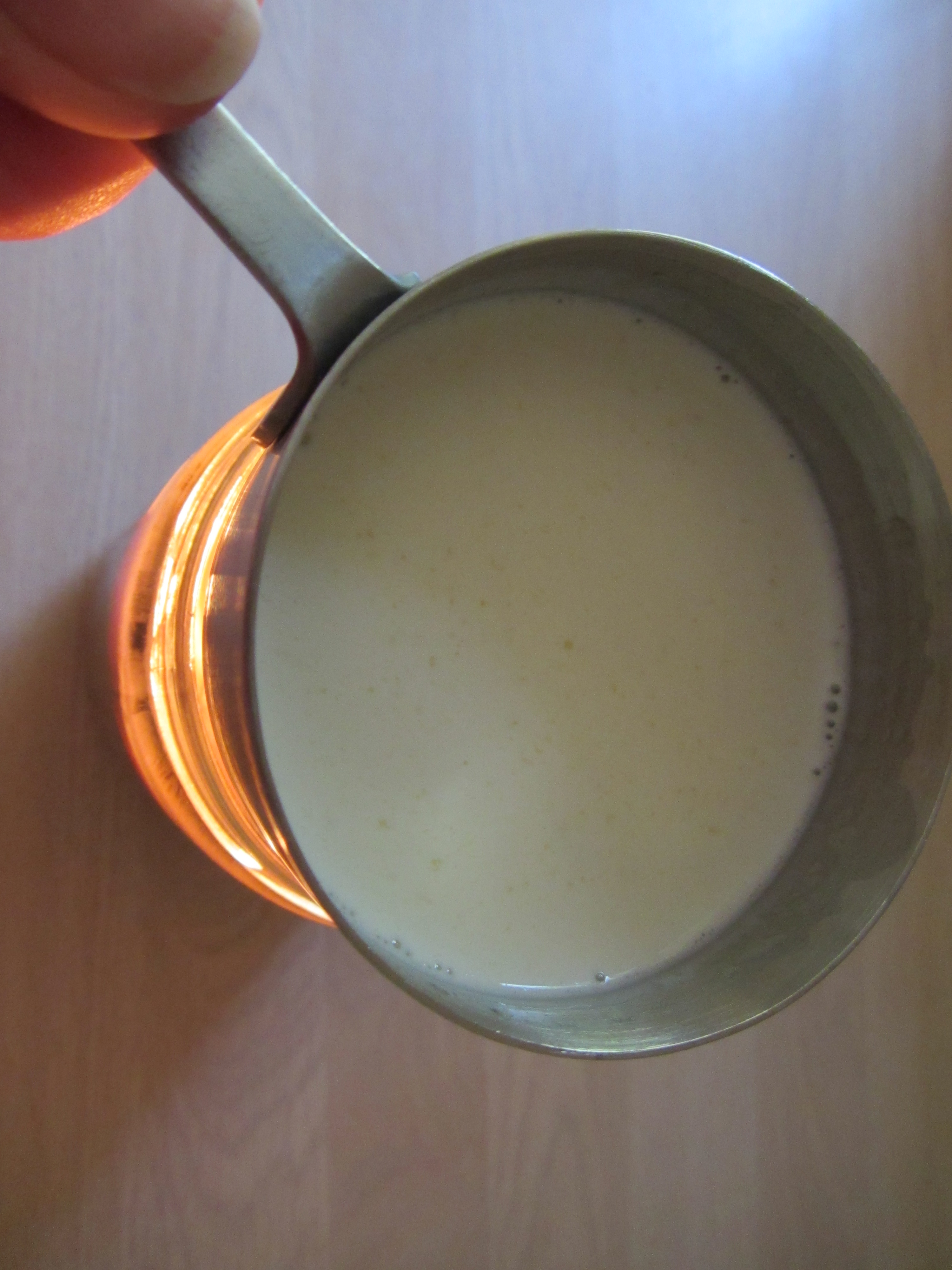
Heavy cream.

Heavy cream.

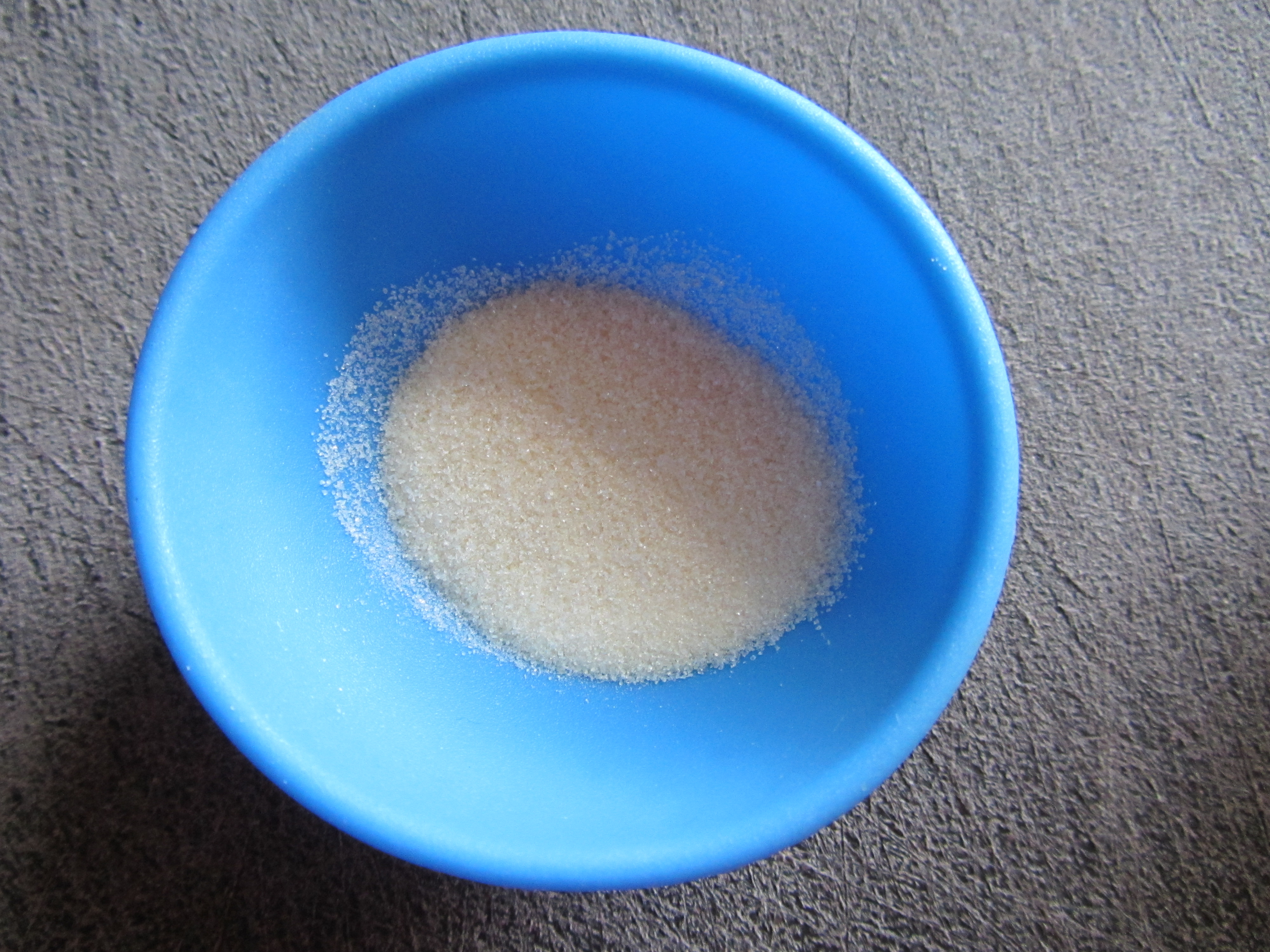
You want to keep the cream in the liquid measuring cup chilled. To the cream in the metal measuring cup, you add some gelatin, and allow it to sit at room temperature for about 10 minutes.

Gelatin.

Gelatin.

Gelatin bloomin in some of the cream.

Gelatin blooming in some of the cream.

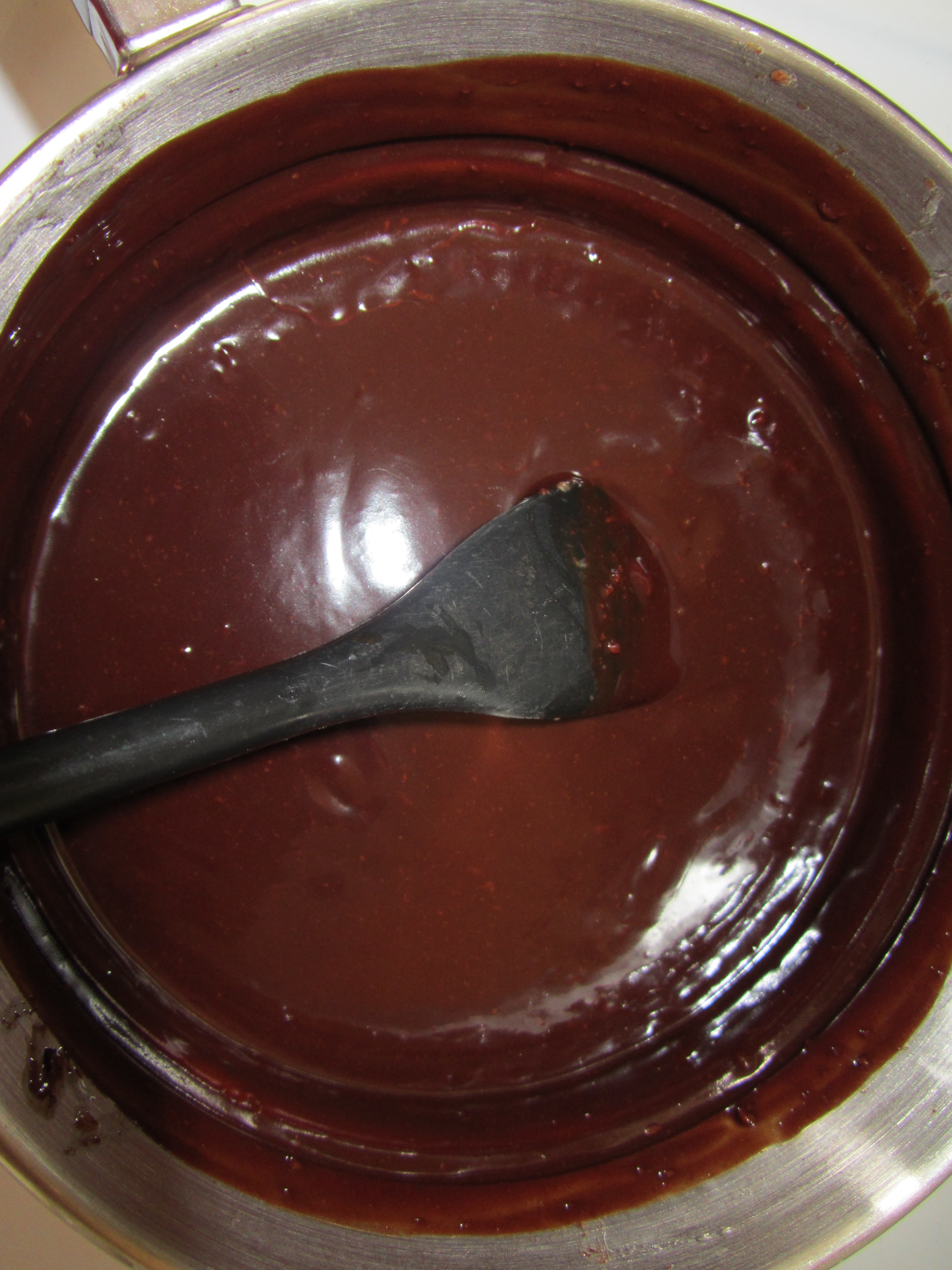
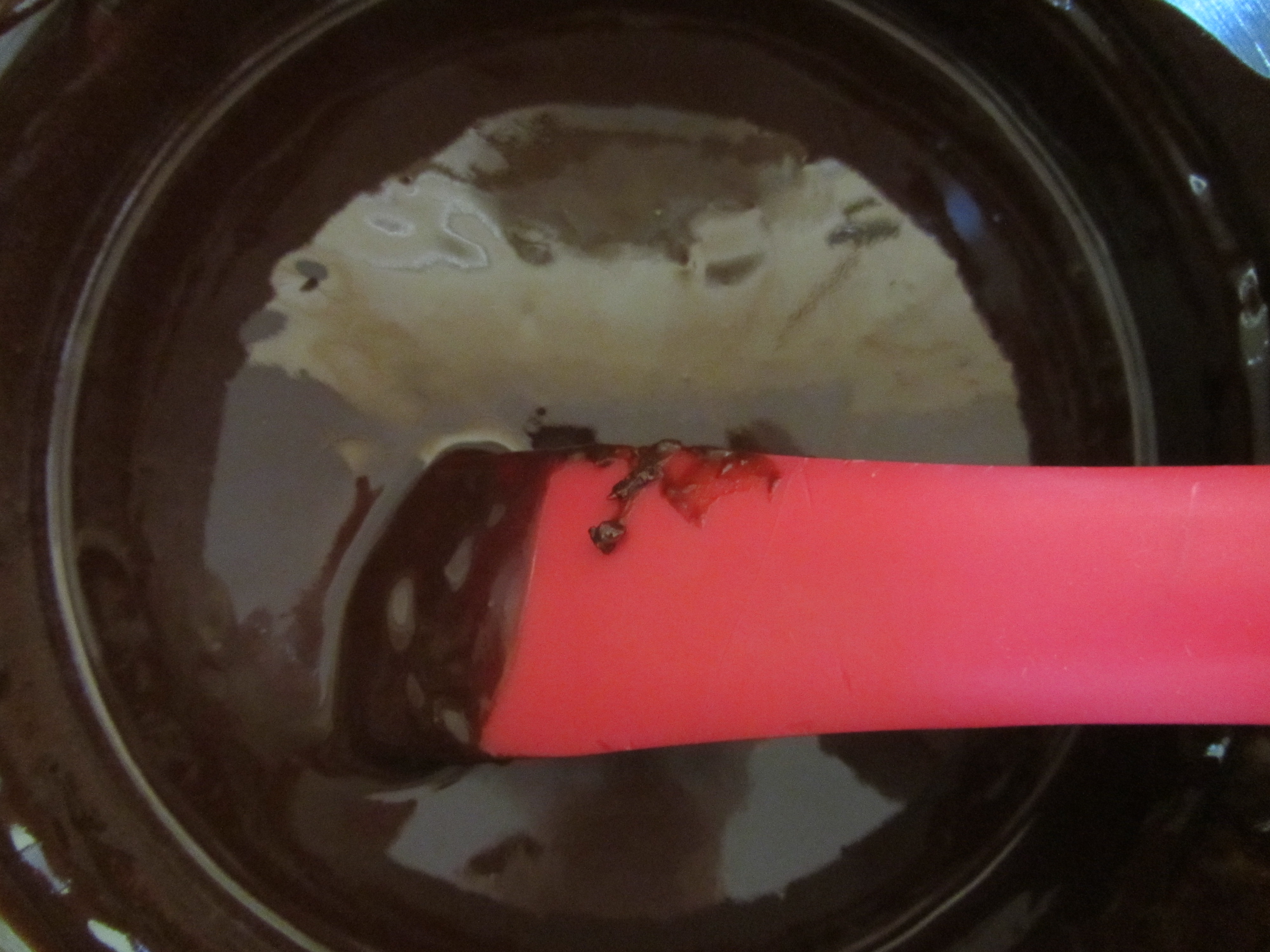
By this time, your chocolate mixture should be melted, and you want to remove it from the heat.

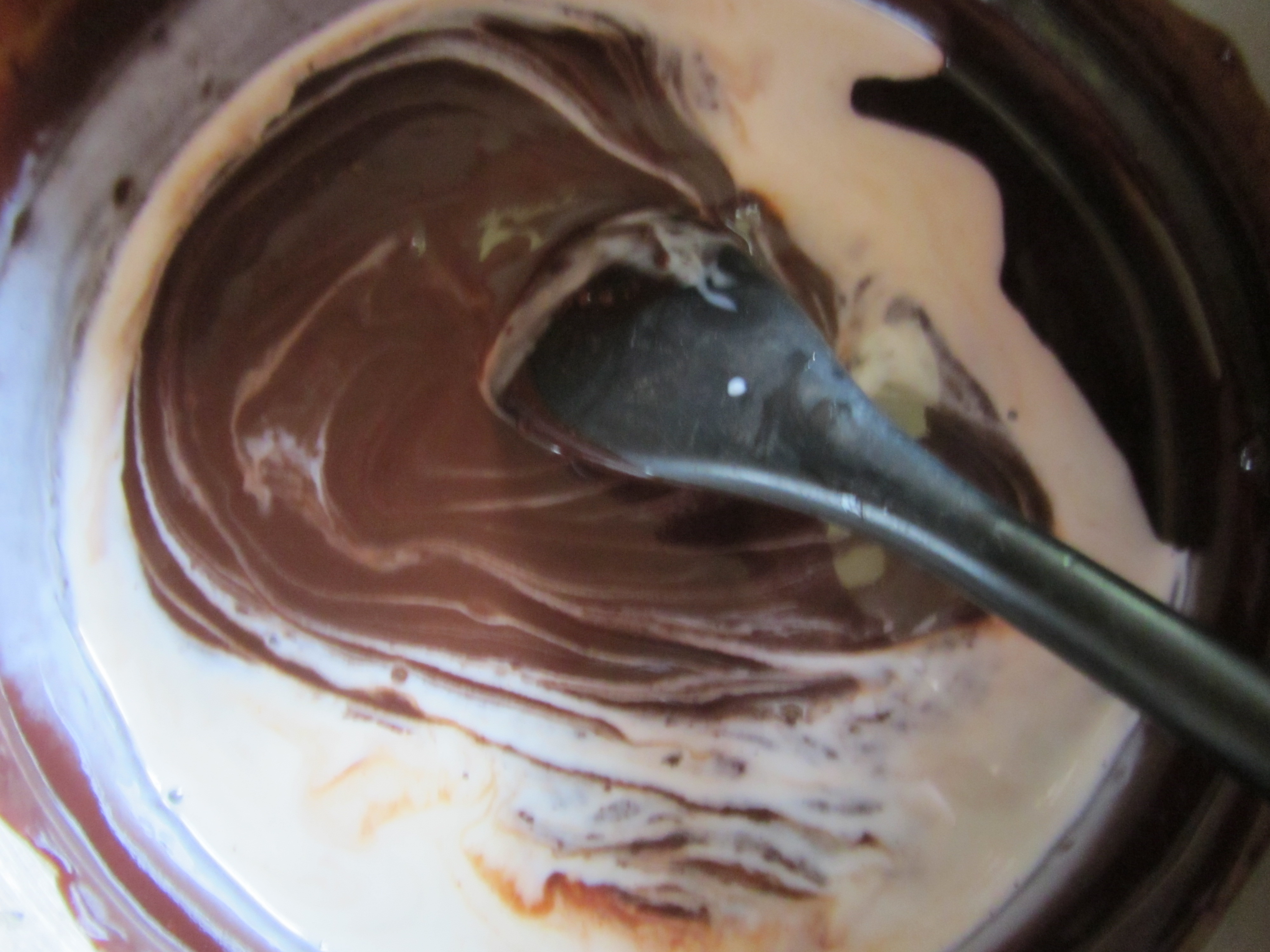
Melted chocolate mixture.

Melted chocolate mixture.

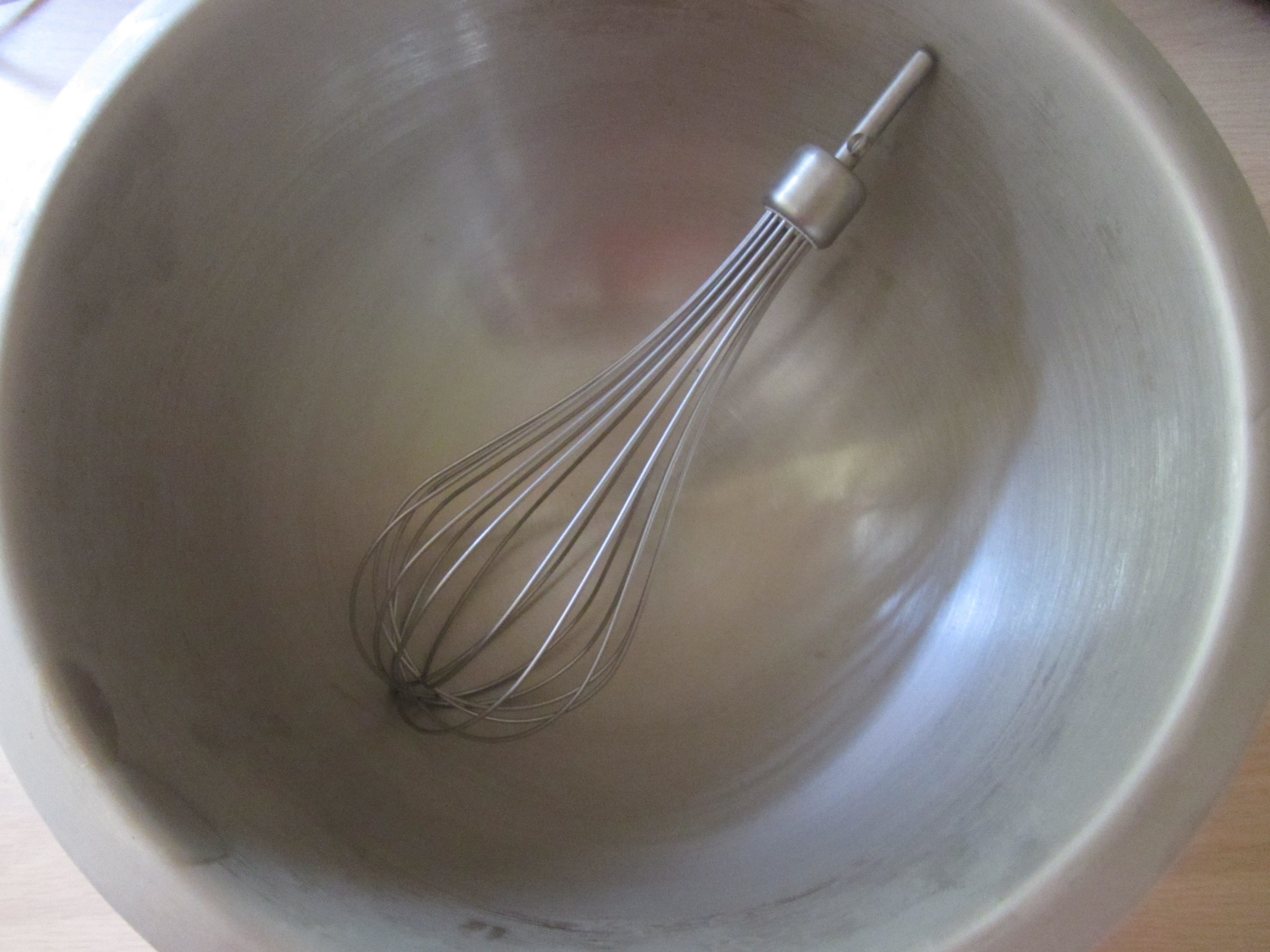
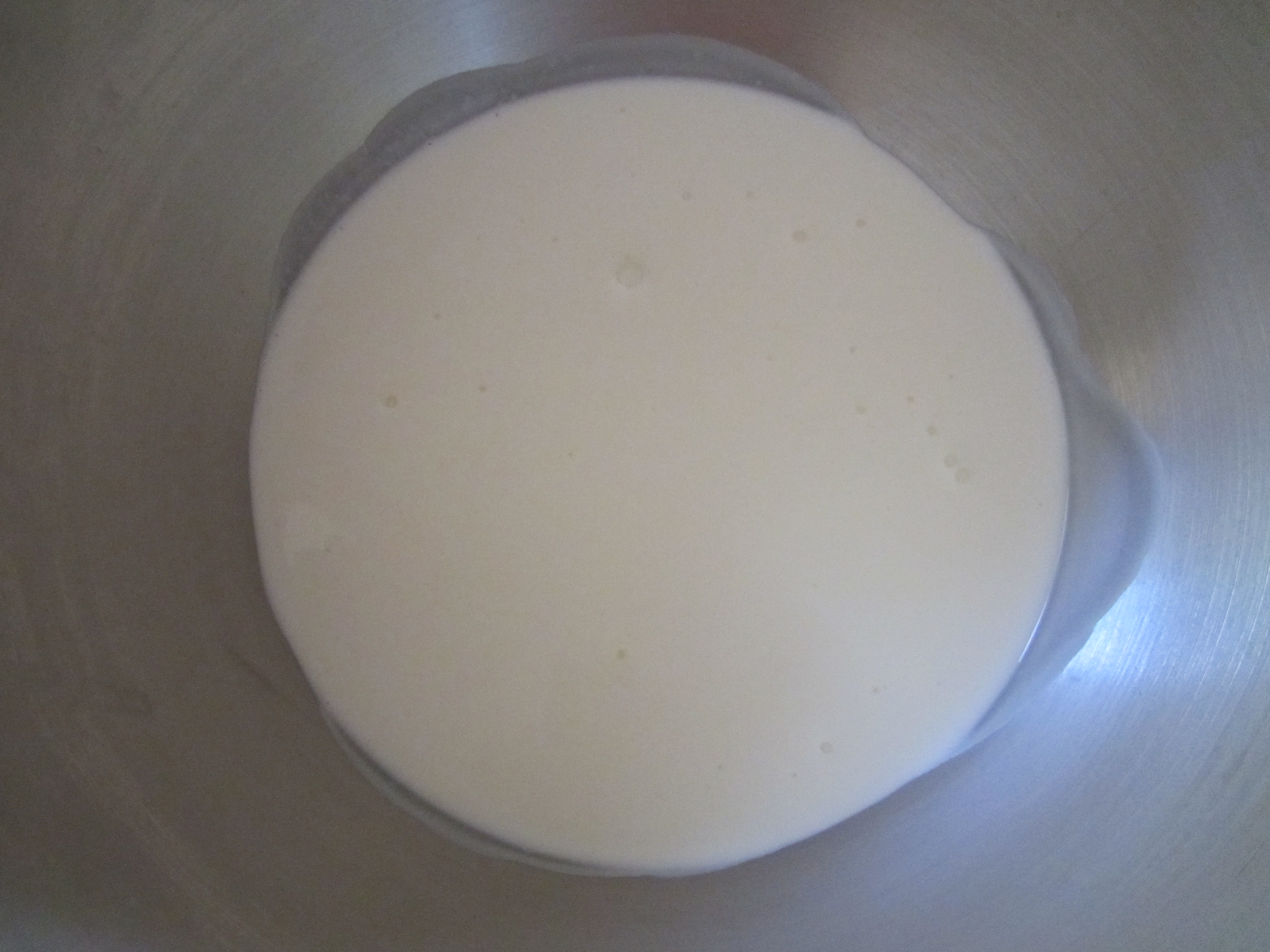
While your chocolate cools, you beat your cream in a chilled metal mixing bowl, using a chilled beater. You should beat your cream until you have medium peaks.

Chilled mixing bowl and beater.

Chilled mixing bowl and beater.

Heavy cream, ready to be whipped into submission... or medium peaks.

Heavy cream, ready to be whipped into submission… or medium peaks.

A taste of the cream for "helper" #1.

A taste of the cream for “helper” #1.

And a taste for "helper" #2.

And a taste for “helper” #2.

The gelatin/cream mixture gets heated over a gas burner or a candle until all of the gelatin granules are gone. You do not want to boil this liquid. Once the gelatin is dissolved, you add the cream/gelatin to the chocolate mixture, stirring to combine.

Heating the gelatin/cream mixture over a candle.

Heating the gelatin/cream mixture over a candle.

Adding the gelatin mixture to the chocolate.

Adding the gelatin mixture to the chocolate.

Now it is time to combine the chocolate with the whipped cream, but you want to do this gradually and gently, beginning by stirring 1/4 of the cream into the chocolate. Then you will gently fold the remaining cream into the chocolate in two additions.

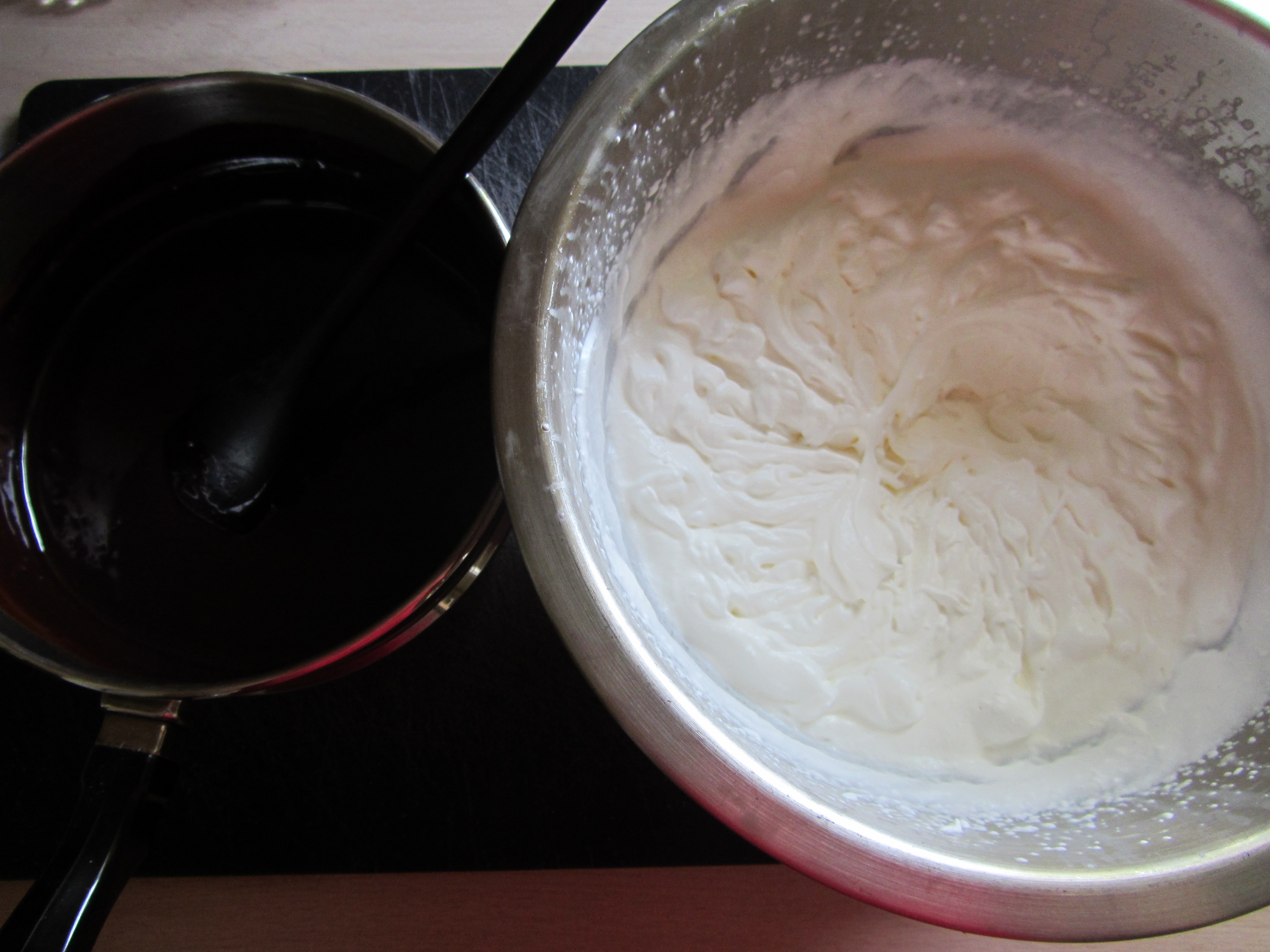
Side by side bowls of goodness, ready to be combined to make even greater goodness.

Side by side bowls of goodness, ready to be combined to make even greater goodness.

Stirring in about 1/4 of the whipped cream.

Stirring in about 1/4 of the whipped cream.

Alton stresses that it is okay to have streaks in your mousse. The important thing is to gently fold the cream into the chocolate, so as not to remove the air from the cream. I definitely had some streaks in my mousse.

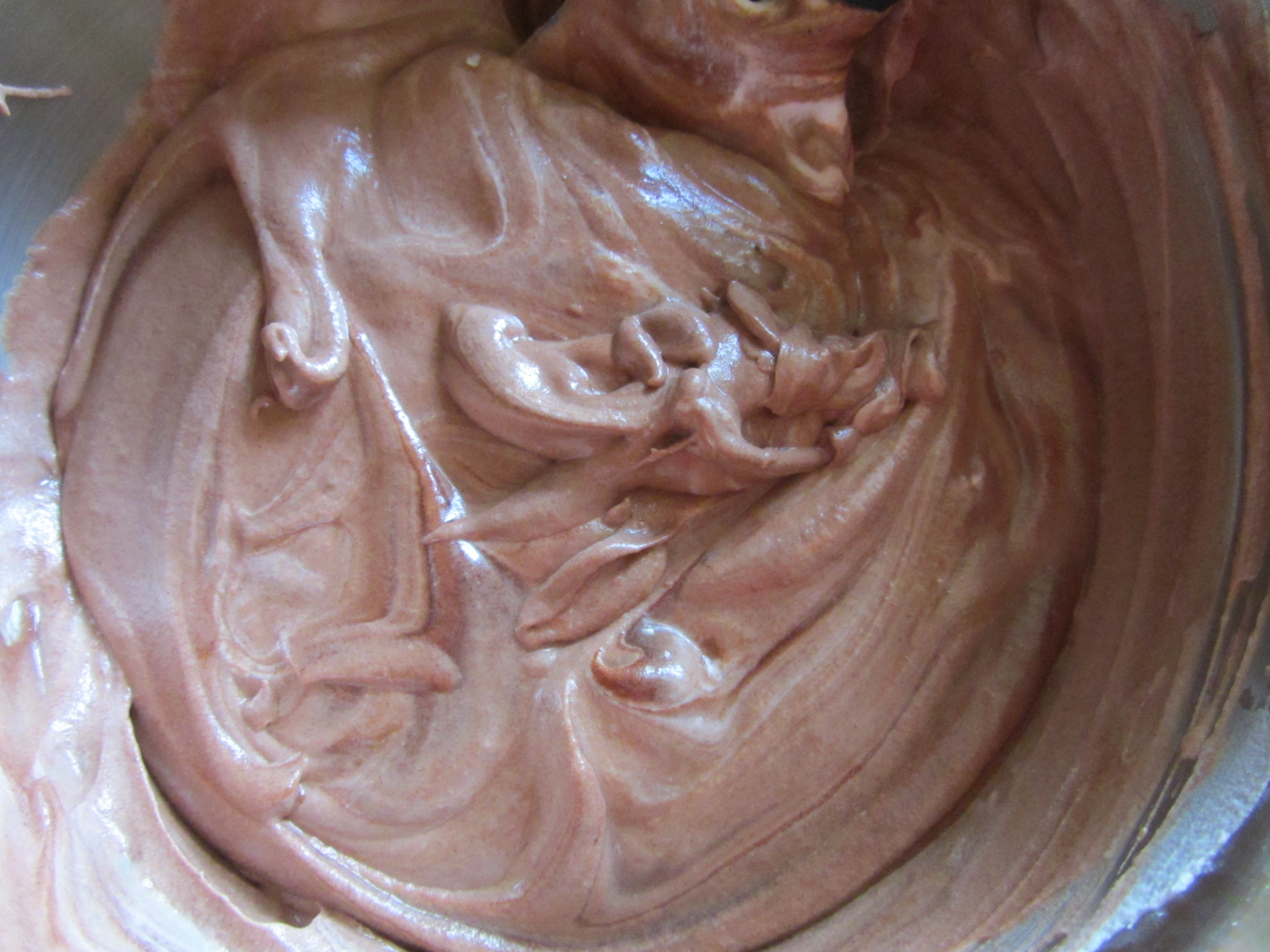
The final product, after folding in the remaining whipped cream.

The final product, after folding in the remaining whipped cream.

You gently spoon the mousse into individual serving cups and refrigerate it for an hour before covering the cups with plastic wrap.

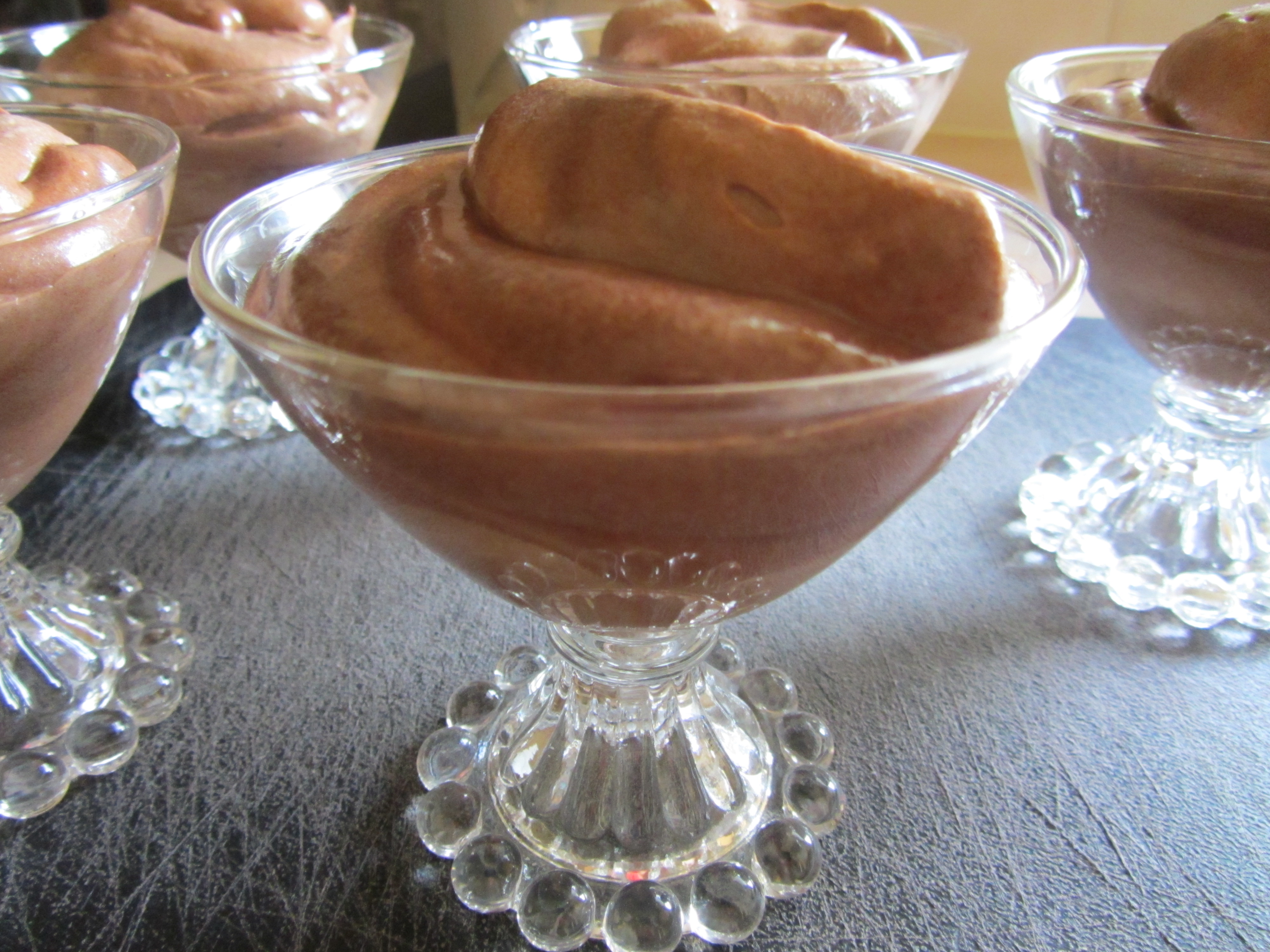
Yum. Chocolate mousse.

Yum. Chocolate mousse.

I made my mousse several hours in advance and we ate it for dessert three days in a row. I also shared some mousse with my parents. We all thought this mousse was delicious. It was light and fluffy, and mine had tiny bits of chocolate throughout, which I’m sure were not supposed to be there, but were actually a nice touch! The mousse was very rich without being heavy. There was a hint of rum in my mousse, but the espresso flavor was really not discernible. This is a recipe I will be making again because it is easy, fast, and delicious, and because my mom has already requested it!

Chocolate Lava Muffins

I will confess that I have made Alton’s Chocolate Lava Muffins a few times in years past, so this was not a new recipe to me. I still watched him prepare the recipe on the episode to ensure that I completed the recipe as prepared in the episode. When I made these in the past, I followed the online recipe, and as we know, there are usually differences between the online and episode recipes.

You start by melting chocolate chips with butter and vanilla extract.The online recipe calls for 1/2 t of vanilla, while Alton uses 1 t in the episode.

Melting chocolate chips with butter and vanilla.

Melting chocolate chips with butter and vanilla.

Once melted, you beat the chocolate mixture. I used my handheld mixer, which was given to me by my grandma about 15 years ago (she became quite the QVC shopper in her later years). It sometimes gets warm and emits a funky electrical smell, but it’s still ticking, and I use it occasionally.

The melted chocolate mixture.

The melted chocolate mixture.

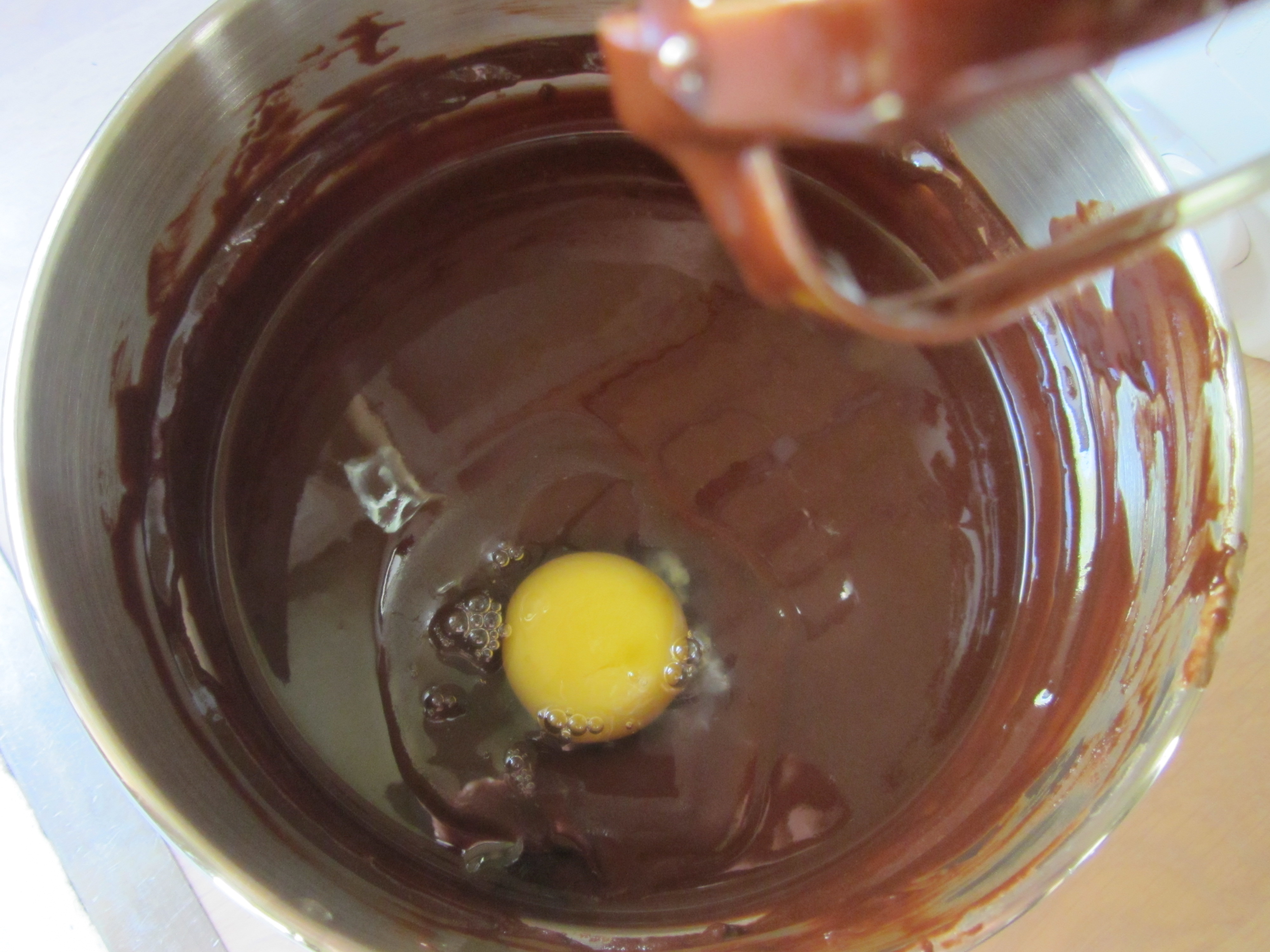
One by one, you beat in four eggs, until incorporated.

Beating in the eggs, one at a time.

Beating in the eggs, one at a time.

Then you sift in your dry ingredients (Alton uses 4 T of flour in the episode, rather than the 3 T in the online recipe), and beat the mixture for at least 5 minutes (that electrical smell was present after that!) until the batter is light and smooth.

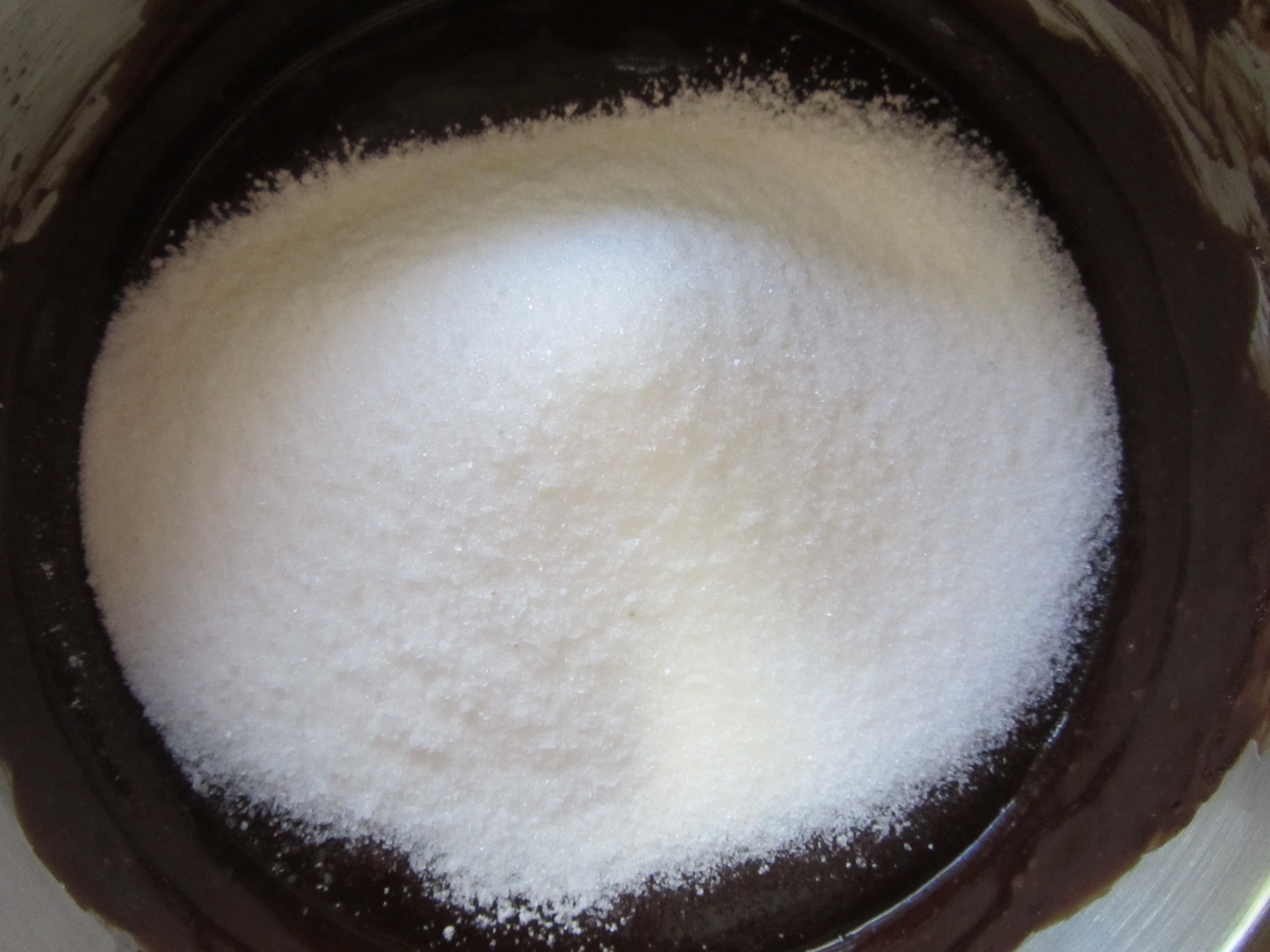
Sugar, flour, and salt.

Sugar, flour, and salt.

Adding the sifted dry ingredients to the chocolate.

Adding the sifted dry ingredients to the chocolate.

The completed batter, after beating for over 5 minutes.

The completed batter, after beating for over 5 minutes.

You chill the mixture to let it set a little bit. How long? This is not specified in either the episode or the online recipe. I chilled my batter for about 20 minutes. While the mixture chills, you can grease your muffin tin, and coat the cups with some cocoa powder.

Muffin tin, greased and dusted with cocoa powder.

Muffin tin, greased and dusted with cocoa powder.

Alton then tells you to use a 4-ounce scoop for each muffin. I used a ladle (not sure what size), and simply filled my muffin cups until they were about 2/3 full. This filled all 12 of my cups, while many reviewers on the Food Network site said they ended up with 8 or 9 muffins.

Batter in the muffin cups.

Batter in the muffin cups.

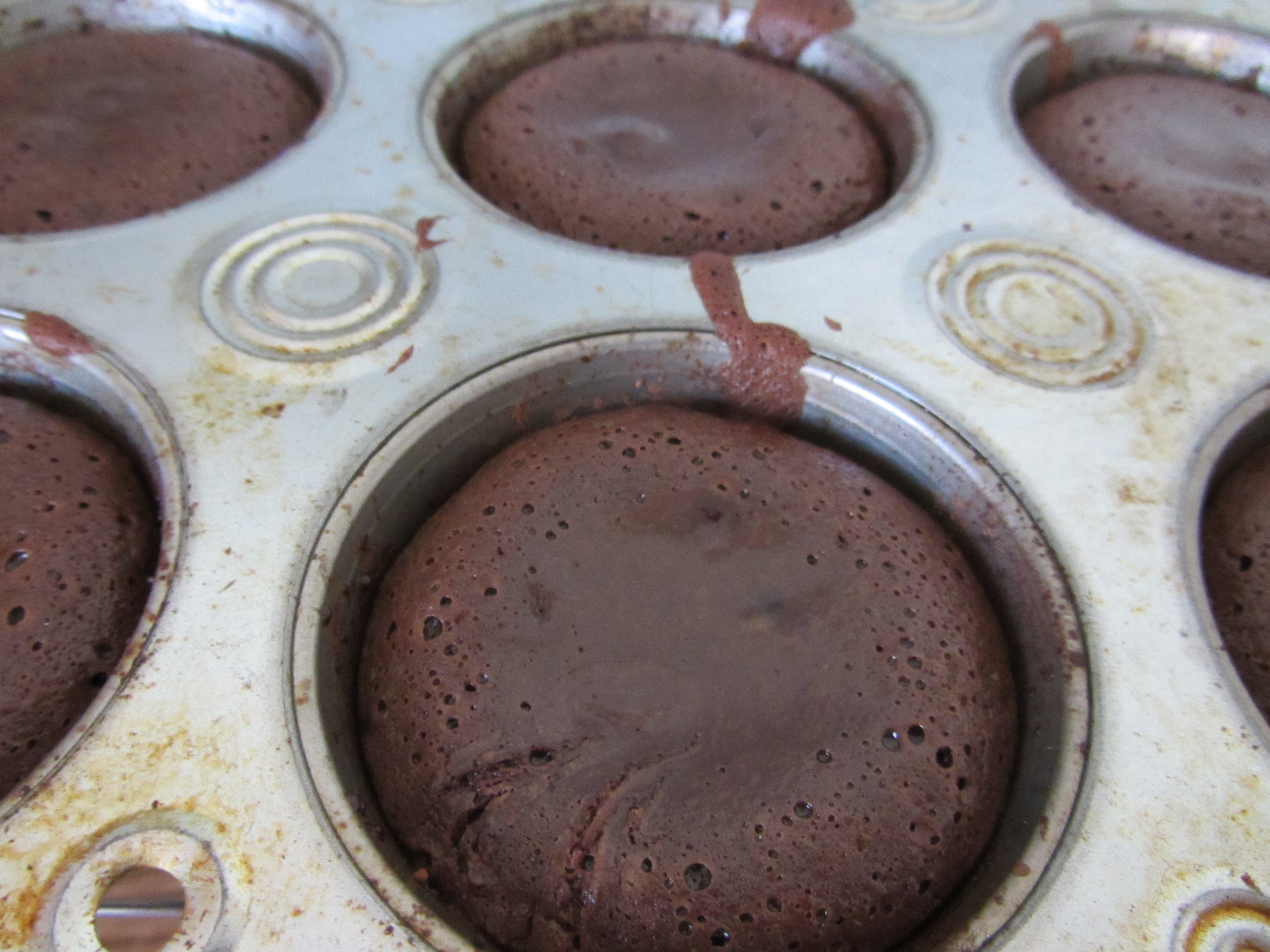
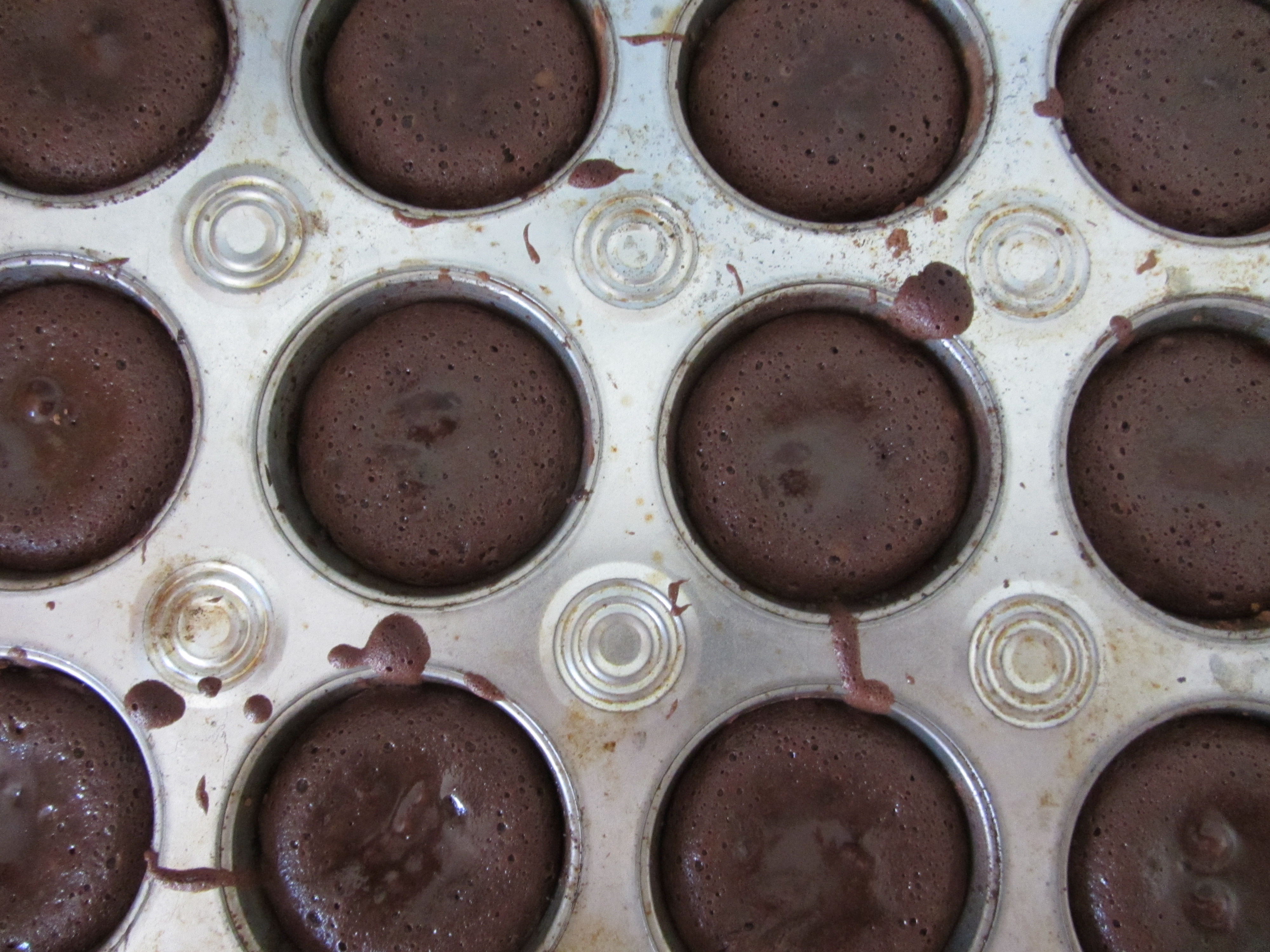
Once your cups are full, you stick the muffins in the oven and bake them for about 10 minutes, or until the sides are set and the centers are still jiggly. I checked my muffins at 9 minutes, but they were not quite done. Ten minutes was perfect for my muffins.

Baked lava muffins.

Baked lava muffins.

The baked muffins.

The baked muffins.

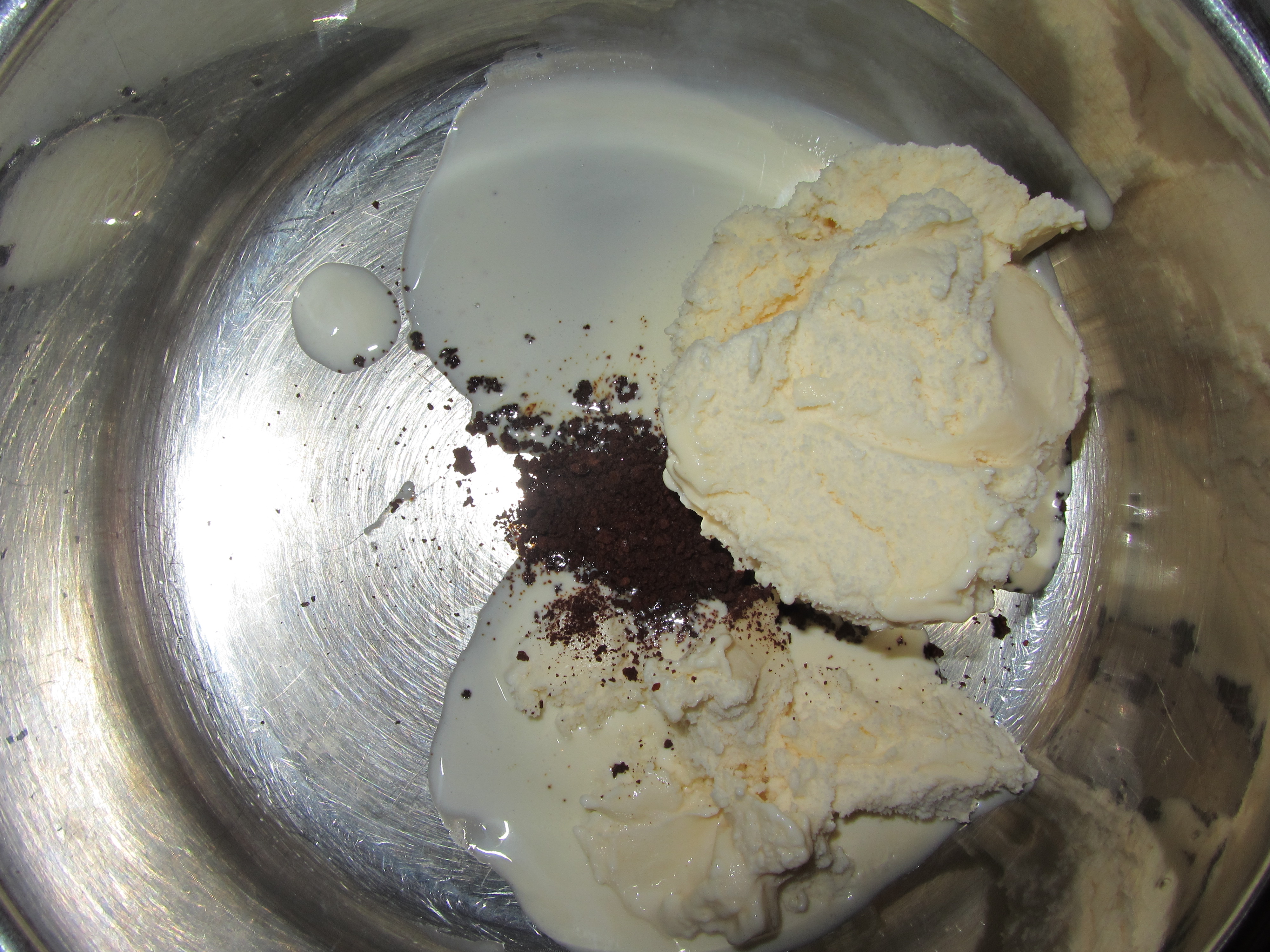
To serve the muffins, Alton makes a sauce by melting vanilla ice cream with espresso powder, and pours this over the top.

Melting vanilla ice cream with espresso powder.

Melting vanilla ice cream with espresso powder.

The completed sauce.

The completed sauce.

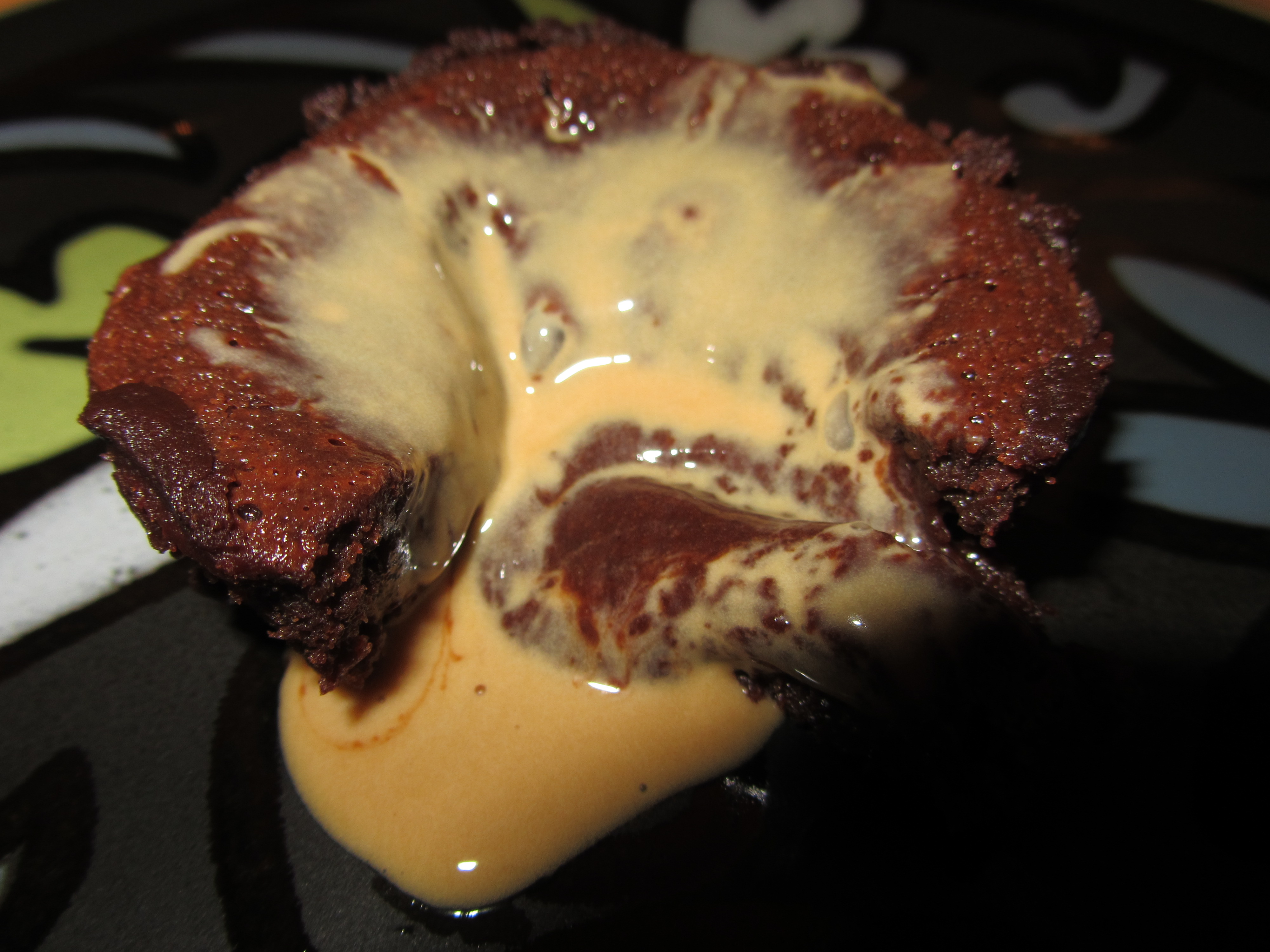
Lava muffin with sauce.

Lava muffin with sauce.

I have now made these muffins at least three times, so I guess that tells you that I like them. They kind of look like little chocolate hockey pucks. Perhaps filling the muffin cups a bit more results in more of a typical muffin shape, but I actually like the small size of these. They are very dense and rich, with an almost-liquid center and cake-like edges. I like them with the sauce, though I think they would maybe pair better with plain vanilla ice cream or barely sweetened whipped cream. The combo of the muffin with the sauce is just sweet on sweet. The muffins keep nicely for a couple of days, and while you can serve them warm, I think they are great at room temperature also.

With that, I complete Season 1 of Alton’s recipes on Good Eats.


Rice Pilaf

In the 12th episode of Good Eats, Alton educates the viewer on all things rice. He talks about the many types of rice, how they differ, how to store them, and how to cook them. Did you know you should not store brown rice at room temperature? The oils in brown rice can turn rancid at room temperature, producing off-flavors. Instead, you should store it in an airtight container in the freezer.

There is only one recipe in this episode, and it is for Rice Pilaf. We eat a fair amount of rice in our house, but I honestly do not know if I had previously made a rice pilaf. For this recipe, you steep some saffron threads in warm water while you prep the rest of the dish. I did not have any saffron, but I was able to borrow some from my parents.

Saffron threads

Saffron threads

Steeping saffron in warm water.

Steeping saffron in warm water.

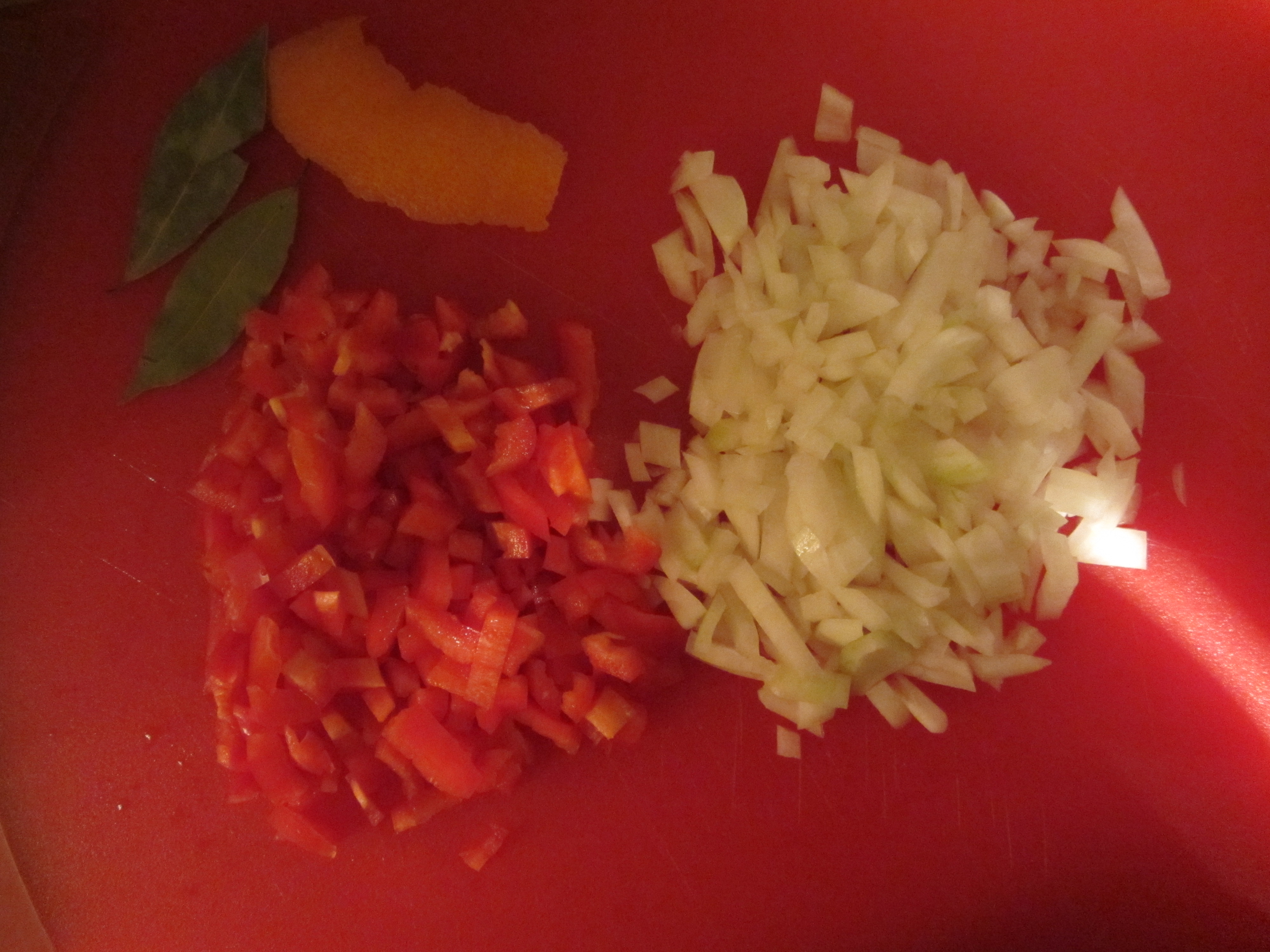
You melt some butter in a heavy oven-safe pan that has a lid, and you cook some onion, red bell pepper, and Kosher salt until the vegetables are tender.

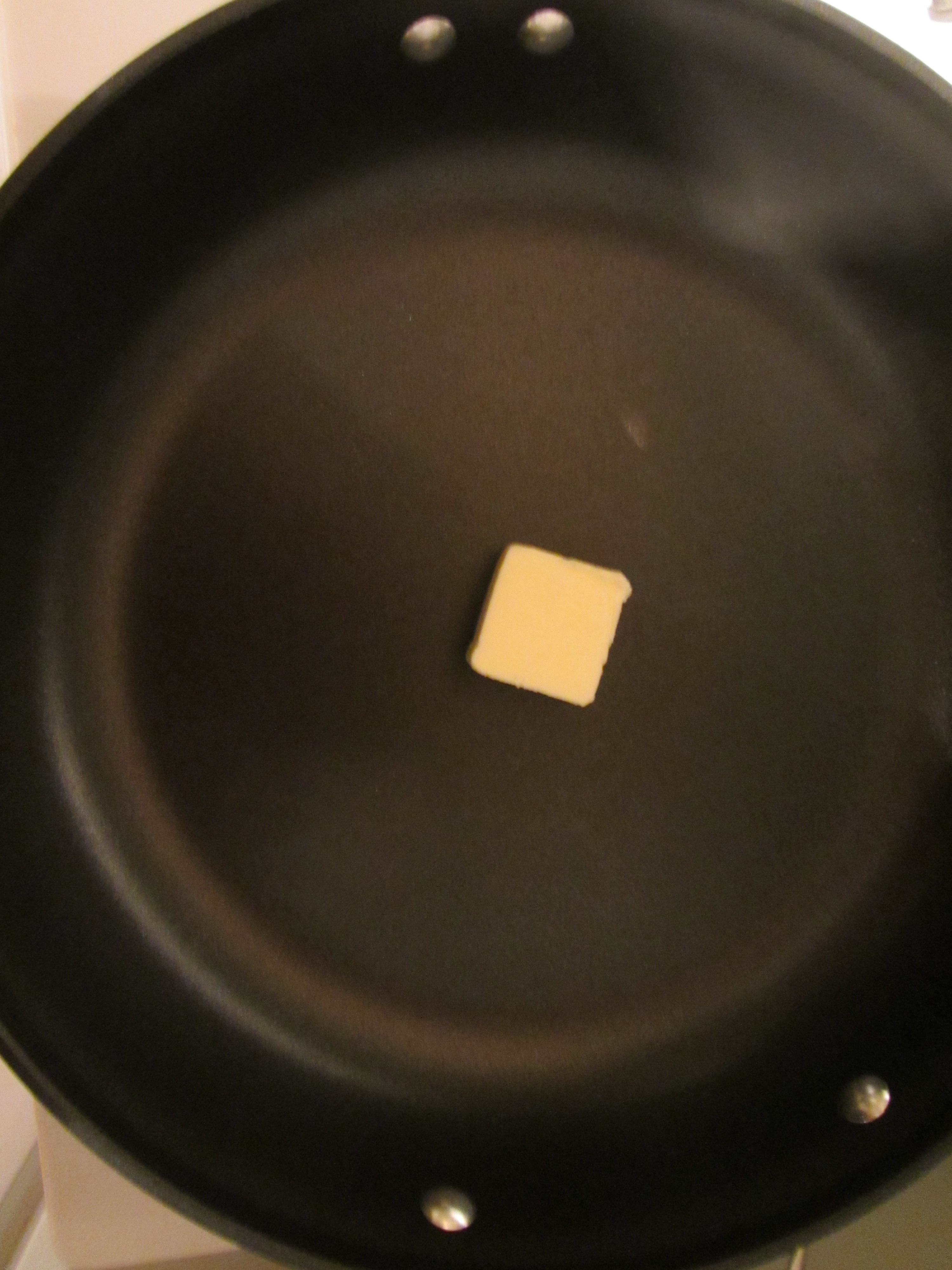
Melting butter.

Melting butter.

Onion, bell pepper, orange zest, and bay leaves.

Onion, bell pepper, orange zest, and bay leaves.

Cooking the vegetables.

Cooking the vegetables.

To this vegetable mixture you add long grain rice, stirring it until it has a nutty aroma. This step reminded me of how you start a risotto.

Stirring the rice until it has a nutty aroma.

Stirring the rice until it has a nutty aroma.

Once aromatic, you add chicken broth, a strip of orange zest, two bay leaves (the online recipe calls for one), and the saffron water. The saffron is used to add both color and flavor to the pilaf. You also want to add Kosher salt at this point, until your cooking liquid has the flavor of sea water. Alton insists that you stir the pilaf only once, and then allow it to come to a boil.

All of the ingredients in the pan.

All of the ingredients in the pan.

Once boiling, you cover the pan with a damp towel and the pan’s lid, folding the corners of the towel up onto the top of the lid. The pan goes into a 350 degree oven for 15 minutes.

Pan covered with damp towel before going into the oven.

Pan covered with damp towel before going into the oven.

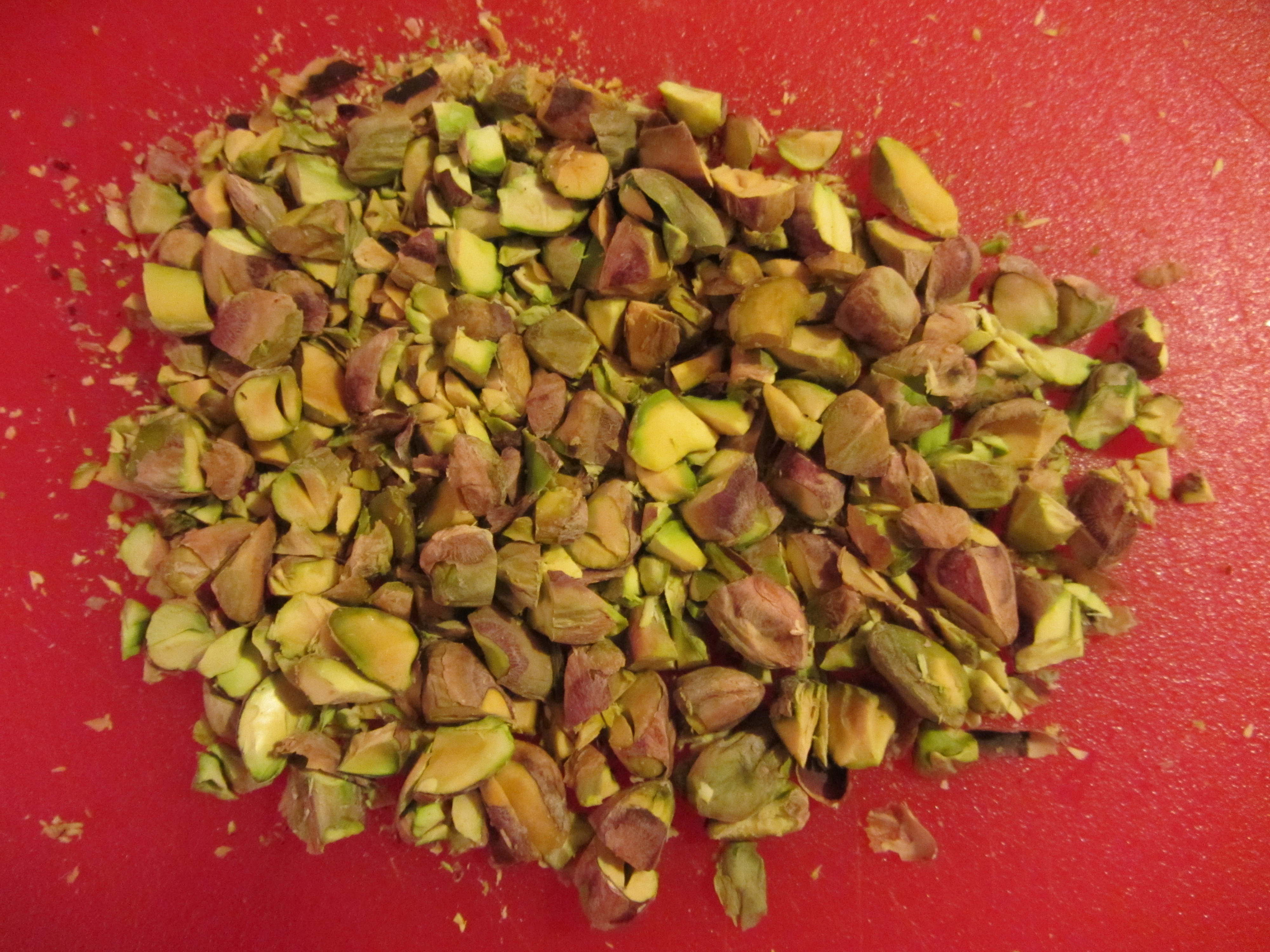
Once out of the oven, Alton says the pan must rest, covered, for 10-20 minutes. This is an important part of the process, as the rice continues to cook. While the rice rests, you prepare some add-ins for the final pilaf:  green peas, golden raisins, and chopped pistachios. Once the resting period has completed, you turn the pilaf out onto a serving platter, add the add-ins, and fluff the pilaf with a fork.

Pilaf after resting for 15 minutes after baking.

Pilaf after resting for 15 minutes after baking.

Chopped pistachios.

Chopped pistachios.

Finished pilaf with peas, golden raisins, and pistachios.

Finished pilaf with peas, golden raisins, and pistachios.

We ate our pilaf as our dinner entree, and we thought it was pretty tasty. The pilaf was nice and fluffy, as opposed to some “gummy” pilafs I have had in the past, and the rice had an “al dente” texture. I think our saffron was a bit older, as my pilaf did not have as much color as Alton’s did, but it still had a yellow hue, which made the dish more attractive than plan white rice. I really liked the contrasting textures in the dish – the al dente rice with the chewy raisins, popping peas, and crunchy pistachios. It was also quite flavorful. Though not a complete standout to me, this was an easy, successful dish that I may do again.

Pasta

Pasta is definitely a staple in our house, and it was something my mom cooked regularly when I was growing up. Thank goodness my brother and I were active bicycle racers growing up because we sure ate A LOT of carbs in our house! A typical pre (or post) bike race meal in our house was a huge bowl of pasta (often a recipe selection from a Marcella Hazan book), a loaf of bakery bread with lots of olive oil and balsamic vinegar, and a salad. In the summer, antipasto pasta salad was on regular rotation for our Thursday night time trial (local bike race) nights. Due to our family’s frequent consumption of pasta, it became one of the first meals I was comfortable fixing for my family. One of my favorite pastas to make as a kid had a simple sauce of olive oil, garlic, salt, pepper, rosemary, tomatoes, a splash of balsamic vinegar, and some grated hard cheese. Pasta, in my mind, is comfort food, and a great plate of pasta is one of my very favorite things.

In the 11th episode of Good Eats, Alton makes a simple pasta that uses the various ingredients you happen to have on-hand in your own pantry. To begin, he explains that the only way to properly cook pasta is in a very large volume of water. He recommends six quarts of water per pound of pasta, and of course, that the water be salted to the flavor of sea water.

Salted water.

Salted water.

Note:  I’ve listened to Alton’s recent podcast where he stated that there is a better way to cook pasta. In his own words, “I really messed up with cooking pasta in season 1. I said to bring a gallon of water to a boil before cooking dry pasta. Crap! Start in cold water and only use enough to cover the pasta.”

I have yet to try this cold water method of cooking pasta, though I did tell my brother about it and he told me he had great results. I’m sure many Italians are rolling over in their graves at the very thought of this new method of pasta cooking, but this Scottish/Irish girl is open to the idea and will be trying it the next time I cook pasta. Guess that means we have to have pasta again soon. Darn (sarcasm)!

Back to the recipe, as featured in the episode. You bring a large pot of salted water to a boil and add your spaghetti, using tongs.

Spaghetti.

Spaghetti.

Alton stresses that you need to fan the pasta out, rather than dropping it into the water in a large clump. I consider this to be somewhat intuitive. I have never before used tongs when cooking pasta, as my tool of choice is the slotted spork, but I followed Alton’s recommendation and used the tongs. They were effective at separating the pasta strands in the water, but I found them to be more cumbersome than the spork. Alton tells you to cover the pot while the pasta cooks, which is something I never do, but I did it for this recipe.

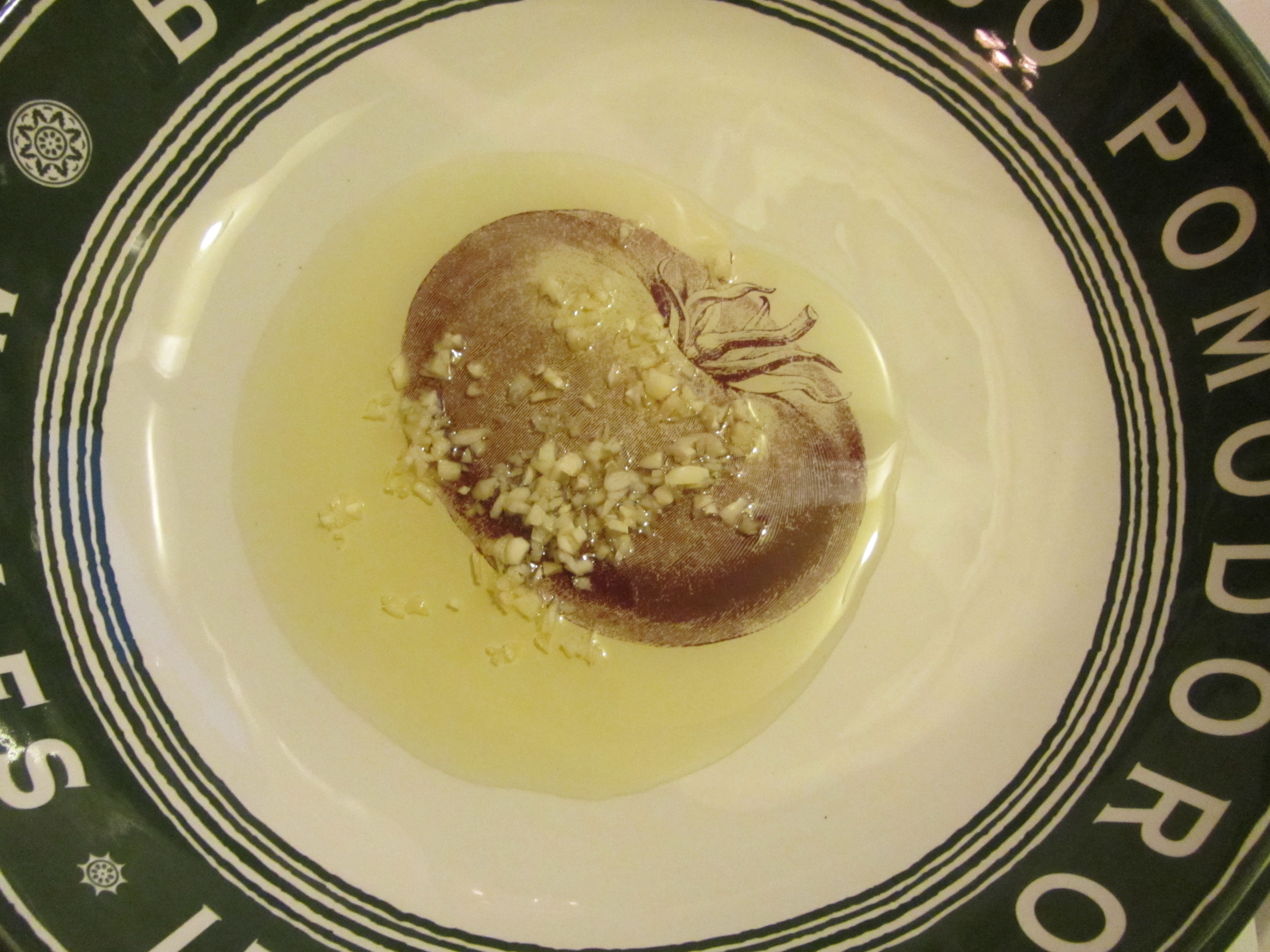
While the pasta cooks to al dente, you pour some good olive oil in the bottom of your serving bowl and add some finely minced garlic.

Olive oil and garlic in the serving bowl.

Olive oil and garlic in the serving bowl.

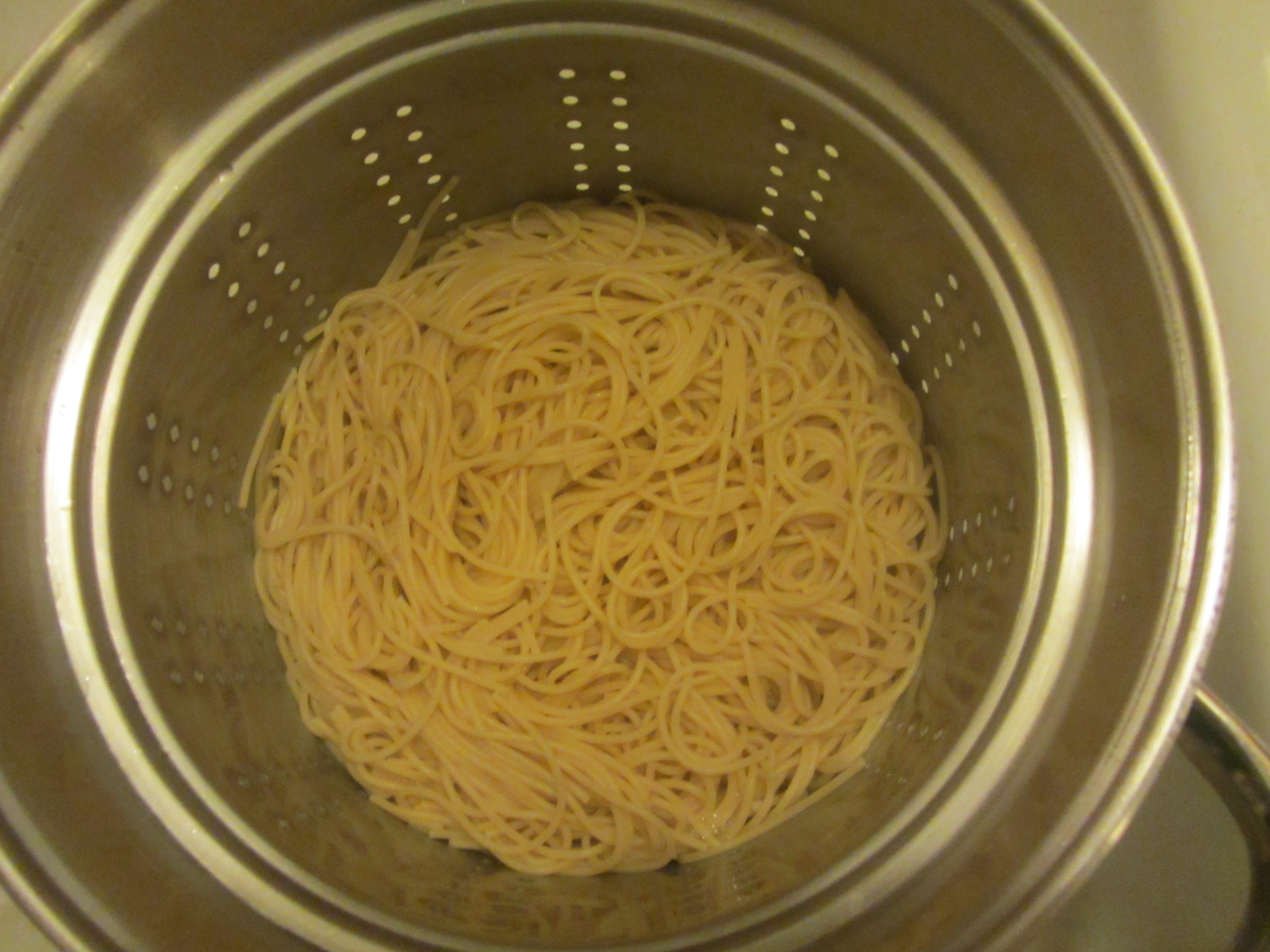
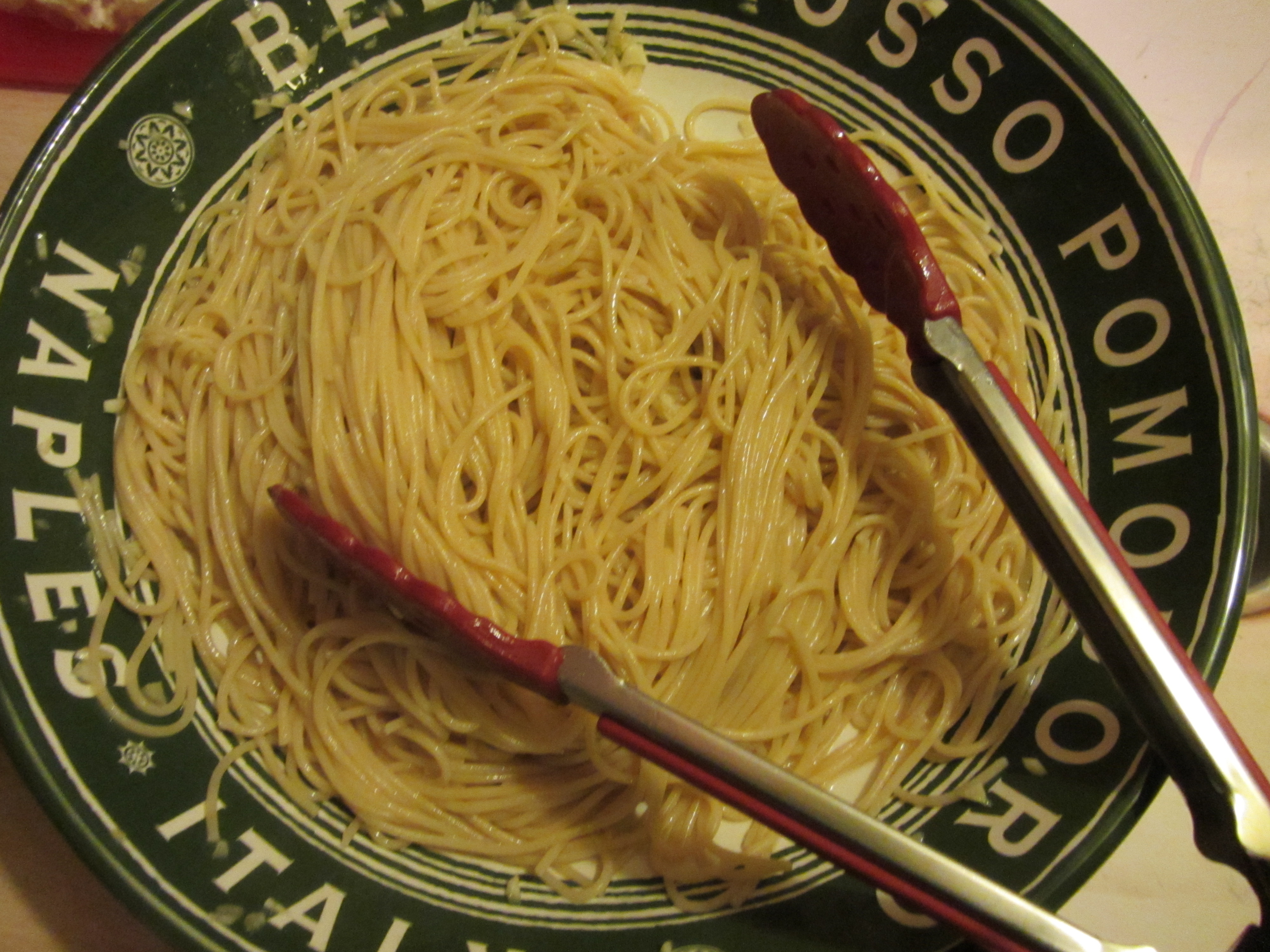
When the pasta is cooked, you toss the hot noodles with the garlic/oil mixture until evenly coated.

Cooked to al dente.

Cooked to al dente.

Tossing the noodles with the garlic and olive oil.

Tossing the noodles with the garlic and olive oil.

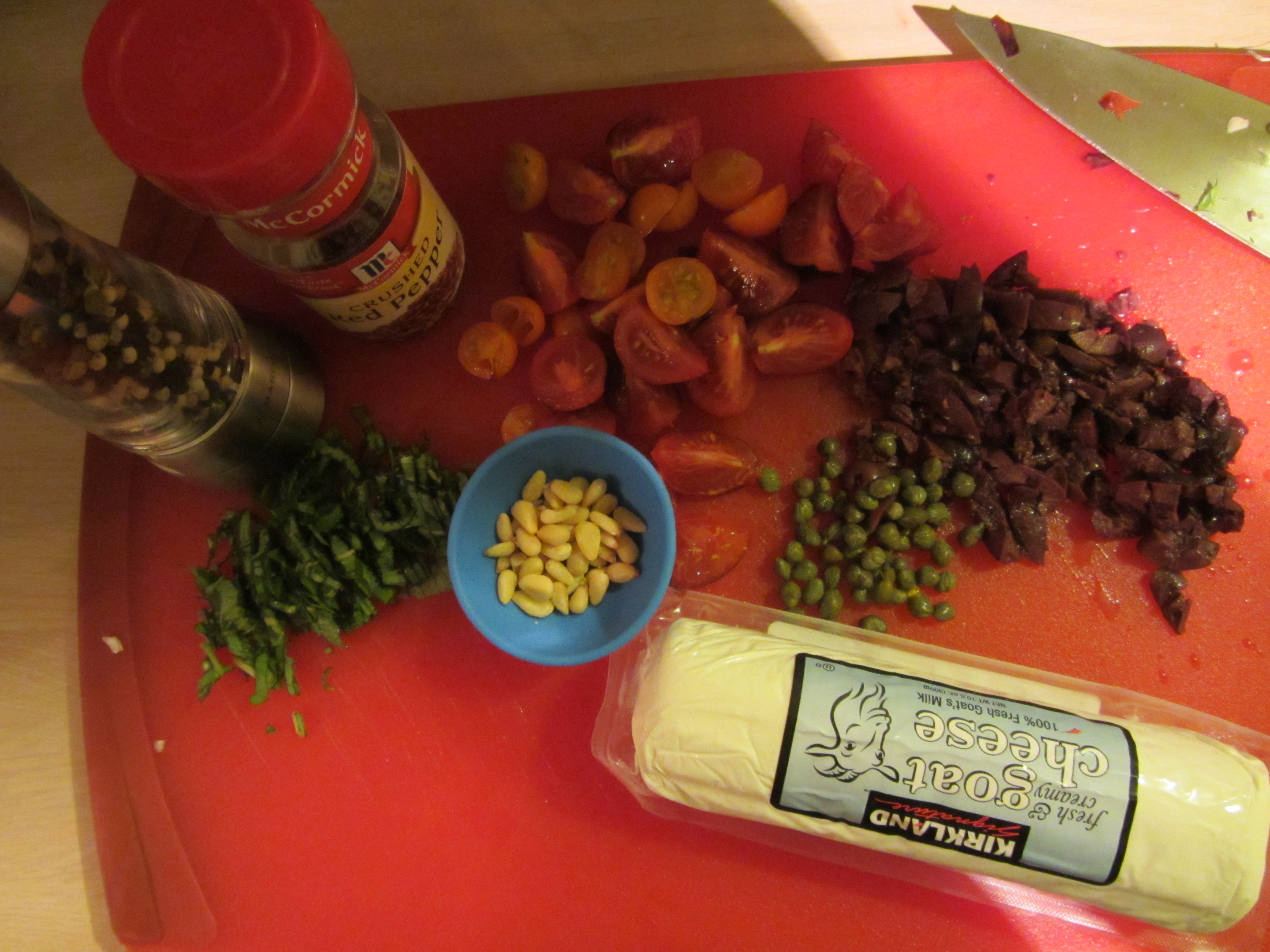
Alton says the noodles will cook the garlic enough to get rid of the strong raw garlic flavor. At this point, you add whatever pantry ingredients you choose to have. I opted for orange cherry tomatoes and black tomatoes from the garden (Deer ate all of our San Marzano tomatoes on the day of this recipe!), fresh basil, pine nuts, kalamata olives, capers, red pepper flakes, black pepper, and goat cheese.

Black pepper, red pepper flakes, basil, pine nuts, capers, kalamata olives, black tomatoes, orange cherry tomatoes, and goat cheese.

Black pepper, red pepper flakes, basil, pine nuts, capers, kalamata olives, black tomatoes, orange cherry tomatoes, and goat cheese.

Final pasta with the pantry ingredients of choice.

Final pasta with the pantry ingredients of choice.

We thought this pasta was tasty, but not Earth-shattering, as it is not unlike the pastas I will throw together on a regular basis. We did find that a relatively strong flavor of garlic remained, but we love garlic, so we were okay with it. Of the recipes I have done thus far from Good Eats, I would say this was the least novel, though still good.

Whole Fish

I live in the Northwest, where we tend to eat a lot of fish, so I was excited for the 10th episode of Good Eats. I printed out the two recipes posted online and sat down to watch the episode. To my surprise, there was an additional (third) recipe featured in the show. Why this recipe is not posted online I don’t know, but it is for a whole fish cooked in a salt dome. I had never cooked a whole fish before, so I was excited and nervous about this preparation. Alton uses a six pound Striped Bass when he makes this on the show, and I knew we were going to need a considerably smaller fish. Still, when I made this last week, we had my parents over to share in our two pound Red Snapper. I will confess that we had a frozen pizza on hand, just in case I botched the fish!

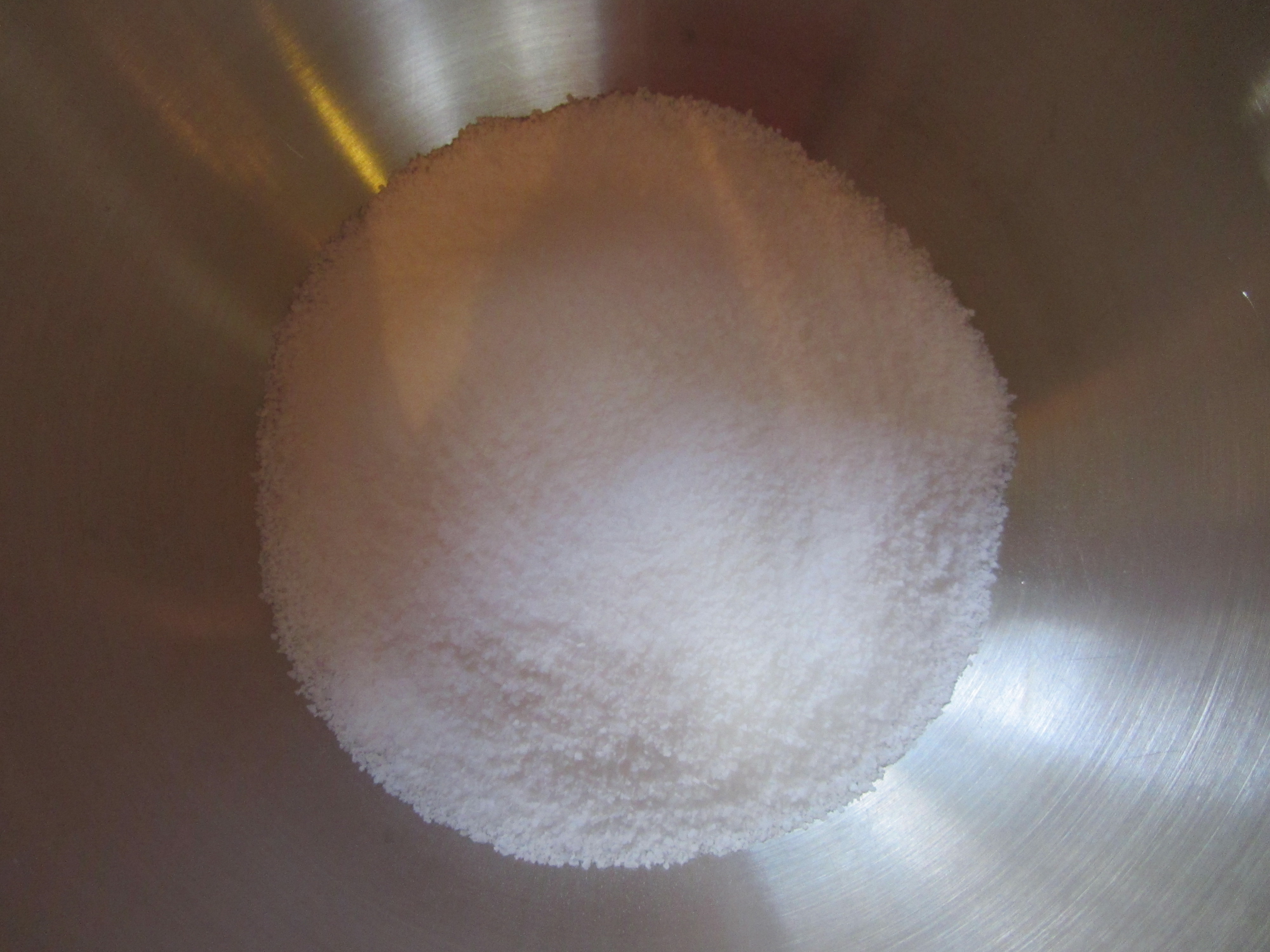
Alton tells you to use a pound of Kosher salt per pound of fish.

A pound of salt per pound of fish.

A pound of salt per pound of fish.

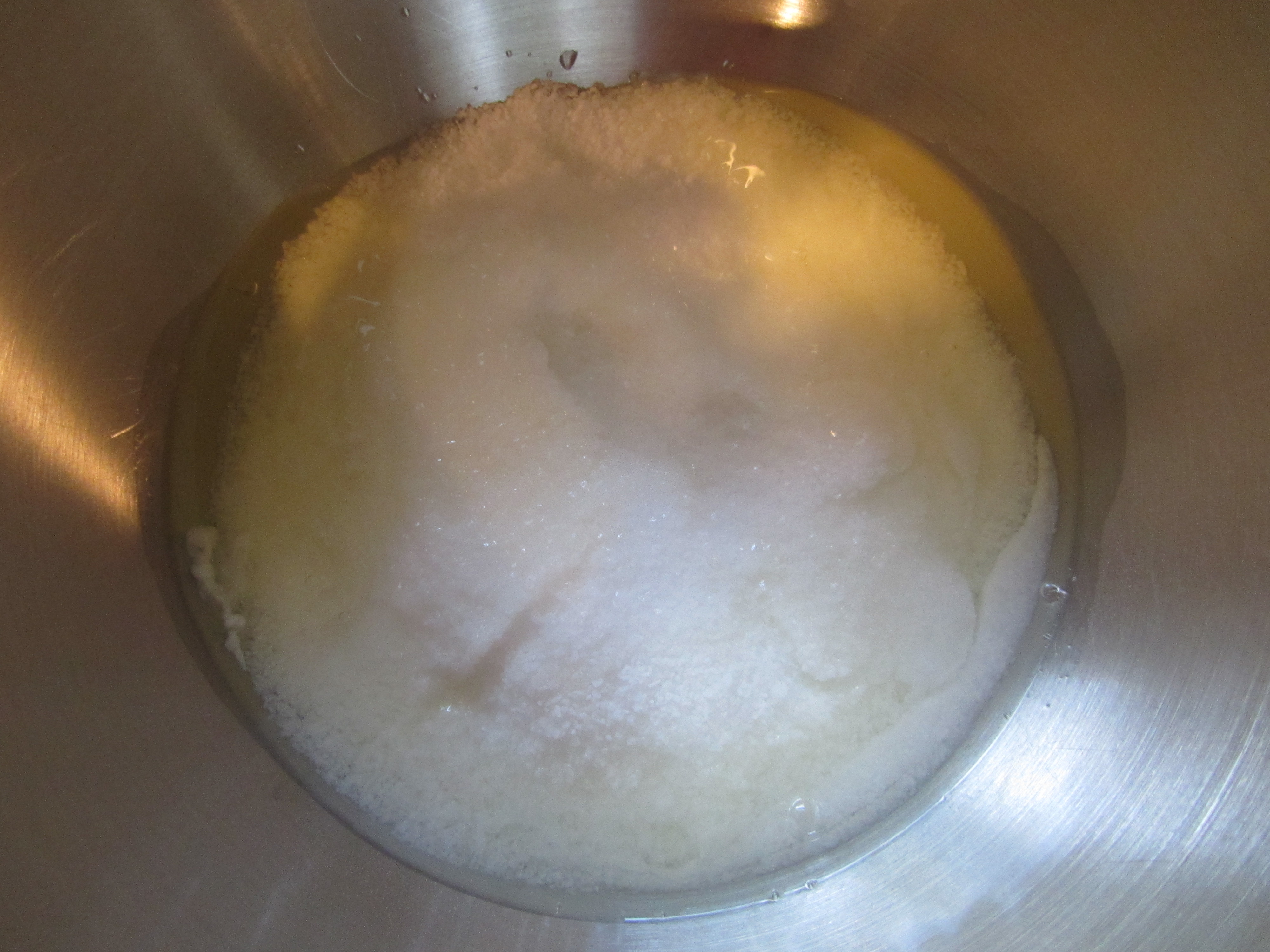
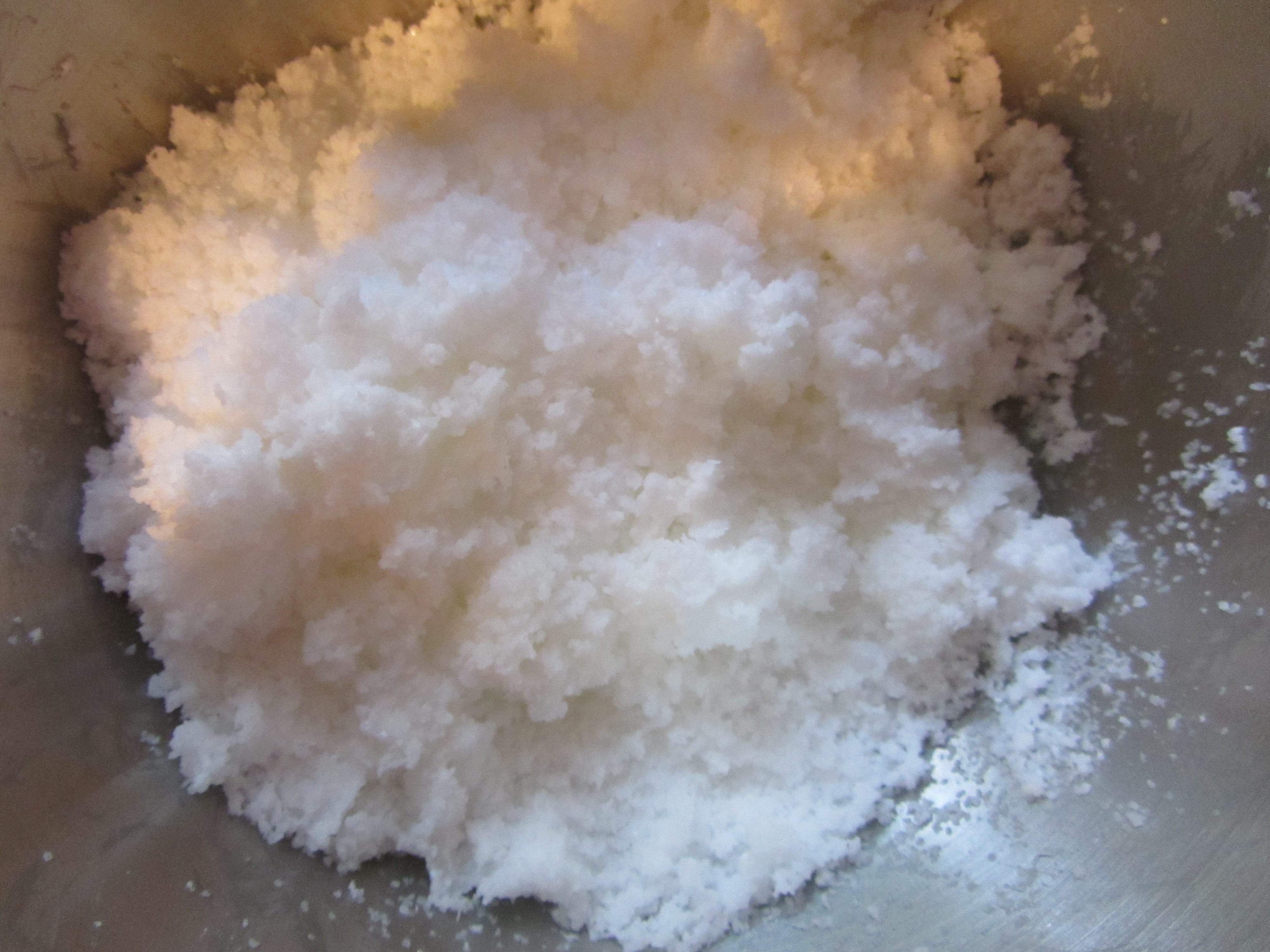
This is combined with egg whites and some water, and mixed by hand. For our two-pounder, I used two pounds of salt, two egg whites, and a bit less than 1/4 C of water.

Salt with egg whites and water.

Salt with egg whites and water.

Mixed to a mortar-like consistency.

Mixed to a mortar-like consistency.

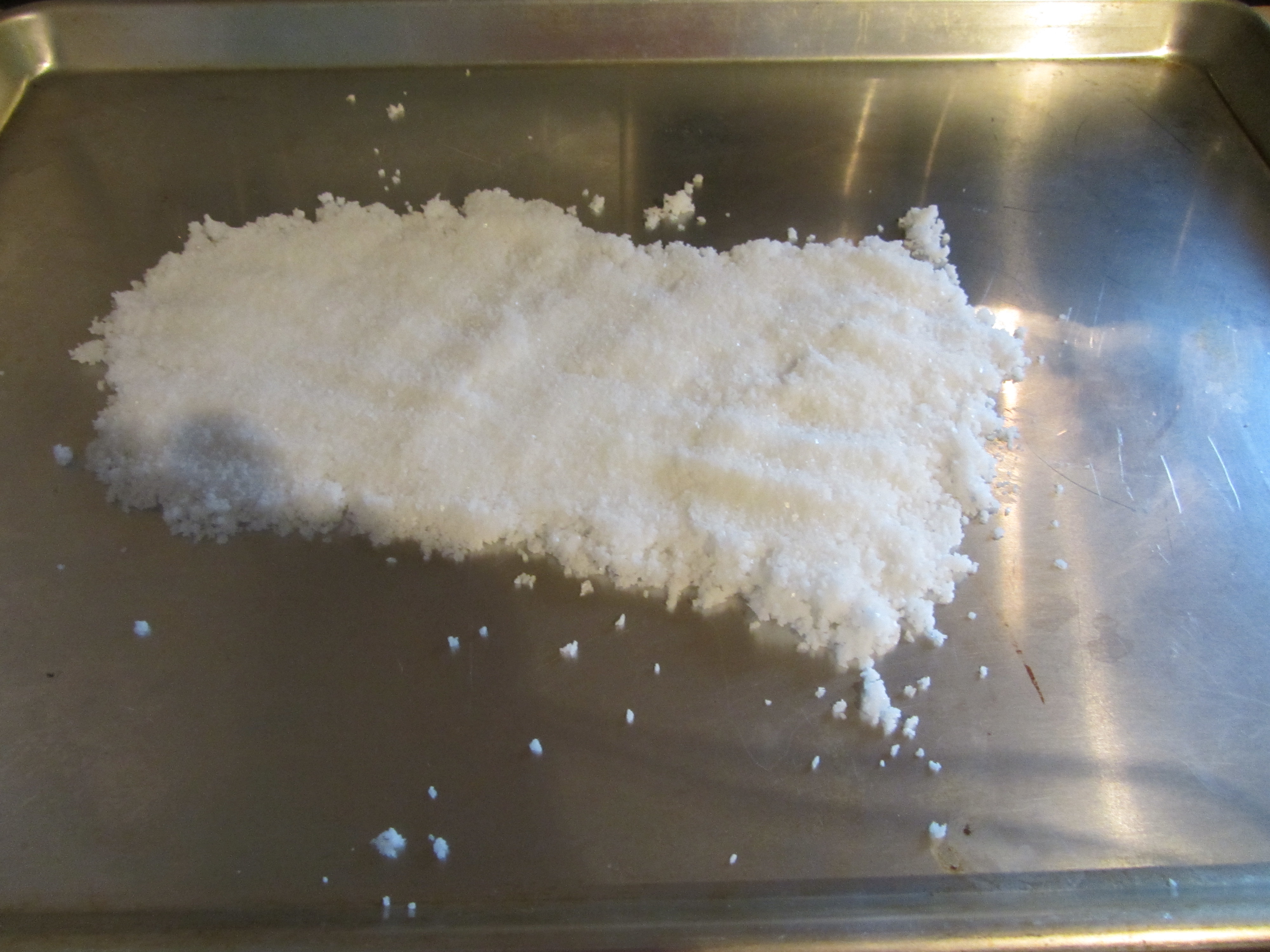
You spread a 1/2″-thick layer of this salt mixture on your baking sheet as a bed for your fish.

Bed of salt for the fish to bake on.

Bed of salt for the fish to bake on.

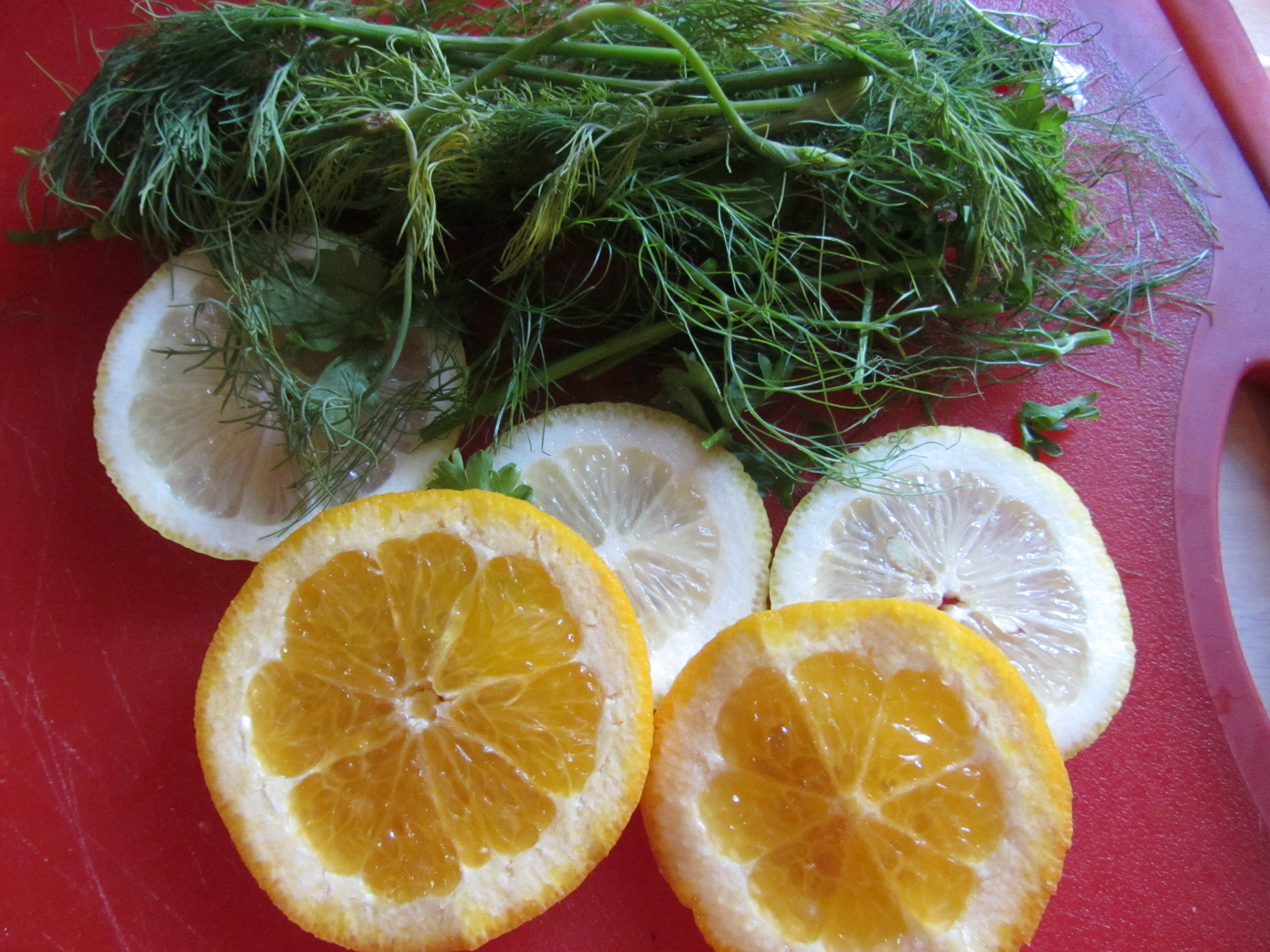
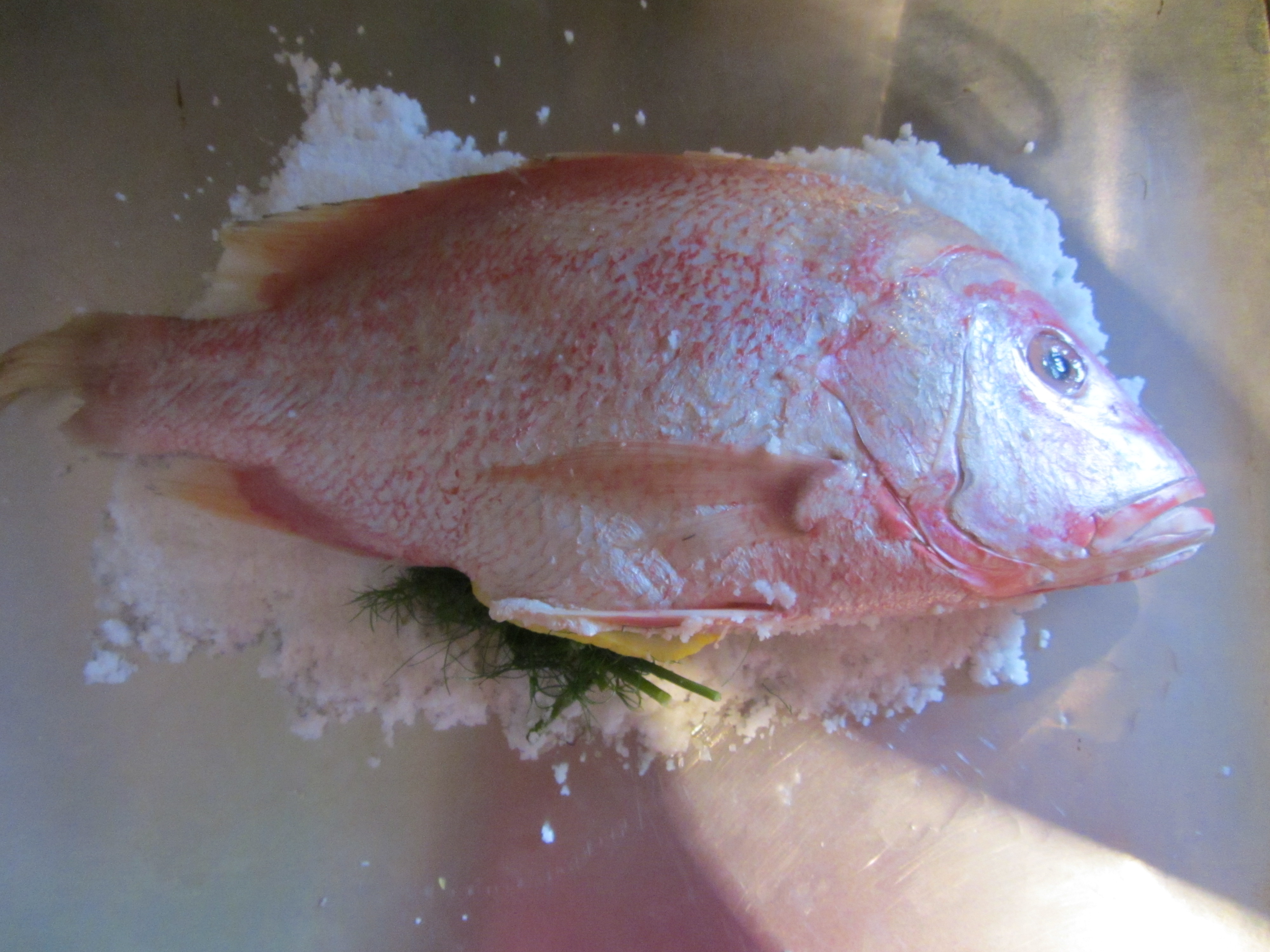
Your fish is placed on top of the salt layer, and you fill his cavity with whatever aromatics you have on hand. For my fish, I used fennel, dill, lemon slices, and orange slices.

Dill, fennel, orange, and lemon.

Dill, fennel, orange, and lemon.

Red Snapper stuffed with aromatics.

Red Snapper stuffed with aromatics.

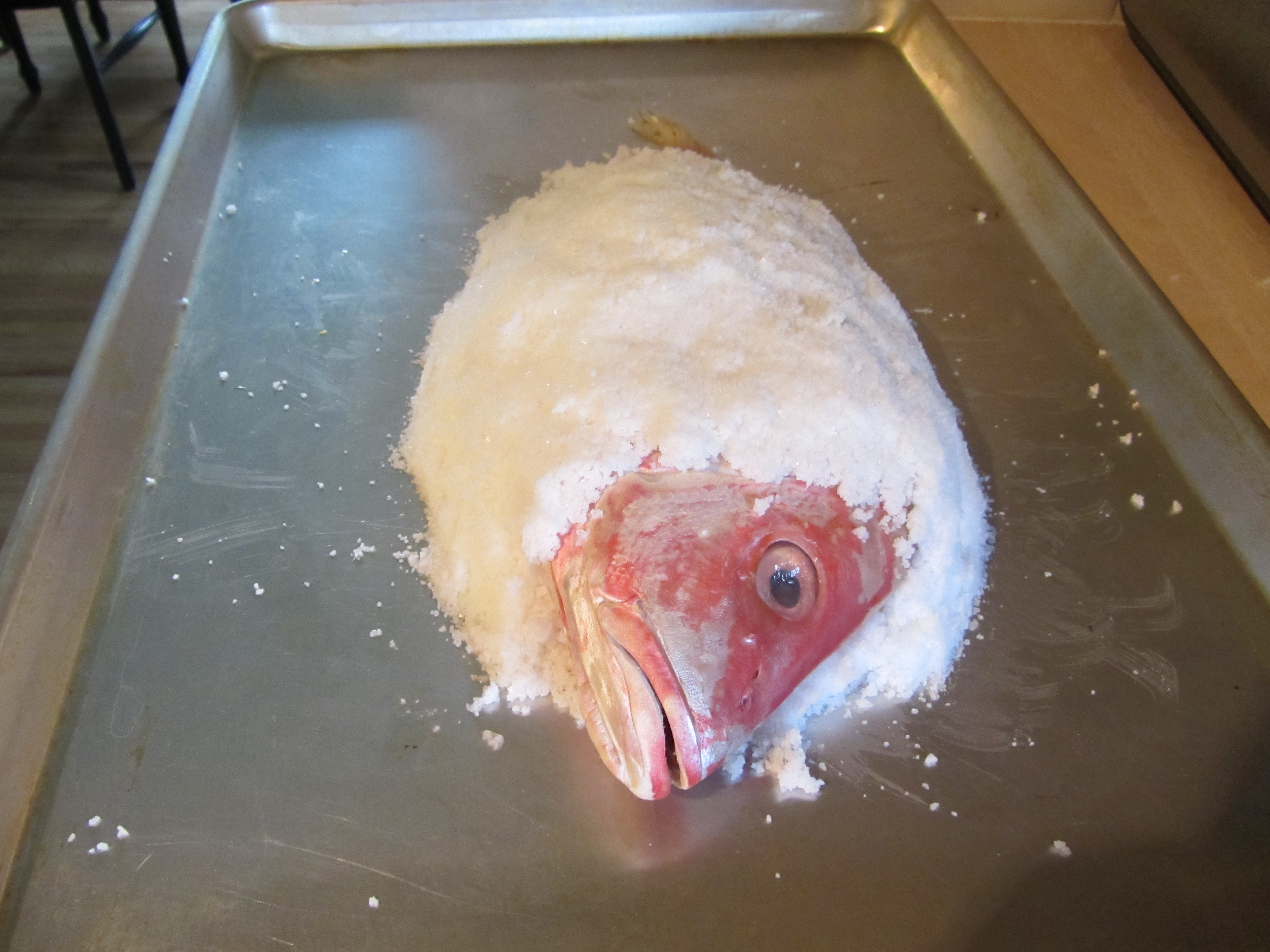
The remaining salt mixture is mounded over the fish’s body, forming a dome with only the head and tail visible. I had a little more salt than I needed, but I still had a healthy layer of salt all over my fish.

Fish in his salt dome, and ready for the oven.

Fish in his salt dome, and ready for the oven.

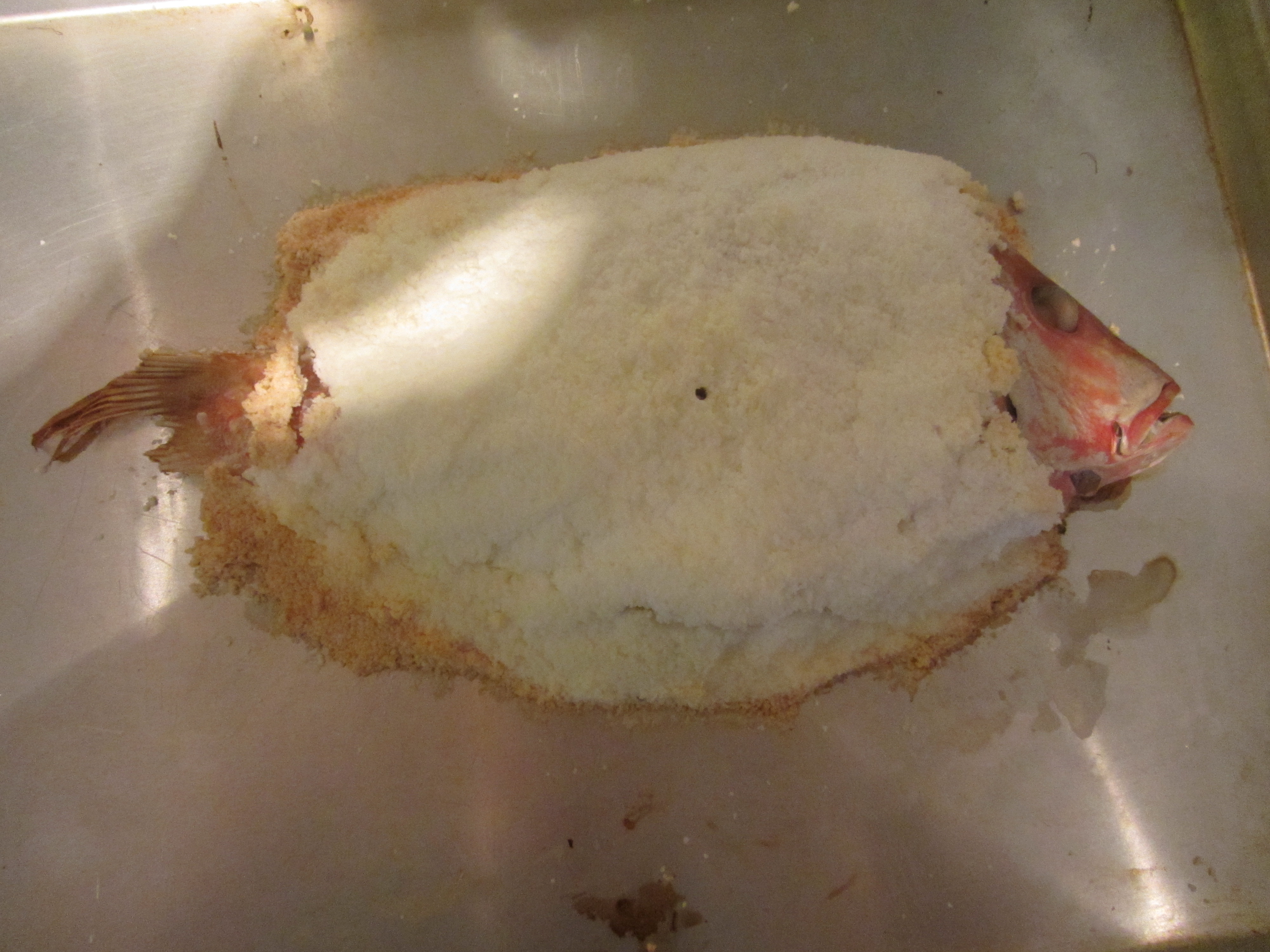
I baked my fish at 450 degrees, checking it after 20 minutes, and it happened to be done. You want to cook your fish to a temperature of about 130-135 degrees (you can take the temperature of the fish straight through the salt dome).

Post-baking.

Post-baking.

I let my fish rest for about 5 minutes before beginning to remove my salt dome. In the episode, Alton suggests using a mallet or hammer to crack your dome, but I simply used the serrated edge of my pie server (the tool Alton recommends to use for serving the fish) to form a crack along the front of the dome. I was nervous that my dome would shatter into a million messy pieces, but the lid lifted off in one beautiful piece, revealing a perfectly cooked Red Snapper inside.

Salt dome removal.

Salt dome removal.

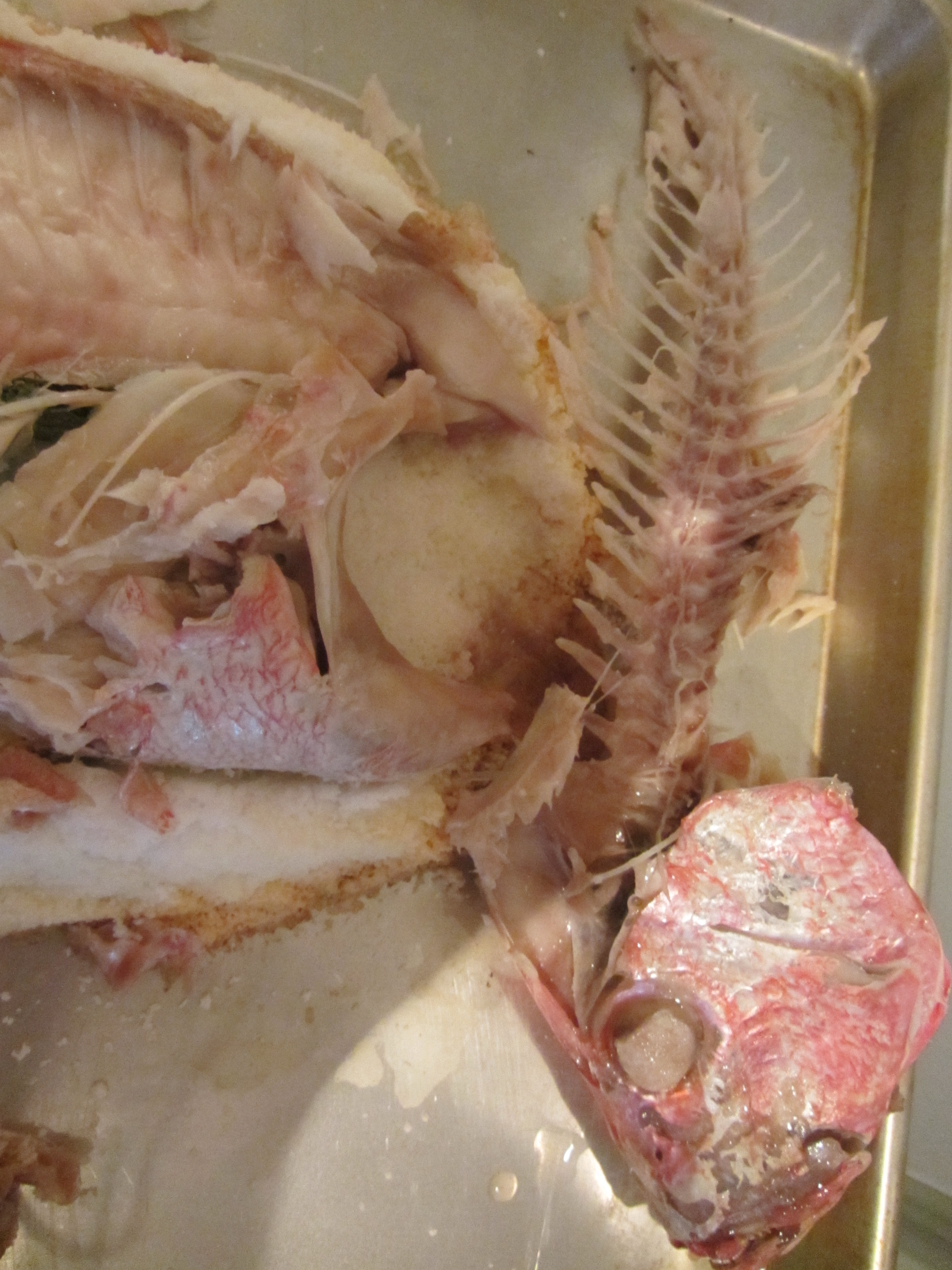
At this point, you remove the skin from your fish and cut the meat from the top half of the fish. You grab the fish’s tail, give it a twist, and the bones should lift out in one big piece. This actually worked seamlessly for me, and, as a bonus, the head popped right off with the bones, which meant I no longer had that creepy eye looking at me. Once the bones are removed, you have access to the bottom half of the fish, which you can lift right off the skin for easy serving.

Bones came out in one easy twist.

Bones came out in one easy twist.

Completed fish, served with lemon.

Completed fish, served with lemon.

Ted, my parents, and I all thought this fish was a big success. The fish itself was moist, and the flavors of the various aromatics really came through. I particularly tasted the dill and fennel. Ted and my mom commented that they thought the fish had a hint of saltiness, but it was far from salty. Lemon wedges were the only adornment needed. I served the fish alongside couscous with currents and almonds, and a minted pea salad. This recipe intimidated me a bit at first, but it was super easy and delicious, and the presentation is fun. This is one I will be making again.

Pan Fried Fish

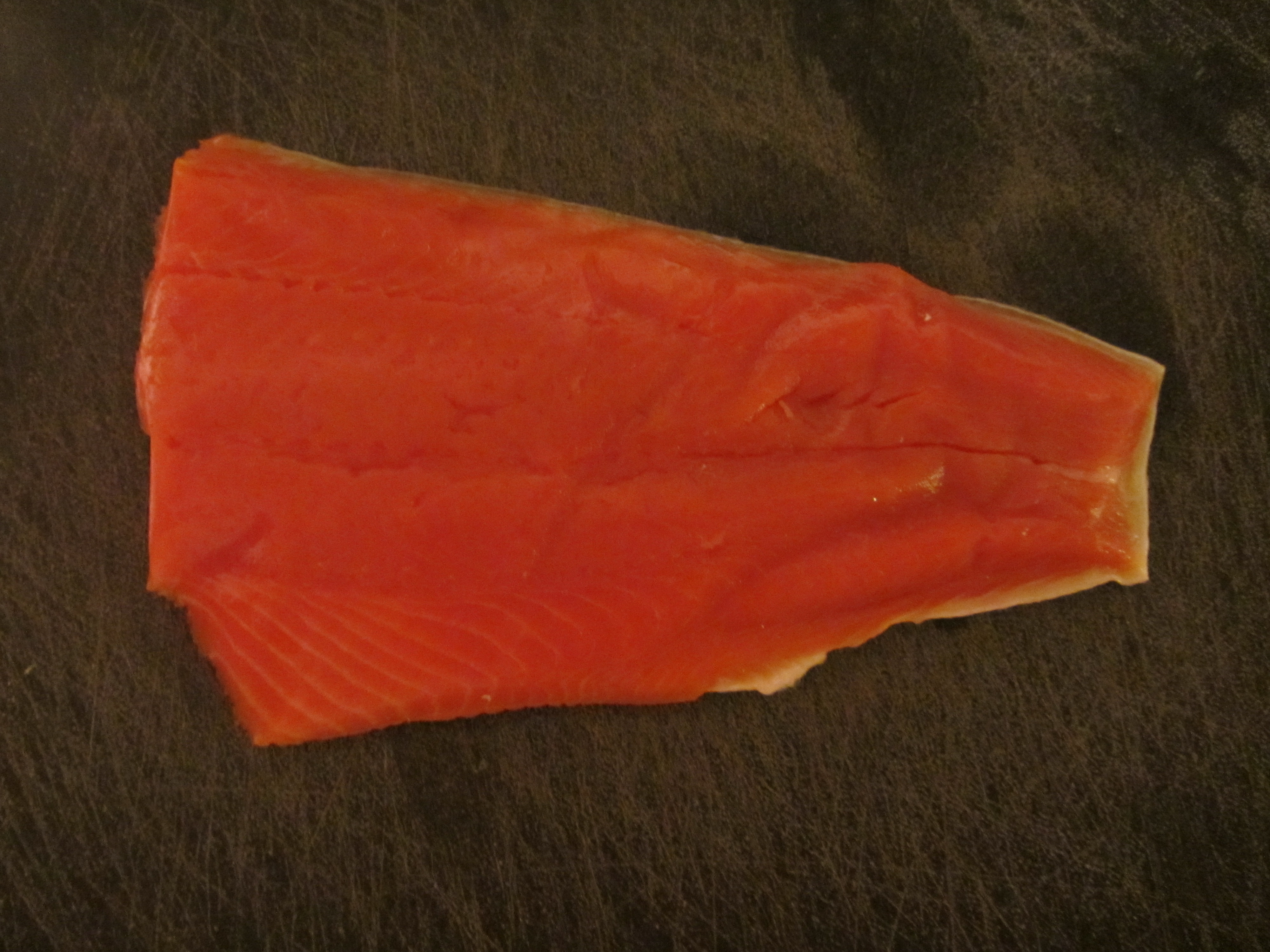
The second recipe in the 10th episode is for Pan Fried Fish. For this recipe, you use a fillet of fish, and we happened to have some frozen Copper River Salmon fillets on-hand.

Copper River Salmon fillet.

Copper River Salmon fillet.

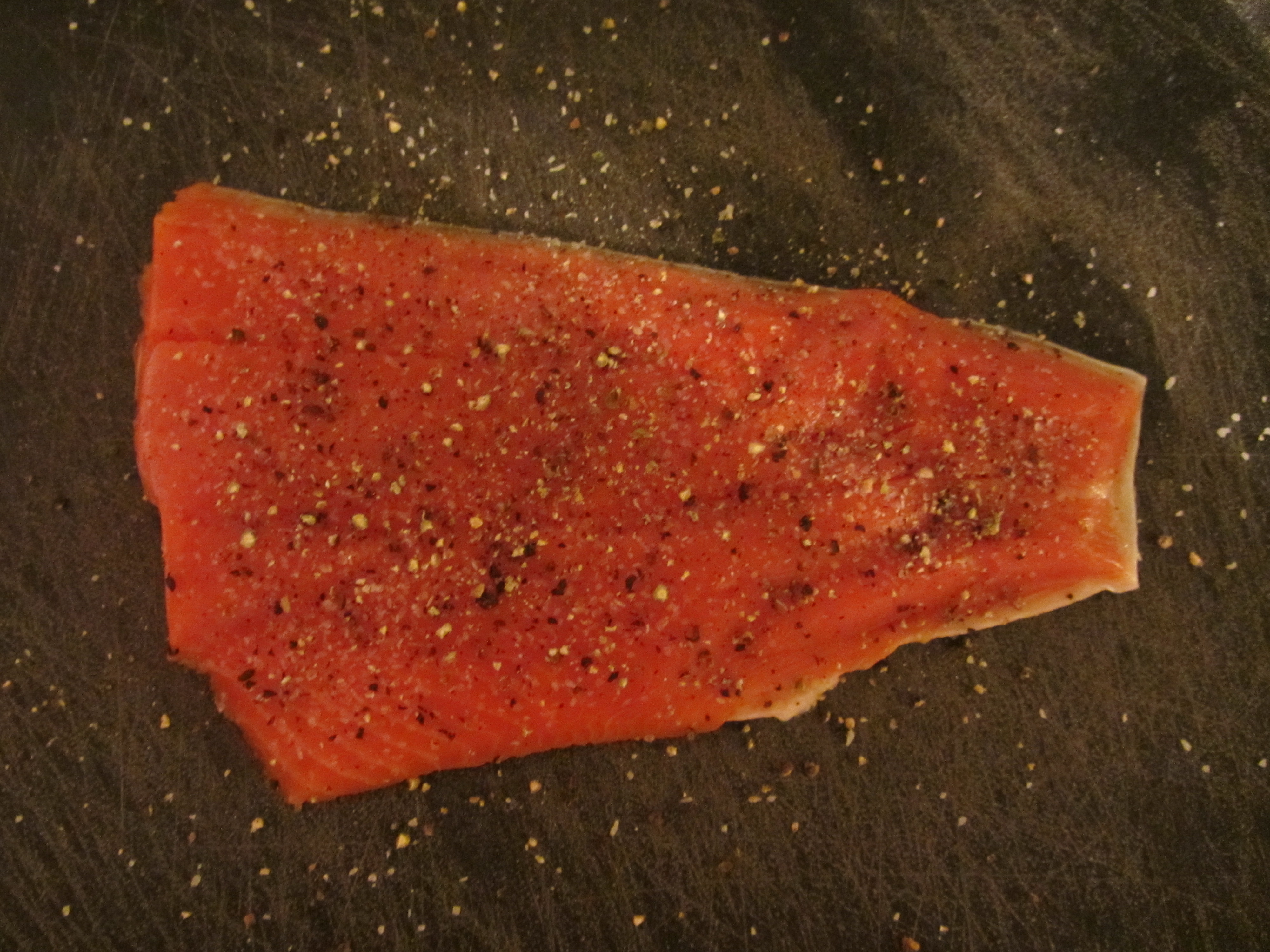
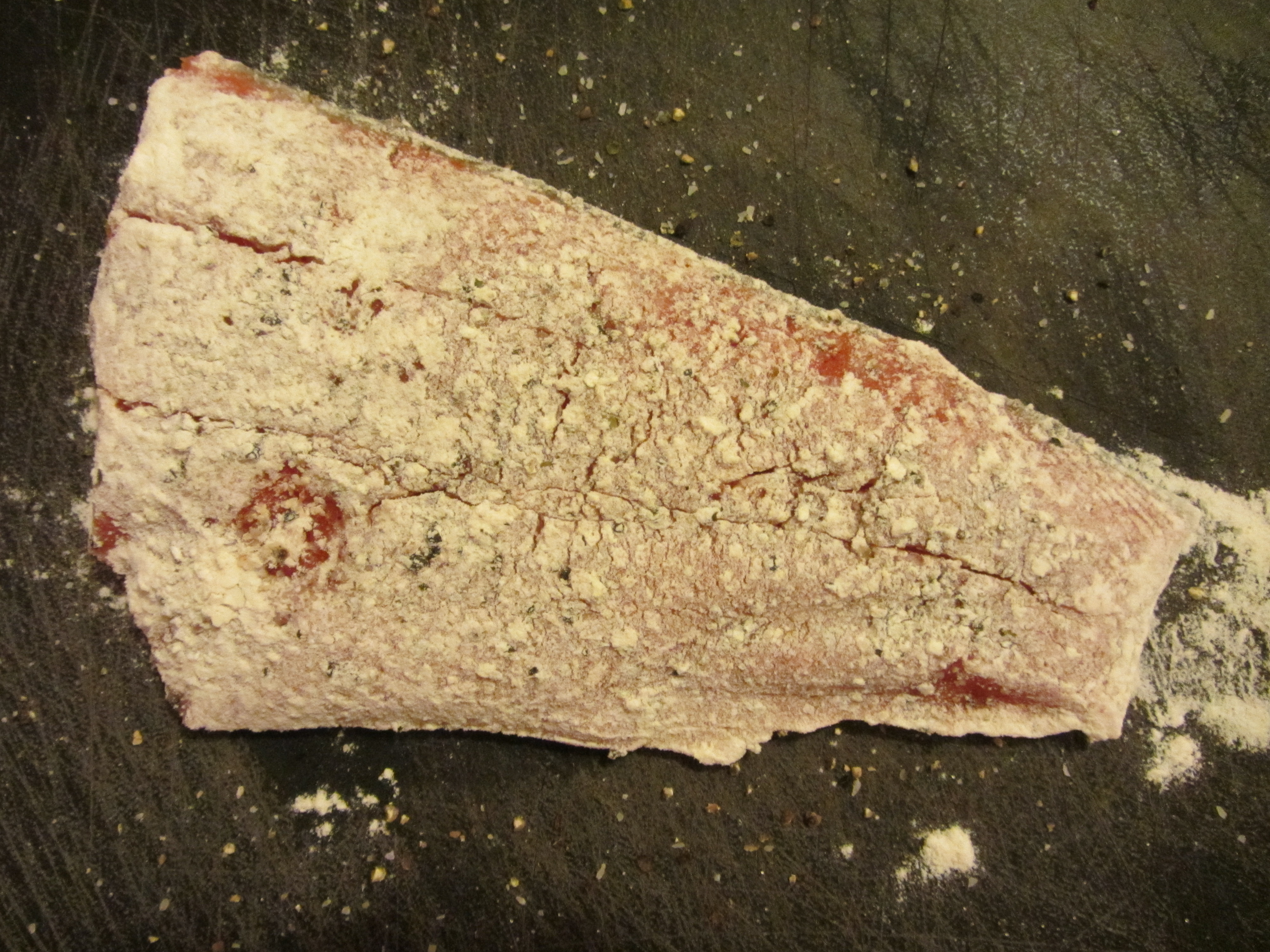
You season your fillet with salt and pepper and dredge it in flour.

Fillet seasoned with salt and pepper.

Fillet seasoned with salt and pepper.

Fillet dredged in flour.

Fillet dredged in flour.

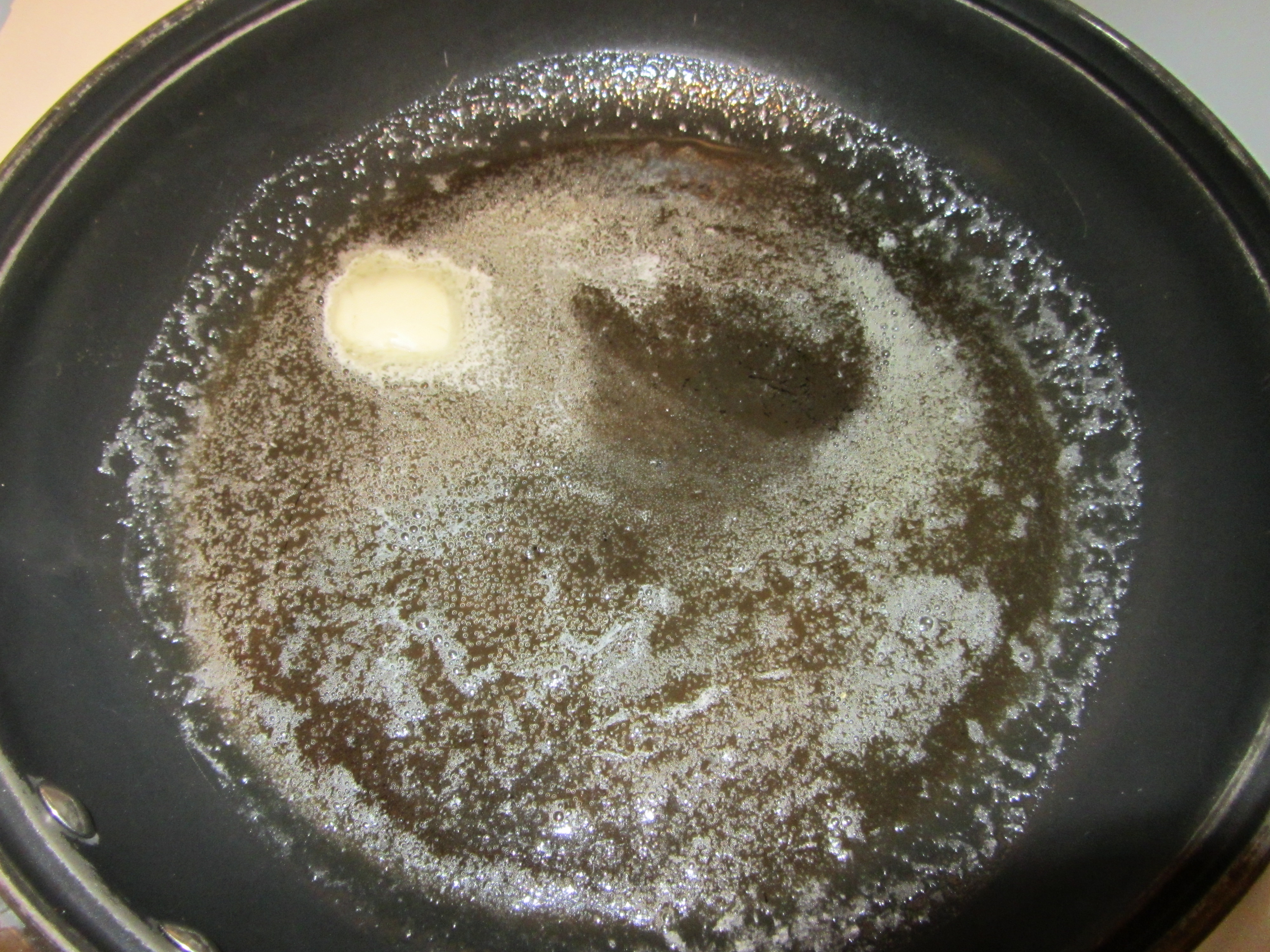
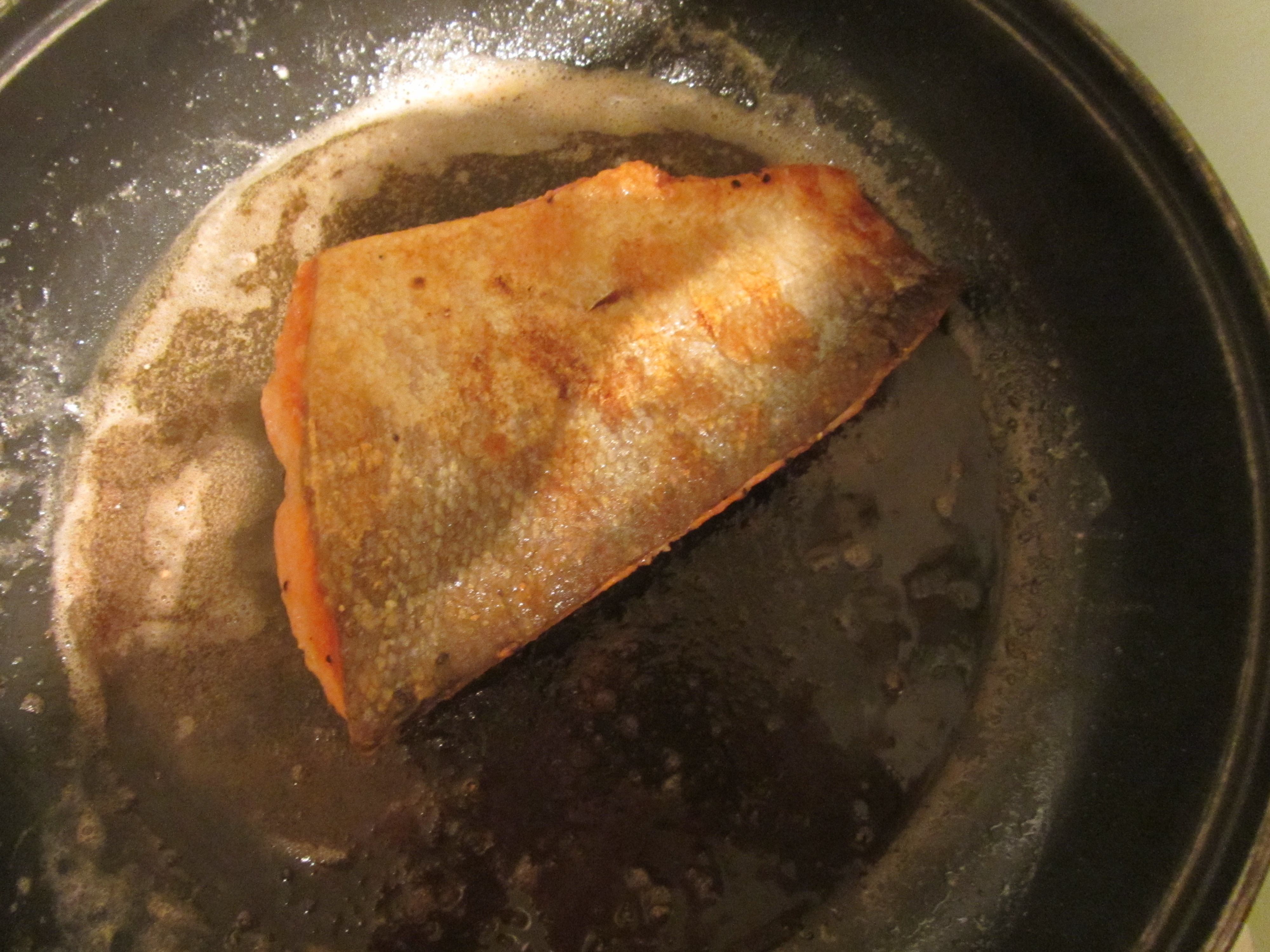
Meanwhile, you heat Canola oil in a skillet, along with some butter. Once the butter has ceased foaming, you put your fillet into the pan.

Butter and oil in the pan.

Butter and oil in the pan.

Fish in the pan.

Fish in the pan.

Alton emphasizes that you want to jiggle the pan for a few seconds to keep the fish from sticking. Once the fish is golden, you flip it to the other side, again jiggling the pan. 8-24-2014 021You want to cook the fish just until the muscles start to separate, and then remove it from the pan.

Fish after cooking.

Fish after cooking.

You pour out the fat, add additional butter to the pan, and fry some capers, which will visibly plump.

Caper and lemon sauce.

Caper and lemon sauce.

You remove the pan from the heat, add the juice of a lemon, and pour the caper sauce over the fillet.

Finished pan fried fillet.

Finished pan fried fillet.

Super easy, super fast, and super good! The fish paired with the briny capers and the tangy lemon makes an excellent combination. We tend to grill fish most of the time, but this is a great alternative.

Grilled Salmon Steaks

The final recipe from the 10th episode is for Grilled Salmon Steaks. I typically tend to prefer fillets to steaks simply because you do not have to deal with the bones when you have a nice boneless fillet. I recall a time when I was a freshman in college and I went to a party at a friend’s house. It was a BYOM (that’s Bring Your Own Meat) party. The grill would be fired up, but it was up to you to cook your meat at the party. I was not a huge red meat eater at this time, so I opted for salmon at the grocery store. I made the mistake of getting a salmon steak, rather than a fillet. Not knowing that I needed to prep the steak prior to grilling, I simply threw it on the grill as it was. I remember being very disappointed with the plethora of bones I encountered, and I made every effort to get fillets from there on out. Honestly, that may have been the last time I cooked a salmon steak prior to this recipe of Alton’s.

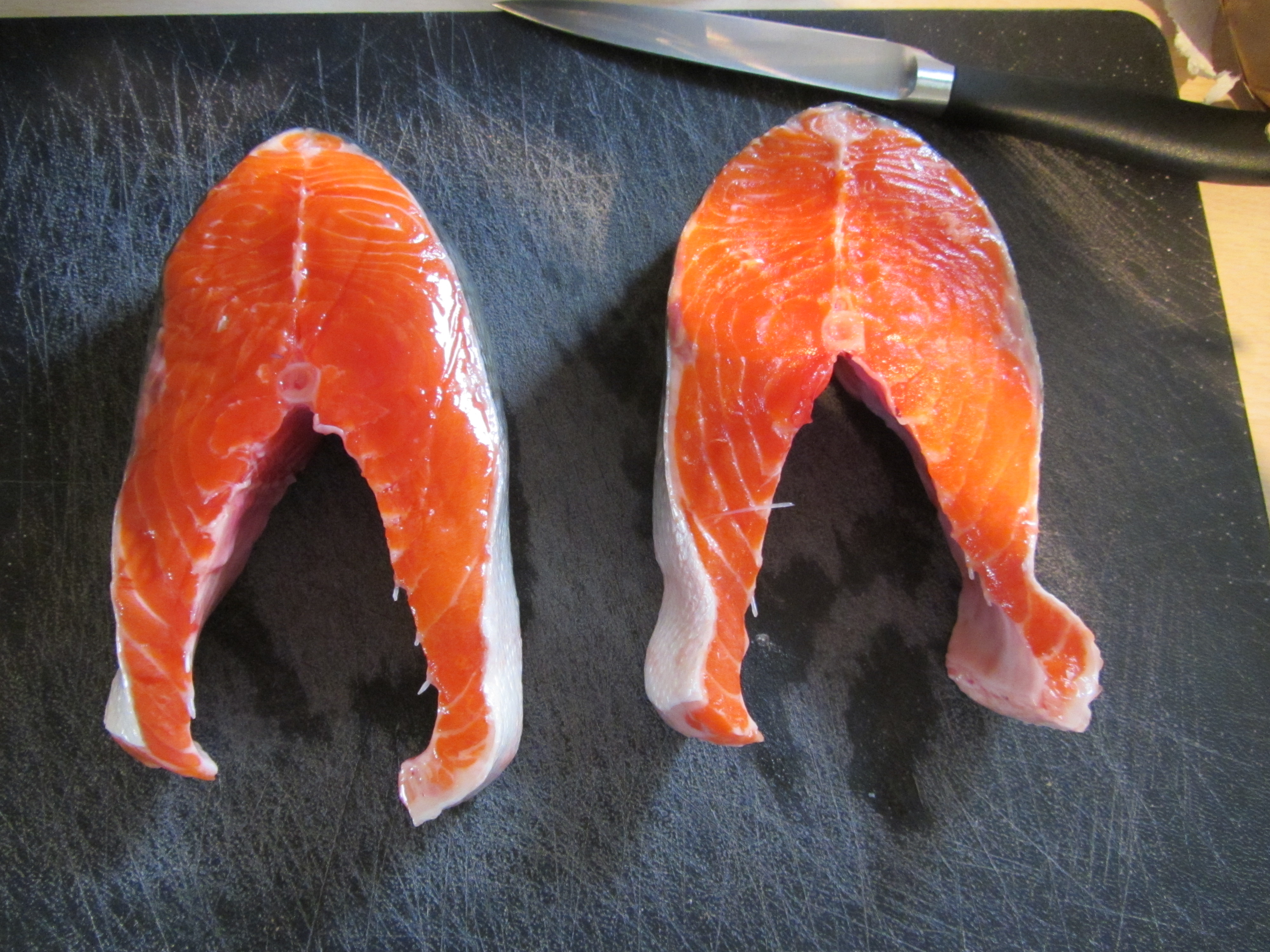
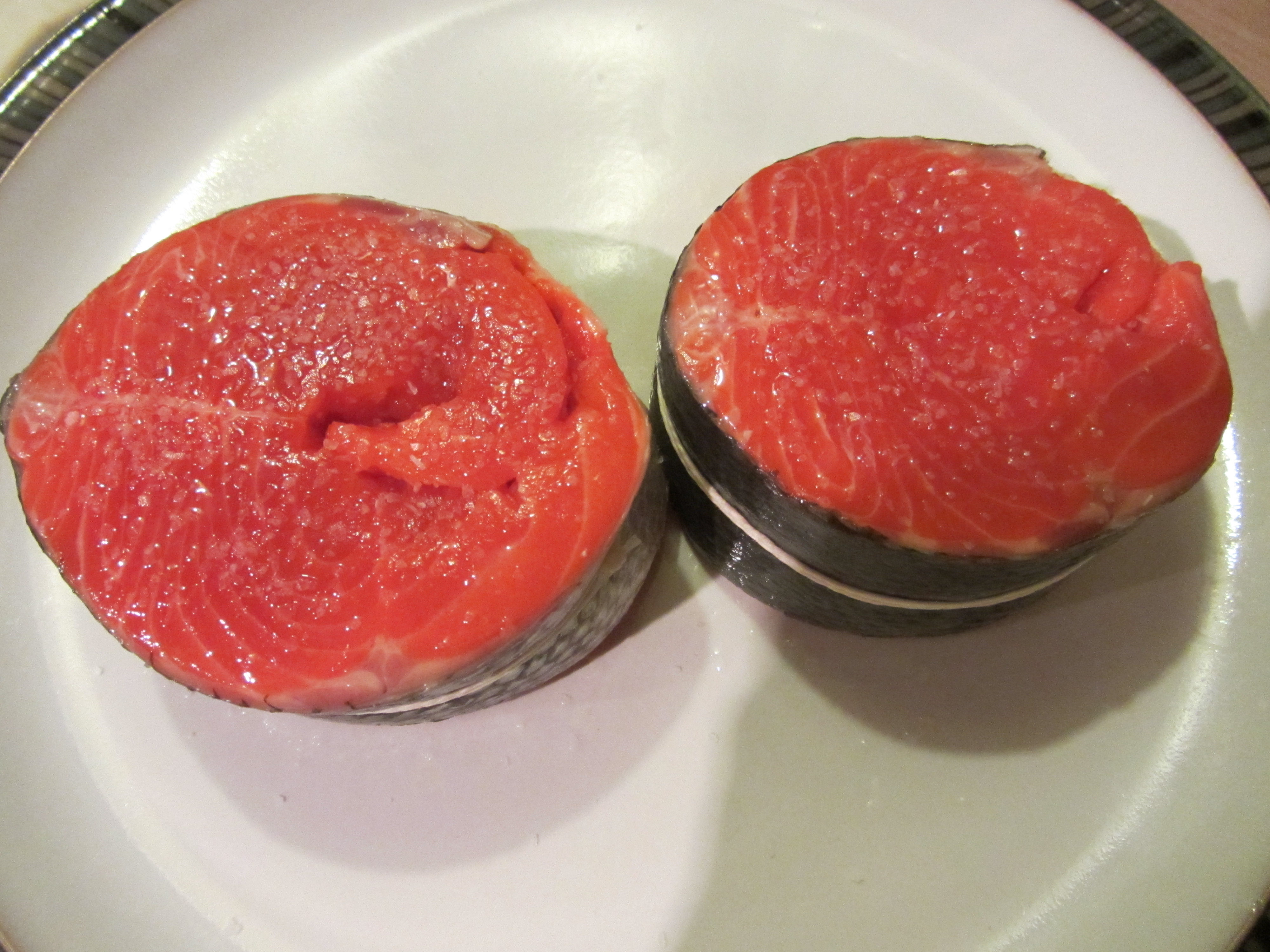
It was key to watch Alton’s preparation of the salmon steaks, as it was hard to visualize the technique from simply reading the online recipe. To begin, you run your fingers over the surface of the steaks, removing any pin bones with tweezers.

Salmon steaks.

Salmon steaks.

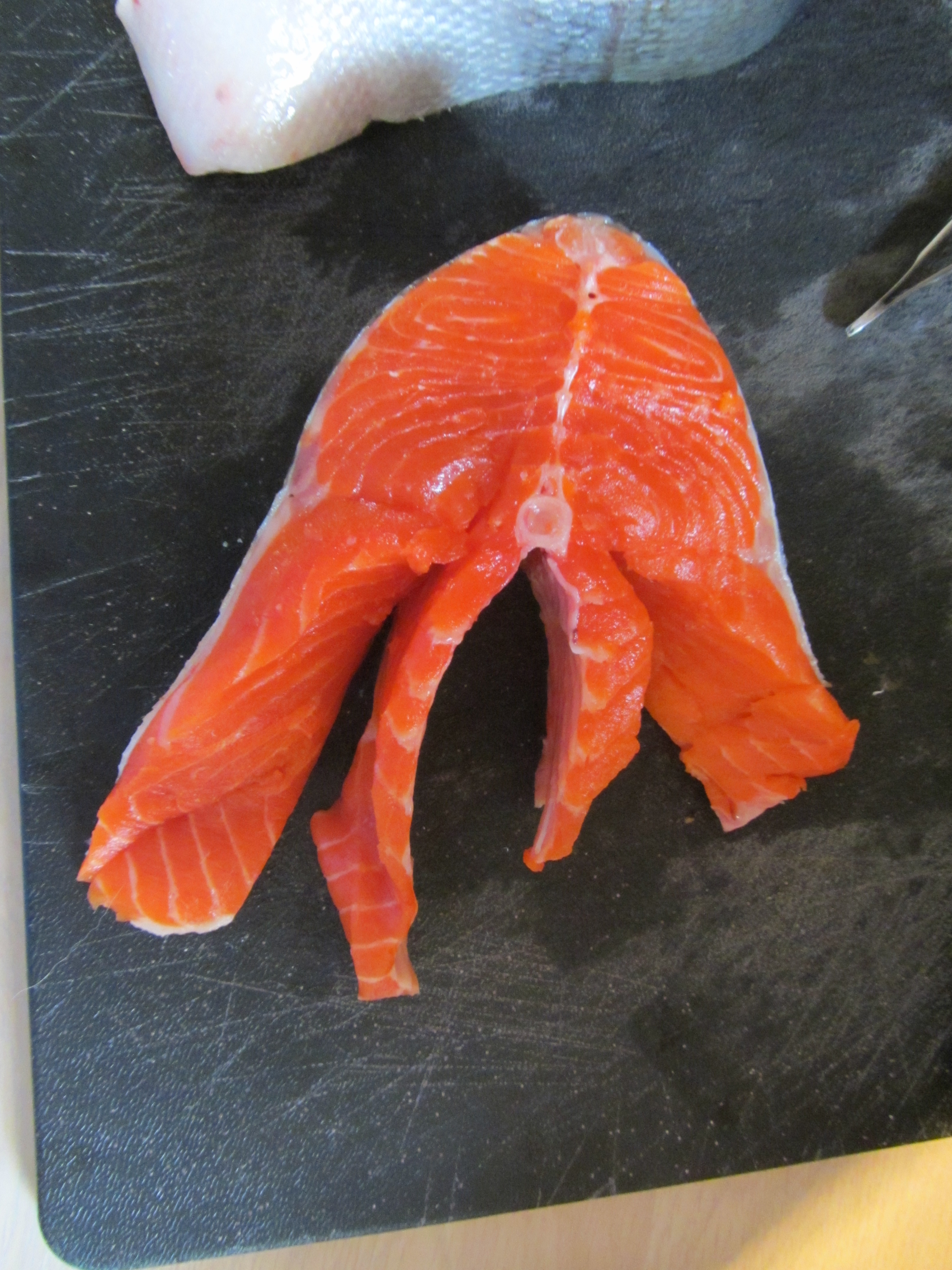
Now, some of these bones came out very easily for me, while others were real buggers. The next step is to trim the cavity sides of the steaks. You do this with a sharp knife, and then use scissors to cut out the bony center. At this point, Alton smoothly and seamlessly glides his blade down the stomach flaps, leaving one side without some skin and the other without some meat. This will allow the excess skin on the one flap to perfectly overlap the skinless meat on the other flap. This step was not quite so effortless for me, and I’m sure I hacked away more of the fish than I needed to, but I made it work.

Trimming the cavity side, and shortening the flaps.

Trimming the cavity side, and shortening the flaps.

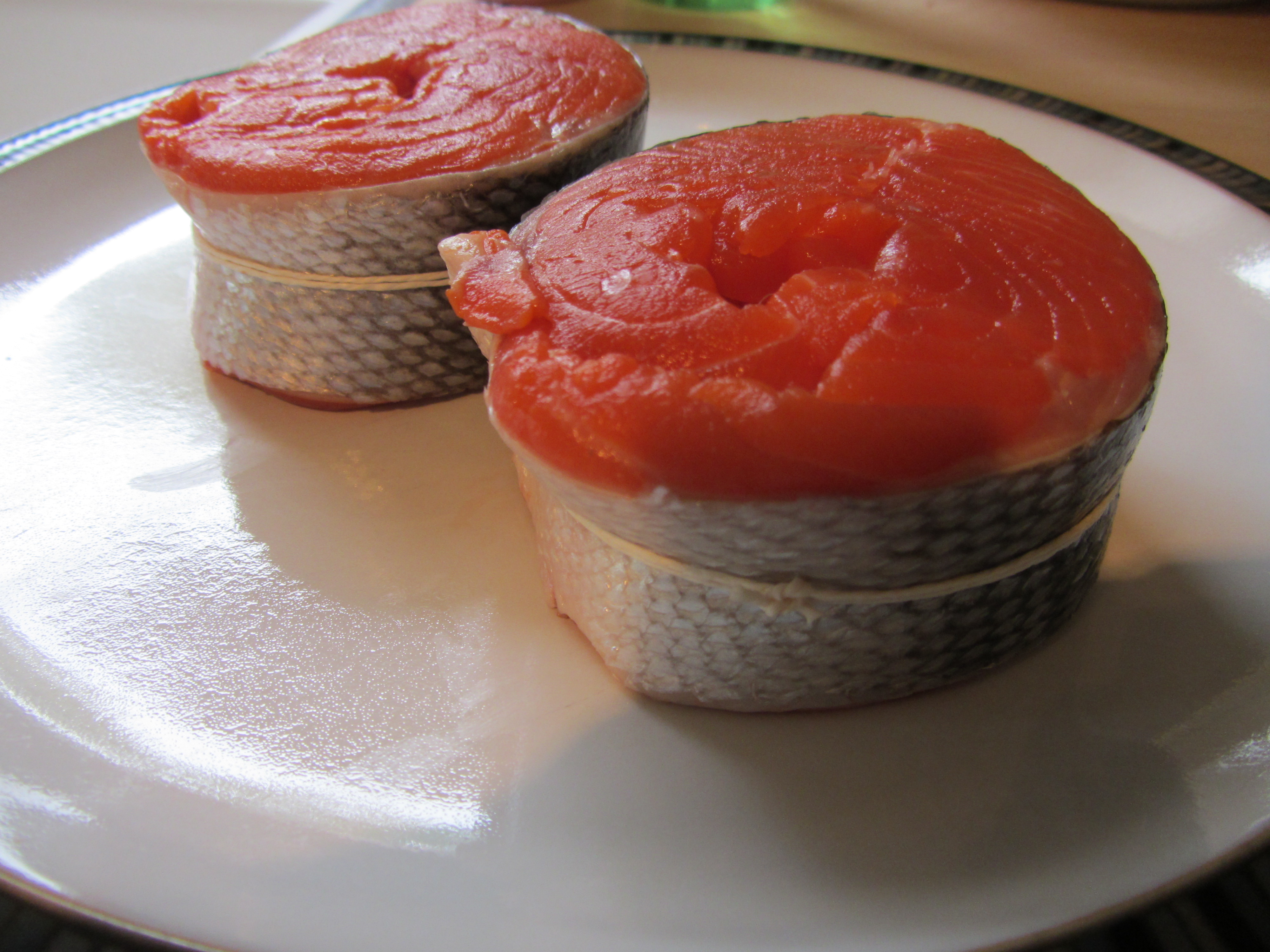
After this trimming, you roll the two flaps up into the center of the steak, overlapping the longer flap over the shorter flap, and you secure the round with butcher’s twine. I was actually quite surprised that my steaks looked as good as they did after this step. Mine had a bigger “hole” in the center than Alton’s did, but they otherwise looked pretty good.

Rolled up and secured with twine.

Rolled up and secured with twine.

8-24-2014 005 Once your steaks are tied, you make a seasoning blend of cumin seed, coriander seed, fennel seed, and green peppercorns. This blend is toasted over the grill, just until fragrant.

Cumin, fennel, coriander, and green peppercorns.

Cumin, fennel, coriander, and green peppercorns.

Prior to grilling the steaks, you coat them with oil (along with the grill), sprinkle them with some Kosher salt, and then liberally sprinkle them with a ground blend of the toasted seasoning mix. We had an extra pepper grinder in our kitchen, so I used that to grind the spices.

Oiled and salted steaks.

Oiled and salted steaks.

Steaks with spice blend.

Steaks with spice blend.

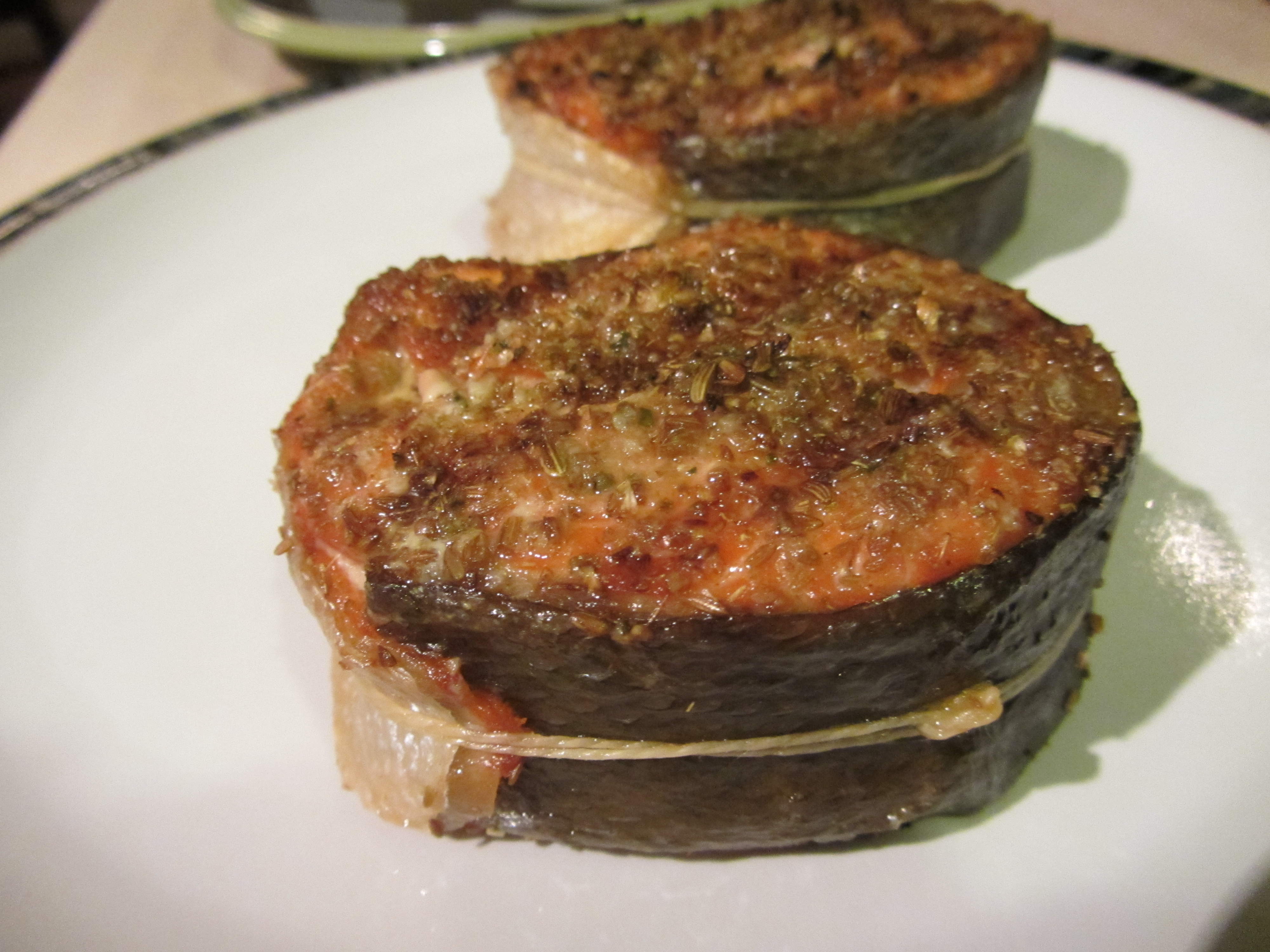
Alton tells you to grill the steaks for approximately three minutes per side, but I found that my steaks took a few minutes longer than that. Once done grilling, you simply cut the twine with scissors, and the skin comes right off with the twine.

Steaks after grilling.

Steaks after grilling.

The skin came off easily with the twine.

The skin came off easily with the twine.

Grilled steak.

Grilled steak.

Ted and I were both surprised at how good we thought these steaks were. The fish was moist and the spice blend paired excellently with the salmon. There were almost no bones in either of our steaks. Though the recipe first appeared to be labor-intensive, it really was pretty easy to execute, and with further practice it could be a quick go-to for grilled salmon.


French Onion Soup

I’m not gonna lie – I was excited when I saw that Alton’s French onion soup was next on the agenda. I have loved French onion soup since I was a kid, even vaguely recalling the first time I had it. I was in a restaurant with my parents and brother (I believe it was a restaurant called Jonathan’s, but I may be wrong on the location) and my parents encouraged me to try onion soup. When I saw the crock full of steaming broth, crusty bread, and bubbling cheese, I was not sure how to go about “attacking” it. My dad, describing the best onion soup he ever had, instructed me that the key to properly eating French onion soup is to be sure to get a bit of broth (and onion), bread, and cheese in every bite. Oh, and he also advised me to use the side of the crock to help to “cut” the cheese. It was love at first bite for me, and I, along with the rest of my family, have continued to love this classic soup ever since. Somewhere along the line, French onion soup even managed to become our go-to Christmas Eve meal. How? I don’t recall, but I know the idea was my mom’s… and that it was pure genius.

I have made a plethora of French onion soup recipes, including those from Julia Child (though delicious, I do not recommend this recipe if you plan a family outing in a confined car the following day), Thomas Keller, Tyler Florence, and Cook’s Illustrated. I am sure there have been others. Last weekend, I added Alton Brown’s recipe from Good Eats to this list.

I watched the 9th episode of Good Eats, taking notes on Alton’s preparation in the show. He strictly recommends using sweet onions (preferably Vidalias), or a combination of sweet and red onions. I opted to do the latter. Since I was making a double batch of soup, I ended up using about eight pounds of onions, with half being of each type of onion. Alton suggests using an electric skillet for the soup, but I do not have one, so I used a standard stockpot.

Per Alton’s instructions, I melted butter in my pan and added my sliced onions in layers, sprinkling Kosher salt over each layer.

Melting butter

Melting butter

First layer of sweet onions in the pan.

First layer of sweet onions in the pan.

Combination of sweet and red onions, along with salt.

Combination of sweet and red onions, along with salt.

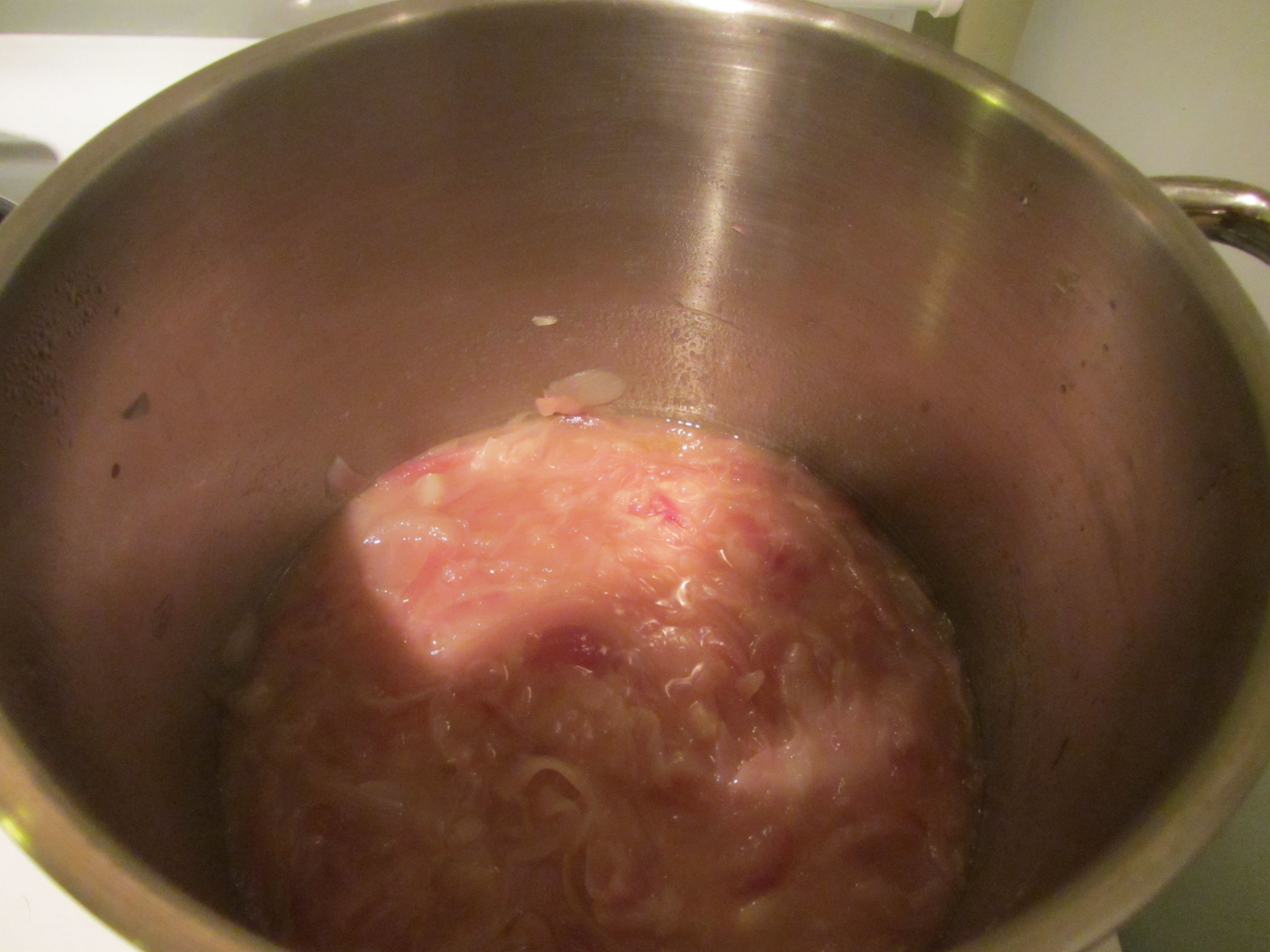
After the onions sweated for a while, I began stirring them every 15 minutes until they had drastically cooked down and were caramelized to a dark brown. This took at least a couple hours for my onions.

Onions beginning to cook down.

Onions beginning to cook down.

8-12-2014 010

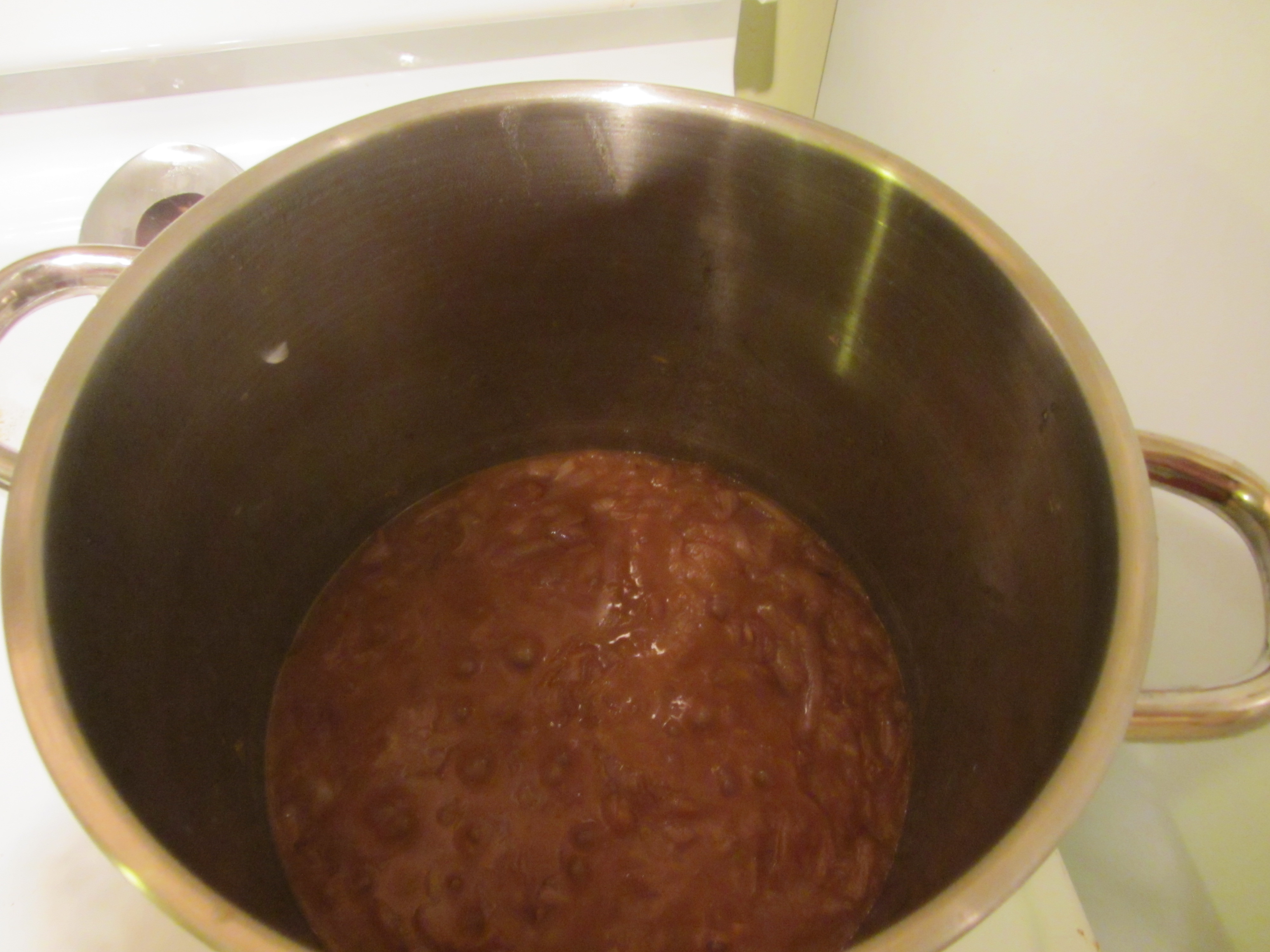
Onions after a couple hours on the stove.

Onions after a couple hours on the stove.

Once cooked down, I covered the onions with Gewurztraminer (Alton recommends this or a Chardonnay), and allowed the wine to cook down to a syrup-like state.

Wine to add to my onions.

Wine to add to my onions.

Onions with wine.

Onions with wine.

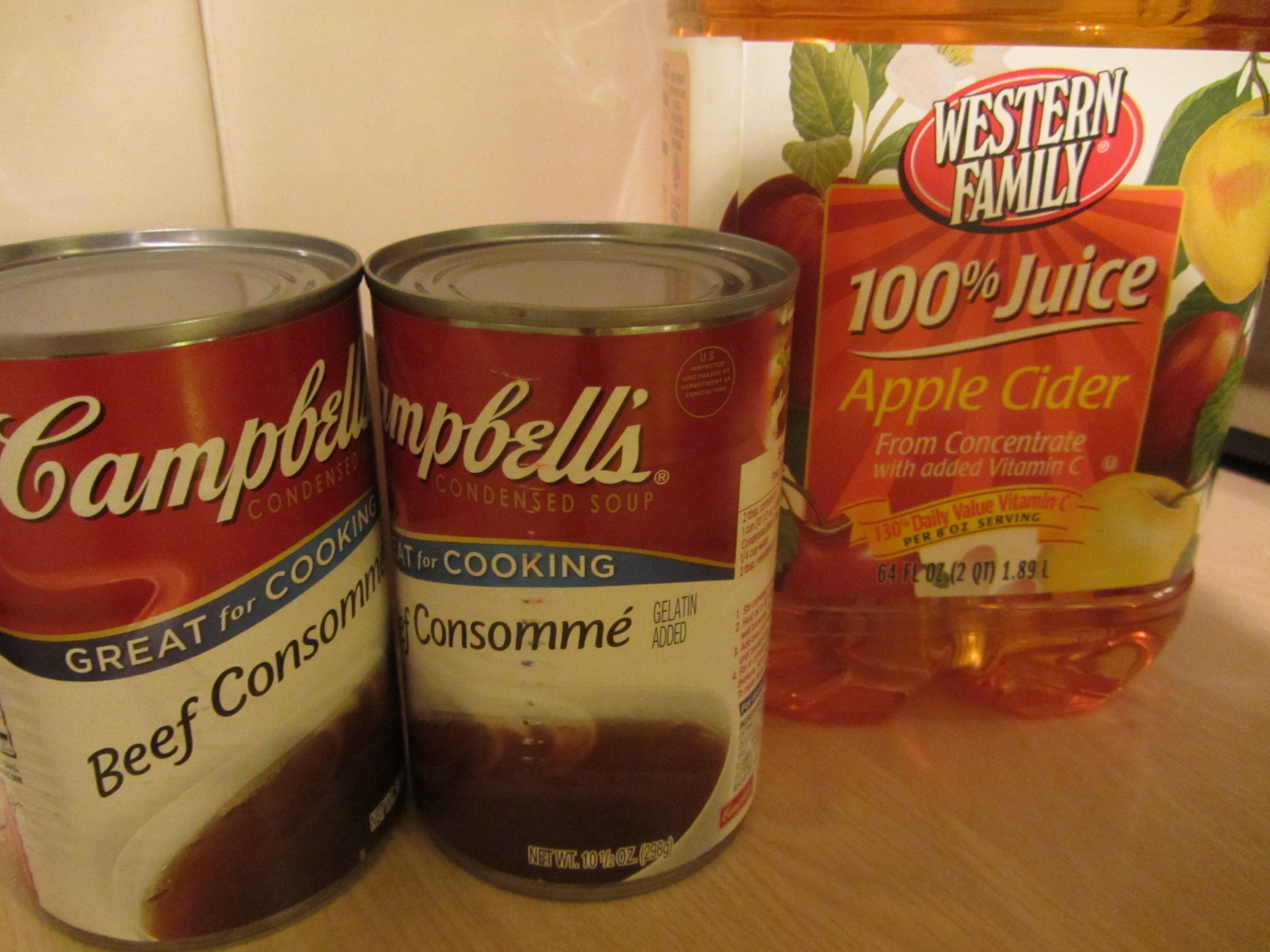
At this point, the remaining liquids were added:  beef consomme, chicken broth, and apple cider; in the show, Alton says it does not matter whether the cider is filtered, so I used filtered cider.

Beef consomme and apple cider. Not pictured:  chicken stock.

Beef consomme and apple cider. Not pictured: chicken stock.

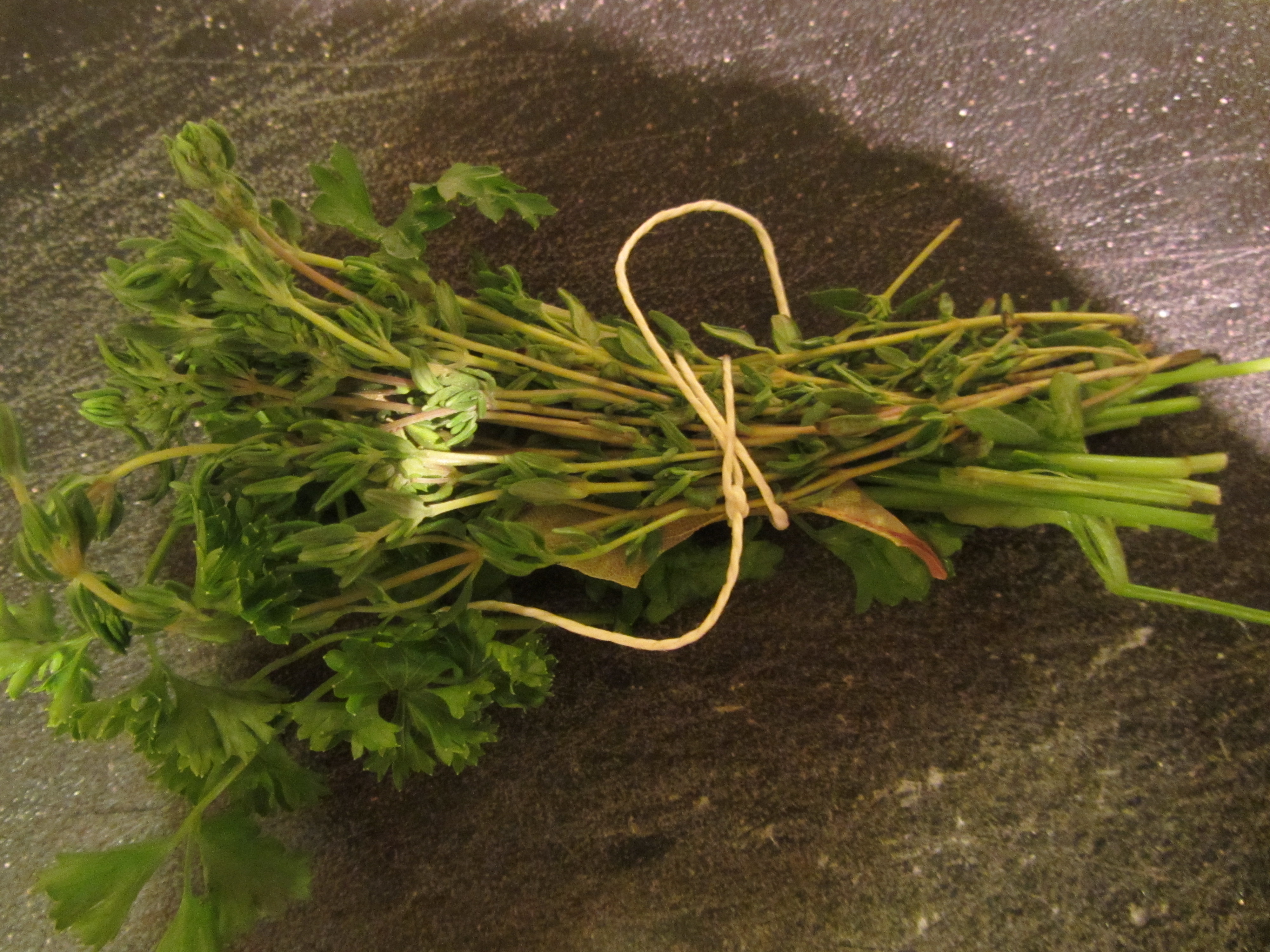
The bouquet garni is also tossed in at this point, and the soup is simmered to allow the flavors to combine.

Bouquet garni of thyme, parsley, and a bay leaf.

Bouquet garni of thyme, parsley, and a bay leaf.

After simmering, the soup is seasoned with Kosher salt, pepper, and Cognac.

Completed soup, simmering.

Completed soup, simmering.

To serve, the soup is topped with toasted bread (toasted under the broiler), grated Parmesan, and sliced Fontina. The bowls go back under the broiler until the cheese is melted and bubbly, and voila!

Bread to be toasted under the broiler.

Bread to be toasted under the broiler.

Soup with bread on top.

Soup with bread on top.

A combination of cheeses to top the soup.

A combination of cheeses to top the soup.

Parmesan and Fontina cheeses on the soup.

Parmesan and Fontina cheeses on the soup.

The completed soup.

The completed soup.

I shared some of this onion soup with my parents, and Ted and I had it twice for dinner. My parents felt that the soup was a bit too sweet, but we did not think the same. To me, all onion soups are sweet, and this one actually had a nice tang on the finish. Perhaps it was the cider that my parents did not much care for. Overall, I thought this was a very good French onion soup. It was far less labor-intensive and time-consuming than some others I have made, but it still had well-developed flavors. I also really liked the combination of Parmesan and Fontina to top the soup. Traditionally, my mom always topped her soup with Gruyere or Emmentaler, but I think I maybe liked Alton’s combination more. Alton’s recipe is quite different from some of the others I have had, using white wine and chicken stock, as opposed to red wine and beef stock. The addition of cider is another twist. I think that the flavor of the actual onions shone more with Alton’s recipe, as the onions were not overpowered by liquids in the soup, and the soup still had a nice “bite” to it. I think it is safe to say that we will be turning to this recipe again in the future… Christmas Eve, perhaps?

This post is far overdue. I suppose Summer has gotten the best of me! Without further ado, here is my recap of the recipes featured in the eighth episode of Good Eats, featuring gravy.

I was not raised on gravy. Yes, you read that correctly. Our family did not eat gravy at holidays. While there was a place on our Thanksgiving dinner table for sauerkraut, gravy rarely, if ever, made an appearance. I realize this is a rarity in our country. The funny thing is, I did technically eat gravy as a child… it just wasn’t called gravy! My grandma and my mom would make Chipped Beef or “Shit on a Shingle (SOS)” for us, and it was one of my very favorite breakfasts. I never realized I was eating gravy because SOS was, to me, its own entity. Every time I eat Chipped Beef I recall eating it at Grandma’s house with my brother, Rusty, and my cousins, Jimmy and David. I have gone on to make SOS for my husband, and it remains a family favorite to this day. I guess this proves that gravy, or SOS, or whatever you choose to call it, truly is comfort food.

White Roux

The first recipe featured in the 8th episode of Good Eats is for White Roux. Alton explains that the white roux is the thickener used in the actual gravy recipe. While the online recipe uses 4 T of fat and 6 T of flour, Alton uses equal portions of fat and flour (by weight) in the episode. I used 2 oz. of butter and 2 oz. of flour.

Two ounces of butter and two ounces of flour.

Two ounces of butter and two ounces of flour.

The butter is melted in a pan, and the flour is added to the pan, whisking until the mixture is combined and starts to thin.

Melted butter.

Melted butter.

Flour added to melted butter.

Flour added to melted butter.

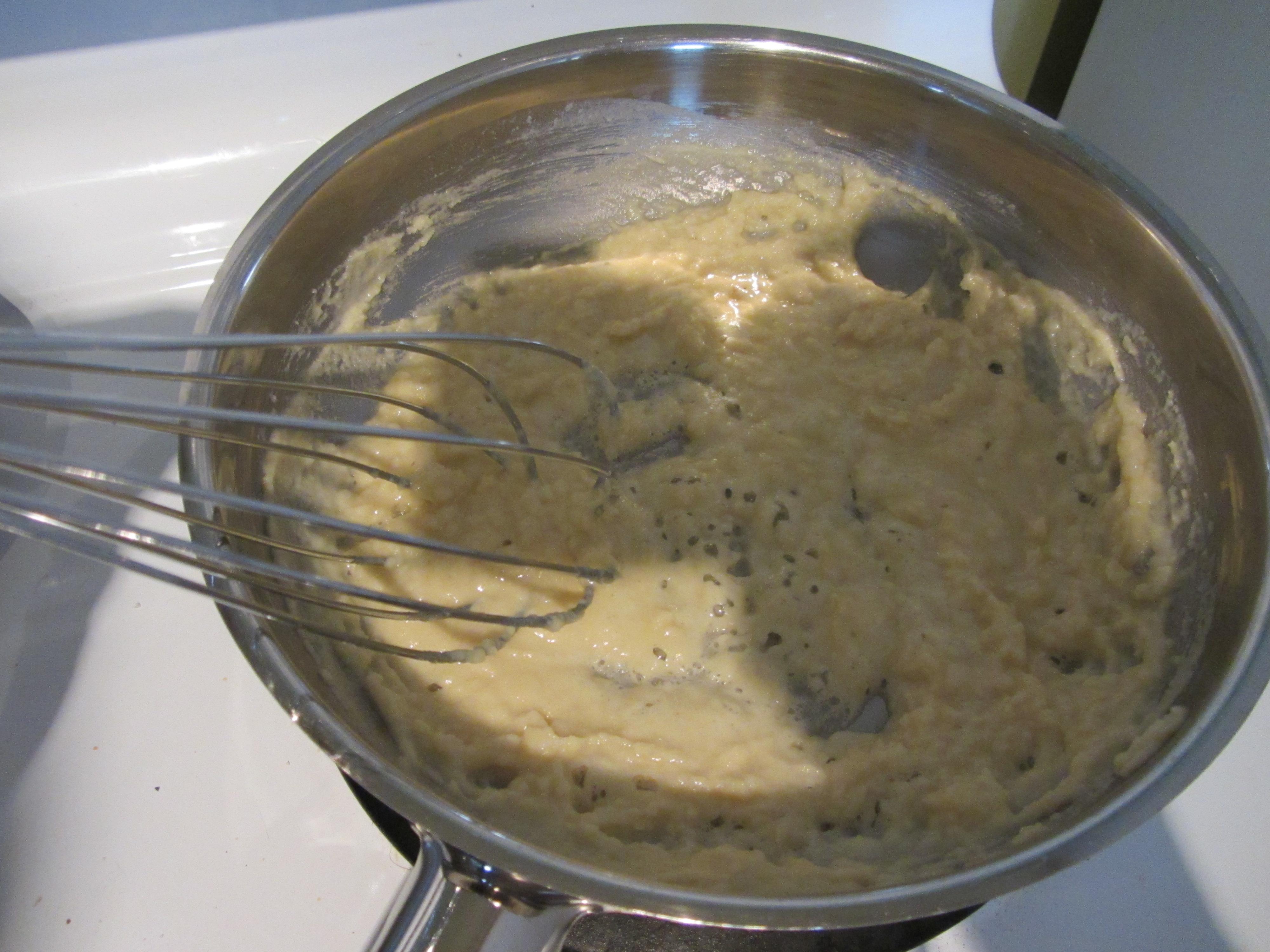
At this point, the heat is reduced and the roux is cooked until it smells as if it has been toasted.

Completed white roux.

Completed white roux.

A key note is that the roux should be used to thicken a liquid of opposite temperature; so, a hot roux should be combined with a cool liquid, while a cool roux should be used to thicken a warm liquid.

Gravy from Roast Drippings

The primary recipe in the eight episode is for a gravy made from roast drippings. Since this recipe uses drippings from a roast, I roasted a pork tenderloin to get some drippings. Since tenderloin is such a lean cut of meat, there was not a large yield of drippings, so a different cut of meat with a greater fat content may have been better suited for making this gravy.

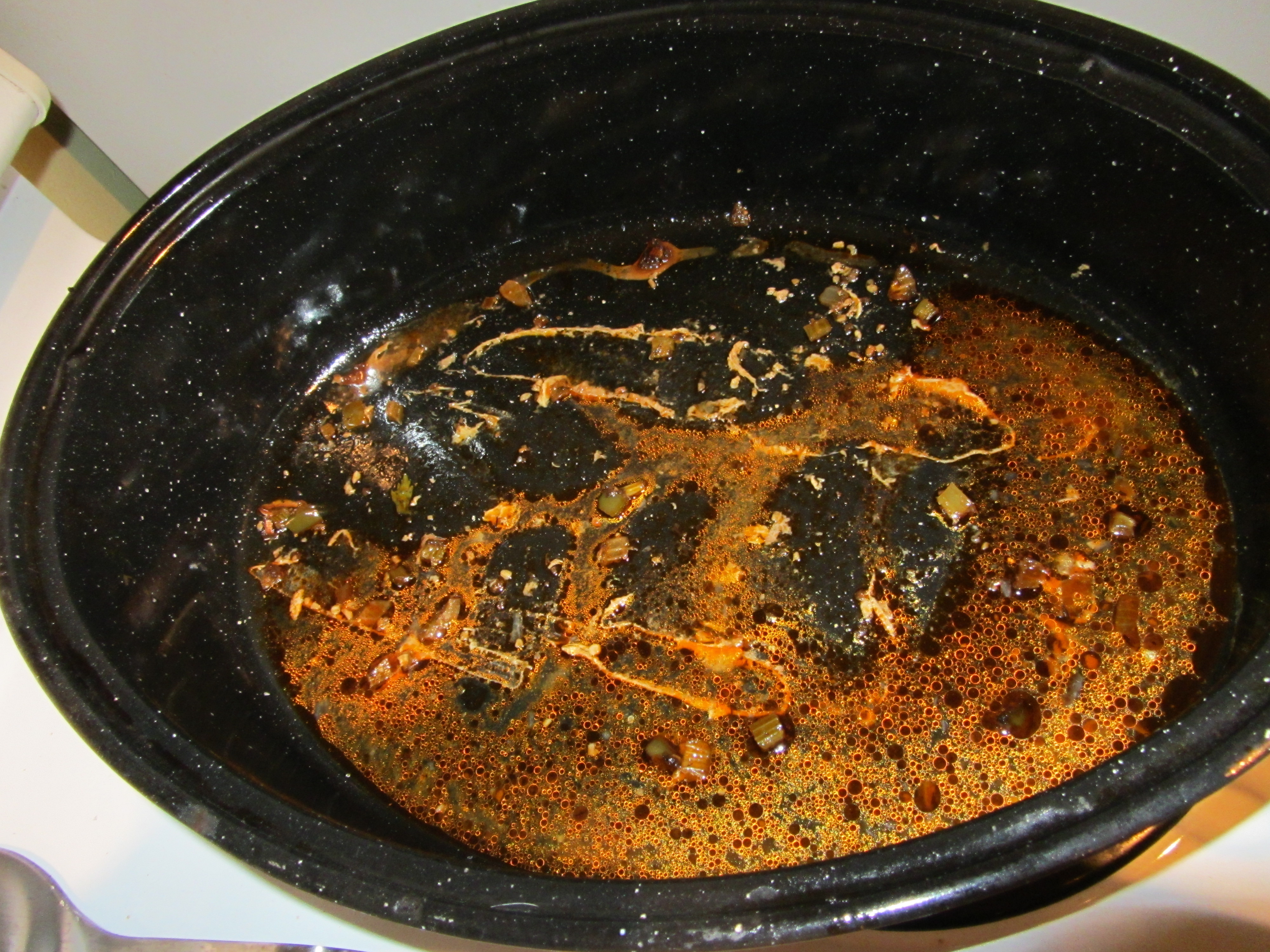
Pan drippings from pork tenderloin roast.

Pan drippings from pork tenderloin roast.

Following the recipe in the episode, Alton instructs you to deglaze the pan (with drippings), using red wine.

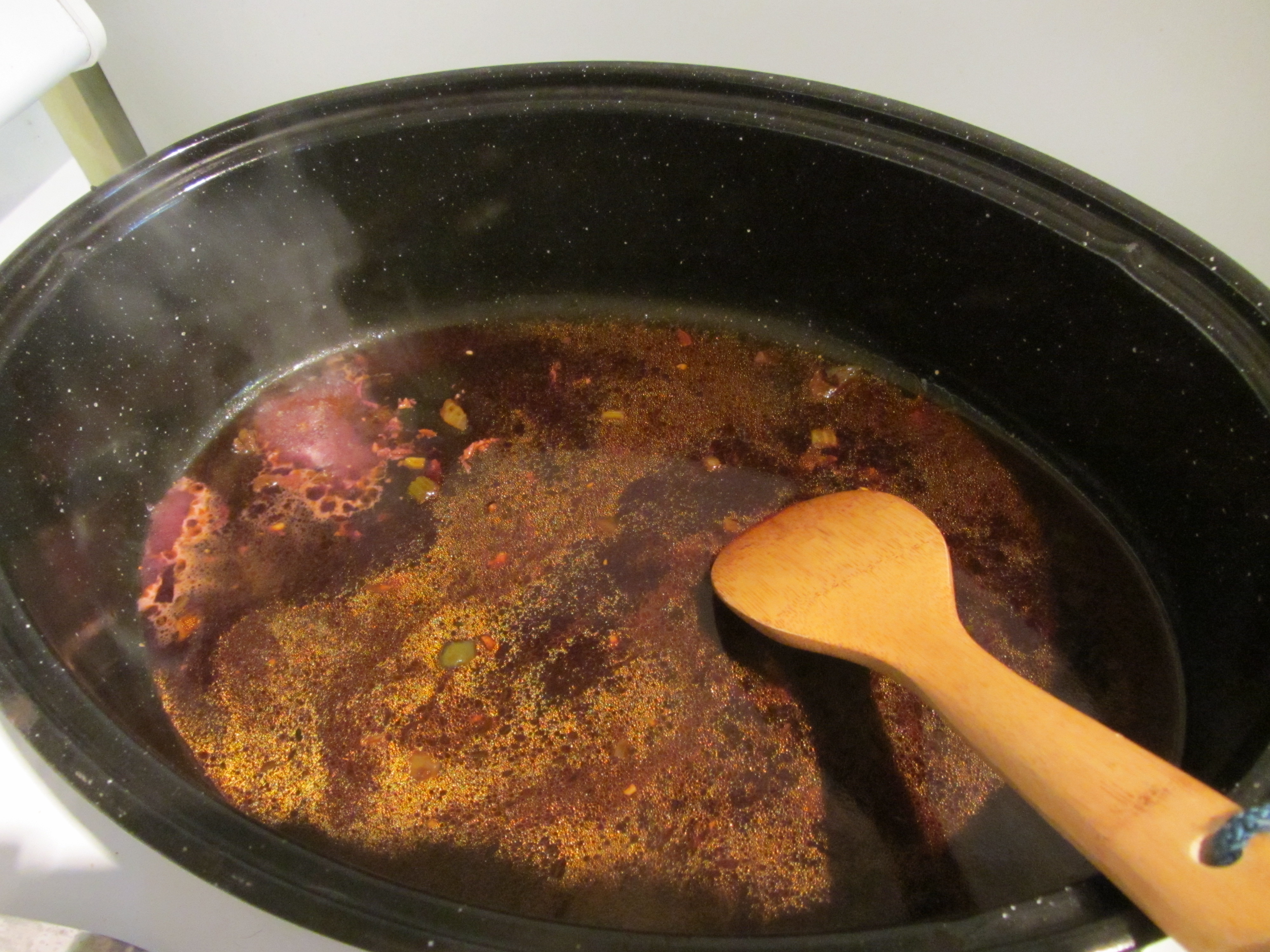
Deglazing the pan with red wine.

Deglazing the pan with red wine.

This liquid is then strained into a pan, and the broth (low-sodium is specified in the episode), bay leaves (2), and peppercorns are added. This liquid is reduced to approximately 2 1/4 C.

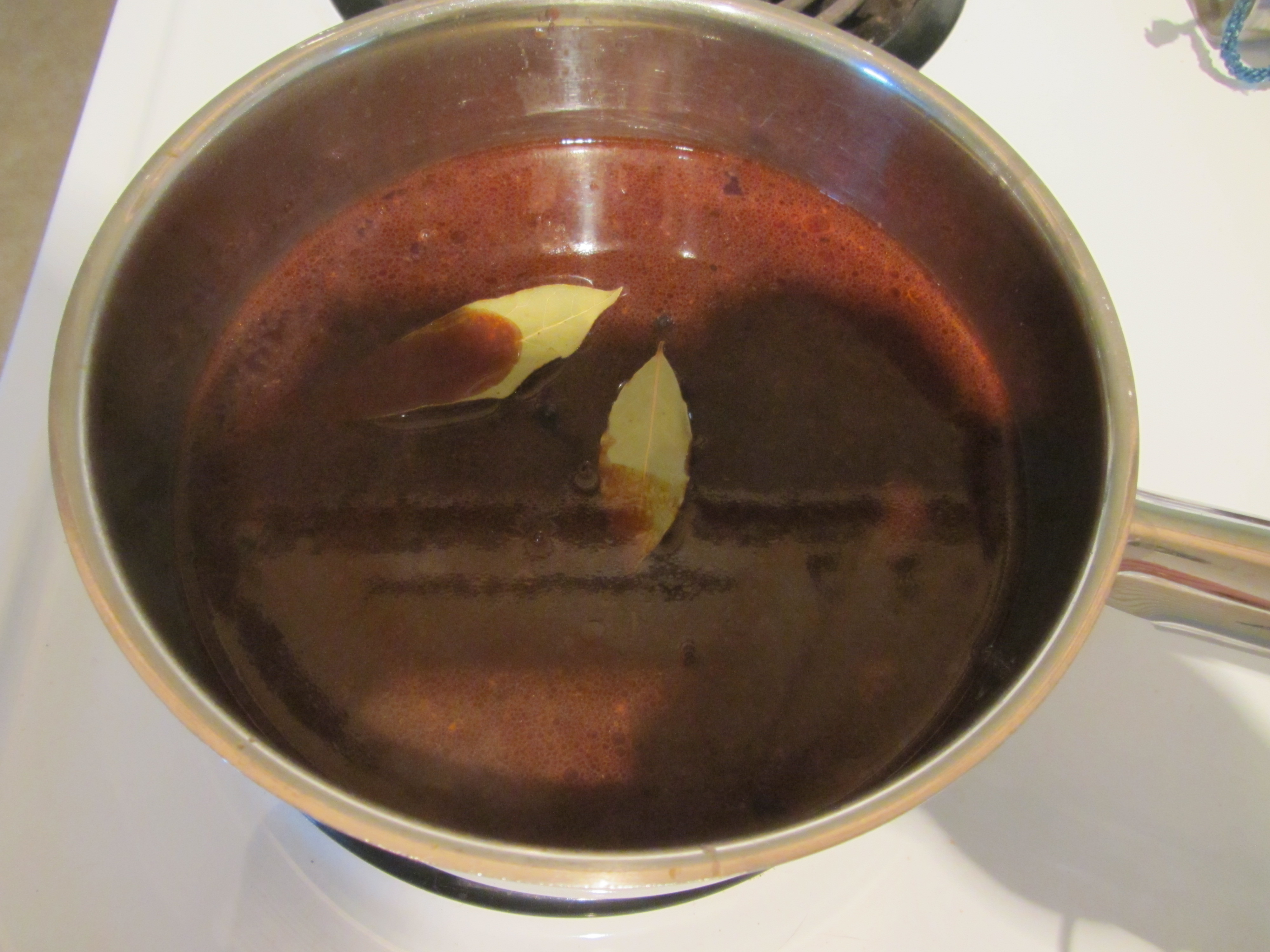
Drippings, wine, broth, bay leaves, and peppercorns.

Drippings, wine, broth, bay leaves, and peppercorns.

At this time, you whisk 1/2 C of the liquid into the cooled white roux. The remaining liquid is whisked into this mixture over high heat, reserving 1/4 C.

Hot liquid combined with cold white roux.

Hot liquid combined with cold white roux.

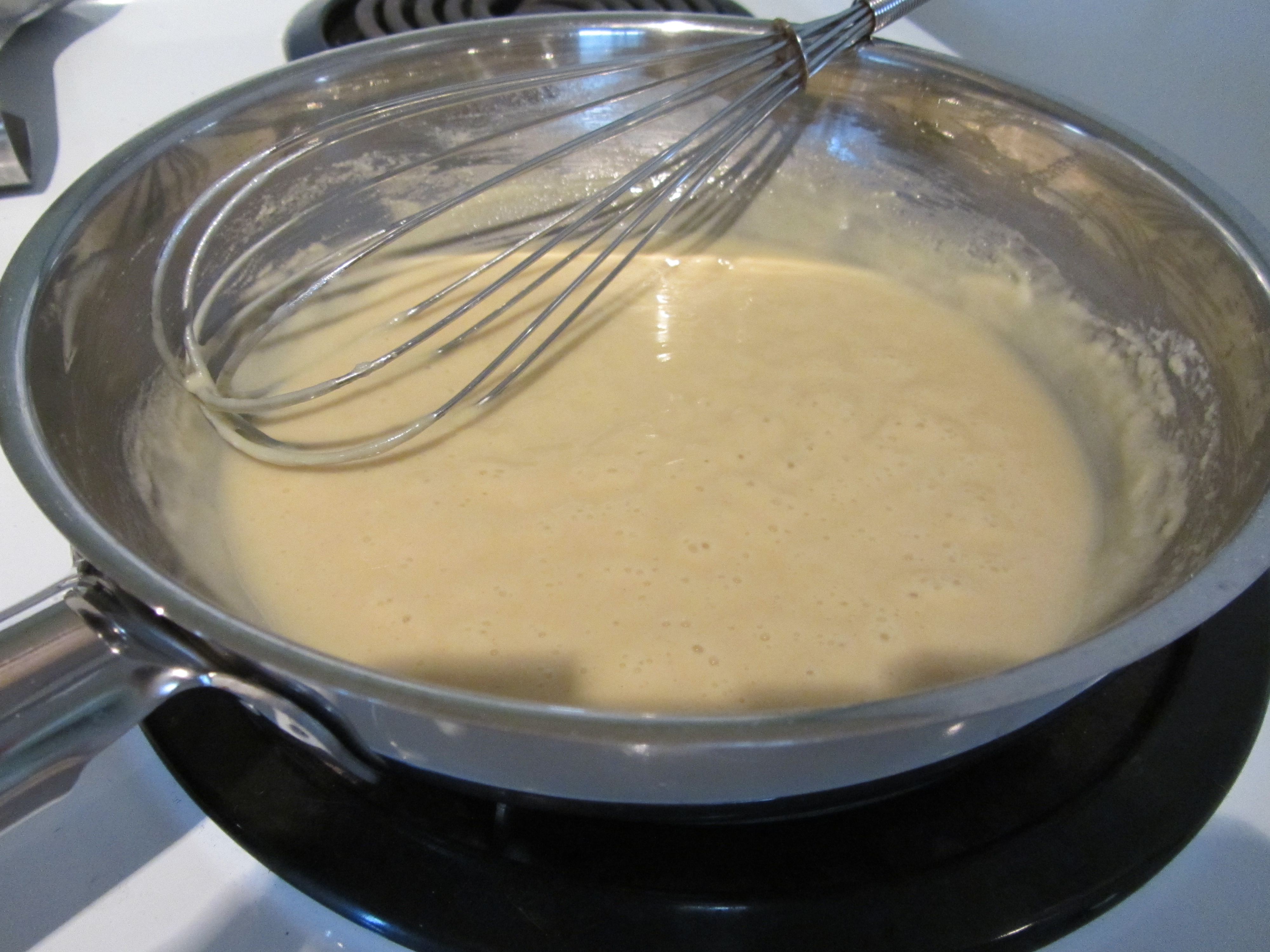
Alton encourages you to leave your gravy on the thin side, as it will thicken as it cools. I added all of my liquid to my roux, and it definitely ended up being on the thick side.

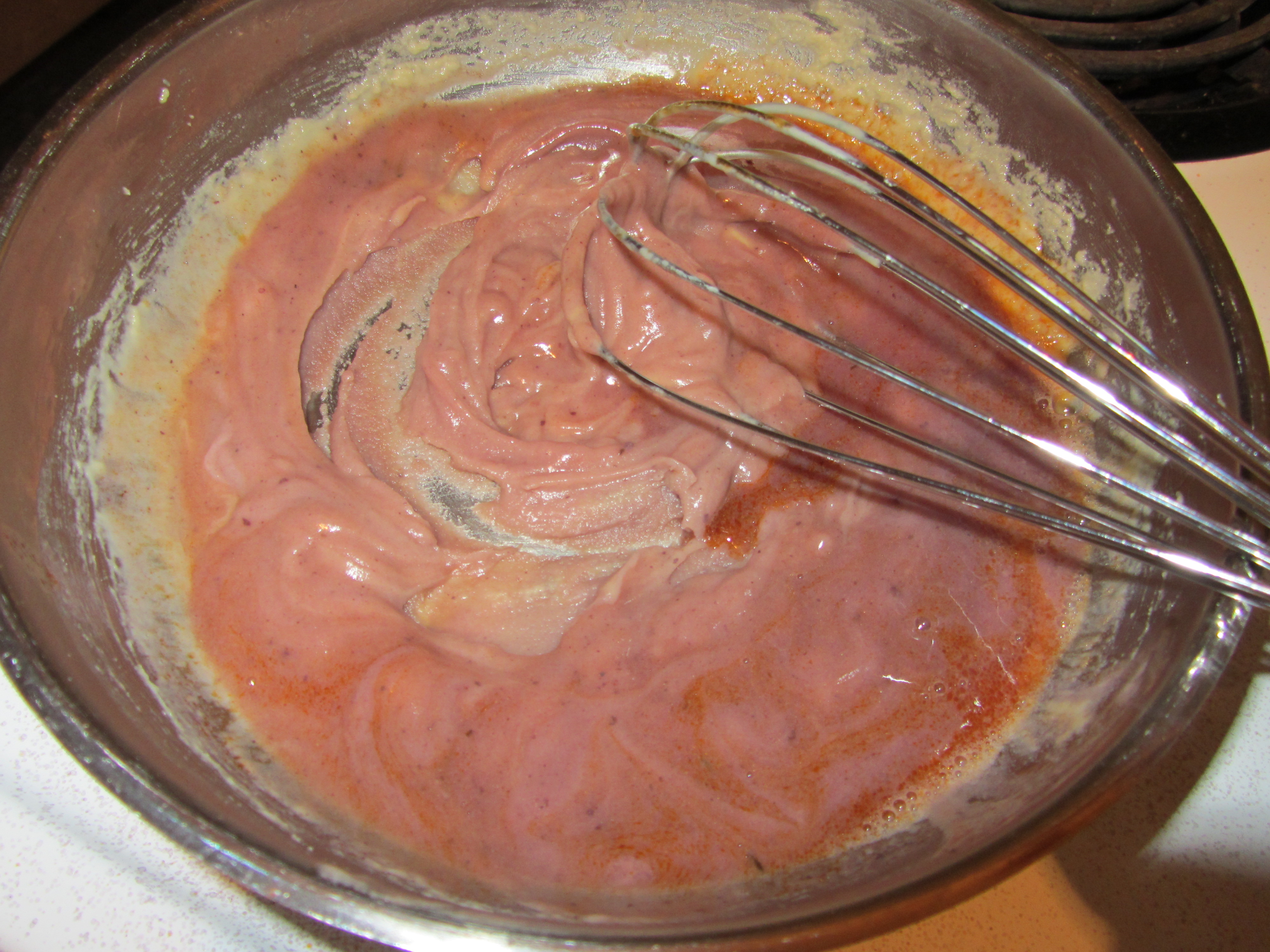
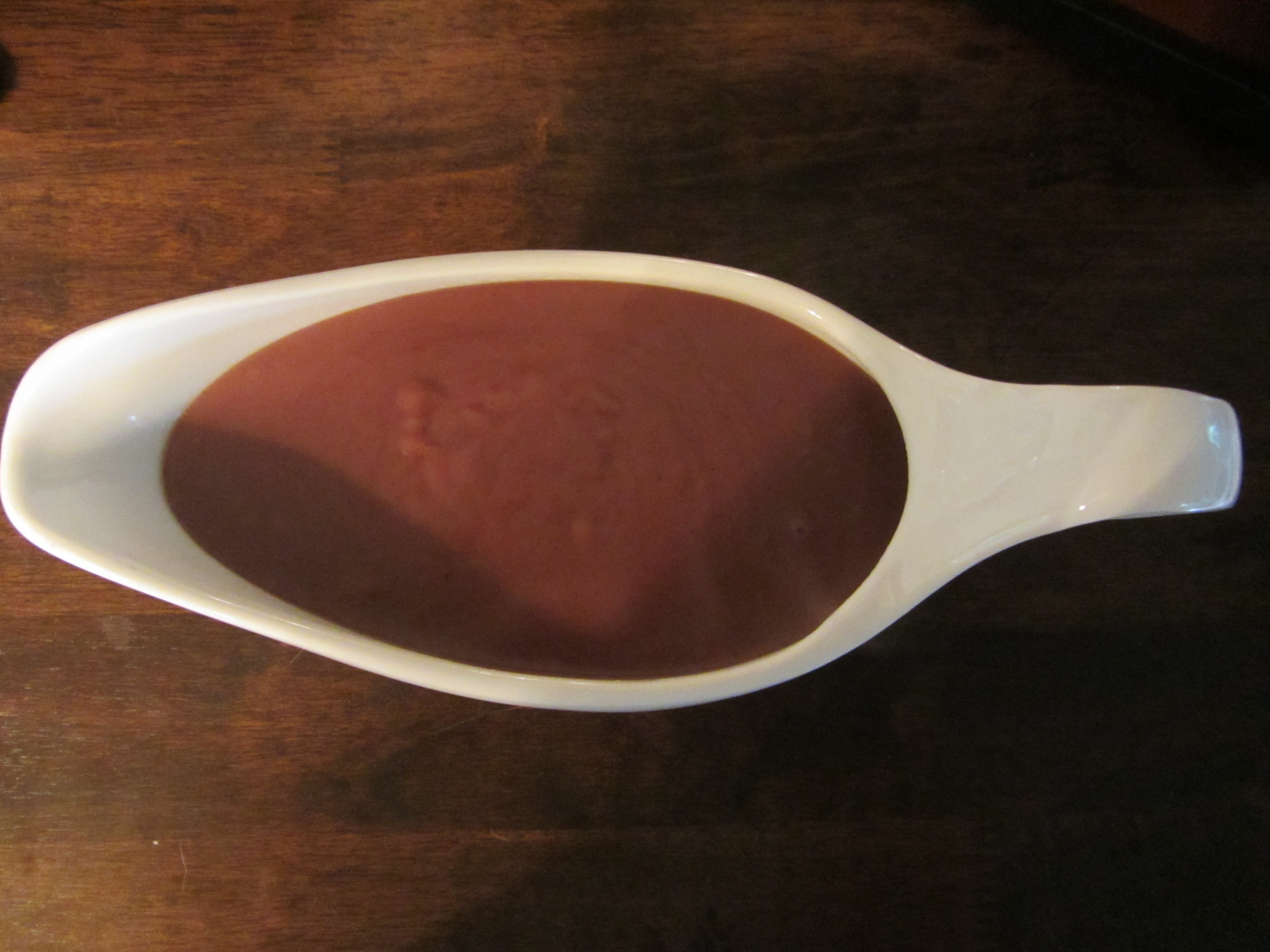
Finished gravy.

Finished gravy.

Conversely, the online recipe tells you to utilize only 2 T of the white roux to thicken your gravy. This is a large difference in the amount of thickening agent. I probably would use less white roux if I were to make this again. The resulting gravy had a very pleasant flavor. The red wine flavor really did come through, which I really liked. In fact, it was probably my favorite gravy I have had. Ted said he also liked this wine flavor, though it was different from the more traditional gravies he is used to having. I will go to this recipe in the future for any gravy needs I have!
Sawmill Gravy

When I saw Alton make his Sawmill Gravy, I immediately recognized it as a version of the “gravy” I grew up eating. I took some liberties with this one, and made my grandma’s version of sawmill gravy, which differs (only slightly) from Alton’s. Alton’s recipe uses fat from sausage or breakfast meat. To this, flour is added and stirred until a nutty, toasted aroma is present. The pan is removed from the heat and milk is added, whisking. This is cooked over high heat until thickened. My grandma’s version uses butter, which is melted over medium heat.
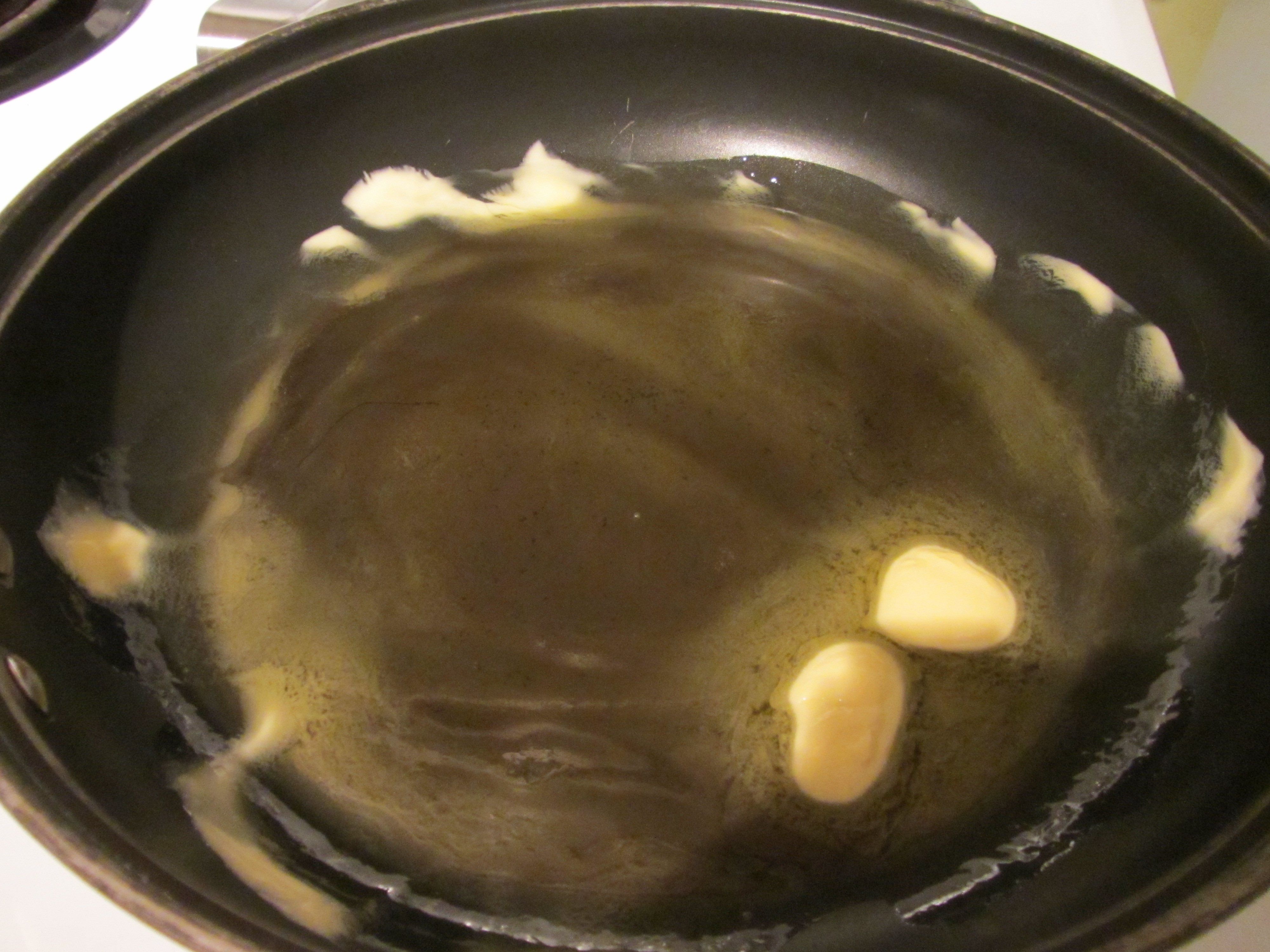
Melted butter.

Melted butter.

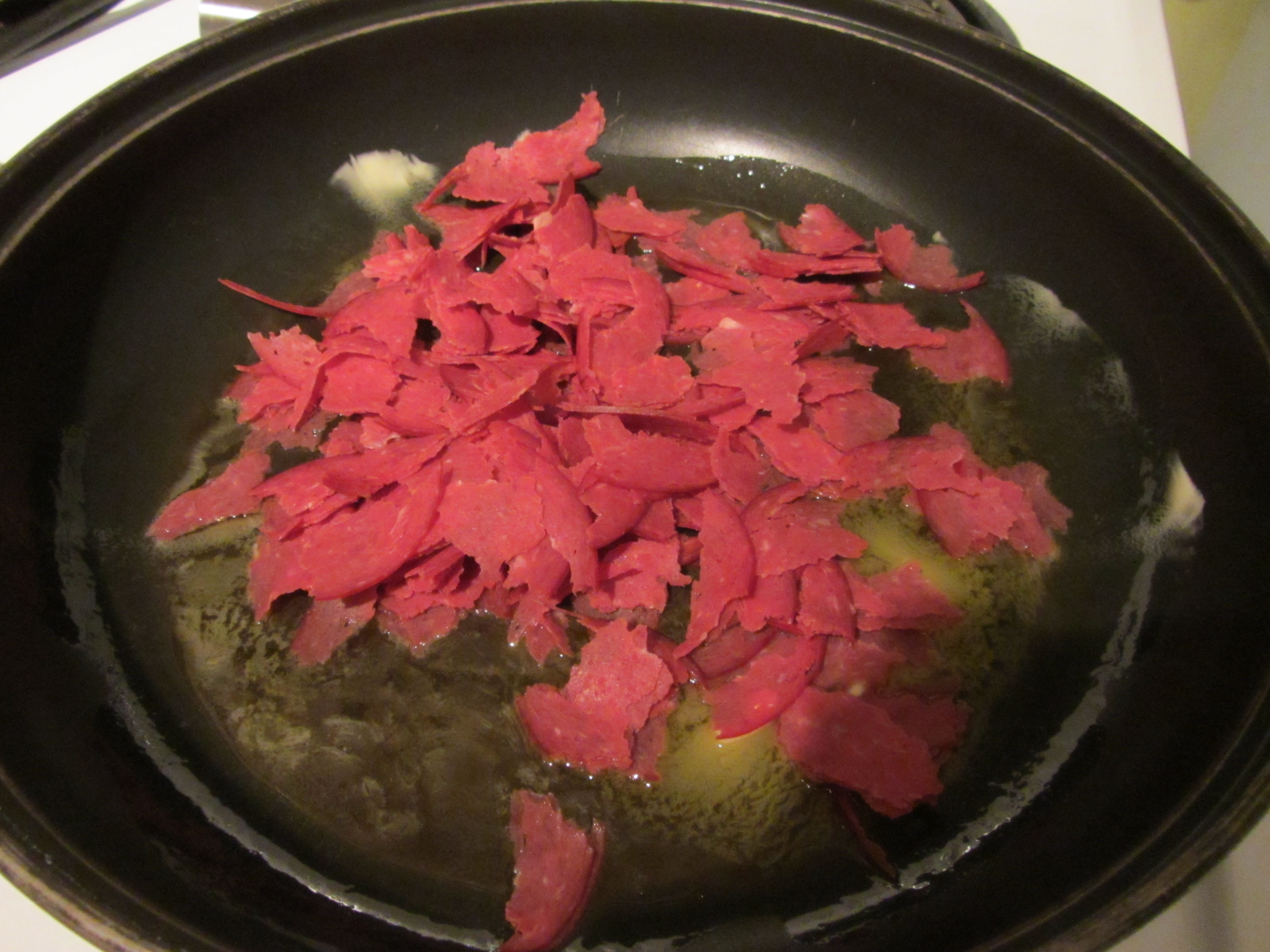
To this, a whole jar of shredded, dried meat is added. The jar’s label instructs you to rinse the meat before using. Ignore this, or you will shamefully rinse the goodness (aka flavor) down the drain.
Shredded canned beef added to butter.

Shredded canned beef added to butter.

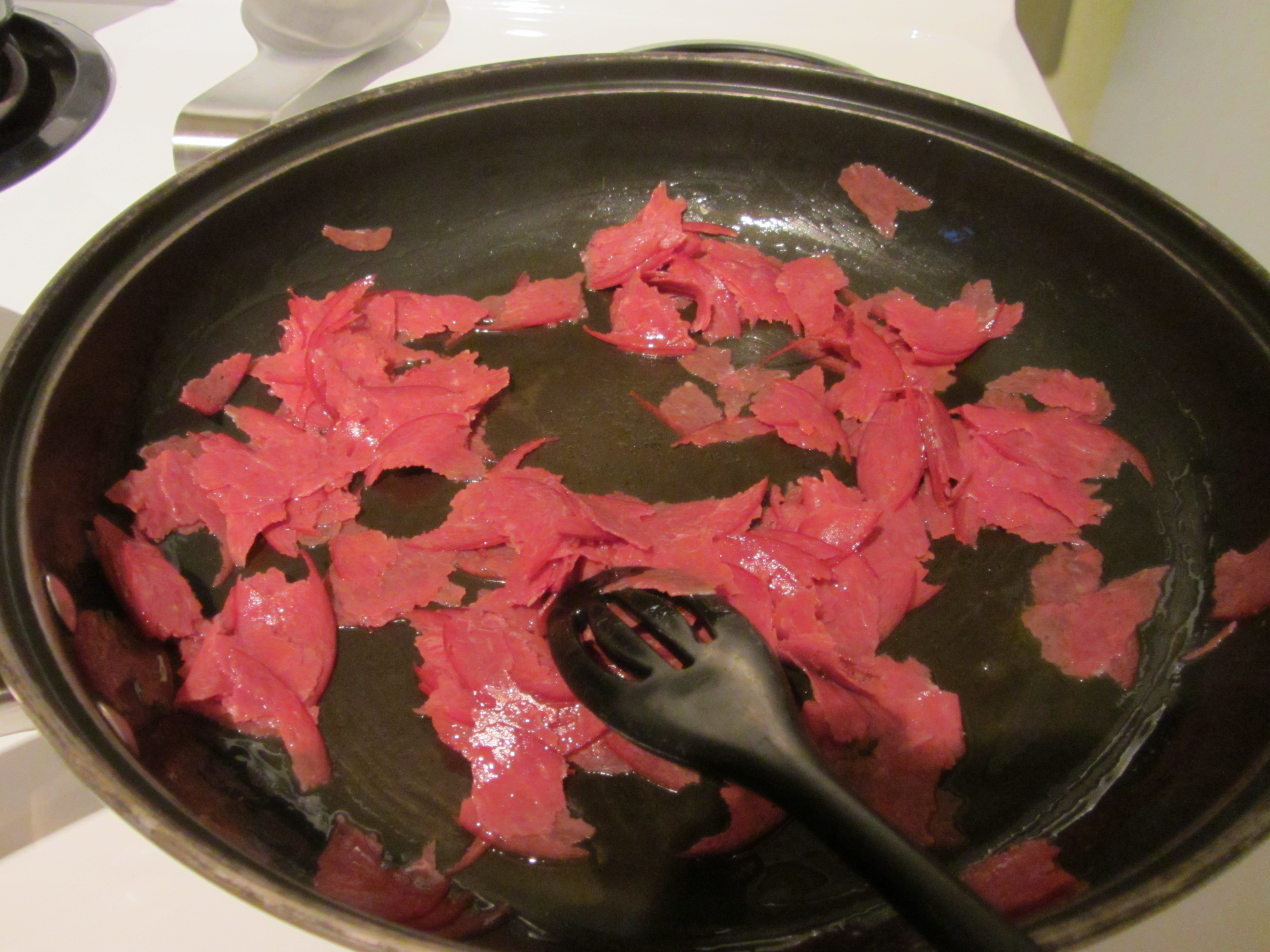
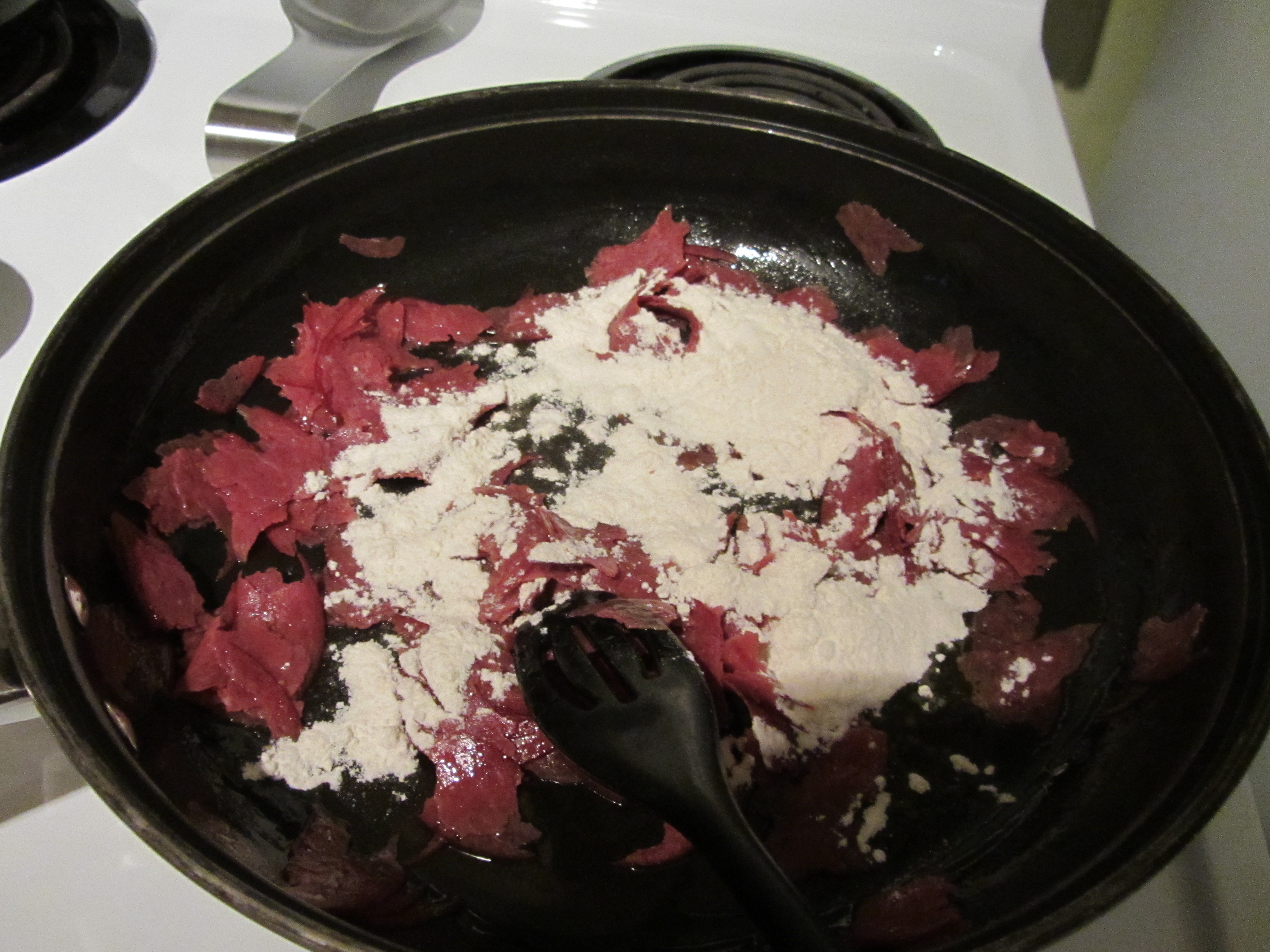
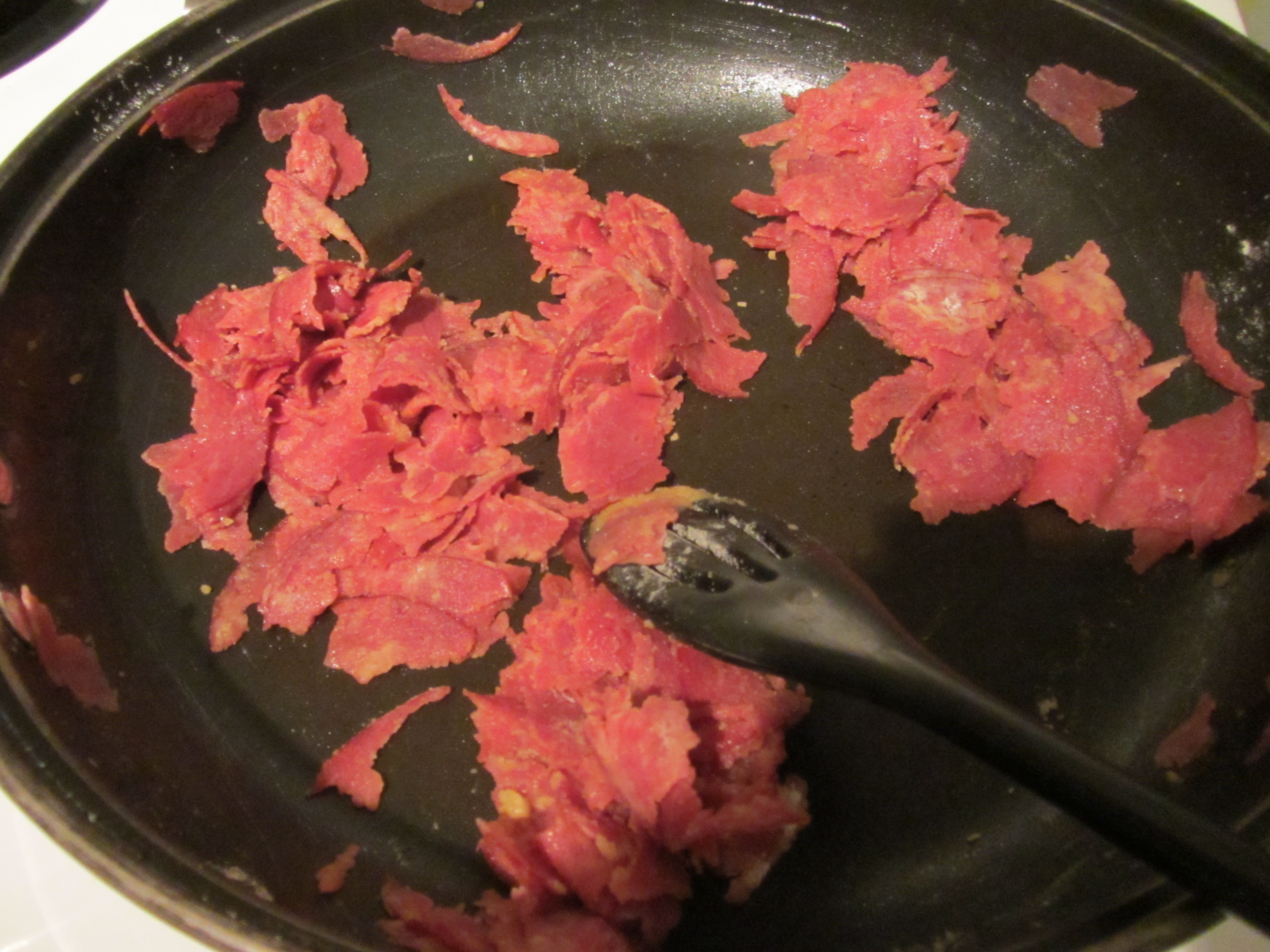
The meat is stirred until thoroughly coated with the butter. 8-1-2014 021To this, flour is added, and this mixture is stirred until the flour is no longer visible and a toasted aroma appears.

Flour added to beef and butter.

Flour added to beef and butter.

Cooking out the raw flour taste.

Cooking out the raw flour taste.

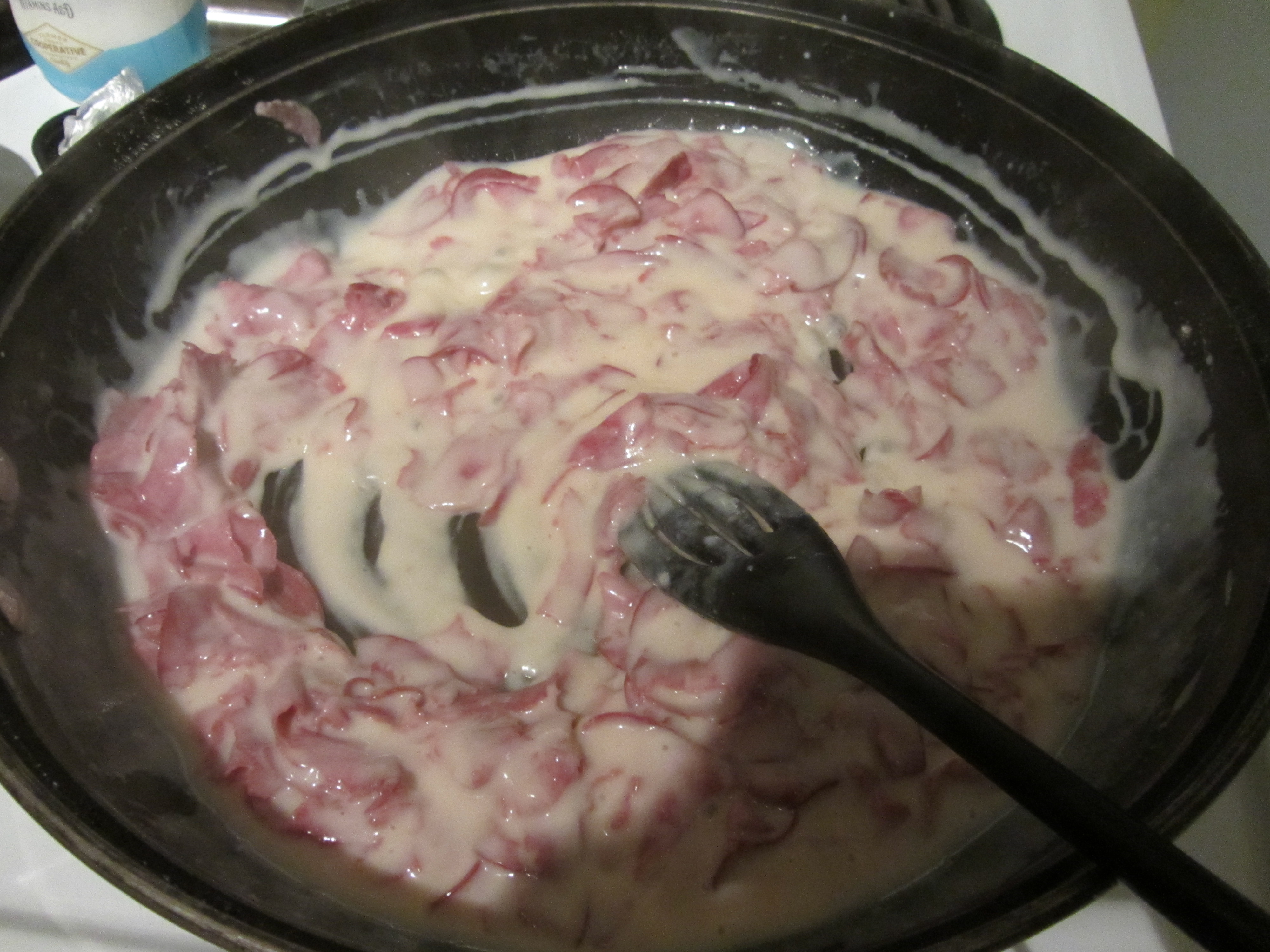
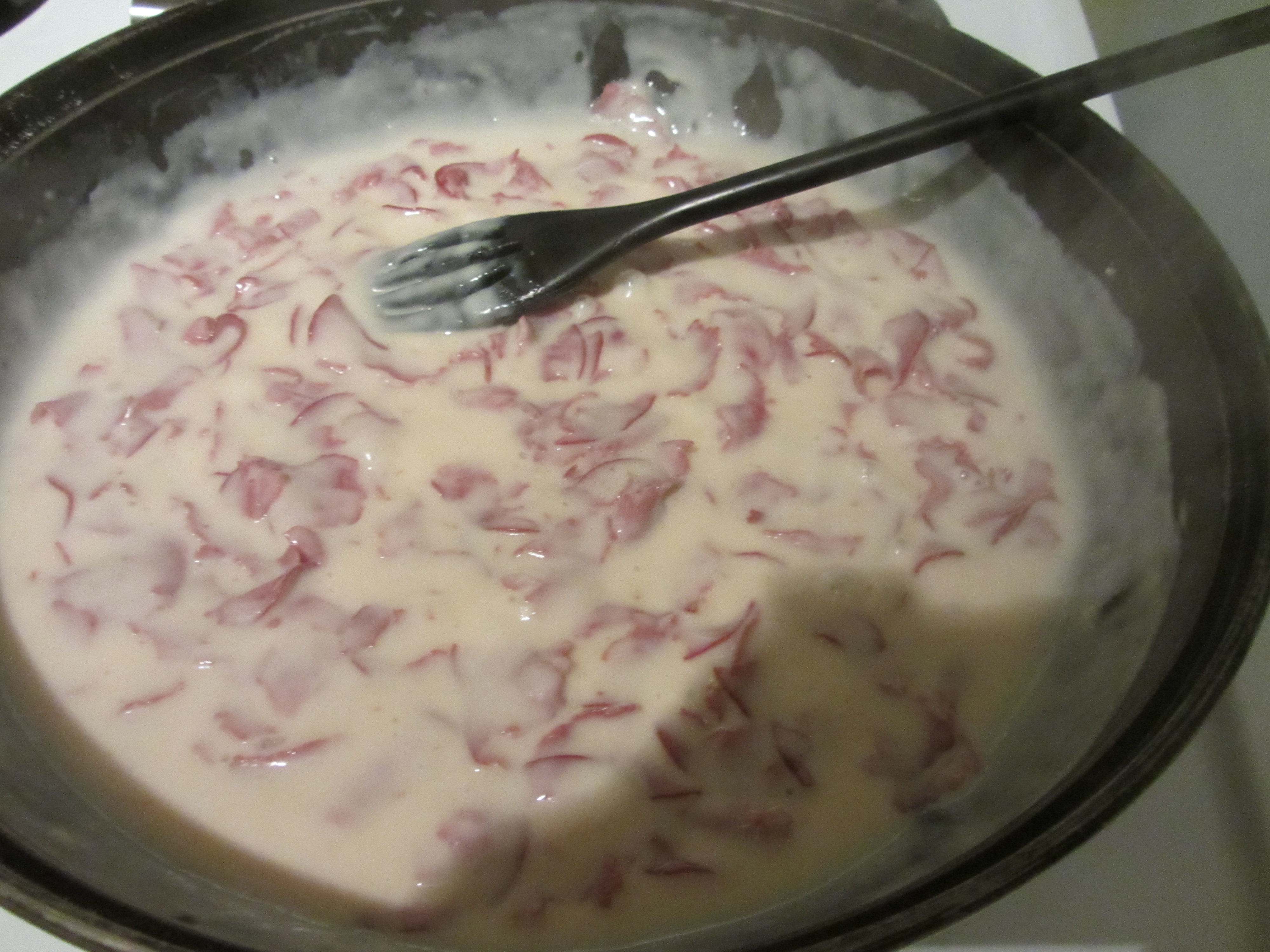
Gradually, milk is added to this mixture, stirring until each addition begins to thicken.

First milk addition to meat.

First milk addition to meat.

Beginning to thicken.

Beginning to thicken.

8-1-2014 026

Finished Chipped Beef.

Finished Chipped Beef.

The final mixture is served over toasted English muffins. I like mine topped with lots of fresh ground pepper and a dash of Tabasco. I am sure that all nutritionists would highly frown upon this use of sodium-laden jarred beef. It is worth it. Trust me.

Shit on a Shingle!

Shit on a Shingle!