


My quest appears now be to complete a blog post during nap time. Will it happen this time? I’m guessing not, but we’ll give it a shot. We’re all still in isolation as we wait for this pandemic to be deemed as safely past. Since we can’t go out to eat, we may as well cook, right? We have been trying to support some of our local restaurants by getting takeout here and there, but I’m also cooking as much as I can with a six month old baby. Lately, I’ve been futzing with sourdough, as I have my mom’s old starter and a new one I picked up from a local eatery. This episode has nothing to do with sourdough, though. Instead, it deals with pocket pies. The recipes from this episode are all contained in one link, which is here.
Well, I did not successfully finish a blog post during nap time. In fact, it’s now nap time again two days later! Let’s give this another go.
Alton’s pocket pies have numerous iterations, so you can play with fillings, cooking methods, etc. The online link contains recipes for his pocket pie dough and for two fillings. To make the dough, pulse together in a food processor: 2 t baking powder, 3/4 t Kosher salt, and 9.5 ounces flour; this will “sift” and aerate the flour.
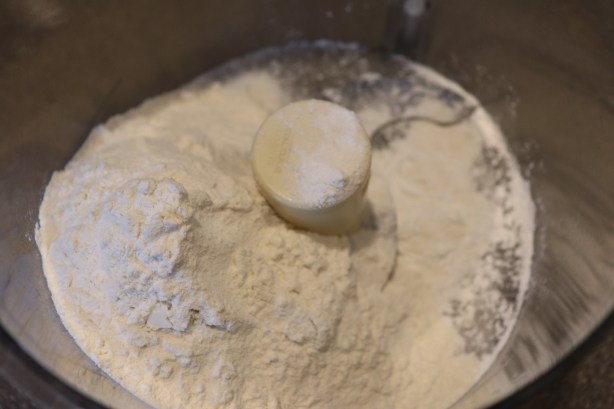
“Sifting” flour, Kosher salt, and baking powder in the food processor.
Place 2.5 ounces of shortening in ice water to chill for a few minutes. Once chilled, remove the shortening from the water and place it in a large bowl.


Add the flour mixture to the shortening and use your fingertips to work the shortening into the flour. Make a well in the center of the flour and pour in 3/4 C milk, stirring well (you want gluten development here).


Turn the dough onto a counter and knead it 10-20 times with your hands.
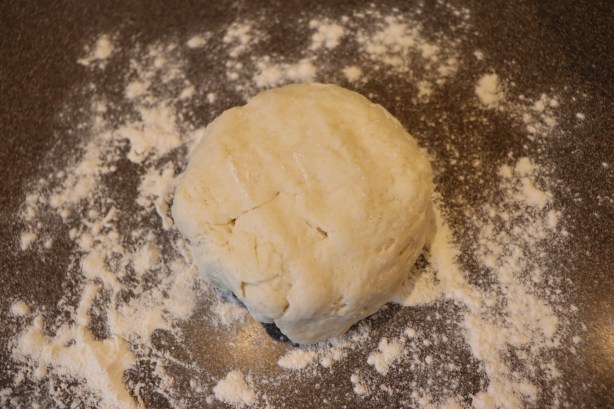
Finished dough after kneading.
Roll the dough until it is 1/2″ thick and cut rounds with a 2.5 inch circular cutter. Roll each round until it is a thin disc measuring 5-6 inches in diameter. Place the dough rounds between sheets of wax paper and let them chill in the refrigerator for 1-2 hours before forming pies.


Alton’s favorite fruit filling for hand pies is a curried mango filling. You want this filling to be chilled before you use it, so you’ll want to make it several hours ahead. Peel and dice four mangoes, and place them in a large saucepan. Add 1/2 C brown sugar, 1/2 C cider vinegar, 2 t curry powder, and 1/4 C fresh lime juice to the pan.

Mangoes, brown sugar, cider vinegar, curry powder, and lime juice in a large saucepan.
Bring the mixture to a boil over high heat, place a lid on the pan, and decrease the heat to a simmer. Let the filling simmer for 30 minutes.


Cool the filling at room temperature for an hour, and then place it in the refrigerator for 3-4 hours; a metal bowl will speed up the chilling.
Alternatively, for dessert pies, you can make Alton’s favorite chocolate filling. To do this, put 10 ounces of softened butter in a large ziplock bag. Add 2 1/2 C sugar, 1/4 C + 1 T cocoa powder, and a pinch of Kosher salt.
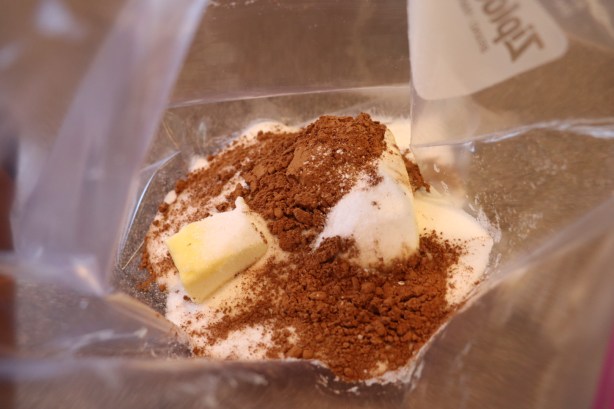
Chocolate filling ingredients in a large plastic bag: butter, sugar, cocoa powder, and Kosher salt.
Seal the bag and mash the filling with your hands until it is combined. When you are ready to fill pies, you can simply snip one of the bottom corners off of the bag and pipe the filling directly onto the dough.
Although there are no real recipes for other fillings in this episode, Alton did mention some other filling possibilities. For example, you could use leftover beef stew as a pie filling. Or, you could make mini pizza pies by filling the dough with pizza sauce, cheese, and toppings.
Regardless of which fillings you utilize, to form the pies place a large spoon of filling on one side of each chilled dough circle. Rub the edges of the circle with egg wash (1 egg plus 2 t water). Fold the dough over the filling to form a half moon, and press any air out with your fingers. Press the edges together with your fingers to seal them well, and use a fork to crimp the edges together. Place the sealed pies on a parchment-lined sheet pan and cut three small steam vents in the top of each pie with kitchen shears. Doh! Nap time appears to be over again!
Fast forward to another nap time a day later, and here we are. Now, back to baking the hand pies. Bake the pies at 350 for 25-30 minutes, or until golden brown. Let the pies cool for several minutes before eating. I baked some mango pies and some chocolate pies, and some of them leaked a little bit, especially the chocolate ones.


The crust here was very pie-like, though I think the crust would have been better if it had a little more flakiness to its texture. The mango filling was sweet, but not overly so, so you could easily eat these for breakfast or a snack. I had to use a slotted spoon when I placed the mango filling on the dough, as the filling was pretty thin and seemed to run all over the dough. The curry flavor was definitely evident, but it wasn’t completely overpowering.
Pan frying is another option for cooking hand pies. To do this, heat a heavy skillet over medium-low heat, adding a pat of butter. Once the butter has melted, place two hand pies in the pan, jiggling the pan to be sure the pies do not stick.


Flip the pies once they are golden brown. I pan fried some chocolate hand pies for dessert and they leaked less than the baked chocolate pies. The pies came out looking a little flat – like pressed sandwiches, but I liked the richness of cooking the pies in butter.


These pies seemed much more indulgent than the baked ones. The chocolate filling was very rich and had a slight grittiness to its mouthfeel from all of the sugar. I’m sure the grittiness could be remedied by making the filling in a mixer, but it’s certainly more fun to mash it together in a plastic bag!
If you want to get super indulgent, you could always try deep frying your hand pies. To do this, heat two quarts of canola oil to 375 degrees in a Dutch oven. For hand pies that will be deep fried, do not cut steam vents in the tops, but rather use a fork to dock the dough a few times. Fry the pies, a few at a time, until they float and are golden brown. Transfer the fried pies to an inverted cooling rack on newspaper, and allow them to cool for at least five minutes before eating. I did not end up deep frying any of my hand pies, as I just ran out of time to try this application. I imagine that these would be the crispiest pies.
You can store cooked fruit or chocolate pies at room temperature for up to a week. Pies with meat fillings can be refrigerated/reheated for up to a week. You can also freeze uncooked pies on a baking sheet, throwing them in a 350-degree oven for 30 minutes when you are ready to eat them.
In addition to his baked, pan-fried, and deep-fried pies, Alton also made homemade toaster pastries in this episode. Yep, you can make pop-tarts at home. To make these, make a full batch of dough as for the hand pies above, but divide the dough in half after kneading. Roll each of the two dough pieces into a 12″ x 10″ rectangle, using a knife to trim the edges. Divide each dough rectangle into six 4″ x 5″ rectangles, cutting them with a pizza cutter.
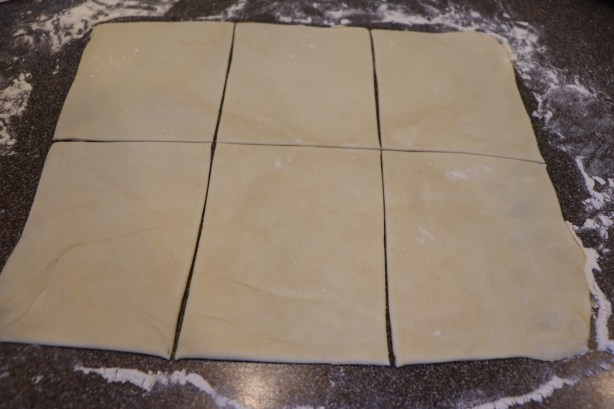
Half of the dough rolled into a 12″ x 10″ rectangle and cut into six 4″ x 5″ rectangles.
Rub egg wash (1 egg plus 2 t water) all around the edges of six of the 12 smaller rectangles. Spoon a couple tablespoons of your desired filling (Alton used fruit preserves) onto the center of each egg-washed rectangle, spreading it with a spoon.

Egg wash rubbed around edges and filling spooned onto rectangles.
Use a fork to dock the remaining six dough rectangles and place these rectangles on top of the filled/egg-washed rectangles. Use your fingers to press any air out of the pastries and to seal the edges tightly.


Crimp the edges with a fork and bake the finished pastries for 20 minutes at 350 degrees.
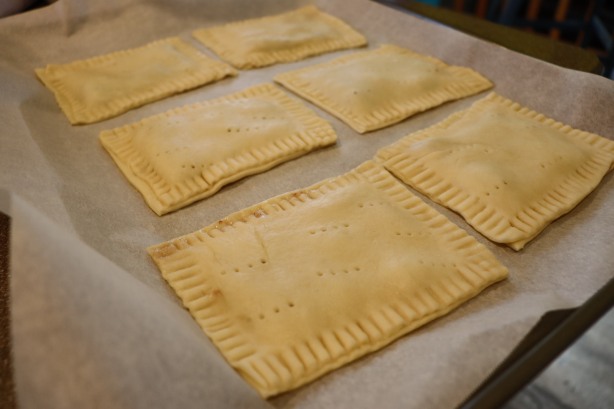
Crimped pastries placed on parchment-lined sheet pan.
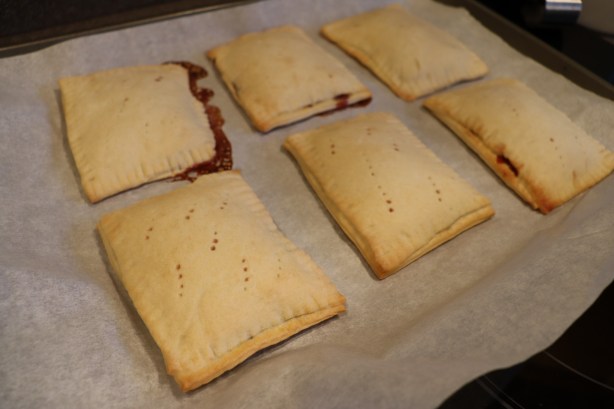
Toaster pastries after baking for 20 minutes.
Cool the pastries, storing them in plastic for a week or freeze for a month. Reheat the pastries by toasting them in a toaster on the lowest setting.

One of Alton’s toaster pastries.
These were fun and easy to make, and were my favorites of all of Alton’s hand pies. Kids would really enjoy eating these, and you could fill them with any number of fillings. The resulting dough was crispy at the edges and tender in the center.
I have made many empanadas and hand pies (usually savory) over the years. I do have a dough recipe that I overall prefer over Alton’s, as it is easier to work with and results in a very flaky crust, but Alton’s crust is pretty good too. For dessert, I’d opt for pan-fried chocolate pies and for breakfast I’d certainly make Alton’s toaster pastries. Regardless of how you cook them or which fillings you choose, hand pies are equally fun to make and eat.






 Allison Cooks Alton's Good Eats