Archive for May, 2019

Although we have had a lot of sadness in 2019, we also have some recent and upcoming blessings. A few days after our dog died, we wound up adopting another little hound who has been living with us now for about a month. We named our little Redtick Coonhound Julep, and she has been a funny and busy distraction. Aside from chasing the cat, she has really been quite a good puppy so far. She is only about eight months old, so she has much more energy than we do! We figure this puppy is excellent practice for our baby who is due to arrive in October. Yowza! I think I can safely say that 2019 has already been the greatest year of transition I will likely ever have. Now, onto the cooking.

Wild Mushroom and Asparagus Risotto

My mom was the person who first introduced me to risotto after she had ordered it in a restaurant years ago. She said she instantly thought of me when she ate it, as she was sure it would be something I would love. I have made many risottos over the years, trying various methods and recipes, including a pressure cooker risotto and an almost no-stir recipe. Alton’s risotto is a pretty classical version that requires only about 10 ingredients. You will need some steamed asparagus that is cut into one-inch pieces and some wild mushrooms that you have browned in butter and Kosher salt (you want approximately seven ounces of asparagus and five ounces of mushrooms). You can easily prep the veggies a day in advance, or you can sub any leftover veggies you have on hand. When ready to make the risotto, bring 6 C of chicken broth to a simmer, along with 1 C white wine; Alton likes to use an electric kettle for this, but I just used a saucepan.

IMG_2188

Simmering broth/wine.

You want to keep this liquid at a low simmer for the duration of making the risotto. Next, heat a heavy 3 to 4 quart pan over medium heat and add 2 T butter, 1 C chopped onion, and a pinch of Kosher salt. Sweat the onion until it is soft and add 2 C Arborio rice, which is a short-grain rice.

Stir the rice for 3-5 minutes or until the grains become translucent around their edges.

IMG_2190

Rice stirred until clear at the edges.

Once translucent, add enough of the hot broth to the pan to just cover the rice and shake/stir the rice. Alton’s shaking method was new to me, as the other risotto recipes I have made have called for stirring. Continue to cook the rice, shaking the pan occasionally, at a bare simmer until no liquid remains in the pan when you move the rice with a spatula. At this point, add hot broth/wine again just to cover the rice.

Continue cooking the rice and adding more liquid as needed. When 3/4 of the liquid has been added to the rice, give the risotto a taste; if the rice is tender and creamy, you may not need to add any more liquid. When I tasted my risotto at this point, the rice grains were still quite crunchy, so I ended up adding all of the hot liquid.

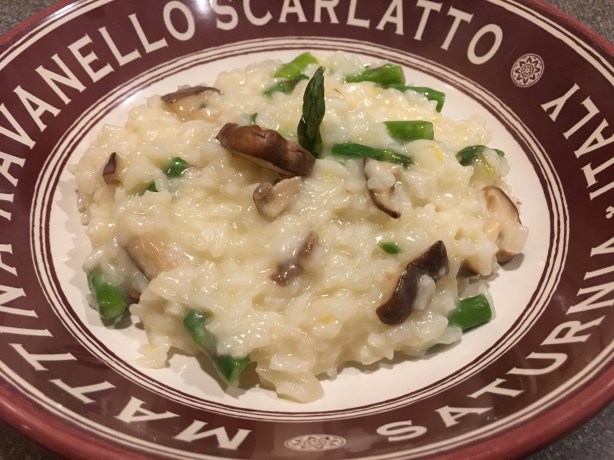
When the risotto has reached a creamy texture, give it another taste and adjust the salt, as needed. To finish the risotto, add the cooked mushrooms and asparagus to the pan, along with 2 ounces of grated Parmesan, 1 t lemon zest, and 1/2 t nutmeg.

IMG_2207

A bowl of Alton’s risotto.

Alton’s risotto is a very classic recipe that works very well. Yes, it does take some time for all of the liquid to be absorbed by the rice, but risotto is really not a difficult thing to make and you can get creative with the additions you make. If you are new to risotto, I can say that Alton’s recipe is a fool-proof introduction.

Brown Rice Salad

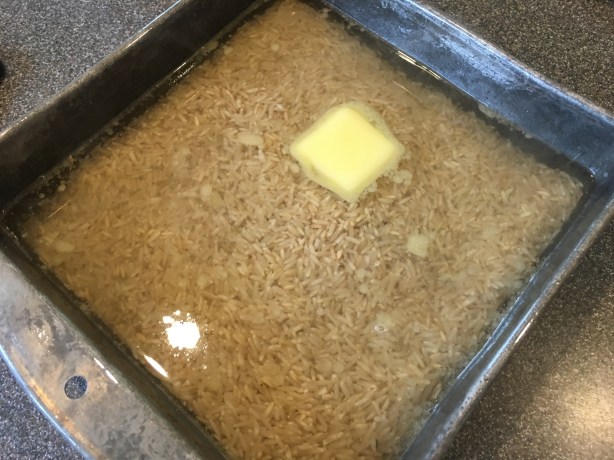
I have always been really comfortable cooking white rice, but have never had a great way to cook brown rice. For this brown rice salad, Alton shares his preferred method for cooking brown rice, which is an oven method. To cook brown rice Alton’s way, put 1 1/2 C short or medium grain brown rice in an 8-inch square pan. Add 2 1/2 C of water just off the boil, 1 T butter, and 1 t Kosher salt, and give it all a stir.
IMG_2146

Brown rice, hot water, butter, and Kosher salt in an 8-inch pan.

Cover the pan tightly with foil and place it in a 375 degree oven for one hour. After an hour, remove the foil and fluff the rice with a fork. Voila – perfect brown rice!

To make Alton’s brown rice salad, heat a 10-inch pan over medium heat and fry six pieces of bacon until crispy. Remove the bacon from the pan and add 1/2 C diced red onion.

When the onion is golden, add 1/2 C white wine vinegar, 1/2 C chicken broth, 2 t Dijon mustard, 1 t sugar, 1 t Kosher salt, and 1/2 t pepper.

IMG_2155

White wine vinegar, chicken broth, Dijon mustard, sugar, Kosher salt, and pepper added to the cooked red onion.

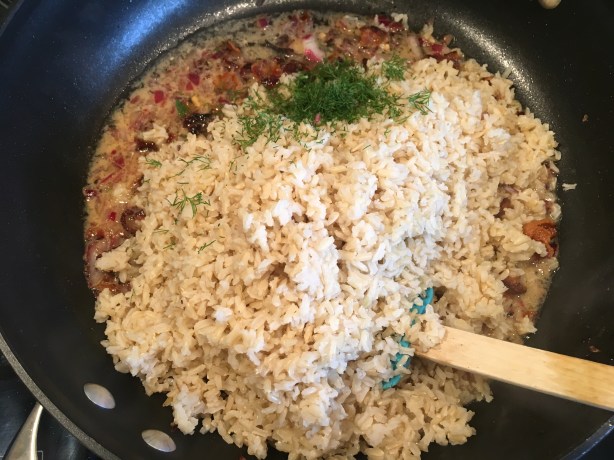
Crumble the bacon into the pan, along with the cooked brown rice and 1 T chopped fresh dill. Stir the mixture until the liquid is absorbed.
IMG_2156

Cooked brown rice, bacon, and fresh dill stirred into liquid.

You can eat the salad immediately or you can refrigerate it for up to a week.

IMG_2158

Alton’s brown rice salad.

I fixed this rice salad for lunch for us and we thought it was great. The rice is perfectly cooked and the salad is super tangy and zesty. I highly recommend this salad for a side dish or light meal. And, Alton’s brown rice cooking method is awesome!

In case you are curious about different types of rice, Alton explained the differences in grain lengths in this episode. Short-grain rices, like Arborio, contain a lot of amylopectin, so they release a lot of starch and have a sticky, creamy texture. Medium-grain rices have a soft texture when cooked and have a mixture of amylose and amylopectin; they have less amylopectin than short-grain rices have, but more amylopectin than long-grain rices do. Finally, long-grain rices have the most amylose and the least amylopectin, so they release less starch and cook up with a fluffy texture.


We eat a lot of produce in our house, but I feel like we sometimes get in a rut with our veggie side dishes; our go-tos are usually steamed asparagus or broccoli with olive oil, vinegar, salt, and pepper. For whatever reason (probably laziness), I tend not to venture too far out of my side dish comfort zone, unless I take the time to find an actual recipe. The 125th episode of Good Eats forced me to try some different side dishes, as it included three recipes for different types of greens, the first being collard greens.

Pot O’ Greens

I can really only recall eating collard greens one time, which was in a Southern-themed wedding buffet. I remember liking them, so I had no qualms about prepping them with Alton’s recipe. Collard greens need to be trimmed and cleaned properly, as they have woody stems and they grow in sandy soil. To trim collard greens, fold a leaf in half along the stem line and use a sharp knife to cut out any stems thicker than 1/8″.

Stack the trimmed flat leaves on top of each other, fold them in half as you did before, and roll them from the bottom up.

Cut the roll of leaves in half the long way and then slice the greens perpendicularly.

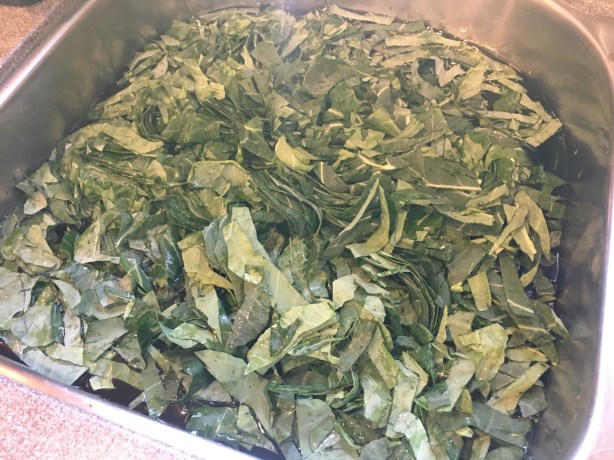
Place your chopped greens in a sink full of cold water, swishing them around and allowing them to sit for several minutes; this will allow any sand/dirt to sink to the bottom.

IMG_2231

Trimmed/chopped greens placed in a sink of cold water.

To drain his greens, Alton likes to put his greens in a large zip-up pillow case. He then places the pillow case in his washing machine for one minute on the spin cycle. I did not have a zip-up pillow case, so I opted to roll my greens in a stack of paper towels.

IMG_2233

Cleaned greens on paper towels to dry.

To store trimmed/clean greens, place them in a large plastic bag in the refrigerator. For Alton’s collards, put a 1 1/2 pound smoked turkey leg in a large pot; I could only find a raw turkey leg, so I had to roast it in the oven first. Add a quart of water to your turkey leg, cover the pot, and bring the water to a boil over medium-high heat. Let the turkey simmer in the water for 10 minutes.

Next, add 1 t sugar and 1 t Kosher salt to the pot, along with 2 pounds of trimmed/cleaned/chopped collard or turnip greens.

Place the lid back on the pot and gently simmer the greens for 45 minutes, stirring every 10 minutes. Be sure to keep the heat very low, as you only want a very gentle simmer.

Use tongs to place the greens in bowls and serve them with hot sauce. To be like a true Southerner, try sipping some of the cooking liquid, which is called “pot liquor.”

IMG_2249

A bowl of Alton’s collard greens after cooking for 45 minutes.

You can also bag and freeze the cooked greens for later use. To thaw frozen collard greens, run the frozen bags under cold running water. I have to be honest that I didn’t enjoy this recipe as much as I expected to. The turkey gave the greens a meaty flavor and the greens were cooked well, so as to maintain a bit of texture instead of being mushy. I found that I needed to add a fair amount of salt to the cooked greens, as they were really lacking in seasoning. Hot sauce definitely gave the greens a needed punch of flavor, as they were otherwise not very exciting. I won’t go out of my way to make these again, but I do hope to encounter collard greens more often, as I hope to sample other preparations. Maybe I am just not as fond of collard greens as I thought I was!

Lemon Sesame Glazed Greens

Alton’s second greens recipe utilizes kale, and you will need 1 1/4 pounds of cleaned/trimmed kale. As with the collard greens above, remove thick stems from the kale leaves, chop the kale, and rinse the chopped greens in a sink of cold water.

While the kale soaks, place a roasting pan over two stove burners on medium heat. I chose to use a large skillet instead of a roasting pan because my burners are different sizes and the roasting pan does not heat evenly. Either way, brush your pan with 1 T olive oil and add 2 cloves of minced garlic and the zest of one lemon.

IMG_2437

Oil, garlic, and lemon zest in the pan.

Next, add 2 t fresh lemon juice to the pan, along with 1 T honey. Follow the honey with 1 1/2 t Kosher salt and 1/4 t pepper, and add your just-washed greens; don’t worry about drying the greens here, as you want some water in the pan. If necessary, add up to 1/2 C additional water.

Use tongs to toss the greens until they have cooked down to resemble thawed frozen spinach. At this point, remove the greens from the heat and stir in 1/2 t red pepper flakes and 1 T sesame seeds.

IMG_2441

Kale cooked down until very wilted. Sesame seeds and red pepper flakes stirred in.

Serve the kale immediately. We liked the flavors in this dish, as the lemon brightened up the greens, while the red pepper flakes gave subtle heat and the sesame seeds gave a bit of nuttiness. The honey served to lightly glaze the greens.

IMG_2443

A bowl of Alton’s lemon sesame glazed greens.

I have never been a huge kale fan, as its chewy texture is just not my favorite, and I found that to be the case with this recipe as well. I think kale lovers would really like this recipe, however, and it comes together super easily with ingredients often on-hand.

Mustard Green Gratin

The third type of green Alton uses in this episode is the mustard green, which he uses to make this gratin. As soon as I saw Alton prepare this recipe, I recognized it from the beet episode. Sure enough, this mustard green gratin is nearly identical to the beet green gratin in episode 83. For the gratin, butter the bottom and sides of a 2 or 2 1/2 quart baking dish. Beat three eggs in a large bowl and add 10 ounces ricotta, 2 ounces grated Parmesan, 1/2 t Kosher salt, and 1/4 t pepper.

Next, melt 1 T butter in a roasting pan placed over two burners on medium heat. Add 2 cloves of minced garlic to the pan, along with 12 ounces of sliced mushrooms. Add a large pinch of Kosher salt and toss the mushrooms until they have browned.

Add a pound of stemmed/rinsed/chopped mustard greens and toss until the greens have wilted.

Remove the pan from the heat and use tongs to add the greens to the egg/ricotta mixture. Stir the mixture to combine.

Place the egg/mustard green mixture in your buttered baking dish, avoiding packing down the greens. Sprinkle the top of the greens with 1 C of crushed Ritz crackers.

Bake the gratin at 375 for 35-40 minutes and let cool slightly before serving.

IMG_2177

Alton’s mustard green gratin.

We were not huge fans of Alton’s beet green gratin, but we both really liked the mustard green version. Mustard greens, if you didn’t know, truly do taste like mustard, so they bring a lot of flavor to the party. To me, I specifically tasted a Dijon mustard-like flavor in this gratin, which I found to pair very well with the creaminess of the egg/ricotta mixture. The cracker crust adds some crunchy texture and buttery flavor. This is really good and we both said we would like to eat it again. I’m surprised Alton didn’t make this addition, but I would personally add a little bit of ground nutmeg to the ricotta mixture. This was by far our favorite recipe of this episode, though it doesn’t look too pretty in the photo. Honestly, though, casseroles are just never pretty, right?